
The History of Football’s Laws Series — Introduction
Aydın Tiryaki & Claude Sonnet 5 (Max Effort, Extended Thinking)
Why Does a Sport Need Rules?
Football is often described as the simplest sport in the world — a ball, a flat surface, two goals. But beneath this simplicity lies a vast text that has been written and rewritten without interruption for 163 years, growing thicker, sometimes contradicting itself, sometimes reversing course entirely: the Laws of the Game. The core argument of this series is this: football is not a fixed game, but a living constitution. Every generation reinterprets and rewrites this text according to its own crises, its own technology, and its own sense of justice.
The fact that a sport needs rules points to a much older human problem: a game without rules is a game the strong win. Football’s 163-year history is the continuous renegotiation of this fundamental tension — the effort to limit the advantage of the powerful, set against the desire to preserve the fluidity of the game. As we will see repeatedly throughout this series (from the offside rule of 1866 to the handball definition of 2019), this dual tension lies behind nearly every rule change.
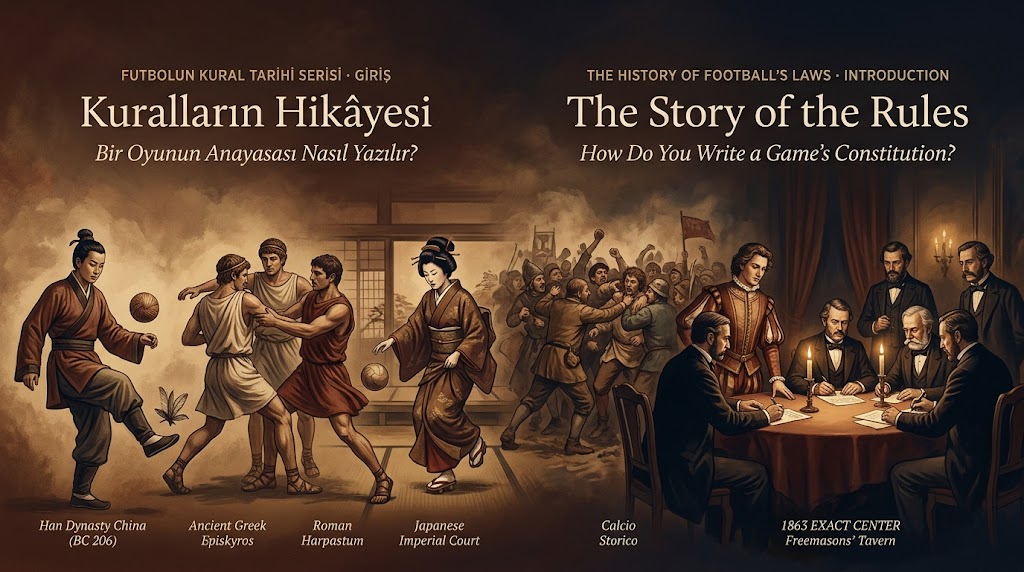
Before 1863: Humanity’s Instinct to Play with a Ball
Most accounts of football’s history begin in 1863 — and we will do the same in the main body of this series. But it’s worth knowing that this date did not emerge from a vacuum. Since the earliest periods of written history, humanity has played with a ball:
- China, Han Dynasty (206 BCE–220 CE): Cuju (蹴鞠) is recognized in FIFA’s own official history as “the earliest form for which there is scientific evidence” — players, without using their hands, tried to kick a feather-stuffed ball through a net strung between posts.
- Ancient Greece: Episkyros, played between two teams using both hands and feet, was structurally closer to modern rugby than to football.
- The Roman Empire: Harpastum, inspired by the Greek episkyros, was a strategic game played on a small field, focused on retaining possession within one’s own team.
- Japan (from around 600 CE): Kemari, played at the imperial court, involved passing a ball around in a circle without letting it touch the ground.
- Medieval England: Rule-less, often violent “mob football” traditions, played between rival villages, were especially common around Shrovetide.
- Renaissance Florence: Calcio storico, played by aristocrats and involving the use of hands, is the direct linguistic root of the modern Italian word for football, calcio.
Honesty matters here: even FIFA’s own museum openly states that there is no proven direct lineage between these games and modern football. These are not “ancestors” of the modern sport but independent, parallel examples of humanity’s instinct to play with a ball. What made 1863 truly distinctive was not the invention of a game, but the transformation of scattered, oral, local traditions into a written, universal rulebook — a codification process built directly on predecessors like the 1848 Cambridge Rules and the 1862 Uppingham Rules. We will examine this process in detail in the first chapter of this series.
Why Does This Work Exist?
This series sets out to trace football’s 163-year history of rule-making, from its official birth in 1863 to 2026, examining each change one by one — its rationale, its consequence, and, where applicable, the story of its repeal. Our goal is not merely to produce a chronology, but to make visible the crisis, the debate, and often the unexpected outcome behind each decision. Wherever possible, we have tried to support this narrative with quantitative data — goal statistics, penalty conversion rates, the amount of time the ball stays in play.
The work brings together, in a single chronology, IFAB’s official law changes, FIFA’s World-Cup-specific applications, and the individual regulations of confederations such as UEFA, CONMEBOL, CAF, AFC, and CONCACAF — because football’s rule history is not a text written solely in London, but a shared inheritance shaped by different footballing cultures around the world influencing one another.
What Awaits You in This Series
Below are the titles and brief descriptions of the thirteen chapters to come:
Chapter 1 — The Birth of Football: The First Official Laws Adopted in 1863
A detailed examination of the 13-article first official rulebook adopted at the Freemasons’ Tavern; the story of football’s separation from rugby.
Chapter 2 — From Savagery to Order: The Birth of Offside, the Referee, and the Penalty
1866–1891: the first relaxation of the offside law, the founding of IFAB, and the adoption of the penalty kick, nicknamed the “kick of death.”
Chapter 3 — From a National Game to a Global Institution: Standardization and the Birth of FIFA
1897–1913: the fixing of player numbers and match duration, the penalty area reaching its modern dimensions, and the founding of FIFA.
Chapter 4 — The Silent Years: Laws Between the Two World Wars and the Great Stagnation
1920–1957: Stanley Rous’s 1938 recodification, and how the Second World War brought football’s rule development to a standstill.
Chapter 5 — Recovery and Democratization: The Foundations of Modern Football
1958–1982: the democratization of IFAB’s voting system, the first substitution rule, the yellow/red card system, and the birth of the penalty shoot-out.
Chapter 6 — Operation Rescue Attack: The 1980–1993 Reform Wave
The adoption of the three-points-for-a-win system, the crisis triggered by Italia ’90, and the back-pass rule it produced — the period that permanently transformed football’s understanding of the goalkeeper.
Chapter 7 — The Second Great Revision: The Laws Are Rewritten
1994–2005: the Laws’ first comprehensive rewrite since 1938, the golden and silver goal experiments, and the clarification of the “involvement in active play” criteria for offside.
Chapter 8 — From Resistance to Acceptance: Technology Knocks on Football’s Door
2004–2012: the crisis triggered by the Thierry Henry and Frank Lampard incidents, and the adoption of goal-line technology and vanishing spray.
Chapter 9 — The VAR Era: Football Starts Watching a Screen
2013–2019: from VAR’s birth in the Netherlands to its official use at the 2018 World Cup, and the rewriting of the Laws to accommodate it.
Chapter 10 — Pandemic and Health: Football Confronts a Crisis
2020–2022: the five-substitute rule introduced by COVID-19, concussion substitute trials, UEFA’s abolition of the away-goals rule, and semi-automated offside technology.
Chapter 11 — The Current Era: Discipline, Behaviour, and Final Adjustments
2023–2026: the drama of the blue card proposal that rose and fell, the permanent concussion-substitute right, and VAR’s expanding authority all the way to corner-kick decisions.
Chapter 12 — Synthesis: The Cumulative Balance Sheet of 163 Years
A thematic clustering of all the changes, and a collective assessment supported by quantitative data.
Chapter 13 — Turning Points: The 12 Decisions That Changed Football
A headline-style presentation of the decisions that changed football the most, ranked independently of chronology, purely by magnitude of impact.
Chapter 1 — The Birth of Football: The First Official Laws Adopted in 1863
Chapter 2 — From Savagery to Order: The Birth of Offside, the Referee, and the Penalty
Chapter 3 — From a National Game to a Global Institution: Standardization and the Birth of FIFA
Chapter 4 — The Silent Years: Laws Between the Two World Wars and the Great Stagnation
Chapter 5 — Recovery and Democratization: The Foundations of Modern Football
Chapter 6 — Operation Rescue Attack: The 1980–1993 Reform Wave
Chapter 7 — The Second Great Revision: The Laws Are Rewritten
Chapter 8 — From Resistance to Acceptance: Technology Knocks on Football’s Door
Chapter 9 — The VAR Era: Football Starts Watching a Screen
Chapter 10 — Pandemic and Health: Football Confronts a Crisis
Chapter 11 — The Current Era: Discipline, Behaviour, and Final Adjustments
Chapter 12 — Synthesis: The Cumulative Balance Sheet of 163 Years
Chapter 13 — Turning Points and a Series Glossary
As we follow these thirteen chapters, we will keep asking the same question across different centuries and different crises: Why does a rule change, whom does it benefit, and does that change actually achieve what it set out to do? Now, we return to that cold London night in 1863 to begin.
Colophon: The subject, scope, and editorial framework of this article series were determined by Aydın Tiryaki. Claude (Anthropic, Sonnet 5, Max Effort + Extended Thinking mode) assisted with research, source verification, and writing.
| aydintiryaki.org | YouTube | Aydın Tiryaki’nin Yazıları ve Videoları │Articles and Videos by Aydın Tiryaki | Bilgi Merkezi│Knowledge Hub | ░ Virgülüne Dokunmadan │ Verbatim ░ | ░ Futbolun Kural Tarihi Serisi │The History of Football’s Laws Series ░ 02.07.2026

