
The History of Football’s Laws Series — Chapter 3/13
Aydın Tiryaki & Claude Sonnet 5 (Max Effort, Extended Thinking mode)
Introduction
This chapter covers sixteen years, from 1897 to 1913 — the period in which the fundamental elements of football (number of players, match duration, pitch dimensions) finally acquired a standard framework, and the game transformed from a national English sport into a global institution with the founding of FIFA. During this period there was not yet a World Cup (the first would be played in 1930), nor had the continental confederations yet been established (the first, CONMEBOL, would be founded in 1916). However, this period saw football’s first genuine international tournament experience: Olympic football. Because this was the direct forerunner of the World Cup, forty-three years earlier, and one of FIFA’s first institutional tests, we include it here alongside this chapter’s rule changes.
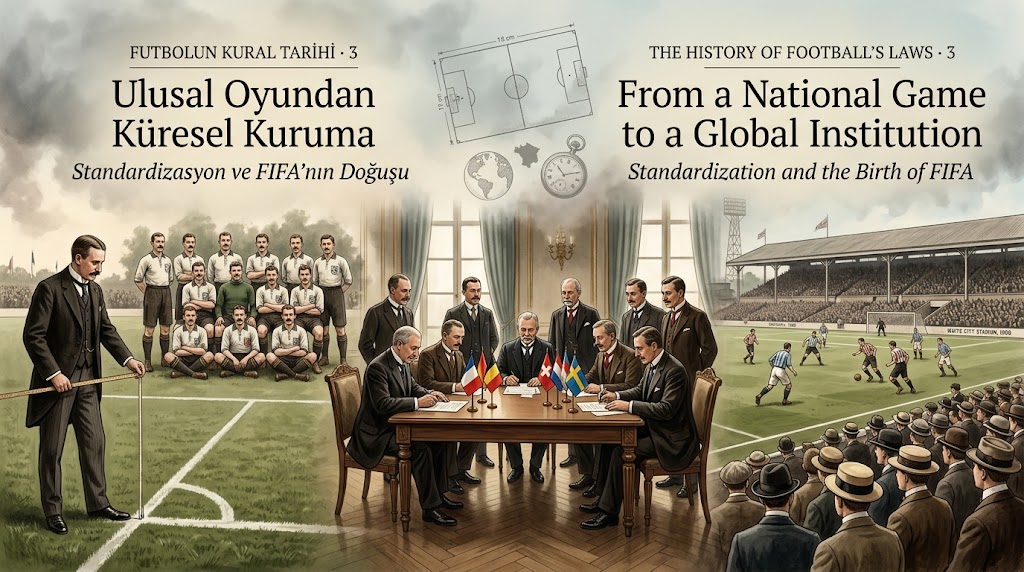
By 1891, football was already an internally coherent game: it had a penalty, a goal net, a single authoritative referee. But what was still missing was the basic standardization that would make the game the same from one match to the next, from one country to the next — how many players would play, how long a match would last, how large the pitch would be. Surprisingly, these questions remained unsettled in law until 1897.
1897 — Standardizing Player Numbers, Match Duration, and the Pitch
Until this year, how many players should be on the pitch in a match, or how many minutes a match should last, was not written into law. In practice, most matches were played with 11 players over 90 minutes, but this was a convention, not a requirement — in theory, two clubs could agree to play with different numbers. In 1897, this ambiguity was resolved: 11 players and 90 minutes (unless otherwise agreed) were formally written into law. The same year, the halfway line was added, and the maximum pitch length was reduced from 200 yards to 130 yards.
Rationale: the need for inter-club and, especially, international matches to be played in a regular, comparable format. Consequence: this was an inconspicuous but genuinely foundational rule — because before it, the very concept of “a football match” had been ambiguous. After 1897, any two teams could now come together and play a match without any prior negotiation; this was the essential precondition for tournaments and leagues to become organizable.
1901 — Freedom for the Goalkeeper to Handle the Ball
Previously, the goalkeeper could only handle the ball “in defence of his goal” — an ambiguous definition that constantly generated disputes in practice (who could determine, and how, whether a goalkeeper was handling the ball “defensively” versus “to launch an attack”?). In 1901 this ambiguity was removed: the goalkeeper was granted permission to handle the ball for any purpose, anywhere within his own half of the pitch.
Consequence: the goalkeeper position became, for the first time, a genuine tactical tool — launching a rapid attack with a long throw or kick was now possible. But this freedom would be largely reversed eleven years later, in 1912 (see below).
1902 — The Penalty Area and Penalty Spot Reach Their Modern Form
The penalty rule adopted in 1891 had a serious technical flaw: a penalty could be taken from any point along a 12-yard line running parallel to the goal line. This meant a player could take the kick from a point close to the side, parallel to the goal line — in which case the scoring angle shrank almost to zero, and the penalty was far from being a genuine guaranteed goal. In 1902 this was corrected: the rectangular 18×44-yard penalty area we know today, and a fixed penalty spot at a set distance from the centre of the goal, were defined.
Consequence: the penalty became, for the first time, a genuinely deterrent punishment. The fact that roughly 75–80% of penalties are converted into goals today traces its origin, technically, not to 1891 but to 1902 — because the 1891 penalty was not nearly as effective unless taken from the correct angle.
1904 — The Founding of FIFA
By the early 1900s, football had spread far beyond England’s borders. Representatives from France, Belgium, Denmark, the Netherlands, Spain (represented by Madrid FC), Sweden, and Switzerland gathered in Paris on 21 May 1904 to found FIFA (Fédération Internationale de Football Association). At the moment of its founding, they made a notable decision: rather than establishing its own ruleset, FIFA declared from the outset that it would adhere to IFAB’s Laws.
Rationale: it made sense, both for legitimacy and for practicality, for these newly founded continental federations to align themselves with an existing, respected authority rather than clash with the countries where football had been born. Consequence: this single decision created a fundamental division that persists to this day — FIFA organizes tournaments and sets disciplinary and transfer rules, but the Laws of the Game themselves remain in IFAB’s hands. This dual structure has not changed in over 120 years.
In England, there was initial unease about this new global institution — as the country that had invented football, there was little enthusiasm for the idea that its rules might need “approval” from another body. But this unease soon gave way to pragmatism.
1906–1912 — The First Attempt at an International Tournament: Olympic Football
As soon as FIFA was founded, it sought an international tournament that would prove its own institutional legitimacy. Its first attempt failed: an independent international tournament it tried to organize in Switzerland in 1906 was, by FIFA’s own official history, described as “unsuccessful.”
The real breakthrough came after football had appeared as an exhibition sport (unmedalled, contested by club sides) at the 1900 and 1904 Olympics. At the 1908 London Olympics, organized by England’s Football Association and under FIFA’s supervision, football became, for the first time, an official Olympic sport and a genuine national-team tournament. This six-nation tournament was won by the host nation’s amateur national team, England. The tournament was open only to amateur players — a restriction that, as we will see, would prove to be the tournament’s greatest long-term weakness. At the 1912 Stockholm Olympics, the number of participating nations rose to eleven, and England defended its title once again.
Consequence and significance: Olympic football remained the world’s only genuinely global football tournament until the first World Cup was played in 1930. But the very restriction we’ve described here — “amateur players only” — increasingly undermined the tournament’s credibility as professionalism spread rapidly through the 1920s: the world’s best players were now professionals, and they could not take part. This contradiction became one of the fundamental reasons that eventually drove FIFA to establish its own independent tournament open to professionals — the World Cup. In other words, the limited success of 1908 indirectly laid the groundwork for the birth of 1930.
1912 — Restricting the Goalkeeper’s Handling of the Ball to the Penalty Area
The freedom granted in 1901 had, predictably, begun to be exploited — goalkeepers could hold or bounce the ball while covering long distances within their own half, wasting time and even reorganizing the defence. This disrupted the flow of the game and, by allowing the goalkeeper to behave like an ordinary outfield player, weakened the distinctive nature of the position.
In 1912, IFAB reversed this freedom: the goalkeeper could now only handle the ball within his own penalty area.
Consequence: this is the clearest example we have seen so far in this series of “a granted right being taken back” — a power expanded eleven years earlier was narrowed in the opposite direction. This rule remained unchanged until the back-pass law of 1992 (Chapter 6); in other words, the question of “where the goalkeeper may handle the ball” passed through a total of three major regulatory phases in football’s history: 1901 (expansion) → 1912 (restriction) → 1992 (a new kind of restriction, this time based not on area, but on how the ball arrives).
1913 — FIFA’s Membership in IFAB
As FIFA grew, the idea gained force that the Laws should be approved not only by the four British associations but by the world at large. At a special meeting held in Wrexham on 25 January 1913, on a proposal from the English Football Association, FIFA was granted two seats on IFAB — at the time, equal in voting power to each individual British association.
Consequence: the rule-making process now formally acquired an international character. But the balance still favoured Britain: if the four English-speaking associations voted together, they could still change the Laws without FIFA’s approval. This asymmetry, as we will see in later chapters, would only be corrected in 1958 — and, by an interesting coincidence, that correction would come immediately after a long period of stagnation (Chapter 4).
By 1913, football had acquired a modern sporting identity in both its in-game rules and its governance structure: a fixed number of players, a fixed duration, a standard pitch, a defined penalty area, an international rule-making authority, and — through the Olympic experience — its first taste of global tournament practice. But immediately following this period of maturation, we enter the quietest — and most clearly explained — period in football’s history. In the next chapter, we examine how the two World Wars brought football’s rule development to a near-total standstill.
Colophon: The subject, scope, and editorial framework of this article series were determined by Aydın Tiryaki. Claude (Anthropic, Sonnet 5, Max Effort + Extended Thinking mode) assisted with research, source verification, and writing.
| aydintiryaki.org | YouTube | Aydın Tiryaki’nin Yazıları ve Videoları │Articles and Videos by Aydın Tiryaki | Bilgi Merkezi│Knowledge Hub | ░ Virgülüne Dokunmadan │ Verbatim ░ | ░ Futbolun Kural Tarihi Serisi │The History of Football’s Laws Series ░ 02.07.2026

