
The History of Football’s Laws Series — Chapter 1/13
Aydın Tiryaki & Claude Sonnet 5 (Max Effort, Extended Thinking mode)
Introduction
As foreshadowed in the series introduction, this chapter covers the starting point of football’s official history: the 13-article rulebook adopted by club representatives meeting in London between 26 October and 8 December 1863. We examine these articles one by one — the need each arose from, and what each permanently established. We also screened this period for confederation-level practices or FIFA World Cup regulations — but in 1863, neither FIFA (founded 1904) nor any confederation yet existed, so there is nothing to add under those headings here. What exists is only the internal consensus-building process among clubs within England itself.
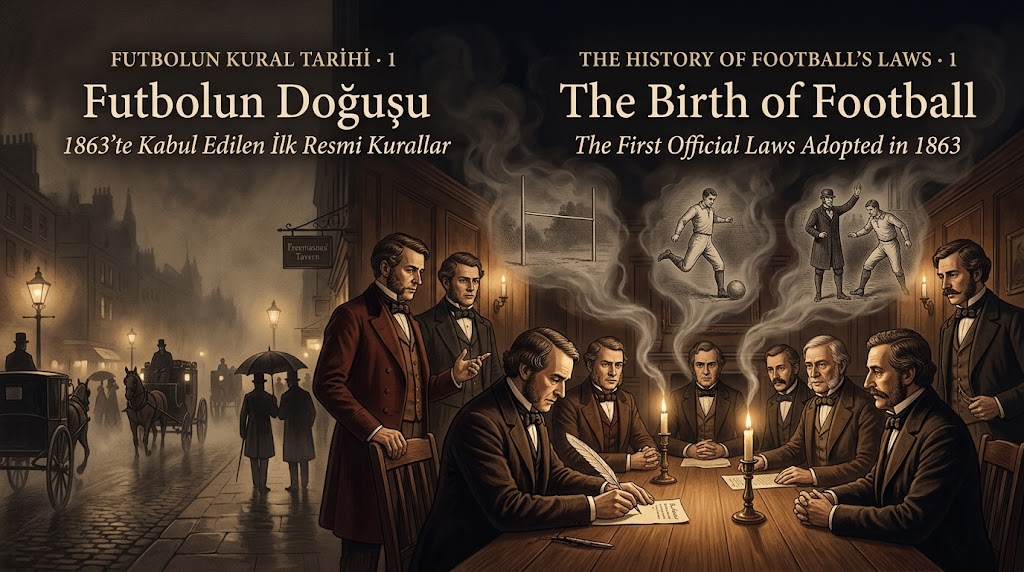
On the evening of 26 October 1863, a handful of club representatives gathered at the Freemasons’ Tavern in London’s Lincoln’s Inn Fields district, almost certainly unaware that what they were about to sign would, a century and a half later, form the foundation of the most-watched sport on the planet. Until that point, “football” was not a single game; every school and every club played its own version. Some allowed carrying the ball by hand; others considered “hacking” — kicking an opponent in the shins — a normal part of sportsmanship. Whenever rival clubs met, which rules applied was a constant source of dispute.
After six meetings marked by increasingly heated debate — particularly between clubs in favour of “hacking” and those opposed — the first official 13-article rulebook was unanimously adopted on 8 December 1863. Blackheath, the club that refused to accept this decision, walked out of the meeting and, eight years later, became one of the founders of the Rugby Football Union. In other words, the parting of ways between football and rugby can be traced to this single night.
The person who drafted the rules was Ebenezer Cobb Morley, the first secretary of The Football Association. Below, we examine each article adopted that night, along with its rationale and consequences.
Defining the Field and the Goal
The first article stipulated that the field could be a maximum of 200 yards long and 100 yards wide, with boundaries marked by flags. The goalposts were to be set 8 yards apart, but — critically — with no crossbar or tape between them. This detail matters: a goal counted regardless of the height at which the ball passed between the posts, a system still seen today in Australian rules football. The rationale was simple: how precisely the concept of a “goal” needed to be defined had not yet been worked out. As a result, this ambiguity persisted for twelve years, corrected only in 1875 with the addition of the crossbar (a topic we will revisit separately in Chapter 13).
Kick-off and Restarts
The team winning the coin toss had the right to choose ends; the losing team kicked off from the centre, with opponents required to stay 10 yards from the ball. After a goal, ends were switched and the team that had conceded restarted play. The purpose of this arrangement was to distribute field advantages — wind, sun, slope of the pitch — fairly between the two sides; a rule that still operates on the same logic today.
The Ball Behind the Goal Line
When the ball crossed behind the goal line, different free-kick rights were defined depending on which side touched it first: if the defending side touched it first, a kick was taken from their own goal line; if the attacking side touched it first, they earned a kick from 15 yards in. This article is the direct ancestor of today’s goal kick (1869) and corner kick (1872) — not yet defined as separate rules, but the underlying logic was already present.
The Fair Catch
A player who caught the ball directly from the air could mark the spot with his heel and claim a free kick; he could then retreat as far as he liked before kicking, while opponents could not advance past that mark. This rule survives today in various forms in rugby, Australian rules football, and American football, but was entirely eliminated from association football (football in today’s sense) — because catching the ball by hand was itself banned over time.
The Prohibition on Carrying the Ball by Hand
“No player shall carry the ball” — this single sentence was, in fact, the most critical article. Under the influence of Rugby School, some clubs considered carrying the ball by hand normal; this article rejected that outright. Rationale: to define a game based on foot skill, running, and kicking. Consequence: this was the most foundational decision defining football — the identity of “a game not played by hand” was born here.
Tripping, “Hacking,” and Limits on Physical Contact
Neither tripping nor “hacking” (kicking an opponent in the shins) was permitted; holding or pushing an opponent by hand was also forbidden. This was the most contentious article of the meeting and the direct cause of Blackheath’s departure. Consequence: football’s “non-contact” identity (relative to rugby) was clarified here.
Equipment Restrictions
Wearing projecting nails or metal plates on the sole or heel of one’s boots was banned — for safety reasons, though enforcement remained loose for decades and it eventually evolved into a separate “player equipment” law (today’s Law 4).
Why does this matter so much? Because these 13 articles formed the foundation on which everything that followed — from offside to the penalty, from goal-line technology to VAR — would be built. What’s striking is what these first rules did not contain: no separate goalkeeper position, no single authoritative referee on the pitch, no fixed match duration, no defined squad of 11 players. As we’ll see in the chapters ahead, all of these were added piece by piece over the following fifty years.
In the next chapter, we turn to the period stretching from the first relaxation of offside in 1866 to the adoption of the penalty kick in 1891 — the process by which football moved from its “wild” state toward a modern sporting identity.
Colophon: The subject, scope, and editorial framework of this article series were determined by Aydın Tiryaki. Claude (Anthropic, Sonnet 5, Max Effort + Extended Thinking mode) assisted with research, source verification, and writing.
| aydintiryaki.org | YouTube | Aydın Tiryaki’nin Yazıları ve Videoları │Articles and Videos by Aydın Tiryaki | Bilgi Merkezi│Knowledge Hub | ░ Virgülüne Dokunmadan │ Verbatim ░ | ░ Futbolun Kural Tarihi Serisi │The History of Football’s Laws Series ░ 02.07.2026

