
The History of Football’s Laws Series — Chapter 10/13
Aydın Tiryaki & Claude Sonnet 5 (Max Effort, Extended Thinking mode)
Introduction
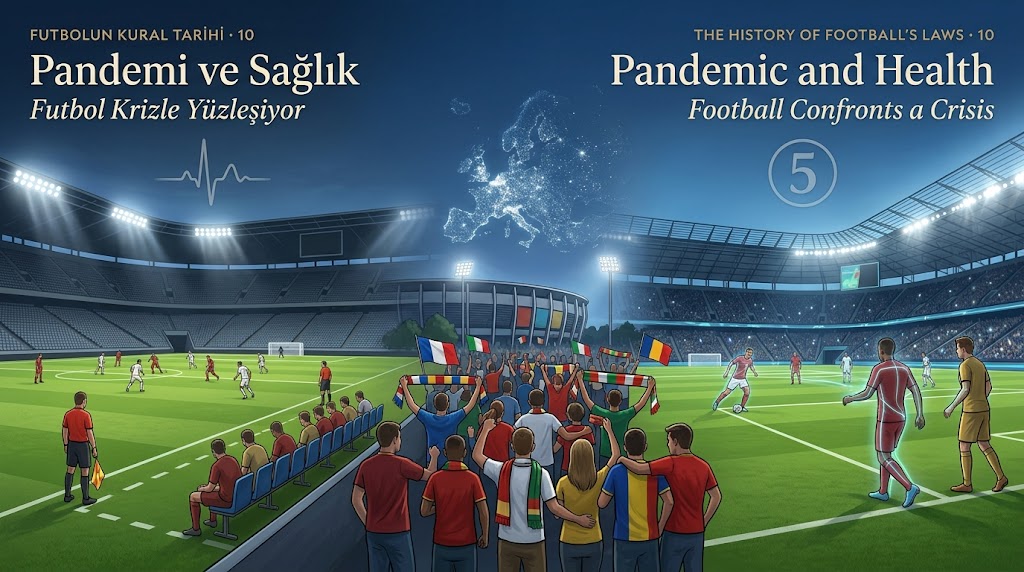
This chapter covers three years, from 2020 to 2022 — the period in which the pandemic plunged football into an acute health crisis, a crisis that produced accelerated decisions which then evolved into lasting reforms. Within these same three years, the European Championship, postponed and eventually played in 2021 (Euro 2020), played host both to a serious incident that embodied this chapter’s central theme — player health — and to temporary measures that served as a direct precursor to the permanent reforms adopted at the 2022 World Cup. In this chapter, alongside IFAB’s decisions, we also examine this tournament.
The COVID-19 pandemic that swept the world in early 2020 brought football, like everything else, to a standstill — leagues were suspended, stadiums emptied, and schedules were thrown into disarray. But this crisis also produced an unexpected acceleration in football’s rule history: IFAB was forced to compress discussion and trial processes that normally take years into a matter of months.
May 2020 — The Temporary Five-Substitute Rule
When leagues suspended by the pandemic resumed, teams faced an impossible schedule: matches normally spread across months had been compressed into just a few weeks. FIFA made a formal request to IFAB to protect player welfare, and in May 2020, the 3-substitution right — fixed since 1995 — was temporarily raised to 5, usable across three separate stoppages, plus a half-time allowance.
Rationale: to ease players’ physical load amid a congested fixture list and reduce injury risk. Consequence: this was initially designed as an emergency measure valid only until the end of 2020 — but, as we will see below, it would become permanent within two years.
December 2020 — Approval of Concussion Substitute Trials
Although not a direct consequence of the pandemic, another health issue in football surfaced during this same period: players who had suffered a head injury (concussion) continuing to remain on the pitch without adequate in-match assessment. At IFAB’s Annual Business Meeting, following the strong recommendation of a Concussion Expert Group, it was decided to launch trials of permanent concussion substitutes.
Rationale: to allow a team to safely remove a player suspected of concussion without having to spend its normal substitution allowance to do so. Consequence: this trial process would be tested across more than 140 competitions and would finally become a permanent rule in 2024.
June–July 2021 — Euro 2020: A Tournament in the Pandemic’s Shadow
The European Championship, originally planned for 2020, was postponed by a year because of the pandemic but retained the name “Euro 2020” — it was played between 11 June and 11 July 2021. The tournament itself became a striking example of both football’s institutional flexibility and its simultaneous fragility. To mark the competition’s sixtieth anniversary, a decision already made back in 2012 had planned for the tournament to be played across 11 different countries and 11 cities — the first time a European Championship had ever been hosted by more than two nations (the second such tournament in history, after the 2007 AFC Asian Cup). Under pandemic conditions, this dispersed format created both a logistical challenge and, unexpectedly, an advantage — since matches were not concentrated in a single location.
The tournament was played under special temporary provisions specific to the pandemic: squads, fixed at 23 players since 2004, were expanded to 26 — a decision that directly foreshadowed the permanent expansion that would be applied at the 2022 World Cup just months later. Special COVID protocols were also established: if the majority of a team’s players were placed under official quarantine, the match would still proceed as long as the team could field at least 13 players (including one goalkeeper).
The tournament’s most serious moment had nothing to do with what happened on the scoreboard, but directly concerned a player’s health: in the Denmark–Finland match, Danish midfielder Christian Eriksen suffered a sudden cardiac arrest on the pitch near the end of the first half. He was stabilised through immediate on-field cardiac resuscitation and taken to hospital; the Danish team stated it was unfair that they had been placed under pressure to decide, that same evening, whether the match should continue. Consequence: although this incident did not, by itself, lead to a specific rule change, it made visible just how fraught football’s on-field medical emergency protocols could be, and how problematic it was for a team to be pressured into a decision immediately after such trauma — a moment that underscored how vital the “prioritizing player health” thread we discuss throughout this chapter is, even outside the rulebook itself.
The tournament ended with Italy defeating England on penalties in the final (with goalkeeper Gianluigi Donnarumma making two decisive saves).
June 2021 — UEFA Abolishes the Away-Goals Rule
The 1965 decision we discussed in Chapters 5 and 7 came to an end, fifty-six years later. UEFA President Aleksander Čeferin, explaining the rationale for the rule’s abolition in June 2021, made a striking admission: the rule now produced an effect directly opposite to its original purpose. The away goal’s high value discouraged home teams — especially in first legs — from attacking, because a goal conceded gave their opponents a crucial advantage.
The statistics UEFA cited in its announcement lent concrete support to the decision: from the mid-1970s to the present, the men’s home/away win ratio had fallen from 61%/19% to 47%/30%, and average goals per match, home versus away, had declined from 2.02/0.95 to 1.58/1.15.
Consequence: from the 2021–22 season onward, tied two-legged ties in UEFA club competitions now go straight to extra time, and penalties if necessary. UEFA’s decision to abolish the rule would prompt CONMEBOL to follow suit a year later (2022), and the AFC two years after that (2023).
2022 — The Five-Substitute Rule Becomes Permanent, and Squads Expand
At the 136th Annual General Meeting, held in Doha, Qatar, IFAB added the 5-substitution right — introduced temporarily in 2020 — to the Laws of the Game as a permanent option, effective from the 2022–23 season. At the same meeting, the maximum number of named substitutes permitted on a match sheet was also raised from 12 to 15. As a natural extension of these changes, FIFA announced in August 2022 that the World Cup squad limit would rise from 23 to 26 players — the moment at which the formula temporarily trialled at Euro 2020 a year earlier became permanent on a global scale.
Consequence: the impact of these changes was immediately visible at that same year’s Qatar World Cup: while 32 goals had come from substitutes across the entire 2018 tournament, that figure had already reached 22 by the end of the group stage alone in 2022.
2022 — Semi-Automated Offside Technology and the First Official Concussion Substitution
The 2022 Qatar World Cup became the first official test of two separate innovations. First, semi-automated offside technology, trialled since 2021 at the FIFA Club World Cup and the Arab Cup, was officially used at a World Cup for the first time. Using a sensor embedded in the ball and cameras tracking players’ body points 50 times per second, this system could now calculate, in milliseconds, the “which body part counts” principle defined back in 2005.
Second, the concussion-substitute trial approved in 2020 was, at that same tournament, actually put into practice for the first time: when Iranian goalkeeper Alireza Beiranvand suffered a concussion in the opening match against England, an extra substitution right was used to replace him with Hossein Hosseini — the first dedicated concussion substitution ever seen at a World Cup.
Consequence: 2022 became a turning-point year in which football’s technological and health reforms were tested together, on the same stage, at the same tournament, complementing one another.
This three-year period reveals a rare acceleration in football’s rule development: debates that would normally take decades were compressed into a few years under the emergency pressure created by the pandemic. But this same period, as the Eriksen incident showed, also served as a reminder of just how insufficient even the most advanced rulebook can be at the moment a human life is at stake. In the next chapter, we turn to the period stretching from 2023 to 2026, examining how this momentum continued — from the rise and fall of the blue-card debate to VAR’s expansion into corner-kick decisions — the final chapter of our series’ chronological portion.
Colophon: The subject, scope, and editorial framework of this article series were determined by Aydın Tiryaki. Claude (Anthropic, Sonnet 5, Max Effort + Extended Thinking mode) assisted with research, source verification, and writing.
| aydintiryaki.org | YouTube | Aydın Tiryaki’nin Yazıları ve Videoları │Articles and Videos by Aydın Tiryaki | Bilgi Merkezi│Knowledge Hub | ░ Virgülüne Dokunmadan │ Verbatim ░ | ░ Futbolun Kural Tarihi Serisi │The History of Football’s Laws Series ░ 02.07.2026

