
The History of Football’s Laws Series — Chapter 8/13
Aydın Tiryaki & Claude Sonnet 5 (Max Effort, Extended Thinking mode)
Introduction
This chapter covers eight years, from 2004 to 2012 — the short but dramatic transition period in which football debated whether to respond to the fallibility of the referee’s eye with technology, first rejected the idea harshly, and then was forced to accept it after two consecutive major scandals. Within these same eight years, the very 2010 World Cup at which this crisis erupted also played host to another historic moment: the tournament being held, for the first time, on African soil. In this chapter, alongside the technology crisis, we also examine this institutional turning point.
By 2004, football had matured considerably in terms of its rule text — offside was clear, the back-pass ban was well established, and even the golden goal experiment had been acknowledged as a failure and reversed. But a far more fundamental, still-unresolved problem remained: the fallibility of the referee’s eye.
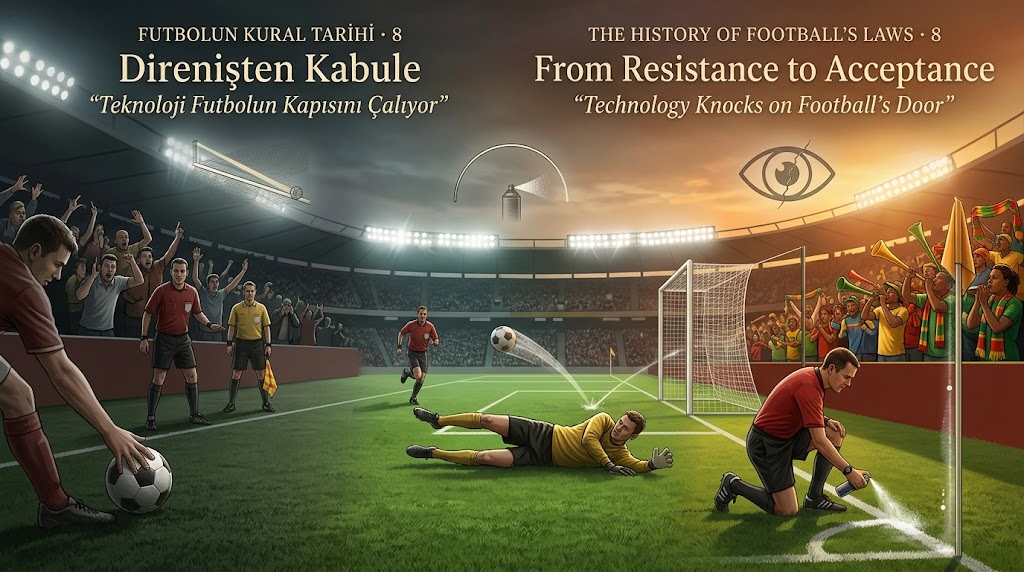
2008 — The First Rejection: “Technology Doesn’t Belong in This Game”
In the mid-2000s, Hawk-Eye-style tracking technologies, already successfully used in sports like cricket and tennis, began to be discussed within football circles as well. Some trial tests conducted in the English Premier League had produced positive results. But in 2008, IFAB closed this debate in blunt terms: it announced that technology would not be used in football in any form. The FIFA President of the time, Sepp Blatter, justified this decision by claiming existing systems were “only 95% accurate.”
Rationale (official): preserving football’s “human element” and fluidity, and the inaccessibility of the cost for smaller federations. Consequence: this rejection was a position that would quickly become unsustainable — because two major injustices occurring in rapid succession in the years that followed would push public pressure past the breaking point.
2009 — The Thierry Henry Incident: A Handled History
18 November 2009, Paris. In the second leg of the France–Ireland 2010 World Cup play-off, in extra time, French star Thierry Henry openly controlled a ball that had gone out of control with his hand and passed it to William Gallas; Gallas’s goal sent France to the tournament, and Ireland was eliminated. Millions of viewers saw the incident instantly — but the referee and his assistants on the pitch did not, and the goal was allowed to stand.
Consequence: this was not merely one match’s injustice; it made visible, worldwide, the fact that football was a system in which visible truth could be rendered invalid simply because the referee had not seen it. Although the Irish Football Association filed an official complaint (and even requested that FIFA admit Ireland as a 34th team to the tournament), the outcome did not change. But this incident pushed the video-technology debate past a point of no return.
2009/2010 — Additional Assistant Referees: An Interim Solution
Since a full transition to technology was not yet possible, UEFA tried an interim solution: additional assistant referees (goal-line officials), positioned right beside the goal lines and watching only that area, in the Europa League in the 2009–10 season and in the Champions League in 2010–11. Rationale: to leave goal-line decisions to an observer standing much closer to that zone, rather than to the main referee running from the centre of the pitch. Consequence: this system worked partially, but could not overcome the natural limitations of human vision — and, indeed, the most striking example of those very limitations was about to occur just a few months later.
March–June 2010 — Rejection, and the Crisis That Followed Immediately After
In an ironic piece of timing, IFAB convened once more in March 2010 and reaffirmed its decision to reject goal-line technology permanently. Only three months later, on 27 June 2010, one of history’s most talked-about “ghost goal” incidents occurred in the Germany–England match played in South Africa: English midfielder Frank Lampard’s long-range shot struck the crossbar and dropped clearly inside the goal line, before bouncing back out. Almost everyone in the stadium — players, spectators, commentators — saw that it was a goal. But the referee and his assistant did not; the goal was not given, and England lost 4–1.
This crisis occurred, remarkably, at the very same tournament as another turning point in football history. The 2010 World Cup had been awarded to South Africa following an all-African contest against Morocco and Egypt — marking the first time the tournament was ever played on African soil. By an interesting coincidence, this also fell in the fifty-third year after the founding of CAF in 1957, which we discussed in Chapter 4; in the run-up to the tournament, the African Union had deliberately linked this milestone to CAF’s half-century of history by declaring 2007 the “Year of African Football.” In the tournament final, Spain defeated the Netherlands to become champions — the first time a European nation had won a World Cup held outside Europe and South America (all previous such instances had been won by South American nations).
Consequence: the Lampard incident made IFAB’s “no” decision from three months earlier indefensible. Blatter announced, immediately after the match, that he had openly changed his position on the technology question. The Henry (2009) and Lampard (2010) incidents together formed a twin breaking point that triggered football’s shift toward technology — and, in a striking symmetry, one had unjustly eliminated a team while the other had unjustly prevented a team’s elimination.
2011–2012 — Trials and Official Approval
Forced into retreat under pressure, IFAB launched a comprehensive testing process running from July 2011 to July 2012; systems developed by different companies (Hawk-Eye, GoalRef, GoalControl, among others) were trialled under match conditions. On 5 July 2012, IFAB officially approved goal-line technology by adding it to the Laws of the Game — a transformation that reversed the board’s 2008 decision entirely, within just four years.
An interesting coincidence: earlier that same year, at the 126th Annual General Meeting in March 2012, IFAB had also approved the general use of vanishing spray. In other words, 2012 became a turning-point year in which football opened its doors to referee-assistance technologies on two separate fronts at once — one a visual marking tool applied on the pitch, the other an electronic verification system.
Consequence: goal-line technology was first tested, using the GoalControl system, at the 2013 FIFA Confederations Cup, and was deemed a success. The 2014 Brazil World Cup became the first World Cup played with this technology — exactly four years after Lampard’s goal, the same kind of controversy had become technically impossible.
This eight-year period reveals a pattern rarely seen in football’s rule history: an institutional resistance collapses under the weight of two separate major injustices, and the institution rapidly moves in the exact opposite direction from its previous position. Strikingly, this technological crisis erupted in precisely the same year that football crossed one of its last major geographic frontiers — the first World Cup on African soil — as if the game were entering a new era, geographically and technologically, at the very same moment. In the next chapter, we turn to the birth of a far more comprehensive system that would replace this limited solution — VAR — and examine football’s deepest confrontation with video technology, stretching from 2013 to 2019.
Colophon: The subject, scope, and editorial framework of this article series were determined by Aydın Tiryaki. Claude (Anthropic, Sonnet 5, Max Effort + Extended Thinking mode) assisted with research, source verification, and writing.
| aydintiryaki.org | YouTube | Aydın Tiryaki’nin Yazıları ve Videoları │Articles and Videos by Aydın Tiryaki | Bilgi Merkezi│Knowledge Hub | ░ Virgülüne Dokunmadan │ Verbatim ░ | ░ Futbolun Kural Tarihi Serisi │The History of Football’s Laws Series ░ 02.07.2026

