
The History of Football’s Laws Series — Chapter 2/13
Aydın Tiryaki & Claude Sonnet 5 (Max Effort, Extended Thinking mode)
Introduction
This chapter covers a quarter-century of football’s history, from 1866 to 1891 — the period in which the game moved from being “an activity whose rules varied depending on who was playing” to acquiring an institutional identity. Neither FIFA nor any confederation yet existed during this period; everything discussed here belongs entirely to England’s internal process. Alongside the rule changes (offside, the corner kick, the penalty, the referee system), this chapter also covers two developments that gave football an institutional structure independent of the Laws themselves: the founding of the FA Cup (1871) and the Football League (1888). Neither of these is a Law in itself, but both form an inseparable part of this period’s story, as they laid the foundation of football’s present-day organisational architecture.
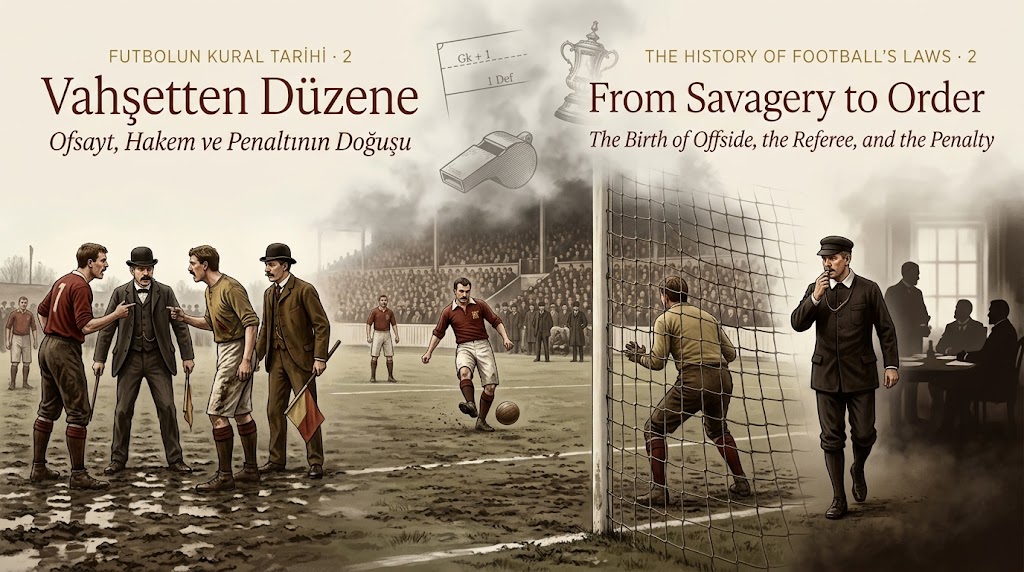
The 13 articles adopted in 1863 had separated football from rugby, but the game itself remained primitive. The offside law was so strict that attacking was almost impossible; there was no single authoritative referee on the pitch, only “umpires” agreed upon by the two team captains; and different regions of England were still playing under different rulesets.
1866 — The First Relaxation of Offside
The offside definition in the 1863 rules was nearly identical to rugby’s: any player ahead of the ball was offside. The rationale had been to prevent players from clustering in front of the goal waiting for a pass (“goal-hanging”) — but the effect was the opposite. The only way to advance play was to dribble alone or engage in physical struggle; passing football was almost impossible. In 1866 the law was relaxed: a player was now considered onside as long as at least three opposing players stood between him and the opposing goal. Consequence: this single change lit the fuse for football’s shift from an identity built on individual dribbling to one built on passing. This rule would change again in 1925 (a topic for Chapter 3) — meaning offside took its first step here toward becoming the single most frequently revised rule in football’s history.
1869 — The Goal Kick
Under the 1863 rules, the method applied when the ball passed behind the goal line was complicated and open to dispute. In 1869 this was simplified into a standard “goal kick,” close to today’s logic. Rationale: to free the game from arbitrary interpretation. Consequence: match flow became predictable.
1870–1871 — The Second Umpire and the Clarification of the End-Switching Rule
Under the 1863 rules, teams switched ends immediately after a goal was scored. In 1870 this rule began to be revised: if no goal had been scored in the first half, ends would also be switched at half-time — a small adjustment that would be tweaked a few more times in the early 1870s. During the same period, discipline and decision-making also began to become institutionalised: in 1871, an “umpire” from each team began taking the field to manage disputes that, until then, had only been settled between the two team captains directly — in cases of disagreement, a third party standing at the edge of the pitch would be “referred to.” This was the first institutional step toward today’s refereeing system; the single-authority referee would not arrive for another twenty years, in 1891.
1871 — The FA Cup: The World’s Oldest Tournament
That same year saw an entirely different kind of milestone in football’s history: the founding of the FA Cup. This remains the oldest football tournament still in existence today, and before it, clubs had only played specially arranged friendly matches — there was no regular, institutionalised competitive structure. Rationale: to place inter-club competition within a regular, predictable framework. Consequence: the FA Cup was the first concrete proof that, beyond the text of the Laws, football’s institutional architecture was also beginning to be built — as the rules matured, the organisational structure surrounding football developed in parallel.
1872 — The Corner Kick
Following a logic symmetrical to the goal kick, if the ball went out of play having last touched a defending player, the attacking team was awarded a kick from the corner. Consequence: this was the first rule to penalise the defending tactic of deliberately putting the ball out of play — in other words, the first example in football’s history of a rule turning a defensive convenience into an attacking advantage. This same logic remains current 154 years later, in 2026, as VAR begins reviewing corner-kick decisions (as we will see in Chapter 11).
1875 — The Addition of the Crossbar
Under the 1863 rules, a goal counted regardless of the height at which the ball passed between the posts — a system still seen today in Australian rules football. This created constant dispute over when a goal should be considered valid. First a rope or tape was added, then a fixed bar. Consequence: the concept of a “goal” acquired a precise geometric definition for the first time; the strategic importance of the goalkeeper position also grew with this newfound clarity.
1877 — Unification with the Sheffield Rules
The London-based FA’s rules were not immediately adopted throughout England. In particular, the Sheffield region, which had used its own ruleset since 1858, continued playing under a parallel system for fourteen years. During this period the two sides influenced each other — the origin of the corner-kick concept, for instance, is thought to lie with Sheffield’s influence. In 1877, Sheffield adopted the FA’s rules. Consequence: a genuinely unified form of football finally became possible in England; without this unification, the next step — IFAB — would have been unthinkable.
1878 — The Referee’s Whistle
Previously, referees and umpires stopped play with a verbal warning or hand signal — impractical in crowded, noisy matches. The introduction of the whistle brought a small but lasting standard: stopping play became instant and audible to everyone.
1882 — The Unification of the British Associations
Which country’s interpretation of the rules should apply in matches between England, Scotland, Wales, and Ireland remained a matter of dispute — because each association applied its own interpretation of offside and fouls. At a meeting in Manchester, it was decided that a permanent, joint rule-making board should be established. Consequence: this decision led directly to the founding of IFAB.
1886 — IFAB’s First Meeting
On 2 June 1886 in London, IFAB — convened with two representatives each from the four British associations — became the first permanent, independent rule-making body in football’s history. The threshold for a decision was, then as now, a three-quarters majority. Consequence: the Laws were no longer subject to the initiative of any single country or club, but bound to a multilateral consensus. This structure — with FIFA added later — has operated on the same basic logic for 140 years; IFAB remains today one of the oldest sports governance institutions in the world.
1888 — The Football League: The World’s First Regular League System
The FA Cup had institutionalised inter-club competition, but it remained a knockout tournament — there was no regular, reciprocal, season-long structure. The Football League, founded in 1888, became the world’s first professional, regular league system; clubs now played each other reciprocally (both home and away) every season. Rationale: to stabilise club revenue and extend competition beyond a single-elimination tournament. Consequence: the template for what we know today, worldwide, as a “league” was formed here — the points system, season-long reciprocal fixtures, championship standings. Without this structure, the three-points-for-a-win system we will discuss later (Chapter 6) would not even have had a framework to be debated within.
1888 — The Dropped Ball
When the referee stopped play (due to an injury or outside interference, for example) without there having been a clear foul, there was no neutral method for restarting the game. The dropped ball filled this gap. This rule would be revised again in 2019 (awarded to the team that last touched the ball) and in 2025 (further clarification), surviving in this evolving form to the present day.
1889 — Dismissal for Repeated Cautionable Behaviour
The referee’s ability to send a player off the field for persistent rule violations was defined for the first time this year — a very early ancestor of today’s card system (1970), though there was not yet any visual signal, only the referee’s discretion.
1890/1891 — The Penalty Kick
The concept of the penalty area did not yet exist, but it was increasingly seen as a serious injustice for defenders to deliberately foul in front of goal to prevent a certain goal. On 20 December 1890, a player’s deliberate handling of the ball to prevent a goal in a Scottish Cup match caused major controversy; following a proposal from the Irish Football Association, the penalty rule — nicknamed the “kick of death” by the press of the time — was adopted on 2 June 1891. That same year, the goal net was also formalised, and the two-umpire system was abolished in favour of a single authoritative referee on the pitch — the umpire system that had begun in 1871 gave way, exactly twenty years later, to today’s single-referee logic. At the same meeting, pitch markings such as the centre circle, the six-yard goal-area line, and the twelve-yard penalty line were also officially defined for the first time.
Consequence and significance: the penalty rule represents a fundamental transformation in football’s rule philosophy. The shift from 1863’s assumption that “a gentlemanly player never deliberately fouls” to the logic that “a deliberate foul must be severely punished” took place here. This philosophical break is so foundational that we will address it separately under “Turning Points” in Chapter 13.
Over this quarter-century, football matured on four fronts at once: the logic of the game (offside, the corner kick, the goal kick), governance (the founding of IFAB), disciplinary philosophy (the penalty, dismissal from the field), and institutional architecture (the FA Cup, the Football League). In the next chapter, we turn to the period stretching from the standardisation of player numbers and match duration in 1897 to FIFA’s admission to IFAB in 1913 — the process by which football transformed from a national English sport into a global institution.
Colophon: The subject, scope, and editorial framework of this article series were determined by Aydın Tiryaki. Claude (Anthropic, Sonnet 5, Max Effort + Extended Thinking mode) assisted with research, source verification, and writing.
| aydintiryaki.org | YouTube | Aydın Tiryaki’nin Yazıları ve Videoları │Articles and Videos by Aydın Tiryaki | Bilgi Merkezi│Knowledge Hub | ░ Virgülüne Dokunmadan │ Verbatim ░ | ░ Futbolun Kural Tarihi Serisi │The History of Football’s Laws Series ░ 02.07.2026

