
The History of Football’s Laws Series — Chapter 4/13
Aydın Tiryaki & Claude Sonnet 5 (Max Effort, Extended Thinking mode)
Introduction
This chapter covers thirty-seven years, from 1920 to 1957. At first glance, this period looks like two different stories at once: on one hand, IFAB’s rule-making enters a long stagnation; on the other, this very same period sees football’s institutional and tournament architecture pass through the fastest growth phase in its history — the first three World Cups (1930, 1934, 1938) fall within these years, the Second World War brings both rules and tournaments to a halt, and the postwar recovery culminates in the successive founding of major confederations such as UEFA, AFC, and CAF. In other words, this chapter tells the story of “stagnation” and “expansion” happening simultaneously, on different levels.
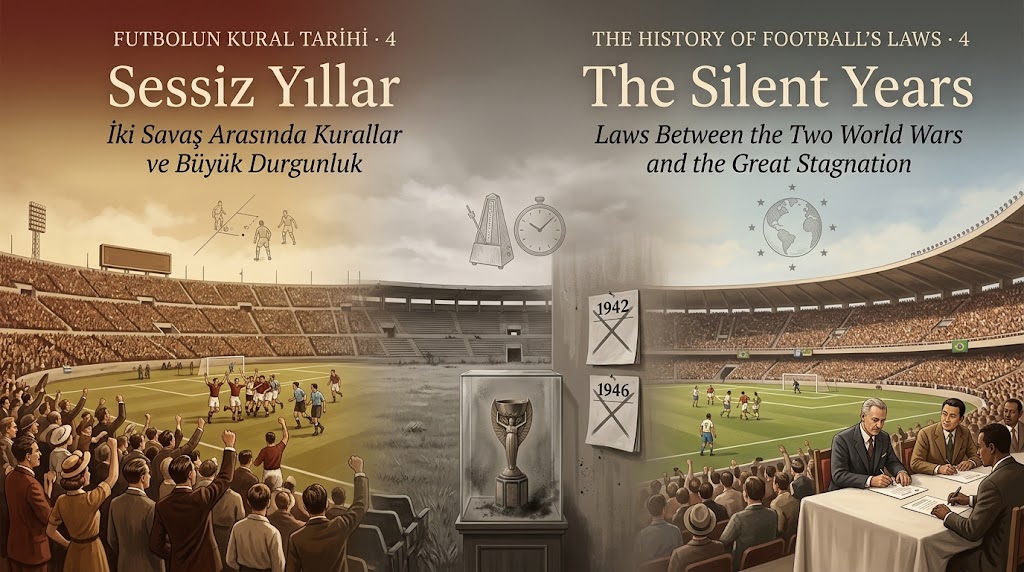
Up to 1913, football had undergone a fundamental transformation almost every decade: the penalty, the penalty area, the founding of FIFA. The period covered in this chapter, 1920 to 1957, carries the opposite character in terms of the text of the Laws — aside from a few important adjustments, IFAB’s rule development enters a long, quiet pause. But this silence does not mean football itself came to a halt; on the contrary, this same period saw the rapid construction of the institutional structure that would determine how the game would be played on a global scale.
1920 — No Offside from a Throw-In
In 1920, a gap in the Laws was clarified: could a player be offside upon receiving the ball directly from a throw-in? No. Rationale: a throw-in already offered a limited area and limited range; adding the risk of offside on top of that made throw-ins unnecessarily complicated. Consequence: this was the beginning of offside’s “list of exceptions” — the first instance of the still-current principle that a player cannot be offside directly from a corner kick or a goal kick.
1924 — Permission to Score Directly from a Corner Kick
On 15 June 1924, IFAB confirmed that the corner kick was, in fact, a direct kick, and that a goal could be scored directly, given sufficient wind or swerve. Consequence: this was a small but practical clarification — players taking corners were now given the option of seeking a direct goal under the right conditions. The “direct goal from a corner” moments still occasionally seen today owe their origin to this decision.
1925 — Offside’s Second Great Relaxation: From Three Opponents to Two
The offside law, relaxed in 1866 with its “three opponents” requirement, became a matter of debate again in the 1920s. The problem was this: defending teams could use the three-opponent requirement to set an extremely high and effective offside trap, which was seriously reducing the number of goals scored in matches. In 1925, IFAB relaxed the law once more: a player was now considered onside as long as just two opposing players (typically the goalkeeper and one defender) stood between him and the goal.
Consequence, in numbers: the impact of this change was striking. The number of goals scored in the English leagues, which had stood at around 4,700 the previous season, rose to 6,373 in the 1925–26 season — an increase of roughly 35%. This is one of the clearest examples in football’s history of a single rule change directly affecting goal-scoring statistics to this degree. This rule remained fundamentally unchanged for sixty-five years (until 1990) — meaning the 1925 decision became one of the longest-lasting major rule changes in football’s history.
1930 — The World Cup: Football’s First Global Tournament
During this same period, as the offside law found a permanent framework, football’s history saw perhaps its most important institutional leap. As we discussed in Chapter 3, Olympic football had been the world’s only global tournament since 1908, but its “amateurs only” restriction was increasingly undermining its credibility. FIFA decided to establish its own independent tournament, open to professionals, and chose as host Uruguay — a country that had won back-to-back Olympic titles and was, that same year, celebrating the centenary of its independence.
Played in Montevideo between 13 and 30 July 1930, the tournament featured 13 teams (7 from South America, 4 from Europe, 2 from North America) — invited directly, with no qualification process. The format also differed from today’s: three groups of three teams and one group of four, with group winners advancing to the semi-finals. 70 goals were scored across 18 matches (an average of 3.89 goals per match — remarkably high by today’s standards). In the final, Uruguay defeated Argentina 4–2 to become the first world champion; this also made history as the first tournament won by the host nation.
A notable detail: England and the other British associations (who had resigned from FIFA at the time) did not take part in this first tournament — the countries that had invented football contented themselves with merely watching the sport’s first global championship. Consequence: from that moment on, the World Cup launched a separate institutional development track, running parallel to but independent of the text of the Laws — a track that, as we will see repeatedly in later chapters (the third substitution right, the three-points system, VAR’s first trials), would go on to indirectly influence the Laws of the Game themselves.
1934 — The Second World Cup: The Move to Europe
Four years later, the tournament moved to Europe (Italy) for the first time — and it arrived with two important structural changes. For the first time, a qualification stage was applied; countries were no longer invited directly but now had to pass through qualifiers first. The format also changed: the group system of 1930 was abandoned in favour of a straight knockout format (including a round of 16). Defending champions Uruguay boycotted the tournament in protest at the poor European turnout in 1930 — the only instance in World Cup history of a champion not taking part in the following tournament. Egypt became the first African country to compete (eliminated in the first round). Italy became champions by beating Czechoslovakia 2–1 in extra time in the final — the first World Cup won by a European nation.
1938 — The Third World Cup and the Recodification of the Laws
The same year saw two parallel but independent developments in football’s history. The third World Cup, played in France, again used the straight-knockout format of 1934 — these two (1934 and 1938) remain the only World Cups ever played without a group stage. For the first time, the defending champions (Italy) and the host nation were granted automatic qualification. Austria, having qualified through the qualifiers, was forced to withdraw after Nazi Germany’s annexation of the country (the Anschluss) — the tournament proceeded with 15 teams. Italy defeated Hungary in the final to defend its title, becoming the first country to win consecutive World Cups.
That same year, an important development also took place on the rules front: since 1863, the Laws had been written piece by piece, in the Victorian English of the era; by the 1930s, the total of 17 articles had become a disjointed, scattered text. Stanley Rous, an IFAB member and the man who first introduced the “diagonal system” of refereeing (and who would go on to become FIFA president in 1961), was tasked with rewriting the Laws from scratch, in a logical order.
Rationale: this was not a change of content but of form — no new rule was added; the existing rules were simply given a clearer, more consistent language. Consequence: Rous’s work was so good that the Laws would not undergo such a comprehensive second revision until 1997 — fifty-nine years later.
1939–1946 — The Complete Standstill Brought by the War
The Second World War, which began on 1 September 1939, brought football’s institutional life to a halt on two fronts at once. On the rules front: not a single FIFA Congress could be held between 1938 and 1946 — the last pre-war congress had been in 1938, and the next one could only take place in Luxembourg in 1946. On the tournament front, the impact was even more direct: the World Cups planned for 1942 and 1946 were cancelled entirely — a tournament meant to be held every four years could only resume in 1950, after a twelve-year gap.
IFAB did not disappear entirely, since it was, technically, a board based in Britain, and its four founding associations could still convene — in however limited a fashion — even during the war’s most intense phases; minutes from the 1940s still exist in the institution’s archives. But during this period, the agenda was not new rule innovation, but institutional survival and postwar normalization.
1946 — FIFA’s Reconstruction and Britain’s Return
The most important decision of the 1946 Congress was not a rule change, but confirmation that the postponed World Cup would be held in Brazil in 1950. That same year, another turning point occurred in football’s history: England, Scotland, Wales, and Northern Ireland — who had resigned from FIFA in 1920 over disputes about amateurism — rejoined the organization at FIFA’s invitation on 28 July 1946. Consequence: the countries that had invented football returned, after a full twenty-six years, to the official family of the global game they had themselves founded — a return that meant the British associations would take the field for the first time at the 1950 World Cup, four years later.
1950 — The World Cup’s Return: A Championship Without a Final
Resuming in Brazil after a twelve-year gap, the World Cup was interesting both symbolically and structurally. The British associations took part for the first time. The format was also unique: instead of a classic final match, the champion was determined by a final group of four teams (Brazil, Spain, Sweden, Uruguay) playing each other in a round-robin — this remains the only “final-less” tournament in World Cup history. In the group’s last match, host nation Brazil — who needed only a draw — lost 2–1 to Uruguay in front of roughly 200,000 spectators. This result, remembered as the “Maracanazo,” stands as one of the most traumatic moments in football history, and delivered Uruguay its second championship.
1953–1957 — The Birth of the Continental Confederations
In 1953, FIFA made a formal decision permitting the establishment of continental confederations — the beginning of a shift from a single centrally managed structure to a multi-layered one, in which continents could organize their own tournaments. This decision produced three founding waves within three years of each other:
- 8 May 1954, Manila: AFC (the Asian Football Confederation) was founded with 13 founding members.
- 15 June 1954, Basel: just a few weeks after the AFC, UEFA (the Union of European Football Associations) was officially founded.
- 8 February 1957, Khartoum: CAF (the Confederation of African Football) was founded, with Egypt, Ethiopia, South Africa, and Sudan as founding members; the first Africa Cup of Nations was also held that same year.
(In South America, this structure had already existed much earlier, since the founding of CONMEBOL in 1916 — and it was this early institutionalization that lay behind Uruguay’s having the international standing, in 1930, to host the World Cup in the first place.)
Consequence: this three-year window marks the definitive turning point at which football moved from a single global authority (FIFA/IFAB) to the multi-layered governance structure — FIFA plus six continental confederations — we still recognize today. Interestingly, this institutional explosion coincides precisely with the period when the Laws themselves were most stagnant — as if football were, at that moment, rethinking not “what” was being played, but “by whom, and how” it would be organized.
Overall balance: in the twenty years between Rous’s 1938 codification and the 1958 reform of the voting system, no major change was made to football’s fundamental rules of play — a natural consequence of the war and its postwar recovery. But these same twenty years were, perhaps, the most intensive period of construction in football’s institutional skeleton — with three World Cups, FIFA’s reconstruction, and the founding of three major continental confederations. While the rules stood still, the world around football never did.
In the next chapter, we turn to the 1958–1982 period, built upon this institutional foundation — the quarter-century in which IFAB democratized its own internal governance, the first substitution rule arrived, the penalty shoot-out was born, and the true foundations of modern football were laid.
Colophon: The subject, scope, and editorial framework of this article series were determined by Aydın Tiryaki. Claude (Anthropic, Sonnet 5, Max Effort + Extended Thinking mode) assisted with research, source verification, and writing.
| aydintiryaki.org | YouTube | Aydın Tiryaki’nin Yazıları ve Videoları │Articles and Videos by Aydın Tiryaki | Bilgi Merkezi│Knowledge Hub | ░ Virgülüne Dokunmadan │ Verbatim ░ | ░ Futbolun Kural Tarihi Serisi │The History of Football’s Laws Series ░ 02.07.2026

