
The History of Football’s Laws Series — Chapter 11/13
Aydın Tiryaki & Claude Sonnet 5 (Max Effort, Extended Thinking mode)
Introduction
This chapter covers the period from 2023 to the present (mid-2026) — the final chapter of the chronological portion of our series. Alongside the rule changes, this period also saw two major tournament turning points: in 2023, a Women’s World Cup that, for the first time, spanned two different confederations (AFC and OFC) and expanded to 32 teams; and, right now — as we write these very lines — the first 48-team men’s World Cup, currently under way in the United States, Mexico, and Canada. In other words, as we set out to do at the very start of this series, this chapter genuinely ends in the middle of “the football currently being played.”
We now bring together the changes gathered across the previous ten chapters of our series with a current period focused on football’s discipline, behaviour, and final fine-tuning. This period carries a different character from earlier ones: the major technological leaps (VAR, goal-line technology) now lie in the past; the agenda has shifted to player behaviour, referee safety, and the fine-tuning of the rules.
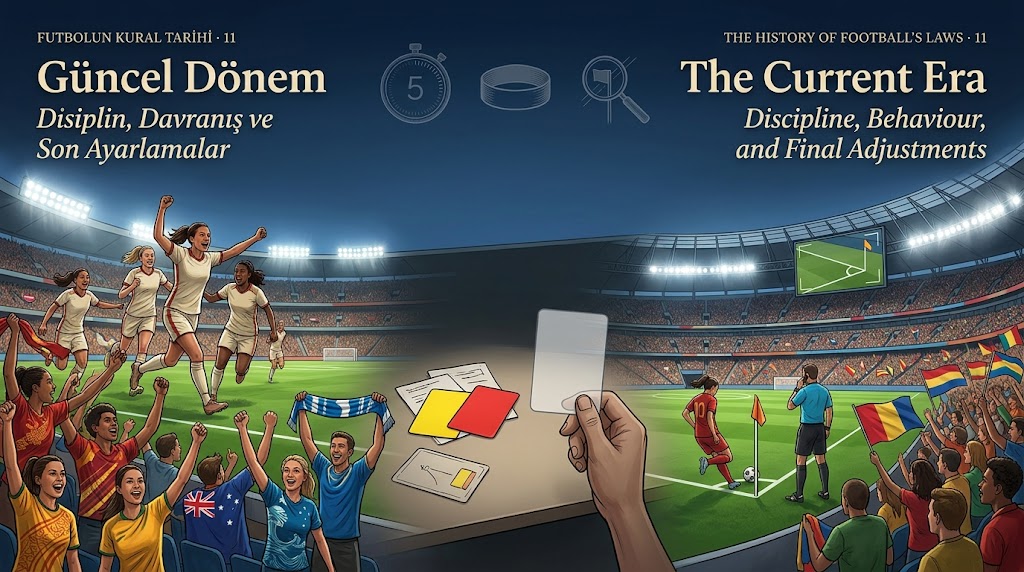
July–August 2023 — The Women’s World Cup: A Tournament That United Three Continents
Played in Australia and New Zealand between 20 July and 20 August 2023, the Women’s World Cup combined several firsts in football history at once. The tournament expanded from 24 to 32 teams, reaching the same scale used by the men’s tournament between 1998 and 2022, for the first time in the women’s game. More importantly, this tournament became — at any level, men’s or women’s — the first World Cup ever to span two different confederations: Australia had moved from the OFC to the AFC in 2006, while New Zealand remained an OFC member. This also meant that a major FIFA tournament was, for the first time, being held in Oceania — the moment at which the OFC, which we touched on briefly in Chapter 5 (founded 1966), finally arrived on its own grand stage.
The tournament also saw a step toward technical clarity: for the first time, VAR decisions could be explained not only on stadium screens but verbally, by the referee themselves — a concrete response to the “spectators can’t understand the VAR decision” criticism that had persisted since 2017. The tournament was won by the United States, who defeated the Netherlands.
Consequence: this tournament symbolically demonstrated that football no longer belonged to a single continent or a single confederation, but that all six confederations now carried this shared heritage as equal stakeholders.
November 2023–March 2024 — The Blue Card Drama: A Rule’s Death Before Birth
At the Annual Business Meeting held in November 2023, IFAB announced its intention to test the sin-bin (temporary dismissal) system in top-level football to improve player behaviour. The idea was simple: for offences too minor to warrant a red card but insufficiently deterred by a yellow (such as Giorgio Chiellini’s blatant tactical foul in dragging back Bukayo Saka in the 2020 European Championship final), a player would be sent off the pitch for 10 minutes. This system had already been successfully applied in England’s grassroots football since 2019–20 — 72% of players, 77% of coaches, and 84% of referees approved of it, and it had produced a 38% reduction in cases of dissent.
The problem was the proposal to use a new blue card to distinguish this punishment from yellow and red. On 8 February 2024, details of this protocol leaked to the press and backlash erupted immediately — managers such as Jürgen Klopp, Mikel Arteta, and Mauricio Pochettino voiced open scepticism. FIFA President Gianni Infantino formally distanced FIFA from IFAB the following day, declaring that reports of a blue card coming to top-level football were “incorrect and premature.” The planned 9 February announcement was postponed.
Consequence: at the 138th Annual General Meeting, held on 2 March 2024 at Loch Lomond, Scotland, the blue card and the top-level sin-bin trial were formally shelved. In their place, only two more modest trials were approved: giving referees the option to establish a “captain-only zone” when feeling threatened, and to separate teams into their own penalty areas for a “cooling-off period” during moments of tension. This is a rare example in football’s rule history: an idea presented as the biggest change in discipline management since the yellow/red card system of 1970 was ended, before it ever reached the public, through internal institutional friction.
March 2024 — The Same Meeting’s Quiet but Lasting Decisions
While the blue card debate dominated the headlines, two far more lasting decisions passed quietly at the same 138th General Assembly:
- The permanent concussion-substitute right: the trial process running since December 2020 concluded, and this right was formally added to the Laws of the Game as an optional provision, effective from 1 July 2024.
- The mandatory captain’s armband: every team was now required to have a captain wearing an identifiable armband on the pitch.
- The goalkeeper ball-holding-time trial: following criticism that the 6-second limit, fixed since 2000, was rarely enforced in practice, a trial was launched in lower-tier leagues (up to the third tier) raising the limit to 8 seconds, with the referee counting down the final 5 seconds visually with his fingers.
Consequence: although overshadowed by the blue card story, these three decisions were, in fact, the period’s most concrete and lasting achievements.
2025–2026 — Small but Consistent Steps in Time Management
Over the following two years, IFAB introduced a series of small but consistent regulations against time-wasting tactics: it was clarified that, when players deliberately prolonged delays at throw-ins and goal kicks, the referee would begin a visible 5-second countdown, awarding the ball to the opposing team once time expired. In addition, with the permission of competition organizers, the option for referees to wear body cameras was formally granted.
Consequence: this period shows that football is now advancing not through “big, dramatic” reforms, but through cumulative small adjustments aimed at speeding up the flow of the game and systematically penalizing time-wasting.
2026 (140th AGM) — VAR’s Expanding Authority and the Final Package
The 2026/27 rule package adopted at IFAB’s 140th General Assembly significantly expanded VAR’s scope of review:
- VAR’s intervention in corner-kick decisions — clearly incorrectly awarded corner kicks may now be reviewed, if the decision can be corrected immediately without unduly disrupting the flow of play.
- Review of red cards arising from a second yellow card and cases of mistaken identity.
- Review by VAR of fouls committed before a set piece.
- A red card for covering the mouth when facing an opponent; a red card for leaving the pitch to protest a referee’s decision.
- The substitution right in international friendlies rising to 8 (or 11 by mutual agreement); a 10-second time limit for a substituted player to leave the pitch.
- In DOGSO offences, no yellow card at all being shown if advantage is played and a goal results.
Consequence: this package shows that the boundaries of VAR’s founding “clear and obvious errors only” principle from 2018 have been gradually expanding ever since.
June 2026 — Currently Under Way: The 48-Team World Cup
And finally, we arrive at a tournament still ongoing as we write these very lines. This World Cup, which began on 11 June 2026 and will conclude on 19 July, carries several firsts in football history at once: it is, for the first time, jointly hosted by three countries (the United States, Mexico, and Canada) — across 16 cities (11 in the US, 3 in Mexico, 2 in Canada); for the first time, it features 48 teams (up from the previous 32); and it uses a new Round of 32 knockout stage following the 12 group stages, made up of the 24 group winners and runners-up plus the 8 best third-placed teams. With a total of 104 matches (compared to 64 in previous tournaments), this has become the longest World Cup in history (39 days). Mexico became the first country to host a World Cup for a third time, after 1970 and 1986.
This tournament is also the first World Cup at which all six confederations (including the OFC) hold a guaranteed berth — a moment in which the OFC we discussed in Chapter 5 has, this time, reached institutional maturity on the men’s side as well. As of 25 June, the tournament has already surpassed, in total attendance, the record set at the 1994 World Cup, also held in the United States thirty-two years earlier.
Consequence: as we write this chapter, who will become champion is not yet known — but the tournament itself, as a natural continuation of the trend we have followed throughout this series (expansion, diversification, technological maturation), stands as the most concrete proof that football has now truly become a game belonging to the entire world.
Our chronological story reaches this point, in the middle of 2026, inside a World Cup that is still being played — and the blue-card drama reminds us that football’s rule changes are not always a linear progression, and can sometimes retreat under institutional friction. In the next chapter, we bring together the more than 60 changes gathered across the first ten chapters of the series and interpret their cumulative effect on the football played today.
Colophon: The subject, scope, and editorial framework of this article series were determined by Aydın Tiryaki. Claude (Anthropic, Sonnet 5, Max Effort + Extended Thinking mode) assisted with research, source verification, and writing.
| aydintiryaki.org | YouTube | Aydın Tiryaki’nin Yazıları ve Videoları │Articles and Videos by Aydın Tiryaki | Bilgi Merkezi│Knowledge Hub | ░ Virgülüne Dokunmadan │ Verbatim ░ | ░ Futbolun Kural Tarihi Serisi │The History of Football’s Laws Series ░ 02.07.2026

