
The History of Football’s Laws Series — Chapter 5/13
Aydın Tiryaki & Claude Sonnet 5 (Max Effort, Extended Thinking mode)
Introduction
This chapter covers a quarter-century, from 1958 to 1982. The institutional construction process we saw in the previous chapter (three World Cups, three continental confederations) is completed here: with the founding of CONCACAF in 1961, all six of the continental confederations we recognize today are now in place. During the same period, IFAB’s rule development also emerges from its postwar stagnation and accelerates once again — the democratization of the voting system, the first substitution rule, the card system, and the penalty shoot-out all fall within this quarter-century. In this chapter, alongside the rule changes, we also examine the format evolution of the six World Cups played during this same period (1958–1982) and how these tournaments directly laid the groundwork for the birth of certain rules — because in this period, the competitive stage and the text of the Laws become two parallel tracks that continuously feed one another.
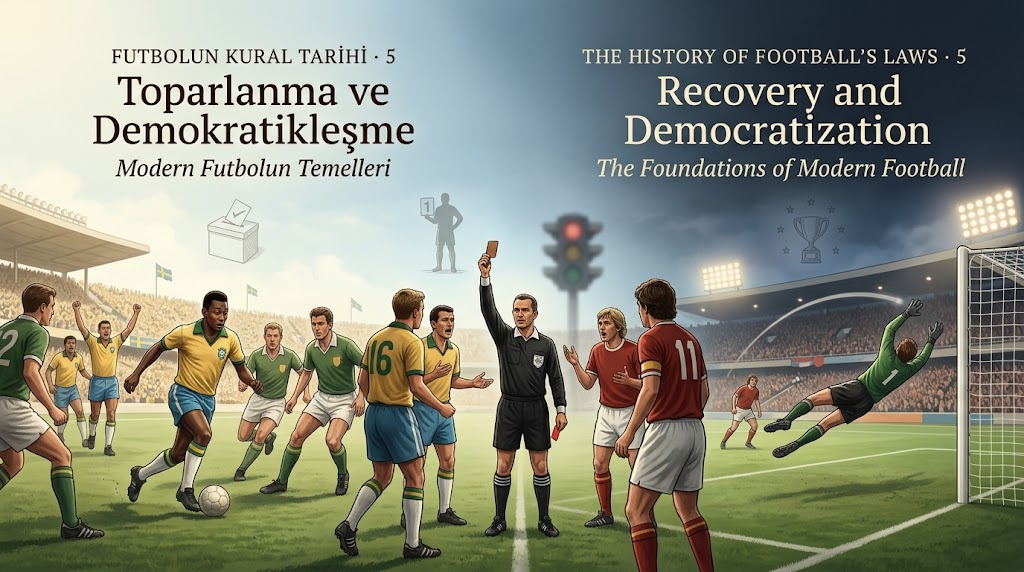
After the long silence brought by the war, football began, from 1958 onward, to make up for a development process that had effectively been postponed, at an accelerated pace. The quarter-century covered in this chapter, 1958 to 1982, saw a fundamental transformation on three fronts at once: the democratization of the rule-making process, the first-ever possibility of player rotation, and the birth of an entirely new method for determining match outcomes — the penalty shoot-out.
1958 — The Democratization of the Voting System
Since 1913, FIFA had held two votes on IFAB — equal in power to each individual one of the four British associations. This meant, in theory, that the four English-speaking associations could unite and change the Laws without FIFA’s approval; it was an asymmetry. In 1958, IFAB adopted the system still in force today: each British association (England, Scotland, Wales, Northern Ireland) would hold one vote, and FIFA would hold four, with six of the total eight votes required to validate a change.
Rationale: the need for governance to reflect the reality that football was no longer an English sport, but a global institution. Consequence: this formula established a balance whereby no change could pass without FIFA’s approval, but FIFA alone (without the support of at least two British associations) could not change the rules either — a system that has held unbroken for 68 years, and stands as the single most enduring structural decision in football’s rule-making process.
1958 — The First Substitution Rule
Since 1863, the 11 players who started a match had been required to remain on the pitch until the final whistle — even an injured player could not be replaced, and his team would simply continue playing with 10 men. In 1958, this was partially relaxed for the first time: a single substitution was permitted, but only in the case of injury.
Rationale: to ease the unfairness created by playing with 10 men due to an injured player. Consequence: this was an inconspicuous but revolutionary opening — because once the concept of “substitution” had entered the rulebook at all, the expansion of its scope became inevitable. Indeed, within twelve years (1970) this right would extend to tactical substitutions as well, rising to three in 1995 and five in 2020 — the origin of the modern game’s entire approach to rotation and squad management traces directly back to this 1958 decision.
An interesting coincidence: in the very same year IFAB made these two decisions, a 17-year-old Brazilian was announcing his name to the world at the World Cup in Sweden: Pelé. With the title Brazil won at this tournament, they became the first South American country to become champions outside their own continent — the Laws and the competitive stage were maturing, in the same year, independently but in parallel.
1961 — The Founding of CONCACAF: The Sixth Confederation
On 18 September 1961 in Mexico City, CONCACAF (the Confederation of North, Central American and Caribbean Association Football) was founded through the merger of two earlier regional bodies (NAFC and CCCF). Canada, Costa Rica, Cuba, El Salvador, Guatemala, Haiti, Honduras, Mexico, the Netherlands Antilles, Nicaragua, Panama, Suriname, and the United States were among the founding members.
Consequence: with this founding, the final link was added to the chain we discussed in the previous chapter — CONMEBOL (1916), UEFA and AFC (1954), CAF (1957). The structure of six continental confederations we recognize today was now, with the founding of the OFC in Oceania in 1966, on the verge of completion. FIFA’s central authority had now transformed into a multi-layered system operating through six independent but affiliated continental structures.
The Golden Age of the World Cup: 1958–1970
This twelve-year window was a period in which the World Cup matured both athletically and institutionally. In Chile in 1962, Brazil — playing the final even without Pelé — defended its title, becoming the second country (after Italy) to win consecutive World Cups. In England in 1966, the host nation reached its first and only championship — but an incident before the tournament produced one of football history’s strangest anecdotes: the Jules Rimet Trophy, stolen from a public exhibition months before the tournament, was recovered a week later in London, found under a garden hedge by a dog named “Pickles.”
Another legacy of 1966 proved more lasting: after FIFA combined Africa, Asia, and Oceania into a single qualifying group with only one finals place available, fifteen African countries collectively boycotted in protest. This protest achieved its aim — at the 1970 Mexico World Cup, Africa was, for the first time, granted a guaranteed place. That same tournament became one of football history’s turning points: it was played, for the first time, outside Europe and South America (in North America); it reached the world for the first time via colour television broadcast; and Brazil — with a lineup featuring Pelé, Carlos Alberto, and Jairzinho — won all six of its matches to claim its third championship. This third victory entitled Brazil to keep the Jules Rimet Trophy permanently; the trophy was stolen from the federation headquarters in Rio in 1983 and was never recovered, presumed to have been melted down.
Consequence: the boycott-response cycle of 1966 (exclusion → protest → quota reform) is one of the earliest major examples in football’s history of “injustice reshaping tournament structure” — an early version of the same “crisis → correction” logic that we will see later governing rule reforms (such as the attack-encouraging package that followed Italia ’90).
1965 — The Birth of the Away-Goals Rule at UEFA
In two-legged (home-and-away) tournament formats, determining a winner when the aggregate score finished level had always been problematic — playing a replay both strained the calendar and created a financial burden. In 1965, UEFA tried a new solution in the Cup Winners’ Cup: if the aggregate score was tied, the side that had scored more goals away from home would advance.
Rationale: on the assumption that scoring away from home was harder than scoring at home, to reward this achievement and avoid unnecessary replays. Consequence: this rule shaped the tactical DNA of European club football for fifty-six years — the logic of “even a single away goal is critical” led to the widespread adoption of defence-first away tactics. This rule would be abolished entirely by UEFA in 2021 (a topic for Chapter 10).
1970 — The Yellow and Red Card System
Since 1889, referees had been able to send a player off the field for repeated violations, but this had been an entirely verbal and invisible process — spectators, and sometimes even the players themselves, could not understand why or at what stage a referee was cautioning a player. A card dispute during the England–Argentina quarter-final of the 1966 World Cup (in which it was unclear why Argentine captain Antonio Rattín had been sent off) spurred referee Ken Aston into action. On Aston’s suggestion, inspired by traffic lights, the yellow (caution) and red (dismissal) card system was formally adopted in 1970 and applied for the first time that same year at the Mexico World Cup.
Rationale: to make disciplinary decisions visual, universal, and independent of language barriers. Consequence: this became one of football’s most recognizable and least-altered rules — fifty-six years later, it still operates on the same basic logic today. That same year, the single injury-substitution right from 1958 was also expanded: teams were granted 2 free (tactical) substitutions.
1970 — The Adoption of the Penalty Shoot-Out
The usual way of determining tied matches had been either replays or a coin toss — the latter having caused major outrage when Italy eliminated the Soviet Union in the 1968 European Championship semi-final by nothing more than a coin flip. In 1970, IFAB adopted the penalty shoot-out method as an official tie-break tool. The first official penalty shoot-out was played that same year in England, in the Watney Cup (Hull City vs. Manchester United).
Rationale: to replace the coin toss with a method that measures a skill genuinely internal to the sport (the ability to take a penalty). Consequence: this represented a fundamental break in football’s conception of “fairness” — performance, rather than luck, was now the basis of the decision.
1974 — A New Trophy and an Expanding Format
Following Brazil’s permanent acquisition of the Jules Rimet Trophy, the 1974 World Cup, held in West Germany, opened with a new trophy: today’s FIFA World Cup Trophy, made of 18-carat gold and selected from 53 submitted designs by Italian designer Silvio Gazzaniga. The format also changed that same tournament — the previous quarter-final/semi-final system was replaced by a second group stage (two groups of 8 teams); this format would also be used in 1978.
Consequence: this was a moment that demonstrated the tournament’s capacity to renew itself, both symbolically and structurally — the loss of the old trophy was transformed into the beginning of a new era.
1976 — The Penalty Shoot-Out’s First Decisive Role in a Final
In the 1976 European Championship final, Czechoslovakia and West Germany finished 2–2, and for the first time in history, a major international tournament final was decided by a penalty shoot-out. This match was also home to one of football’s most famous penalties: Czechoslovak player Antonín Panenka‘s soft, chipped kick down the middle of the goal, deceiving the goalkeeper entirely. This kick gave birth to what is now known as the “Panenka” penalty technique.
Consequence: this match showed that the penalty shoot-out had ceased to be a merely theoretical rule and had become the source of one of football’s most dramatic and beloved popular-culture moments.
1978/1982 — The Penalty Shoot-Out Enters the World Cup, and the Tournament Grows
The penalty shoot-out method adopted in 1970 was formally incorporated into the FIFA World Cup rules in 1978. But it took another four years for this method to actually decide a World Cup match: at the 1982 Spain World Cup semi-final, West Germany eliminated France on penalties (a match also remembered for goalkeeper Harald Schumacher’s brutal challenge on French player Patrick Battiston) — becoming the tournament’s first match decided by a shoot-out.
That same 1982 tournament also marked another structural turning point: the 16-team final format, fixed since 1934, was expanded for the first time to 24 teams — an expansion that allowed significantly more countries, particularly from Africa, Asia, and North America, to take part.
Consequence: from this point on, the penalty shoot-out became a shared dramatic language of world football, and the World Cup increasingly became a tournament open not just to Europe and South America, but, in a genuine sense, to the entire world.
This quarter-century is the period in which football’s governance, gameplay, and institutional identity came closest to their present-day form: the completion of the six continental confederations, a democratic rule-making process, the beginning of player rotation, the birth of the penalty shoot-out, and the World Cup’s transformation into a genuinely global tournament. But this period also brought a problem with it: by the late 1970s and early 1980s, a defence-heavy, results-oriented style of football was becoming increasingly widespread. In the next chapter, we examine the decisions IFAB took, in succession between 1980 and 1993, in response to this trend — decisions aimed at encouraging attacking play and spectator enjoyment.
Colophon: The subject, scope, and editorial framework of this article series were determined by Aydın Tiryaki. Claude (Anthropic, Sonnet 5, Max Effort + Extended Thinking mode) assisted with research, source verification, and writing.
| aydintiryaki.org | YouTube | Aydın Tiryaki’nin Yazıları ve Videoları │Articles and Videos by Aydın Tiryaki | Bilgi Merkezi│Knowledge Hub | ░ Virgülüne Dokunmadan │ Verbatim ░ | ░ Futbolun Kural Tarihi Serisi │The History of Football’s Laws Series ░ 02.07.2026

