
The History of Football’s Laws Series — Chapter 7/13
Aydın Tiryaki & Claude Sonnet 5 (Max Effort, Extended Thinking mode)
Introduction
This chapter covers eleven years, from 1994 to 2005 — the period in which the Laws were comprehensively rewritten for the first time since 1938 (1997). Within these same eleven years, the World Cup also underwent two major structural leaps: it expanded to 32 teams in 1998, and in 2002 it moved, for the first time, outside Europe and the Americas — to Asia — and was jointly hosted by two countries for the first time. Alongside the rule changes, this chapter also examines these two tournament turning points.
The back-pass rule of 1992 had transformed football at its roots, but the reform process IFAB had launched “for the good of the game” did not stop there. The eleven years covered in this chapter, 1994 to 2005, are the period in which both small technical adjustments and the first comprehensive rewrite since 1938 (1997) took place — the period in which the backbone of football’s modern rulebook, as we know it today, took shape.
1994 — Expanding the Substitution Right: The 2+1 Formula
The “2 free substitutions” right, fixed since 1970, was relaxed for the first time at the 1994 World Cup: teams were granted an additional third substitution right, usable specifically for an injured goalkeeper. Rationale: to prevent a team from having to spend its entire allotment of 2 free substitutions on a goalkeeper injury alone. Consequence: this was a short-lived interim formula — it would give way to a much more comprehensive change within a year.
1995 — The Third Substitution Right and the Half-Time Limit
In 1995, IFAB simplified and generalized the 2+1 formula: every team now had the right to 3 free substitutions, regardless of reason — this marked the beginning of the era of three substitutions still referred to today as the “classic” era. That same year, half-time was, for the first time, clearly limited: it could not exceed 15 minutes. A subtle but important detail was also added to the text of the offside law: it was clarified that a player could only be penalized if he actually “gained an advantage” from his position — the first seed of the major clarification that would come a decade later, in 2005.
Consequence: the 3-substitution right remained unchanged for a full twenty-seven years, until 2022 (when it rose to 5 following COVID) — one of the longest-lasting “fixed number” examples in the history of the Laws.
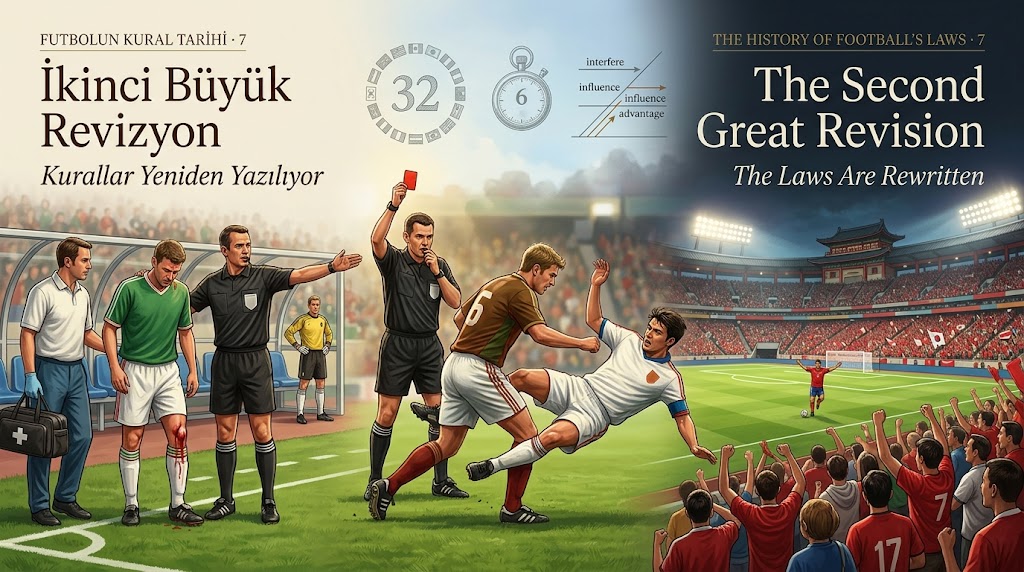
1997 — The Second Great Revision of the Laws
Exactly 59 years after Stanley Rous’s 1938 codification, the Laws were rewritten from scratch for the first time. This was not merely a simplification of language; it also brought substantive changes:
- Permission for direct goals from kick-off and goal kicks: previously, a direct goal could only be scored from a corner kick (1924); now direct goals from the kick-off and from goal kicks would also count.
- The back-pass rule’s expansion: the ban, which in 1992 had applied only to back-passes made with the foot, now also covered throw-ins — when a player threw the ball directly to his own goalkeeper from a throw-in, the goalkeeper could no longer handle it.
- A mandatory departure for bleeding players: a player who was bleeding was now required to leave the field until treated — a health and hygiene measure.
Consequence: this revision finally brought football’s rule text into a coherent framework fit for the end of the twentieth century. The extension of the back-pass ban to throw-ins was especially important, because it closed off defending teams’ loophole of bypassing the foot-based ban by using a throw-in to waste the same amount of time — preserving the “spirit” of the 1992 rule.
1998 — The World Cup Expands to 32 Teams
The World Cup held in France once again expanded the format, which had been fixed at 24 teams since 1982: 32 teams, divided into eight groups, made this the largest tournament in history up to that point. Host nation France defeated defending champions Brazil 3–0 in the final to claim its first title. This same tournament also witnessed the first-ever application of the golden goal rule at a World Cup, which we discussed in Chapter 6: France’s elimination of Paraguay in the round of 16 via Laurent Blanc’s goal.
Consequence: this expansion allowed significantly more countries, particularly from Africa, Asia, and North America, to take part — 1998 saw the first-ever World Cup appearances of countries such as Croatia, Jamaica, Japan, and South Africa. A parallel development: around the same time, FIFA formally took over, in 1997, a small tournament that had been held in Saudi Arabia since 1992 under the name “King Fahd Cup,” transforming it into the FIFA Confederations Cup — a tournament bringing together continental champions, serving as a kind of dress rehearsal for the following year’s World Cup. This was a sign that FIFA was beginning to build a multi-layered tournament portfolio rather than relying on a single flagship event.
1998 — Tackling From Behind: An Automatic Red Card
Hard challenges made by players from behind — directed not at the ball but straight at an opponent’s legs — had long caused serious injuries but had been punished inconsistently from a disciplinary standpoint. In 1998, IFAB defined hard tackles from behind that endangered a player’s safety as an offence requiring a direct red card. Consequence: this was a disciplinary decision that prioritized player health, and it shifted defenders’ approach to challenges toward focusing more on the ball and less on the opponent.
2000 — The Goalkeeper’s Ball-Holding Time: From “Four Steps” to “6 Seconds”
Previously, there had been a “four-step rule” limiting how many steps a goalkeeper could take while holding the ball in his hands — but this was impractical for referees to count, and goalkeepers could manipulate their step count to waste time. In 2000, this rule was scrapped entirely and replaced with a simpler standard: a goalkeeper could hold the ball in his hands for a maximum of 6 seconds. That same year, it was also clarified that a goalkeeper could no longer be charged by an opponent while holding the ball.
Consequence: this was both a more objectively measurable rule (counting seconds rather than steps) and a regulation protecting the goalkeeper from physical harassment while holding the ball — a natural continuation of the “modernizing the goalkeeper” process that had begun in 1992.
2002 — The First Joint Hosting: The World Cup in Asia
Between 31 May and 30 June 2002, two major firsts in World Cup history occurred at once: the tournament was played, for the first time, outside Europe and the Americas (in Asia), and it was hosted, for the first time, not by a single country but jointly by two countries — South Korea and Japan. As the competition to host intensified between Japan and South Korea, FIFA intervened, and the joint-hosting solution was adopted — the only dual-hosting model ever tried in World Cup history until the triple hosting of the United States, Mexico, and Canada in 2026 (a subject we have already discussed).
In the tournament, host nation South Korea advanced past the quarter-finals into the semi-finals, becoming the first Asian country ever to reach that stage — surpassing the record set by North Korea, who had reached the quarter-finals in 1966.
Consequence: this tournament was concrete proof that the AFC, whose 1954 founding we discussed in Chapter 4, had reached, forty-eight years later, the maturity to fully co-host the World Cup — football’s institutional geography was now genuinely becoming global.
2002 — The Silver Goal Experiment
The golden goal rule, introduced in 1993, had produced the “opposite of what was intended”: teams became so afraid of conceding in a match that could end instantly that extra-time periods became more defensive. In 2002, UEFA tried an interim solution: the silver goal. Under this system, if a team was ahead at the end of the first 15-minute half of extra time, the match would end there — but a single goal would not end the match instantly, giving a team slightly more time to extend the lead or level the score.
Consequence: the silver goal was, for the first time, potentially applicable at the 2003 UEFA Cup final (Porto vs. Celtic) but was not actually triggered; its only international use came at the 2004 European Championship, via Traianos Dellas’s goal for Greece against the Czech Republic. But this system, too, created confusion — having different extra-time methods (normal, golden goal, silver goal) coexist across different tournaments undermined consistency.
2003/2005 — The Precise Definition of “Active Play” Criteria in Offside
Since the mid-1990s, the offside law had stated that it was not enough for a player merely to be in an offside position — he also had to be “involved in active play,” “interfere with an opponent,” or “gain an advantage” — but these three concepts had never been clearly defined. This ambiguity generated countless contentious decisions of the sort captured in the famous question, “if he’s not interfering with play, what’s he doing on the pitch?” (attributed to English managers Bill Nicholson and Danny Blanchflower).
In 2003, FIFA issued new interpretive guidelines, and these were formally written into Law 11 in July 2005. The new text defined the three concepts separately, with concrete examples: “interfering with play” (touching a ball played by a teammate), “interfering with an opponent” (blocking an opponent’s line of sight or preventing him from reaching the ball), and “gaining an advantage” (playing a ball that rebounds off a post or an opponent). It was also clarified which parts of the body counted when determining offside position: the head, body, and feet counted, while arms and hands were excluded — based on the logic that “an arm alone being ahead confers no advantage.”
Consequence: this clarification ensured that a player standing passively in an offside position (without interfering with play at all) no longer caused a teammate’s goal to be disallowed if that teammate received the ball — laying the foundation for the offside trap to become a “risky” tactic. This principle also became the basis, seventeen years later, for determining which points of the body semi-automated offside technology (Chapter 10) would measure — meaning this conceptual clarity from 2005 became the mathematical foundation of a technological system nearly two decades on.
2004 — The Abolition of the Golden and Silver Goal
After an eleven-year experiment, IFAB decided in February 2004 to remove both the golden and silver goal entirely from the Laws of the Game — the decision would take effect after the 2004 European Championship. Rationale (in the words of IFAB member David Taylor): “the important thing was to have clarity and a single method to determine the outcome of a match.” The data supported the decision too: instead of the “more attacking play” the system had intended, teams had, in practice, become more cautious. Consequence: from the 2006 World Cup onward, football reverted to the simple formula still used today: a full 30 minutes of extra time, followed by penalties if necessary.
2005 — The Continuous Application of the Away-Goals Rule at CONMEBOL
The away-goals rule, launched by UEFA in 1965, had not been adopted in South America for a long time — CONMEBOL had only tried it once, exceptionally, at the 1988 Copa Libertadores (Nacional’s elimination of Universidad Católica by this method). From the 2005 Copa Libertadores onward, the rule began to be applied continuously, including in finals, across all CONMEBOL cups — a full forty years after UEFA.
Consequence: this is another example of “the same rule being adopted at different times by different confederations.” The rule was applied in South American club football for seventeen seasons (2005–2021), until UEFA’s abolition of it in 2021 prompted CONMEBOL to make the same decision the following year, in 2022 (a topic we will cover in Chapter 10).
This eleven-year period reveals an interesting pattern in football’s rule development: some reforms (the extension of the back-pass rule, the offside clarification) proved lasting and successful, while others (the golden goal, the silver goal) went down in history as well-intentioned but miscalculated experiments. This same period also saw the World Cup begin to become genuinely global in a geographic sense — expanding to 32 teams, moving to Asia for the first time, and being jointly hosted for the first time. In the next chapter, we turn to the short but decisive transition period from 2004 to 2012, in which football began seeking its first serious technological solutions to refereeing errors.
Colophon: The subject, scope, and editorial framework of this article series were determined by Aydın Tiryaki. Claude (Anthropic, Sonnet 5, Max Effort + Extended Thinking mode) assisted with research, source verification, and writing.
| aydintiryaki.org | YouTube | Aydın Tiryaki’nin Yazıları ve Videoları │Articles and Videos by Aydın Tiryaki | Bilgi Merkezi│Knowledge Hub | ░ Virgülüne Dokunmadan │ Verbatim ░ | ░ Futbolun Kural Tarihi Serisi │The History of Football’s Laws Series ░ 02.07.2026

