
The History of Football’s Laws Series — Chapter 9/13
Aydın Tiryaki & Claude Sonnet 5 (Max Effort, Extended Thinking mode)
Introduction
This chapter covers the period from 2013 to 2019 — the years in which football underwent its most profound cultural transformation through the VAR system. The closing of this period also carries symbolic weight: the 2019 France Women’s World Cup was the only tournament to be both the first Women’s World Cup at which VAR was used and the first major tournament at which the comprehensive rule revision adopted that same year was tested — meaning this chapter’s two main threads (the birth of VAR and the 2019 revision) converge at the very same tournament.
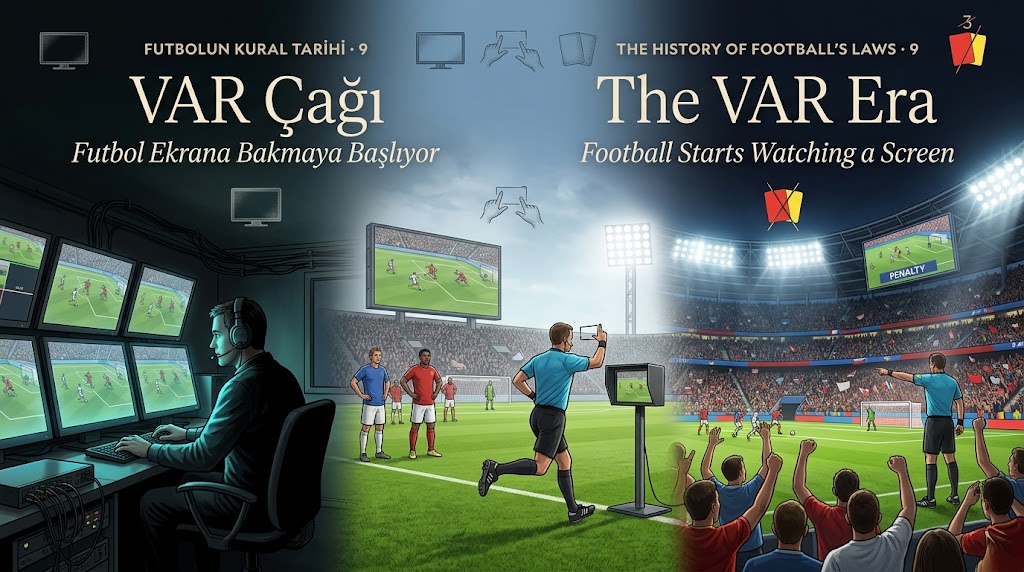
The goal-line technology we discussed in the previous chapter answered only one question: did the ball cross the line, or not? But moments requiring far more complex, interpretive judgment — Thierry Henry’s hand, penalty decisions, red-card disputes — still depended entirely on the human eye. The process covered in this chapter tells the story of football’s answer to this larger problem — the Video Assistant Referee (VAR) system — its birth, its spread, and the most contentious transformation it produced in football’s rule philosophy.
2010–2014 — The Birth of the Idea: The Netherlands’ “Refereeing 2.0” Project
VAR’s origin lies not, as many assume, with FIFA, but in the “Refereeing 2.0” project launched in the early 2010s by the Royal Netherlands Football Association (KNVB). As part of the project, mock trials of real matches were carried out during the 2012–13 Eredivisie season — a video referee would watch a live match and produce decisions, but these decisions never affected play on the pitch; only the system’s functioning was being tested. As IFAB Secretary Lukas Brud later summarized, the rationale was clear: “With all the 4G and Wi-Fi in stadiums today, we knew we had to protect referees from making mistakes that everyone can see immediately” — a direct reference to Henry’s handball, which had eliminated Ireland from 2010 World Cup qualifying. Encouraged by the results, the KNVB submitted a formal request to IFAB in 2014, seeking permission to trial video technology in real matches, in a way that would actually affect decisions.
March–December 2016 — First Steps: Approval, Live Trials, and the First FIFA Tournament
At its Annual General Meeting in March 2016, IFAB approved the KNVB’s request and sanctioned a two-year experimental period. At that same meeting, in a notable coincidence, IFAB also made another decision unrelated to VAR but one that also changed football’s disciplinary philosophy: the abolition of the “triple punishment” rule. Previously, a defender who committed a foul inside the penalty area to prevent a certain goal received three separate punishments at once — a red card, a penalty, and a suspension for the next match. IFAB decided that if the player had genuinely been attempting to play the ball (rather than committing a deliberate foul, but making contact during a genuine attempt to reach it), this triple punishment was disproportionate, and shifted to a yellow card instead of a red in such cases — the penalty was still awarded, but the player could remain on the pitch.
Consequence: this was the last major reflection, in 2016, of the “encouraging attacking play” philosophy we discussed in Chapter 6 — the punishment was made more proportionate to the severity of the offence.
On the VAR front, the first genuine, live use affecting an actual decision took place on 21 September 2016, in a Dutch Cup (KNVB Beker) match (Ajax vs. Willem II) — this match was also the first to use a “pitchside monitor”; a VAR-based yellow card was upgraded to a red after review, though this occurred even before the official FIFA rule change, and spectators in the stadium could not fully understand what had happened — an early lesson that VAR decisions needed to be clearly communicated to the crowd. That December, VAR was trialled for the first time at a major FIFA tournament — the Club World Cup in Japan; Kashima Antlers were awarded a penalty in the semi-final against Atlético Nacional following a video review.
2017 — The Confederations Cup: The Big Test and Early Criticism
The 2017 Russia Confederations Cup was VAR’s second and much higher-profile FIFA trial — effectively a dress rehearsal for the following year’s World Cup. The tournament demonstrated the system’s potential, but also brought its most-criticized aspects to light: lengthy reviews, spectators’ inability to understand what was happening in the stadium, and inconsistent application.
That same year, VAR also began spreading rapidly through club football: Australia’s A-League became the first top-flight professional club league to use VAR, on 7 April 2017 (Melbourne City vs. Adelaide United); a day later, in the Wellington Phoenix–Sydney FC match, VAR actually affected a national-league decision (a penalty) for the first time. MLS in the United States adopted VAR during the 2017 season. Despite this, two major European leagues — the German Bundesliga (from August 2017) and Italy’s Serie A — began applying VAR full-time in their own leagues, under an experimental framework, before IFAB’s official rule approval.
Consequence: this period revealed a deeply rooted institutional habit in football — major leagues and confederations could adopt innovations on their own, without waiting for central authority’s official approval. This was itself a pressure that accelerated IFAB’s final decision.
March–July 2018 — Official Approval and the First World Cup
On 16 March 2018, at the FIFA Council meeting in Bogotá, VAR was formally added to the Laws of the Game — exactly ten years after IFAB’s 2008 decision to close the door on technology entirely, football now accepted video technology as part of its rulebook. Three months later, the 2018 Russia World Cup became the first World Cup played with VAR.
Its impact was immediate and measurable: 335 VAR reviews were conducted during the group stage alone; 22 of 29 penalties were converted into goals — comfortably surpassing the previous record (17 goals) set at the 1998 World Cup. IFAB’s technical director, David Elleray, attributed this increase directly to VAR: players could no longer trust that they could commit a foul inside the penalty area “unseen.”
Consequence: VAR’s philosophical foundation had been clearly defined from the outset, and it remains so today: the system intervenes only in cases of a “clear and obvious error” or a “serious missed incident” — meaning it corrects not every contentious decision, but only visibly obvious mistakes.
2019 — The Comprehensive Revision of the Laws
At IFAB’s 133rd Annual General Meeting, held on 2 March 2019 in Aberdeen, Scotland, following two years of worldwide trials, one of the most intensive single rounds of updates ever made to football’s rule text was approved:
- The handball law’s rewrite: a player’s arm or hand now constituted a handball if it made his body “unnaturally bigger” (i.e., the arm was in a position not required by the movement in question). Furthermore, even following an unintentional handball, if the ball went directly into the goal or the player created a scoring opportunity from that contact, this was now punishable.
- A change to the dropped-ball procedure: the dropped ball, open to both teams since 1888, would now be awarded solely to the team that had last touched the ball, at the point of contact.
- A relaxation of the goalkeeper’s penalty rule: previously, the goalkeeper had been required to have both feet on the goal line; now, having just one foot on the line was sufficient.
- The penalty-area waiting distance: it was clarified that attacking players could not come within 1 metre of a “wall” formed by three or more defenders.
- Cards for coaches: for the first time, it was formalized that yellow and red cards could also be shown to coaches and other team officials on the touchline.
Consequence: this revision package was a response to the reality VAR had introduced — that every detail could now be reviewed on screen — because VAR had made visible countless previously overlooked handballs and penalty-area infringements, making it necessary to rewrite the rules in a more precise, less interpretation-dependent form.
June–July 2019 — The Tournament Where Two Threads Converged: The Women’s World Cup
This chapter’s two main storylines converged precisely, that same summer, at the Women’s World Cup held in France. On 15 March 2019 — just thirteen days after the adoption of the 2019 rule revision — the FIFA Council approved the use of VAR for the first time at a Women’s World Cup. French referee Stéphanie Frappart officiated the USA–Netherlands final, becoming one of the referees to take charge of a match at this level with VAR in operation.
The tournament was also the first major event at which the new rules, which had taken effect on 1 June 2019, were tested — and it showed just how severe an effect the rule on goalkeepers leaving the line early during penalties could have when combined with VAR: during the group stage, numerous successful saves were disallowed and penalties retaken after VAR reviews determined that the goalkeeper’s foot had left the line — an early sign of just how surprising the letter-of-the-law application of a rule could be for players and spectators alike. The tournament also saw VAR-related controversies: Cameroonian players’ reactions to VAR decisions in the match against England (stopping play, arguing with the referee) drew heavy criticism.
Consequence: the 2019 Women’s World Cup demonstrated that VAR had become part of football as a whole, not just the men’s game — but it also served as an early warning that the letter-of-the-law application of the new rules could produce results far harsher than intended.
The period stretching from 2013 to 2019 saw perhaps football’s most profound cultural transformation: the game was now managed not only on the pitch, but in front of a screen as well. This transformation brought with it a major question — how quickly, or slowly, VAR would spread among the confederations, and what kind of inequality this spread might create in global football. In the next chapter, we examine the urgent health-focused reforms brought by the 2020–2022 pandemic period.
Colophon: The subject, scope, and editorial framework of this article series were determined by Aydın Tiryaki. Claude (Anthropic, Sonnet 5, Max Effort + Extended Thinking mode) assisted with research, source verification, and writing.
| aydintiryaki.org | YouTube | Aydın Tiryaki’nin Yazıları ve Videoları │Articles and Videos by Aydın Tiryaki | Bilgi Merkezi│Knowledge Hub | ░ Virgülüne Dokunmadan │ Verbatim ░ | ░ Futbolun Kural Tarihi Serisi │The History of Football’s Laws Series ░ 02.07.2026

