
The History of Football’s Laws Series — Chapter 13/13 (Final Chapter)
Aydın Tiryaki & Claude Sonnet 5 (Max Effort, Extended Thinking mode)
Introduction
This final chapter consists of two independent parts. In the first, we set aside chronology and instead rank, purely by magnitude of impact, the 163 years and more than 60 articles covered across the previous twelve chapters, highlighting, headline-style, the 13 decisions that truly changed football. In the second part, we gather every football term and abbreviation used across this fourteen-part body of work into an alphabetical glossary — so that the series can also serve as a standalone reference resource going forward.
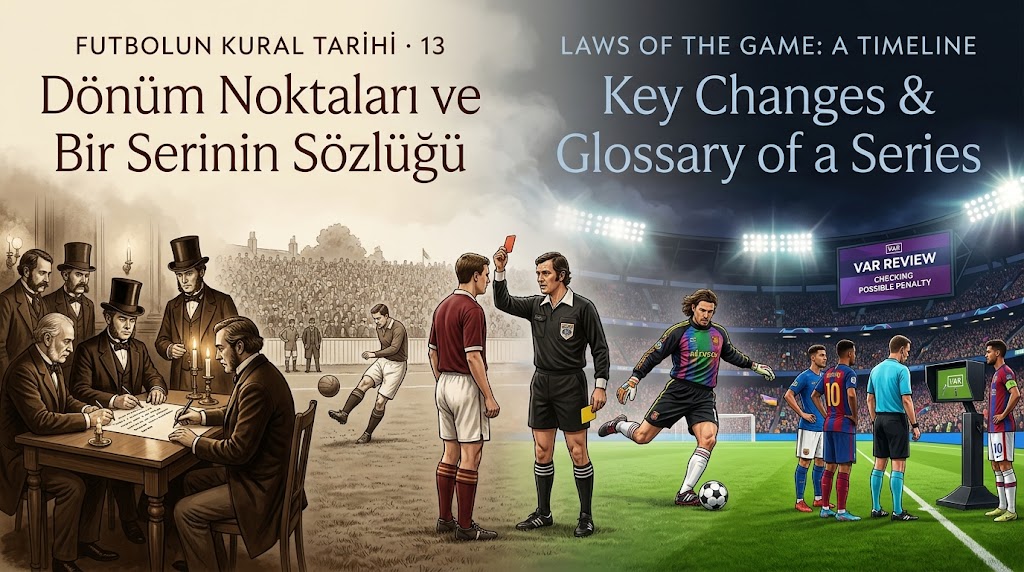
Part I: Turning Points — The 13 Decisions That Changed Football
The ranking here is based not on chronology, but on magnitude of impact.
1. 1863 — A Sport Born in a Single Night
The night at the Freemasons’ Tavern, which ended after six meetings and the angry departure of one club (Blackheath), effectively split two separate sports apart: football and rugby. Without the ban on “hacking,” the game we watch today would almost certainly never have existed.
2. 1904 — The Birth of an Authority Without Rules of Its Own
The founding of FIFA changed not a single rule — the organization chose to remain bound to IFAB rather than establish its own ruleset. Yet this one decision created the institutional foundation on which the following 122 years would be built: the World Cup, the six continental confederations, the Women’s World Cup, VAR’s global adoption — all are, indirectly, consequences of this modest decision made at that meeting in Paris.
3. 1875 — A Bar, and a Definition
For twelve years, the concept of a “goal” meant a ball passing between the posts at any height whatsoever. A decision as seemingly mundane as adding a crossbar in fact gave the goal a precise mathematical definition.
4. 1891 — The “Kick of Death”
The penalty represented a revolution in football’s rule philosophy: the shift from the assumption that “a gentlemanly player never deliberately fouls” to the logic that “a deliberate foul must be severely punished.” The nickname the press of the time gave it — “the kick of death” — still reflects the scale of the shock it caused.
5. 1925 — 35% More Goals in a Single Night
The reduction of the offside law’s requirement from three opponents to two is football history’s most directly measurable rule impact: the number of goals in the English leagues jumped from 4,700 to 6,373 in a single season.
6. 1958 — The Birth of Rotation
A modest beginning — “only an injured goalkeeper may be substituted” — would evolve, over sixty-four years, into five free substitutions. The seed of today’s concept of “squad depth” was planted here.
7. 1970 — Inspired by a Traffic Light
Referee Ken Aston is said to have looked at a traffic light and arrived at the idea of “yellow, red.” Fifty-six years later, even a spectator who speaks not a single word of any shared language instantly understands what these two colours mean.
8. 1981/1994 — A Reform That Outgrew Its Own Intent
Jimmy Hill’s three-points proposal, curiously, actually lowered the goals-per-game average in its first season. Yet forty years later it is standard in nearly every league in the world — the clearest proof that a rule’s short-term failure does not prevent its long-term adoption.
9. 1992 — The Rule That Reinvented the Goalkeeper
The time-wasting scandal in the Republic of Ireland–Egypt match triggered football’s most far-reaching positional transformation. Without the back-pass rule, neither the concept of the “sweeper-keeper” nor today’s positional play would exist in anything like their current form. In our own assessment, this is the single most influential decision on the rules side that we have examined throughout this series.
10. 2012–2018 — The Technology Trilogy
Goal-line technology, vanishing spray, and VAR — all three were born on different continents, accelerated by different crises, and converged within the same decade. The product of a period in which football’s global tolerance for accepting human error ran out, all at once.
11. 2019–2022 — The Health Era
Concussion trials, the five-substitute right, 26-player squads — all born of different crises, yet all pointing in the same direction: football’s shift toward seeing the player not as a “resource,” but as a human being to be protected.
12. 2023 — The Tournament That United Three Continents
The 2023 Women’s World Cup became the first tournament in football history to span two different confederations (the AFC and the OFC). This was the moment at which sixty years of institutional construction (the founding of the six confederations between 1916 and 1966) finally became concrete, on a single stage.
13. 2024 — A Reform’s Death Before Birth
The blue card is, perhaps, football rule history’s most instructive failure. FIFA’s open distancing of itself from the very board (IFAB) it had helped establish teaches us something important: even the most well-intentioned reforms cannot survive without public support.
Part II: Appendix — A Glossary of Terms and Abbreviations
This glossary lists, in alphabetical order, every football term and abbreviation used across the thirteen chapters of this series. Each entry includes the chapter in which it first appeared, so that this document can also serve as a standalone reference resource for the series.
A) Abbreviations
AFC — Asian Football Confederation. Founded in 1954. Chapter 4.
AGM — Annual General Meeting. IFAB’s official meeting, held around March each year, at which rule changes are voted on and adopted; meetings have been numbered consecutively since the board’s founding (e.g., “the 138th AGM”). Chapter 2.
CAF — Confédération Africaine de Football (Confederation of African Football). Founded in Khartoum in 1957. Chapter 4.
CCCF — Confederación Centroamericana y del Caribe de Fútbol. One of the two predecessor regional bodies that merged to form CONCACAF in 1961. Chapter 5.
CONCACAF — Confederation of North, Central American and Caribbean Association Football. Founded in 1961. Chapter 5.
CONMEBOL — Confederación Sudamericana de Fútbol (South American Football Confederation). Founded in 1916; the oldest of the six confederations. Chapter 4.
DOGSO — Denying an Obvious Goal-Scoring Opportunity. The disciplinary category applied when a player, inside or outside the penalty area, deliberately denies an opponent a clear goal-scoring opportunity. Chapters 6, 9, 11.
FA — The Football Association. The world’s first national football association; founded in London in 1863. Chapter 1.
FIFA — Fédération Internationale de Football Association. Football’s global governing body, founded in Paris in 1904. Chapter 3.
GLT — Goal-Line Technology. Approved by IFAB in 2012. Chapter 8.
IFAB — International Football Association Board. Founded in 1886; the sole authority responsible for setting football’s Laws of the Game. Chapter 2.
KNVB — Koninklijke Nederlandse Voetbalbond (Royal Netherlands Football Association). The body behind the “Refereeing 2.0” project in which the VAR system was born. Chapter 9.
MLS — Major League Soccer. The top-flight professional league of the United States. Chapter 9.
NAFC — North American Football Confederation. One of the two predecessor regional bodies that merged to form CONCACAF in 1961. Chapter 5.
OFC — Oceania Football Confederation. Founded in 1966; the youngest of the six confederations. Chapters 5, 11.
SAOT — Semi-Automated Offside Technology. First officially used at the 2022 Qatar World Cup. Chapter 10.
UEFA — Union of European Football Associations. Founded in Basel in 1954. Chapter 4.
VAR — Video Assistant Referee. Formally added to the Laws of the Game in 2018. Chapter 9.
B) Terms
Added time / stoppage time — The extra minutes a referee adds to compensate for time lost during a match; written into law in 1987. Chapter 6.
Additional assistant referee — An interim solution trialled at UEFA tournaments in 2009–2010 to monitor goal-line decisions. Chapter 8.
Assistant referee / linesman — An official who monitors the touchlines and assists with offside and throw-in decisions.
Away goals rule — The rule by which goals scored away from home determine the outcome of a tied two-legged tie; applied by UEFA from 1965–2021 and by CONMEBOL from 2005–2022. Chapters 5, 7, 10.
Base camp — A dedicated facility where participating teams stay and train during major tournaments; became widespread from around the 1991 Women’s World Cup onward. Chapters 6, 11.
Blue card — A type of card proposed in 2024 to distinguish a sin-bin punishment from yellow and red, but shelved following public backlash. Chapter 11.
Captain’s armband — The requirement that a team’s captain be identifiably marked on the pitch; became a rule in 2024. Chapter 11.
Champions League — The rebranded version, with a new format and name, of the European Champion Clubs’ Cup, launched in 1992. Chapter 6.
Clear and obvious error — VAR’s principle of intervention; the system steps in only for visible, indisputable errors, not for every contentious decision. Chapter 9.
Codification — The process of turning scattered rules into a coherent, written text; its major instances were 1863 (the original adoption), 1938 (Stanley Rous), and 1997 (the second great revision). Chapters 1, 4, 7.
Concussion substitute — An additional substitution right allowing a player suspected of a head injury to be safely removed from play without using the team’s normal substitution allowance; began as a trial in 2020, became permanent in 2024. Chapters 10, 11.
Confederation — A regional football governing body affiliated with FIFA, representing a given continent; there are six in total (UEFA, CONMEBOL, CAF, AFC, CONCACAF, OFC). Chapters 4, 5.
Corner kick — The kick awarded to the attacking team after the ball goes out of play off a defending player over the goal line; adopted in 1872. Chapter 2.
Diagonal system — A refereeing methodology in which the referee follows the pitch along a diagonal line; developed by Stanley Rous. Chapter 4.
Dropped ball — The method for restarting play after the referee stops the game for a reason other than a foul; adopted in 1888, revised in 2019 and 2025. Chapters 2, 9.
Fair catch — An article in the original 1863 rules, rooted in rugby, granting a free kick to a player who caught the ball directly from the air; eventually eliminated entirely from association football. Chapter 1.
Fourth official — An official who assists the referee on the pitch and can, if necessary, replace him; formalized in 1991. Chapter 6.
Gaining an advantage — One of the three core criteria of the offside law; given its precise definition in 2005. Chapter 7.
Ghost goal — An informal term for contentious moments in which the ball is seen to have crossed the goal line but is not given as a goal by the referee (or vice versa); its most famous example is the Lampard incident of 2010. Chapter 8.
Goal area — The 6-yard rectangular area directly in front of the goal; defined in 1891. Chapter 2.
Goal average / goal difference — Secondary criteria used to separate teams level on points in league standings; the “goal difference” system introduced by Jimmy Hill in 1976 remains standard today. Chapter 6.
Goal kick — The restart awarded to the defending team after the ball crosses the goal line having last touched an attacking player; adopted in 1869. Chapters 1, 2.
Goal-line technology — A system for electronically determining whether the ball has fully crossed the goal line; approved in 2012. Chapter 8.
Goal net — The netting that provides a definitive confirmation of a goal; formalized in 1891. Chapter 2.
Golden goal — The rule under which the first goal scored in extra time immediately ended the match; applied 1993–2004. Chapters 6, 7.
Group stage — The portion of a tournament in which teams play each other in round-robin fashion; used at the first World Cup in 1930. Chapter 4.
Hacking — A pre-1863, rugby-derived practice of kicking an opponent in the shins. Banned by the 1863 rules. Chapter 1.
Half-time — The rest period between the two halves of a match; limited to 15 minutes in 1995. Chapter 7.
Halfway line — The line dividing the pitch into two equal halves; added in 1897. Chapter 3.
Handball — Deliberate contact between the ball and a player’s hand or arm; the rule was rewritten in 2019 with the “unnaturally bigger” body criterion. Chapter 9.
Interfering with play — One of the three core criteria of the offside law; given its precise definition in 2005. Chapter 7.
Knockout format — A format in which the losing side is eliminated from the tournament; the 1934 and 1938 World Cups were played entirely under this format, without a group stage. Chapter 4.
Laws of the Game — The name of football’s official rule text, as set by IFAB; comprised of 17 main articles (Laws). Chapter 1.
Mob football — The rule-less, often violent football tradition played between villages in medieval England; part of the pre-1863 history. Introduction.
Offside — The positional rule requiring an attacking player, at the moment the ball is played, to be no further forward than the second-last defender; fundamentally revised in 1866, 1925, 1990, and 2005. Chapters 2, 4, 6, 7.
Offside trap — The tactic by which a defence deliberately pushes its line forward to catch attacking players in an offside position. Chapter 7.
Onside — The state in which a player has not violated the offside law — that is, is in a position from which he is permitted to play. Chapters 2, 6.
Panenka — A technique of deceiving the goalkeeper with a soft, chipped shot down the centre of the goal; named after Antonín Panenka, who first used it in a major final in 1976. Chapter 5.
Penalty area — The 18×44-yard rectangular area; reached its modern dimensions in 1902. Chapter 3.
Penalty kick — The right to a direct shot at goal, awarded for a foul committed inside the penalty area; adopted in 1891 under the nickname “the kick of death.” Chapter 2.
Penalty shoot-out — The method of taking penalties in turn to determine the winner of a drawn match; adopted in 1970. Chapter 5.
Penalty spot — The point, at a fixed distance from the centre of the goal, from which the penalty kick is taken; defined in 1902. Chapter 3.
Pitchside monitor — The screen at which a referee reviews footage directly on the pitch during a VAR review; first used in a Dutch Cup match in 2016. Chapter 9.
Professional foul — A deliberate, physical challenge by a player to deny an opponent a clear goal-scoring opportunity; defined as a red-card offence in 1990. Chapter 6.
Repeated infringement — The rule permitting a player to be sent off for persistent rule violations; defined in 1889, an early ancestor of the card system. Chapter 2.
Round of 32 — The first knockout round following the group stage, used for the first time at the 2026 World Cup; made up of the 24 group winners and runners-up plus the 8 best third-placed teams. Chapter 11.
Second-last defender — The reference point in the offside law: the defending player positioned second-furthest back, after the goalkeeper. Chapter 6.
Semi-automated offside technology — See SAOT (Abbreviations).
Silver goal — An interim formula between the golden goal and a standard finish: the team ahead at the end of the first half of extra time would win, but a single goal would not end the match instantly; trialled by UEFA between 2002 and 2004. Chapter 7.
Sin-bin — The temporary removal of a player from the pitch (usually for 10 minutes) for offences that are not severe but require a deterrent; successful in grassroots football, shelved at the top level in 2024. Chapter 11.
Substitution — The right to replace one player with another during a match; began in 1958 as an injury-only allowance and expanded to five by 2022. Chapters 5, 6, 7, 10.
Technical area — The touchline zone within which coaches may give instructions, but must otherwise behave responsibly without leaving it; formalized in 1993. Chapter 6.
Throw-in — The hand-thrown method of restarting play after the ball goes out over the touchline. Chapters 4, 11.
Triple punishment — The practice of giving a red card, a penalty, and a subsequent match ban all at once to a player who denies a clear goal-scoring opportunity inside the penalty area; abolished in 2016 as disproportionate. Chapter 9.
Umpire — In early football (1871–1891), the role fulfilled by one representative from each team, the forerunner of today’s referee. Chapter 2.
Vanishing spray — Foam used to temporarily mark the position of the ball and the defensive wall at free kicks; approved by IFAB in 2012, though it had already been in use in South American leagues since the early 2000s. Chapters 6, 8.
Wall — The line of defending players formed at free kicks; in 2019 it was clarified that attacking players could not come within 1 metre of it. Chapter 9.
Yellow card — A formal caution shown to a player; adopted alongside the red card in 1970. Chapter 5.
With this glossary, “The History of Football’s Laws Series” is now complete. Beginning with the introduction and continuing across thirteen chapters, we have journeyed 163 years, from 1863 to 2026 — tracing, one by one, more than 60 rule changes, the founding of six confederations, the World Cup’s growth from 13 teams to 48, and the still-unfolding story of the football being played today.
Colophon: The subject, scope, and editorial framework of this article series were determined by Aydın Tiryaki. Claude (Anthropic, Sonnet 5, Max Effort + Extended Thinking mode) assisted with research, source verification, and writing.
| aydintiryaki.org | YouTube | Aydın Tiryaki’nin Yazıları ve Videoları │Articles and Videos by Aydın Tiryaki | Bilgi Merkezi│Knowledge Hub | ░ Virgülüne Dokunmadan │ Verbatim ░ | ░ Futbolun Kural Tarihi Serisi │The History of Football’s Laws Series ░ 02.07.2026

