
The History of Football’s Laws Series — Chapter 6/13
Aydın Tiryaki & Claude Sonnet 5 (Max Effort, Extended Thinking mode)
Introduction
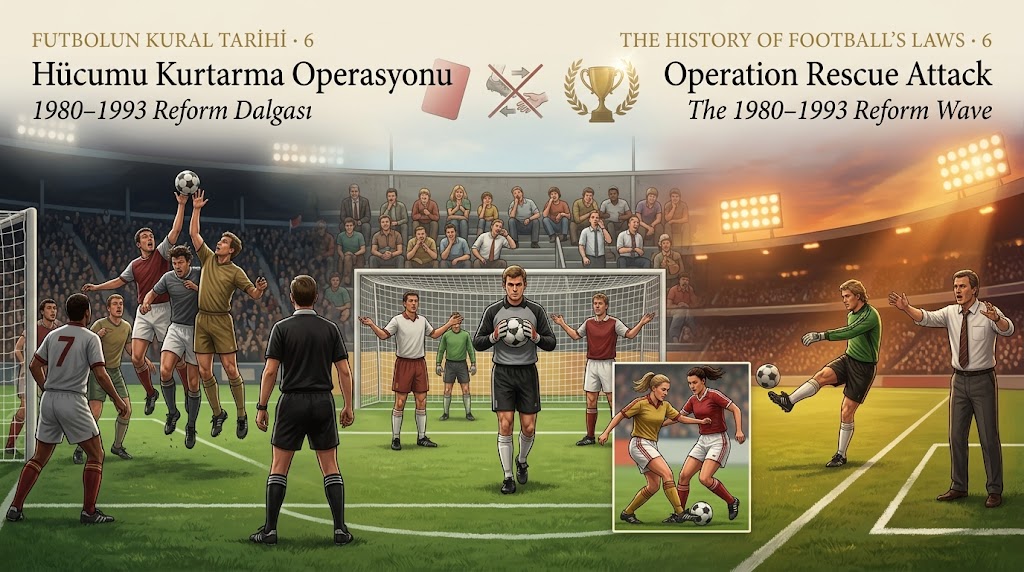
This chapter covers thirteen years, from 1980 to 1993 — the period that saw a deliberate, coordinated attack-encouraging campaign, one that IFAB and FIFA themselves referred to under the banner “for the good of the game.” These same thirteen years also played host to three World Cups (1982, 1986, 1990), football’s first official Women’s World Cup (1991), and the rebranding of European club football’s most prestigious tournament (1992). Alongside the rule changes, this chapter also examines these developments — in particular, how an incident in 1986 laid the groundwork for a crisis of trust that would erupt four years later.
By the late 1970s, football was paying a price for its own success. Rising financial stakes and championship pressure were pushing teams toward increasingly defensive, results-oriented football. This trend peaked at the 1990 World Cup — and it was precisely this breaking point that triggered the most intensive reform period in football’s history.
1980 — The Penalty-Area Requirement at Goal Kicks
Opposing players waiting inside the penalty area during a goal kick created pressure on the kicker and led to unnecessary physical contact. In 1980, the rule was clarified: opposing players were now required to remain outside the penalty area until the ball came into play (left the area). Consequence: a small but practical adjustment — it ensured goal kicks began more cleanly, without dispute.
1981 — Three Points for a Win: Jimmy Hill’s Revolution
In the early 1980s, English football was in serious crisis: attendances were falling rapidly (down 17% at Manchester United, 21% at Liverpool, and 50% at Newcastle between 1977 and 1981), hooliganism dominated the headlines, and the league was carrying a debt burden of fifteen million pounds. Former Coventry City manager and the era’s most recognizable football broadcaster, Jimmy Hill, proposed a simple but radical solution through a committee he led: raise the reward for a win from 2 points to 3, while keeping a draw fixed at 1 point. The logic was clear: if a win was now worth three times as much as a draw (instead of just twice as much), teams would be more willing to risk losing points in pursuit of victory.
In August 1981, the Football League adopted this proposal. An interesting note: Hill had also, back in 1976, introduced “goal difference” in place of “goal average” — meaning we owe both fundamental components of the modern league table to a single individual.
The consequence, in numbers — but an unexpected one: in the rule’s first season (1981–82), the average goals per match in England’s top division actually fell, from 2.66 to 2.54, and the draw rate remained at around 26%. In other words, its short-term impact was not as dramatic as hoped — some academic studies still debate the rule’s true effectiveness today. But in the long run, the rule spread worldwide: it was first applied at a FIFA tournament at the 1994 World Cup, FIFA formally made it a general recommendation in 1995, and it has since become standard in nearly every league in the world.
1984 — Clarifying the Position of the Dropped Ball in the Goal Area
The dropped-ball rule, adopted in 1888, had remained ambiguous about where play should restart when stopped inside the goal area. This was clarified in 1984: for stoppages within the goal area, the dropped ball would now be taken from the nearest point on the goal-area line. A small but practical technical fix.
1986 — “The Hand of God”: A Harbinger of a Crisis of Trust
On 22 June 1986 in Mexico City, one of football history’s most controversial moments occurred in the Argentina–England quarter-final of the Mexico World Cup. Diego Maradona, in a moment neither the referee nor the assistant referee saw, punched the ball into the goal with his left hand — in his own words, “a little with the head of Maradona and a little with the hand of God.” In the same match, four minutes later, Maradona also made history with his second goal (“the Goal of the Century”), dribbling past five English players over sixty metres. Argentina won the match 2–1 and went on to win the tournament.
Consequence and significance: this incident did not, by itself, lead to a rule change — but it made visible, on a global scale, the fact that a violation the referee could not see could determine the fate of a World Cup. An interesting repetition: four years later, in the first round of the 1990 World Cup, in a match against the Soviet Union, Maradona once again intercepted the ball with his hand, again unnoticed by the referee. In other words, behind the 1990 crisis we examine in detail in this chapter lay not just defensive football, but a decade’s worth of experience showing that violations invisible to the referee could determine outcomes — an experience that was one of the early signals on the road to VAR’s eventual adoption, thirty-two years later (Chapter 9).
1987 — Lost Time Written into Law
The referee’s practice of compensating for time lost to injury stoppages, substitutions, and time-wasting tactics was already a de facto convention, but the scope of this authority was not clearly written into law. In 1987, this discretionary power was formally written into Law 7. Consequence: this was part of a gradual process granting referees greater authority over time management.
1990 — The Offside Change: “Level Means Onside”
The 1990 Italy World Cup became one of the most criticized tournaments in football history. With an average of 2.21 goals per game (still an unbroken World Cup low today), 16 red cards, and a final match described as “a dreadful advertisement for the game,” the tournament triggered a deep process of self-criticism throughout the football world. Uruguayan writer Eduardo Galeano described the tournament as “boring soccer, without a drop of audacity or beauty.” The FIFA General Secretary of the time, Sepp Blatter, was more direct: “Something is wrong with this game.”
FIFA established a commission of former players and coaches, and following its recommendations, IFAB shifted the offside law in favour of attackers that same year: previously, an attacker exactly level with the second-last defender had been offside; now, he would be considered onside. The same year also brought the “professional foul” rule: a player deliberately and physically denying a clear goal-scoring opportunity would now be punished with a direct red card.
Consequence: together, these two changes significantly discouraged defenders’ strategy of preventing goals through deliberate fouls. But Italia ’90’s real legacy had not yet arrived — because the tournament’s most criticized feature was not offside, but time-wasting through back-passes to the goalkeeper.
1991 — Football’s First Official Women’s World Cup
Between 16 and 30 November 1991, in China’s Guangdong region, a first in football history took place: the first Women’s World Cup officially organized by FIFA. The road to this tournament ran through a trial event held in the same region in 1988, whose 45,000-strong opening-match crowd answered the question “is a genuine global women’s tournament feasible?” in the affirmative. Not yet fully comfortable using its “World Cup” branding, FIFA officially named the tournament the “1st FIFA World Championship for Women’s Football” (in 2021, FIFA retroactively incorporated this tournament into the official Women’s World Cup numbering).
In this 12-team tournament, featuring teams from all six confederations, there was one striking detail: matches were played over 80 minutes, rather than the standard 90 used in the men’s tournament — one of the rare instances in which the “time-shortening flexibility still present in the Laws but never used in professional men’s football” (which we discussed earlier) was actually applied at a top-level official FIFA tournament. The tournament also featured, for the first time in FIFA history, six female referees and assistant referees; Brazil’s Claudia de Vasconcelos, who officiated the third-place match, became the first woman to referee at this level. In the final, the United States defeated Norway 2–1 to become the first champions.
Consequence: this tournament marked the official starting point of football’s rule and tournament architecture beginning to be built not only for men, but on a global scale for women’s football as well — the direct ancestor of today’s far larger Women’s World Cup.
1991 — The Fourth Official Becomes Official
Referee Ken Aston’s informal introduction, in 1966, of a “reserve referee” practice had not, for twenty-five years, acquired a standard status. In 1991, IFAB formally defined the fourth official position — without yet a detailed list of duties, but equipped with the authority to assist the referee in any matter and, if necessary, to take his place. The details of the role would be clarified two years later, in 1993.
1992 — The Back-Pass Rule: The End of a Generation of Goalkeepers
Italia ’90’s most remembered (and most tedious) moment was probably the Republic of Ireland–Egypt match: the Egyptian defence kept passing the ball back to their goalkeeper, who would pick it up, walk a few steps, and boot it long — the cycle repeating itself over and over. Ireland’s goalkeeper, Packie Bonner, is even alleged to have held the ball for six minutes at one point (the real figure was six minutes in total across the match, not in a single stretch, but the legend stuck this way). This led Ireland — already seeking a goalless draw — to resort to the same tactic. The result was one of the most tedious matches in football’s history.
IFAB’s response was swift: in 1992, it was agreed that when a player deliberately passed the ball back to his own goalkeeper with his foot, the goalkeeper would no longer be permitted to handle it (Law 12, Section 2). The rule came into effect immediately after the 1992 European Championship — and, in a striking irony, Denmark’s goalkeeper Peter Schmeichel used this very tactic one last time against Germany in the final, just before the rule officially took effect, on his way to the championship.
The rule’s early implementation period was chaotic: at Nottingham Forest, Brian Laws attempted to kneel down and head the ball back to his goalkeeper, forcing FIFA to declare that obvious attempts to circumvent the new rule would be treated as unsporting behaviour. But beyond the short-term confusion, the rule permanently changed football’s conception of the goalkeeper.
Consequence — perhaps this chapter’s most far-reaching impact: the back-pass rule transformed goalkeepers from players who simply “played with their hands” into complete footballers who also needed foot skills. Over the following decades, this laid the groundwork for the concept of the “sweeper-keeper,” the rise of technically skilled goalkeepers like Edwin van der Sar, and, ultimately, today’s positional play, in which the goalkeeper is considered the first link in the attack. Johan Cruyff’s philosophy that “the goalkeeper is also part of the team” only became practically possible with this rule. In 1997, this ban would be extended to cover throw-ins as well (a topic for Chapter 7).
A parallel development in the same year: starting with the 1992–93 season, Europe’s most prestigious club tournament, the European Cup, was rebranded — with a new group-stage format and a new name — as the UEFA Champions League. This was not merely a cosmetic change; it now meant more matches, more commercial revenue, and a broader pool of participants. Consequence: one of the most concrete institutional markers of club football’s commercialization occurred in precisely the same period in which the back-pass rule was “speeding up” the game.
1993 — The Technical Area, Fourth Official Details, and the Golden Goal
1993 was an intense year in which three separate regulations were formalized at once:
The technical area: the concept of a “technical area,” within which coaches could give tactical instructions but were required to remain and behave responsibly, was formally added to Law 3. Rationale: to bring order to coaches’ touchline behaviour (excessive protest, encroaching onto the pitch).
The fourth official’s job description: the duties and powers of the position created in 1991 were spelled out in detail, in line with IFAB guidance.
The golden goal: to prevent extra-time periods from being tense and defensively dominated, the “golden goal” rule was adopted — the first goal scored in extra time would immediately end the match. The first official golden goal was recorded on 13 March 1993, when Australia eliminated Uruguay in the quarter-final of the FIFA World Youth Championship. The rule was carried onto the biggest stages at the 1996 European Championship (Germany’s win over the Czech Republic in the final via Oliver Bierhoff’s goal) and the 1998 World Cup (Laurent Blanc’s goal taking France past Paraguay).
Consequence — the exact opposite of what was intended: the golden goal had been introduced to “encourage attacking play,” but in practice it produced the opposite effect: teams became so afraid of conceding in a match that could end instantly that extra-time periods became even more cautious, even less attack-minded. This inconsistency and unpredictability would lead to the rule’s complete abolition eleven years later, in 2004 — a topic we cover in Chapter 8.
This thirteen-year period is perhaps football’s most “self-correcting” era: IFAB responded to a concrete crisis (the tedium of Italia ’90) with concrete, rapid decisions. But this same period was also one in which football’s institutional horizons expanded — the birth of the Women’s World Cup and the rebranding of the Champions League showed that the game no longer fit into a single mould. In the next chapter, we turn to the period stretching from 1994 to 2005, which includes the Laws’ second major written revision (1997) — a period in which the back-pass rule would be extended, the third substitution right would arrive, and one of offside’s most contentious interpretations would finally be clarified.
Colophon: The subject, scope, and editorial framework of this article series were determined by Aydın Tiryaki. Claude (Anthropic, Sonnet 5, Max Effort + Extended Thinking mode) assisted with research, source verification, and writing.
| aydintiryaki.org | YouTube | Aydın Tiryaki’nin Yazıları ve Videoları │Articles and Videos by Aydın Tiryaki | Bilgi Merkezi│Knowledge Hub | ░ Virgülüne Dokunmadan │ Verbatim ░ | ░ Futbolun Kural Tarihi Serisi │The History of Football’s Laws Series ░ 02.07.2026
 Aydın Tiryaki