
As of November 20, 2026, Google Gemini completed its transition from Gems to Skills and added a sharing option to the menu. However, this method—which amounts to little more than distributing a static zip file via Google Drive—remains far from the live usability of the Gem era and a true sharing ecosystem.
Aydın Tiryaki (21 November 2026)
Version 1.12
From the “Two Steps Forward, One Step Back” Critique to November 20
When Google announced that it would retire the long-standing “Gem” structure in the Gemini ecosystem and transition to “Skills” (localized as “Beceriler” in the Turkish interface, whereas I prefer the term “Yordamlar”), I evaluated this transformation in detail along with firsthand field tests in my article titled “Gemini Skills: Two Steps Forward, One Step Back,” published on October 18, 2026 (1). In that piece, I described the shift of specialized modules from isolated chat rooms into dynamic subroutines invoked directly within the main conversation—alongside the cross-platform SKILL.md file standard—as “two steps forward.” Conversely, I criticized the complete shutdown of link-based sharing, one of the strongest features of the old Gem ecosystem, and the resulting push forcing users to “play in their own sandbox” as “one step back” (1).
In its initial announcement, Google stated that all existing Gems would be automatically converted into the new structure starting November 17, 2026. The transition did not occur on November 17, but was completed three days later, on November 20, 2026. With that, the “Gem” label disappeared completely from the menu and was replaced by the “Skills” interface. An era had closed, the Gem legend had come to an end, and Gemini had kept its word by carrying out the automatic conversion.
An Archive of Over 90 Gems, a New Order of 59 Skills, and the Control Group
While waiting for the transition date, I did not leave my own archive unattended. At the time of moving from Gems to the new structure, I had over 90 usable and shared Gems, and I adapted all of them myself ahead of schedule. However, as I examined in detail in my November 4, 2026 article “Limited Memory, Unlimited Skills: A Directory Proposal for Reaching Every Skill in Gemini,” Gemini enforces a limit of 100 active skills at any given time (3). Because of this cap, it became necessary to organize this broad archive into a more efficient architecture. I merged related Gems by turning their previous titles into menus within the new structure. Without dropping a single one, I transitioned to a streamlined arrangement of 59 active skills that encompasses all roughly 90 of the former Gems.
The breakdown of this 59-skill structure is as follows:
- 7 belong to the ATG Skill Factory ecosystem (the Campus). This campus is a production and management system consisting of 1 factory, 1 library, 1 campus hub that brings them together, and 4 workshops.
- The remaining 52 are product skills built from the approximately 90 former Gems, covering every single one of them completely.
In terms of sharing status, all 52 of these product skills are currently open to everyone as SKILL.md files. In the coming days, I will also add the .zip packages generated by Gemini itself under the Gemini Skills folder, allowing users who prefer that method to access them directly as well. On the other hand, from the 7-unit production package consisting of the campus, factory, and workshops, I have shared only the skill library (ATL1 Subskill Library) for now, because the other product skills rely on the subroutines inside this library to function. The factory, campus, and workshops are not yet open to public sharing. Since these units still reflect a somewhat personal workflow, I will open them to everyone once I refine their menu structures and ergonomics to be thoroughly user-friendly. All of the skills I have built can be followed under a single roof on the Skill Almanac (Skill Dağarcığı) page (6), and the rules for using the archive, setting up the ATL1 Subskill Library, and accessing the folders are explained in my November 20, 2026 guide, “Aydın Tiryaki Skill Archive User Guide” (7).
In addition, I deleted around 15 to 20 older Gems that I had created in the past for testing and experimentation—ones I had kept around thinking I might revisit them someday, but no longer needed—so that the system would not needlessly convert them all over again.
However, in order to observe firsthand how the system performs automatic conversion, I deliberately left two old Gems that I had already folded into another structure (World Compendium)—one in Turkish (koordinat-gem-atg) and one in English (coordinate-gem-atg)—as a control group.
On November 20, 2026, a banner appeared at the top of the interface reading “Gems have moved to skills.” The notice stated that Gems are now called skills, that users should review and save them to start using them, and that any unconverted files could be downloaded before December 20, 2026. When I looked at those two coordinate skills sitting in the inactive list under “All,” I saw that they had been migrated directly without any modifications, with two small icons next to them:
- An exclamation mark inside a circle (!) indicating that the skill is awaiting review and confirmation.
- A two-person sharing icon reflecting their shared status from the old Gem era.
Seeing that sharing icon sparked an immediate, natural excitement. It seemed that the gap I had criticized as “one step back” on October 18 had been closed and sharing was back. Indeed, when I opened the three-dot (…) menu on any skill, I saw that a “Share skill” option had been added.
The Reality Behind the Share Screen: Why It Remains Half-Complete
That initial excitement gave way to realistic disappointment the moment I clicked “Share skill.” Although the sharing flow initially resembles the old Gem sharing screen, it operates on a completely different and severely limited mechanism behind the scenes. The process consists of three steps:
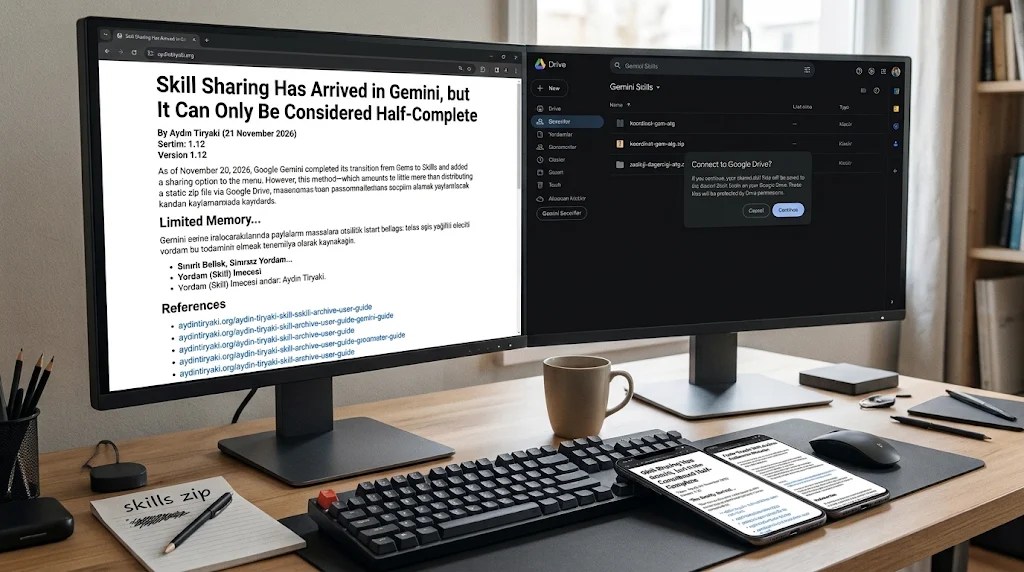
- Google Drive Connection: When sharing is initiated, the system asks “Connect to Google Drive?” and informs the user that shared skill files will be saved to a Gemini Skills folder in Google Drive and protected by Drive permissions.
- Static Archiving: The skill’s SKILL.md file and any accompanying files are bundled into a single .zip package (for example, zooloji-dagarcigi-atg.zip).
- Standard File Sharing: The window that appears is nothing more than the familiar Google Drive sharing dialog, where a file link is copied with “Anyone with the link – Viewer” permissions.
Why this method cannot be considered true sharing—and at best represents half a step—is evident in three clear ways:
- No Live Usage, Only Manual Installation: Anyone who clicked an old Gem link could start using that tool immediately without any technical friction. In the new model, sharing is merely a file transfer so others can take the SKILL.md file and install it in their own accounts. The recipient has to download the .zip package and manually upload it to their Gemini account.
- Update Disconnect: The shared .zip file is a static snapshot taken at the moment of export. When a skill is improved or updated, that package does not update automatically. The sharing process has to be repeated, and users who previously installed the package must notice the new version on their own and manually overwrite it using the “Replace skill” option in the menu.
- Weaker Than a Personal Workflow: From the very first days of building my skills—for roughly a month now—I had already set up my own Gemini Skills folder structure on Google Drive, created a separate folder for each skill, and automated the replacement of the SKILL.md file on every update. Moreover, in my October 30, 2026 guide “How to Use and Update a Published and Shared SKILL.md File in Your Own Gemini Account,” I documented step by step how sharing a fixed folder link rather than a single file ensures links never break and always point to the latest SKILL.md file (2). Because Google’s official .zip distribution cannot even reflect updates immediately, it falls behind the personal system I built and documented on my own.
Of course, the other side of the coin must also be considered. Security and control concerns likely lie behind the platform’s preference for a static .zip package over a live link. If a remotely linked skill were silently altered by its developer, unwanted instructions could slip into a user’s prompt context without their knowledge. File-based transfer ensures that users know exactly what is running in their account and guarantees portability. However, this security requirement does not mean trapping the user experience in a download-and-reupload loop is the only solution; as I emphasized in my November 15, 2026 article “Skills as a Communal Effort: A Proposal for Sharing and an Open Skill Development Model,” having the platform run AI-assisted security reviews on shared skills—both upon initial publication and with every new version—can address this risk without killing sharing (5).
The Sharing Model Needed to Say “Full Forward”
For us to say “full forward” for Gemini instead of “two steps forward, one step back,” skill sharing must offer true usage sharing just as Gems once did, supported by two distinct options:
- Source File Sharing (Subject to Developer Permission): If the skill’s developer permits it, the SKILL.md file and its supporting files should still be shareable as a .zip package. That way, users who wish to make their own adaptations, modifications, and updates can download the file and tailor it to their needs.
- Direct Usage Sharing Without Installation: In the second option—which is where the real gap lies—not just the file, but the right to use the skill directly should be shared. Someone who wants to use a skill exactly as its original author built it should be able to run it from its original location without any installation burden. Fully aligned with the principle I argued in my November 4, 2026 directory proposal (“a skill should not occupy memory continuously; it should arrive, do its job, and leave”) (3), the vision of sending finished skills back out of memory and accessing unlimited skills outlined in my November 12, 2026 article “The Skill Utopia: Sending Back and Unlimited Skills” (4), and the single pool, common source open development model proposed in my November 15, 2026 article “Skills as a Communal Effort” (5), this model should offer users the following flexibilities:
- Directly activating and using frequently needed skills without installing a separate copy;
- Keeping occasionally needed skills in their deactivated (passive) list, activating them only when needed and turning them off again once finished;
- Keeping only the reference to the author’s original page in their own archive for skills they do not wish to add to their list at all, calling or downloading them directly from there when needed;
- Receiving a single-click confirmation prompt (“A new version is available, would you like to update?”) whenever the developer releases an update—preserving security while also guaranteeing that users who prefer an older version in the pool can remain on it.
When such flexible and user-friendly options are possible, confining sharing to a .zip file that cannot even update itself may count as a small step, but it is certainly not a big enough step forward.
In short, Gemini made a move to close the sharing gap I criticized on October 18, 2026. Yet what emerged is less a true sharing ecosystem and more a way to distribute .zip files through Google Drive. As it stands, this is not a full step—at best, it can only be considered half a step.
References
[1] Aydın Tiryaki, Gemini Skills: Two Steps Forward, One Step Back, 18 October 2026 (Accessed: 21 November 2026), https://aydintiryaki.org/2026/10/18/gemini-skills-two-steps-forward-one-step-back/
[2] Aydın Tiryaki, How to Use and Update a Published and Shared SKILL.md File in Your Own Gemini Account, 30 October 2026 (Accessed: 21 November 2026), https://aydintiryaki.org/2026/10/30/how-to-use-and-update-a-published-and-shared-skill-md-file-in-your-own-gemini-account/
[3] Aydın Tiryaki, Limited Memory, Unlimited Skills: A Directory Proposal for Reaching Every Skill in Gemini, 4 November 2026 (Accessed: 21 November 2026), https://aydintiryaki.org/2026/11/04/limited-memory-unlimited-skills-a-directory-proposal-for-reaching-every-skill-in-gemini/
[4] Aydın Tiryaki, The Skill Utopia: Sending Back and Unlimited Skills, 12 November 2026 (Accessed: 21 November 2026), https://aydintiryaki.org/2026/11/12/the-skill-utopia-sending-back-and-unlimited-skills/
[5] Aydın Tiryaki, Skills as a Communal Effort: A Proposal for Sharing and an Open Skill Development Model, 15 November 2026 (Accessed: 21 November 2026), https://aydintiryaki.org/2026/11/15/skills-as-a-communal-effort-a-proposal-for-sharing-and-an-open-skill-development-model/
[6] Aydın Tiryaki, Skill Almanac (Gem Dağarcığı), 14 March 2026 (Accessed: 21 November 2026), https://aydintiryaki.org/2026/03/14/gem-dagarcigi/
[7] Aydın Tiryaki, Aydın Tiryaki Skill Archive User Guide, 20 November 2026 (Accessed: 21 November 2026), https://aydintiryaki.org/2026/11/20/aydin-tiryaki-skill-archive-user-guide/
Article Credits
This article was written by Aydın Tiryaki on November 21, 2026. All ideas, field observations, structure, and proposed solutions in the article belong to the author. During the preparation of the text, the Gemini 4 Neon model (Medium thinking level, Chat window) within the Google Gemini ecosystem served as a writing assistant and, at times, as a research assistant. This English version was rewritten in English faithfully to the Turkish original and its full context by Gemini 4 Neon (Medium thinking level, Chat window).
- Version 1.01 – 1.05 (21.11.2026): Initial draft created; title finalized, transition from over 90 Gems to 59 active skills (7 campus + 52 product), control group observation, and the “full forward” sharing model added; automated system citation tags removed.
- Version 1.06 – 1.09 (21.11.2026): Related articles from October 30, November 4, November 12, and November 15, 2026 were integrated into the text and references.
- Version 1.10 (21.11.2026): Text restructured as a Continuous Publication Block in accordance with Human-AI Interactive Editor standards (lead spot text, clean author line, clean version line, in-text (1)–(5) reference matching, single-paragraph Article Credits, and version history notes).
- Version 1.11 (21.11.2026): Added details on the public SKILL.md and upcoming .zip availability of the 52 product skills, the sharing of only the library from the 7-unit campus package, the plan to release the factory and workshops once fully user-friendly, and the Skill Almanac link
[6]. - Version 1.12 (21.11.2026): Added the November 20, 2026 Aydın Tiryaki Skill Archive User Guide (
[7]) with in-text citation and references, and produced the complete English version with matched English references.
| aydintiryaki.org | YouTube | Aydın Tiryaki’nin Yazıları ve Videoları │Articles and Videos by Aydın Tiryaki | Bilgi Merkezi│Knowledge Hub | ░ Virgülüne Dokunmadan │ Verbatim ░ | ░ Gemini’ye Skill Paylaşımı Geldi ama Bu Paylaşım Ancak Yarım Sayılabilir │Skill Sharing Has Arrived in Gemini, but It Can Only Be Considered Half-Complete ░ 21.11.2026

