
Early this year I imagined, under the names InGem, InGPT and InClue, an AI module that could be called from inside a conversation and would withdraw once its job was done. Today that module has become a standard under the name Skill. Yet two of my wishes are still waiting: being able to send a finished Skill back out of memory completely, at the moment I choose, and being able to use an unlimited number of Skills without placing any extra load on the system.
Aydın Tiryaki (12 November 2026)
Version 1.07
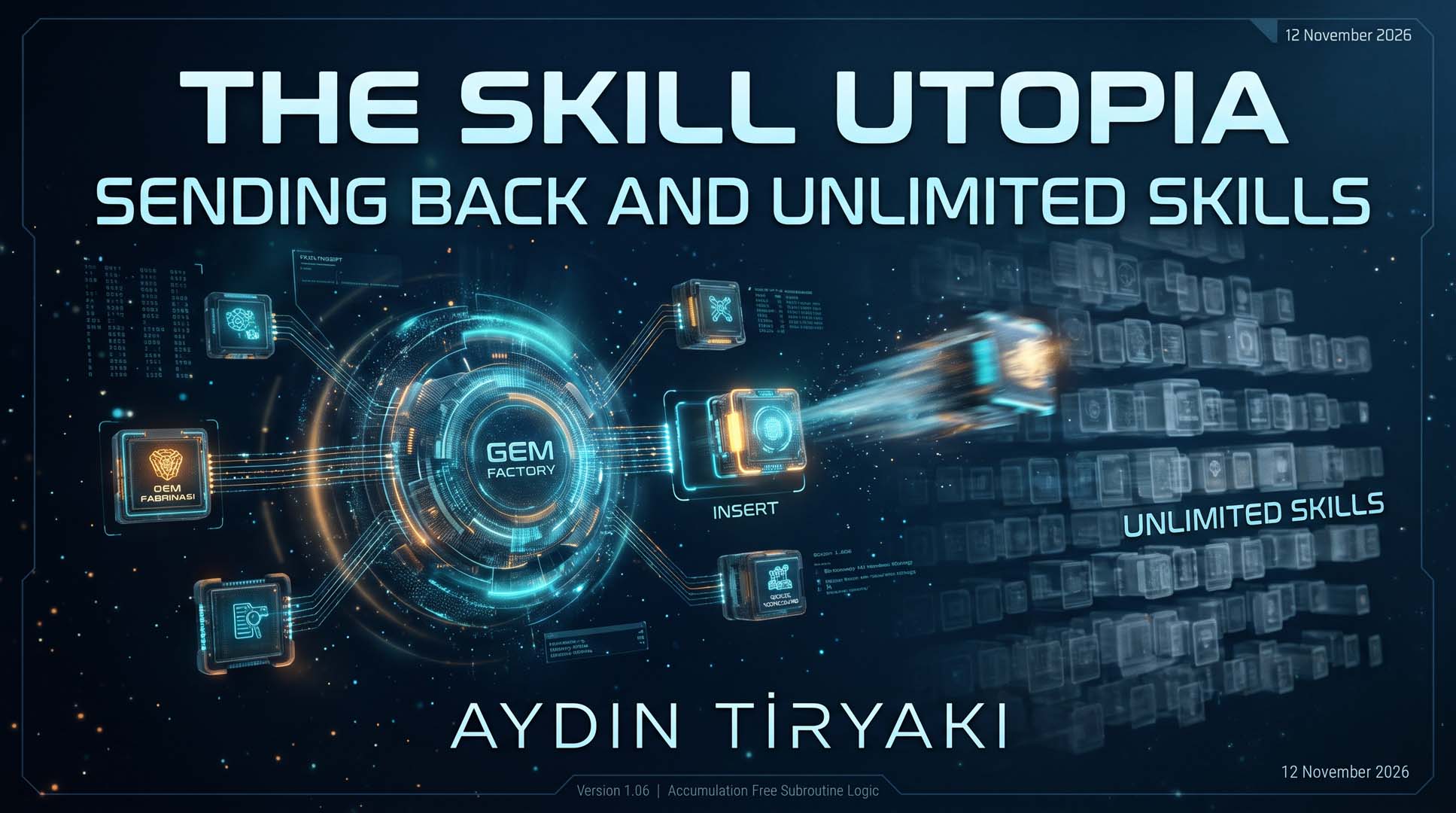
A Skill Imagined Before It Had a Name
I imagined the structure that AI platforms now call a Skill, and for which I have proposed the Turkish term “yordam”, before I ever came across that name. While using Gems in Gemini, GPTs in ChatGPT and Projects in Claude, I kept feeling the same gap. For every area of expertise I had to open a separate window and start a separate conversation. What I actually needed was to call that expertise without leaving the conversation I was working in, and to remove it from the conversation once the job was done.
I gave this dream a name in the first months of this year. In February 2026 I used the name InGem (Insertable Gem) for Gemini. I then expressed the same idea as InGPT for ChatGPT and InClue for Claude. At the time, these were utopian ideas for me. When I used these words, I was in fact imagining a Skill. It simply did not have a name yet.
Part of that utopia has come true. In this article I will describe what has been realised, but what I really want to dwell on are two wishes that have not yet come true. The first is that a skill which has finished its job should be sent back out of memory completely. I do not want the skill to leave on its own; I want to be able to send it back whenever I choose. The second is that the number of Skills should be unlimited, and that this should be achieved through a model that places no extra load on the AI. In February my utopia was the Skill itself. Today my utopia is a Skill that can be sent back, and an unlimited number of them.
Where the Dream Began: The Factory and the Workshops
The first source of this dream was my own workbench. The largest Gem I have written, and today my largest Skill, is the Gem Factory (Gem Fabrikası). It started as a Gem. When Skills arrived, I adapted it from producing Gems to producing Skills, but I kept the name Gem Factory. I may change it in the future. Today it is a Skill of about 40,000 characters, perhaps even more.
In the Gem era, when I was using Gemini at the Pro level, the model began making very serious nonsense once the factory went past 30,000 characters. To keep the factory below that threshold, I moved many of its tasks out into workshops. At first there were a few workshops; as needs grew, so did their number. I opened each workshop as a separate Gem, in a separate window. I did the work there, copied the result like a patch, and pasted it into the factory. I also had to take things from the factory and paste them into the workshops. The workshops were a kind of helper Gem, and while working I had to keep many session windows open at the same time.
That was when I made this wish: If only I could call both the factory and whichever workshop I wanted within the same session. If only the factory could stay open all the time, and I could send back a workshop once it had finished its job. This was the first source of my dream. It was also why I made the InGem proposal.
A Factory of a Thousand Versions
To test the features of the Gem Factory, I had to work on it constantly. I developed what needed to be in the factory and kept releasing new versions. Each major version from 1 to 13 went through roughly 70–80 sub-versions. By the time it reached today, the factory had gone through about 1,000 changes, which means it was published about 1,000 times.
With each release I had to test something. Most of the time I had enough Gems at hand to develop. I would choose the Gem to which the change I had just made could best be applied, and run the test with it. Sometimes, however, I had to create a new Gem, because there was no other way to test the changes made during a new round of production. For this, instead of far-fetched topics, I kept in mind, or noted down, topics that could genuinely be useful. I would pick one of them and build it. That is why, during that period, Gems were also produced on topics that resembled one another.
I launched the Skills Edition with version 14.01. In the roughly one month I have been working with Skills, 22 versions have been released, and the factory is now at version 14.22. This version looks like a stable release, but it may still change according to needs.
Subroutine Logic: Plug In, Run, Eject
I first defined InGem, in an article published on 18 February 2026, as a proposal for a new standard of interaction (1). The core of the idea rested on one of the oldest solutions in software engineering: the subroutine call. A main program calls a subroutine for a particular task and returns to the main flow when the task is done. In the InGem model, the conversation was the main program and the InGem was the subroutine being called.
The working principle I proposed consisted of three steps. The user invites the relevant InGem into the conversation at the moment it is needed (Insert). The InGem does the work within the rules and formats defined for it (Process). When the job is done, the user removes it from the conversation (Eject). I described this last step as the most revolutionary aspect of the proposal. Complex instructions that were no longer in use would be cleared from the AI’s memory, that is, from the token window, and the model would be freed from unnecessary load and return to its lean and flexible state.
In the same article I went further. I described several InGems being able to work at the same time, a panel opened by a button at the edge of the chat window and managed with checkboxes, and a ready-made standard library approved by the platform. At the end of all this, the conversation would turn into a production line in which writing, translation, summarising and technical notes could be carried out one after another with a single command.
A Dream Written in the Future Tense
In April 2026 I returned to the concepts of InGem and InGPT in the fourteenth article of my series “Thinking and Producing with Artificial Intelligence” (2). There I presented these concepts as the original vision of the series and stated clearly that they were “still at the proposal stage”. The language of the text reflected this as well: The proposal was “aiming” at a dynamic structure, and if the modular design were implemented, the user “would gain” the freedom to switch instantly between modules. The expected benefits were also listed in the future tense. Because the system would work only with the rules of the module active at that moment, the context would become clearer, memory and processing power would be used only for the relevant task, and the user would be able to design different modules for different tasks.
Out of the Closed Box
I followed developments on the Gemini side much more closely than on the other platforms. Until May 2026, Gems were rather isolated structures. A Gem did not know who the user was; it did not recognise them. It did not even know how the user should be addressed. Loading a Gem and working inside it meant working in a completely closed box. No information could be passed directly from there to the normal conversation; everything stayed inside that closed box.
In mid-May, a change that I believe was announced on 16 May and went live on 19 May altered this picture. The transition was very rough, and there was great confusion in the first days. But it gave me hope. At least the Gem came out of its closed box and began to recognise the user and address them properly. That a Gem, once updated, could continue working with its new version in the same chat window was also a genuinely revolutionary step.
This update had another side as well. The same changes caused serious breakdowns in my professional workflows. I examined the quota bottlenecks, the session management that forced every window into the same mode, and the marginalisation of power users in a separate article package under the name “the May 19 Fracture” (3). But seen from the perspective of the Skill utopia, this update opened a door, showing that modules could come out of their closed boxes and connect with the user’s world.
A Name Proposal for Claude: Clue and InClue
In June 2026 I conveyed the same vision to Anthropic in an open feedback letter (4). That piece contained three proposals. The first concerned the name. Gemini’s “Gem” and ChatGPT’s “GPT” were platform-specific and memorable names, whereas “Project” was an extremely generic word. So I proposed “Clue”, a short, platform-specific name derived from the C of Claude. The second proposal was that Clues should not remain limited to personal use but should become a shareable and discoverable ecosystem, like the Gem library. The third was InClue, that is, Clues being called without leaving the main conversation and withdrawing after doing their job. I had stressed that I was conveying this proposal separately to all three platforms, because it was not the need of a single platform but of the entire AI ecosystem.
From Utopia to Standard
In that same piece I used the phrase “not yet implemented on any platform” for InClue. Yet Anthropic had announced the feature it called Agent Skills on 16 October 2025, about eight months before that piece (5). At the time I was not aware of this feature. In the February period when I was developing InGem, I was not even using Claude intensively. In other words, I had arrived at the ideas of InGem, InGPT and InClue independently, as a user, starting from my own needs.
According to Anthropic’s definition, Skills are folders containing instructions, scripts and resources that Claude loads when needed (5). In the first stage, Anthropic also offered ready-made Skills for producing Word, Excel, PowerPoint and PDF documents. According to the company’s technical explanation, at the start only the name and short description of each Skill are kept in context, and the full content of a Skill is loaded only when the task requires it (6). On 18 December 2025, Anthropic published Agent Skills as an open standard for cross-platform portability, and added a directory of Skills prepared by partners as well as organisation-wide Skill management (5).
So the structure I had described as a utopia began to become a standard, under another name and by another route.
What Has Come True Today: The Factory and Workshops in a Single Session
Today, within the Skill structure, I can call all the Skills that make up the factory and the workshops into a single session and do all my work within that one session. In the past I had to open many windows at once, copy the work done in one and paste it into another. Using the factory and the workshops in the same session was once a utopian thought for me, and I had made the InGem proposal for exactly that. Today I am doing it. That dream of mine has come true.
My everyday experience in Gemini confirms this. When a topic is mentioned, the model finds the most suitable one among the active skills. If the skill’s name is known, it can also be called directly by name. One skill can be called from inside another, and even a third from inside that second one (7). Once a send-back mechanism is added, these chained calls will be able to work like a relay race, with skills that hand over their task and withdraw, without bloating memory.
But this realised dream is still incomplete. I am writing this article to define what is missing. I have other dreams too, and I am putting forward proposals to complete what is missing.
A Map of the Utopia: Fifteen Criteria
Today I can read the InGem I described in my February article as a list of criteria. The Skill in my dream had these features:
- Being a modular tool called into the conversation, specialised in a single task and removed once the job is done.
- Establishing a structure in which the conversation is the main program and the module is the subroutine being called.
- Working through a plug in, run, eject cycle.
- Clearing its instructions from memory once the job is done, so that the model returns to its lean state.
- Allowing several modules to work at the same time.
- Allowing modules to be selected from a panel with checkboxes.
- Allowing modules to be switched on and off one by one, and new ones to be added, while the conversation continues.
- Allowing active modules to work together, complementing one another.
- Having a quick-access button at the edge of the chat window.
- Listing recently used modules.
- Showing clearly in the interface which module is active at any given moment.
- Allowing users to create their own modules.
- Having a ready-made standard library approved by the platform.
- Turning the conversation into a production line that carries out tasks one after another with a single command.
- Protecting the token economy and reducing the user’s mental load.
Some of these criteria clearly have a counterpart in today’s Skill architecture. Users being able to create their own Skills, the platform offering ready-made Skills, and Skill content being loaded only when needed are foremost among them. On the other hand, the announced architecture includes no operation by which the user can explicitly remove a loaded Skill from the conversation (6). In other words, part of the memory-economy goal appears to have been achieved, but the eject mechanism I proposed has not yet found a counterpart in this form.
Below I describe where these criteria stand today, based on my own experience. The status of each criterion on Gemini, ChatGPT and Claude will be examined in detail in later versions of this article.
What Has Not Yet Come True
Part of my utopia from those days has come true. But there is one thing that still has not: sending a Skill back once we have finished with it. Today this cannot be done fully. The eject step, which I considered the most revolutionary aspect of my February proposal, still stands as the missing link.
Sending Back at the User’s Request
In today’s architecture, a Skill is loaded when the task requires it. But once it has been loaded, there is no control that actually removes the skill’s instructions from memory when the user says “I’m done, send this back now”. My wish is that a skill which has finished its job can be sent back out of memory completely.
There is an important distinction here. What I want is not for the skill to leave on its own, but for it to leave whenever I say so. The system may make the decision to load it, but the decision to send it back should be in the user’s hands. In the February InGem proposal, too, it was the user who took the eject step: When the operation is complete, the user removes the InGem from the conversation. This wish has not yet come true.
The Difference Between Suspending and Sending Back
In Gemini today, a skill can be suspended with a spoken request. A suspended skill no longer interferes with the rest of the conversation, but it does not leave the context completely. In the article I published on 4 November, we defined this not as a memory cleanup but as a behavioural closure, and wrote that a real unloading would only become possible as the architecture develops (7). My wish today is exactly this real unloading.
What I mean by sending back is not erasing every trace of the skill. We called the skill to benefit from it, and we benefited from it as much as we wanted. The outputs it produced and the traces it left in the conversation should of course remain; nobody wants to destroy them. But if we have no further business with that skill, its instructions should not occupy memory. What we are actually doing here is memory optimisation. Let AI offer us unlimited possibilities, but let them not accumulate in memory. Let what has work stay, and let what has none go.
Let me give a concrete example from my own ecosystem. There is a data archive that lets the user track the Skills being produced at that moment. The skill that writes to this archive comes only to write a single record to a spreadsheet, once Skill production has finished and everything is complete. After that, we have no further business with it. Let it come, make its record and go. Whether or not it leaves a trace in the conversation does not matter at all. This is exactly what I want.
The Active Skill Limit
We have a second problem as well. The number of Skills that can be active at once is limited. We cannot prepare as many Skills as we like and keep all of them at hand all the time. We can only keep them in reserve. Keeping them in reserve means storing them deactivated, that is, in an inactive state. To reach them, we have to perform an extra step: first activate the relevant Skill, and only then call it.
Even though the Skill itself has come true, this limit forces the user back into manual management. The user decides which Skill stays active and which stays in reserve. And when a Skill in reserve is needed, the job of finding and activating it again falls to the user.
The Limit’s Effect on the Collection
In Gemini, you can create as many skills as you like, but no more than 100 can be active at the same time. I deliberately pushed this limit on my own account, and the system did not allow me to exceed 100 by any route (7). On 4 November there were about 180 skills in my collection.
When the limit came into play, I merged the skills that had been produced on similar topics during the factory’s testing period. The workshop already had facilities for such merging, and the result turned out very well. Some skills were absorbed into one another; in others, separate menus emerged. It became possible to carry out several operations within the same Skill under menu headings. Meanwhile I also added a few new skills. Today my archive contains 80 Turkish skills and their 80 English counterparts.
So these mergers were triggered by the limit, but in the end the collection was put in order and the quality of the skills genuinely improved.
The Solution I Built Myself: A Skill Directory
For now I get around this problem with a system I built myself. To make things easier to follow, I will use the word “yordam”, my Turkish term for a Skill, in my own setup.
I created a folder called “Gemini Skills” in Google Drive. Under this folder I opened a folder for every one of my skills, whether active or not. Each folder carries the skill’s original name exactly, and inside it sits that skill’s SKILL.md file. I also indexed the names and contents of all the skills in a spreadsheet. In this way, all the information and short descriptions of every skill, active or inactive, were gathered in one place.
The benefit of this arrangement is that when a topic is being researched, a suitable skill can be found there very easily. Because each skill’s name and content are known, the AI can suggest the right skill to me, and I can activate it. I currently use this system in Gemini, and very soon I will set up the same thing for Claude.
But this is exactly where the problem begins: I can find the skill I am looking for, but I still have to do the activation by hand.
The Factory, the Workshops and the Campus
The Gem Factory, which I use to produce Skills, has now formed a large ecosystem. The ecosystem consists of the factory itself and eight separate Skills, namely seven workshops and one campus. Depending on the task, all of these take part in the system in different ways.
Over time these structures became so intertwined that I set up an umbrella above them to bring the factory and the workshops together: a campus (ATG Skills Production Campus, ATG Yordam Üretim Yerleşkesi). The campus contains the factory and the workshops, but it does no work itself. No task of its own is defined within it. It only calls the tasks defined in the factory and the workshops.
The Second Utopia: Unlimited Skills
My utopia in February was the Skill itself, and that utopia has come true. Back then I did not know its name; today I do. My utopia today is unlimited Skills.
My dream is this: The AI interface we use will take over the work I do by hand today. We will not try to archive the skills ourselves. The platform already stores all the Skills we create, some active and some inactive. What I want is for a directory to be kept for the inactive ones as well.
When a user calls a Skill, whether knowing its name or simply saying they want something on a particular topic without knowing the name, the system should be able to find and call that Skill if it exists among the inactive ones. The user should be able to do this verbally or from within another Skill: to say “call this now, activate it”, and once the job is done, to say “I’ve done my work, deactivate it now”. I want this option to be built into the system.
While the limits are being lifted, no extra load should be placed on the AI. No problem such as taking up excessive space in its memory should arise. We will call what we need and send it back once the job is done. We will call and send back; nothing will accumulate.
This principle is a continuation of the same idea as the eject step of my first utopia in February. The first utopia brought the Skill, but it did not bring the ability to send it back. The second utopia seeks to remove the limit by completing the call-and-send-back cycle.
The Model I Propose
I can summarise the system I propose step by step as follows:
- Storage: The platform itself archives all the Skills the user creates, whether active or not. The user does not have to keep a separate archive.
- Directory: A directory containing the names and short descriptions of inactive Skills is maintained.
- Calling: The user asks for a Skill by name or simply by describing its topic, verbally or from within another Skill. The system finds what is being looked for in the directory.
- Activation: The Skill that is found becomes active for that task without the user changing any setting by hand.
- Sending back: When the job is done, the user says “deactivate it now”. The Skill leaves memory completely and returns to the inactive ones. This decision is not made automatically, but at the user’s request.
- No accumulation: Because every call is closed by a send-back, Skills do not accumulate in memory. The limit on numbers disappears, but the system’s load does not increase.
In short, the cycle I described in February as “plug in, run, eject” should apply today to an unlimited number of Skills.
The Detailed Design of the Directory
I set out a detailed design of this model for Gemini in the article I published on 4 November 2026 (7). The structure I proposed there consists of three parts. The first is a greyed-out list in the interface that also shows inactive skills. The second is a Skill Directory, written and updated automatically by the platform as a special SKILL.md called Skill Ecosystem. The third is a mechanism that activates a skill found in the directory only temporarily, for the task at hand.
In that design, the detailed part of the directory does not sit permanently in context; it is read only when requested. In small collections only a short directory stays in context. In large collections, only cluster headings remain in context, and the details are opened when needed. In this way, the list of active skills turns into a favourites list that is kept open all the time. This approach rests on the principles of virtual memory and the working set, which have worked in computer science for decades. Skills are not kept in memory, but the way to them is shown. A skill comes, does its job and leaves.
What I Mean by Unlimited
I need to explain here why I use the word “unlimited”. In my 4 November article I wrote that the active skill limit has justified reasons, and that I was not asking for it to be removed (7). By unlimited Skills I mean being able to prepare as many Skills as we like and to reach all of them, however many there are, without placing any load on the system. The barrier that needs to be removed is the limit standing in the way of the user’s access to the skills they own.
Gemini’s figure of 100, or the total character limit in Claude, can be raised over time as the capabilities and features of AI systems develop. But they will never be unlimited. If a system is built in which all Skills can be used, there will be no need to raise these limits very much. If we can take a Skill whenever we wish and send it back once the job is done, there is no need for it to be permanently active either. All that matters is that we know them.
What is more, such a system places no load on the AI. If we know we will use a particular Skill for a particular purpose and we call it by name, the AI does not need to spend any resources searching for it. A Skill that is called by name and sent back once its job is done will never be a burden on the system.
The Details of the Utopia: Visibility and Numbering
Alongside the two main wishes, there are two further details whose need I feel while working with Skills every day. One concerns the interface; the other concerns how Skill texts are written.
Being Able to See the Available Skills
Every session window should have a clickable, easily accessible link or option. The list of all the Skills active at that moment does not need to be on screen all the time. But whenever we click it, we should be able to see all the Skills that are available at that moment.
Moreover, in this list, the Skills currently active in the conversation and those simply waiting to be called could be distinguished with different marks.
Today we can only see them indirectly; in a sense, we sense them. An interface arrangement that shows them clearly would make a very important contribution. This wish is in fact a continuation of one of my February criteria: showing clearly in the interface which module is active at any given moment (1). The greyed-out list I proposed in my 4 November article, which also shows inactive skills, rests on the same need (7).
Numbering in Instructions
Whether writing Gems or converting those Gems into GPTs or Projects, I have always used a numbering hierarchy. This hierarchy was a great help, especially when intervening later during further development. That is why I have never given it up.
But the three AI systems I use most intensively, Gemini, Claude and ChatGPT, never use numbering when preparing Skills. When editing what I have written, they sometimes use section numbers, but in the end there is no numbering system of the kind we are used to from software. This then causes problems in tracking the Skill later on.
Of course, I am not saying they should write the way I do. Nor am I saying that the hierarchical numbering I use is the most correct method. But I am saying this: Especially in long Skill texts, there should be some form of numbering in the instructions section. An optimal, perhaps standard, method should be established for this. There will be a great need for it in later corrections and improvements.
This article itself is an example. The Human-AI Interactive Editor (Doğal-Yapay Zeka Etkileşimli Editör) skill I used while writing it was written with this hierarchy. While working, the writing assistant was able to refer directly to the rules by their clause numbers.
There is an even more concrete example in my ecosystem: the ATG2 Patch Workshop. This workshop prepares the corrections to be made to Skill texts as patches. Without the numbers, making these patches would have been very hard for me, because describing in words where a change should be made is very difficult. Thanks to the numbers, I can prepare the patch and direct it to the right places.
The Step That Remains from Utopia to Reality
From February to November: A Cycle to Be Completed
The structure I described in February 2026 under the name InGem was a utopia for me at the time. Today it has become a standard under the name Skill. The days when I had to run my factory and my workshops in separate windows and copy and paste between them are behind me. I can call all of them into a single session. But the cycle I described in February is still only half complete. We can call and we can run, but we cannot send back.
Call, Run, Send Back
The two missing steps are clear. The first is that a Skill which has finished its job can actually be sent back out of memory, together with its instructions, at the moment the user chooses. The second is that all Skills, active or not and however many there are, can be reached without placing any load on the system. Being able to see the available Skills clearly when needed, and numbering long instructions, are details that will make this cycle easier. We will call and send back; nothing will accumulate. Let what has work stay, and let what has none go.
References
[1] Aydın Tiryaki, “A Proposal for a New Standard in AI Interaction: The InGem (Insertable Gem) Model”, aydintiryaki.org, 18 February 2026, accessed 12 November 2026. https://aydintiryaki.org/2026/02/18/a-proposal-for-a-new-standard-in-ai-interaction-the-ingem-insertable-gem-model/
[2] Aydın Tiryaki and Gemini, “Designing Your Own AI: Gem and GPT Logic” (Thinking and Producing with Artificial Intelligence, Article 14), aydintiryaki.org, 27 April 2026, accessed 12 November 2026. https://aydintiryaki.org/2026/04/27/designing-your-own-ai-gem-and-gpt-logic/
[3] Aydın Tiryaki and Gemini (NotebookLM), “Introduction and Manifesto: The May 19 Fracture and the Anatomy of an Engineering Resistance”, aydintiryaki.org, 21 May 2026, accessed 12 November 2026. https://aydintiryaki.org/2026/05/21/introduction-and-manifesto-the-may-19-fracture-and-the-anatomy-of-an-engineering-resistance/
[4] Aydın Tiryaki, “Open Feedback to Anthropic: Three Proposals on Claude Projects”, aydintiryaki.org, 15 June 2026, accessed 12 November 2026. https://aydintiryaki.org/2026/06/15/open-feedback-to-anthropic-three-proposals-on-claude-projects/
[5] Anthropic, “Introducing Agent Skills”, 16 October 2025 (with the update of 18 December 2025), accessed 12 November 2026. https://claude.com/blog/skills
[6] Anthropic, “Equipping Agents for the Real World with Agent Skills”, Anthropic Engineering, accessed 12 November 2026. https://www.anthropic.com/engineering/equipping-agents-for-the-real-world-with-agent-skills
[7] Aydın Tiryaki & Claude Opus 5.5 & Gemini 4 Argon, “Limited Memory, Unlimited Skills: A Directory Proposal for Reaching Every Skill in Gemini”, aydintiryaki.org, 4 November 2026, accessed 12 November 2026. https://aydintiryaki.org/2026/11/04/limited-memory-unlimited-skills-a-directory-proposal-for-reaching-every-skill-in-gemini/
Article Credits
This article was written by Aydın Tiryaki on 12 November 2026. All the ideas, views and proposals in the article belong to Aydın Tiryaki: the vision of the ideal Skill; the concepts of InGem, InGPT and InClue; the story of how the Gem Factory, its workshops and its campus developed; the observations on developments in Gems; the information on his skill collection; the skill directory he built in Google Drive; the wish to send skills back at the user’s request, and its definition as “let the traces stay, let the instructions go”; the record-keeping skill example; the unlimited Skills model; the explanation of what the word “unlimited” means; the wish to be able to see the available Skills in the interface on request; the proposal for a standard numbering method in Skill instructions; and the ATG2 Patch Workshop example. The author directed the process from start to finish and decided what would go into the article. Anthropic’s Claude Opus 5.5 model, working with the Human-AI Interactive Editor v2.37 skill, served as research and writing assistant. It edited the author’s spoken accounts, clearing them of errors introduced in speech-to-text transcription, collected what was said in a numbered accumulation list, and examined the author’s pieces dated 18 February, 27 April, 21 May, 15 June and 4 November 2026 to compile the information to be carried into the article. It researched and verified the dates and technical details of Anthropic’s Agent Skills announcements, and prepared the references together with a Turkish–English source matching table for the English version. It offered options for the title, proposed the section structure and drafted the text under the author’s direction. Claude Opus 5.5’s contributions that entered the text are limited to structural proposals connecting the author’s account. It proposed the balancing paragraph in the section “Out of the Closed Box”, which acknowledges the critical side of the 19 May update; the paragraph linking the two utopias through February’s eject step; and the step-by-step arrangement of the proposed model. The author kept these in the text. It also proposed gathering the visibility and numbering wishes in a separate section, and adding the editor skill used in writing this article as an example of numbering. That example rests on its own observation that, while working, the writing assistant could refer to the rules by clause number. The three headings it proposed for the closing section were used together at the author’s decision, and the closing text was compiled from what the author had said earlier. Claude Opus 5.5 also drew attention to possible contradictions with the author’s earlier articles: It corrected its own inaccurate sentence in version 1.03 in light of Gemini’s spoken suspension feature, and pointed out that the word “unlimited” could contradict the 4 November article. It also raised reasoned objections to some of Gemini’s suggestions. It argued that the view that sending back would remove any need for an active skill limit contradicts the author’s 4 November article; that sequential operation of skills should not replace simultaneous operation; and that the claim that numbering prevents loss of attention in language models has not been proven. The author did not include that claim in the article. Google’s Gemini 4 Argon model, at the medium thinking level, reviewed versions 1.03, 1.04 and 1.06 of the article. In its review of 1.03 it raised the following topics: the distinction between the outputs a Skill produces in the conversation and its instructions; the cost of keeping a large directory in context and the need for the directory to be read only on request; the sequential, relay-race operation of skills; giving the active skill limit as a number; a status table for the fifteen criteria; and the ecosystem of skills that produce skills. These topics were worked into the text on the basis of the author’s own explanations and his earlier article. In its review of 1.04 it proposed a two-layer distinction for the word “unlimited”, between total access and skills kept open at the same time; confirmed the names of the campus and workshops; stated that the section structure had settled into place; and proposed the sentence that chained calls could work like a relay race once sending back is possible. That sentence was added in version 1.05. In its review of 1.06 it proposed that available Skills currently active should be distinguished from those waiting with different marks, that the ATG2 Patch Workshop be cited as an example of numbering, and that a closing section be added to the article. These three proposals were worked into version 1.07 with the author’s approval. At the author’s decision, the byline has been kept as a single byline. It will be reconsidered in the final versions according to the nature of the contributions. This English text was rewritten in English by Claude Opus 5.5, remaining faithful to the Turkish original and its context.
Version notes:
Version 1.01 (12 November 2026, 21:30): First version. Built on the author’s account of InGem, InGPT and InClue, his articles dated 18 February, 27 April and 15 June 2026, and Anthropic’s Agent Skills announcements. Not yet reviewed by another AI model.
Version 1.02 (12 November 2026, 21:40): Three new sections were added from the author’s account: features that have still not come true (sending a Skill back and the active Skill limit), the skill directory the author built in Google Drive, and the proposal for unlimited Skills as a second utopia. The standfirst was updated to match. Not yet reviewed by another AI model.
Version 1.03 (12 November 2026, 21:52): At the author’s choice, the title was changed to “Skill (Yordam) Ütopyası: Geri Gönderme ve Sınırsız Skill” (“The Skill Utopia: Sending Back and Unlimited Skills”). The two unfulfilled wishes were brought to the fore in the standfirst and the first section. A new section on Gems coming out of their closed box in May 2026 was added, along with two subsections under “What Has Not Yet Come True” and a subsection under “The Second Utopia” setting out the proposed model step by step. The 21 May 2026 manifesto was added to the references, and the reference numbers were reordered to follow the text. This version was reviewed by Gemini 4 Argon (medium thinking level).
Version 1.04 (12 November 2026, 22:25): New sections were added from the author’s account: the factory and workshops as the source of the dream (with their thousand-version history); the factory and workshops working in a single session today; the difference between suspending and sending back, with the record-keeping skill example; the limit’s effect on the collection; the campus bringing the factory and workshops together; the detailed design of the directory from the 4 November article; and the meaning of the word “unlimited”. One sentence under “Sending Back at the User’s Request” was corrected in line with Gemini’s spoken suspension feature. The 4 November 2026 article was added to the references. This version was reviewed by Gemini 4 Argon (medium thinking level).
Version 1.05 (12 November 2026, 22:37): Two paragraphs based on the author’s explanation were added under “What I Mean by Unlimited”: platform limits may rise but will never be unlimited, and a Skill called by name and sent back places no load on the system. At Gemini’s suggestion, a sentence was added to “What Has Come True Today” saying that chained calls could work like a relay race. The name of the campus and the fact that the ecosystem consists of seven workshops and one campus were added. The credits were expanded to describe all the contributions of Claude Opus 5.5 and Gemini 4 Argon in detail. Not yet reviewed by another AI model.
Version 1.06 (12 November 2026, 22:44): Two new proposals from the author were added in a new section, “The Details of the Utopia: Visibility and Numbering”, with two subsections: being able to see the available Skills in the interface on request, and a standard numbering method for long Skill instructions. The credits were updated to reflect these additions. This version was reviewed by Gemini 4 Argon (medium thinking level).
Version 1.07 (12 November 2026, 22:51): Three proposals from Gemini’s review of 1.06 were worked in with the author’s approval. A paragraph was added under “Being Able to See the Available Skills” saying that active and waiting Skills could be distinguished with different marks. The ATG2 Patch Workshop example was added under “Numbering in Instructions” from the author’s account. A closing section, “The Step That Remains from Utopia to Reality”, was added, built by using together, at the author’s decision, the three headings proposed by Claude Opus 5.5. Not yet reviewed by another AI model. The English version was rewritten from Turkish Version 1.07.
| aydintiryaki.org | YouTube | Aydın Tiryaki’nin Yazıları ve Videoları │Articles and Videos by Aydın Tiryaki | Bilgi Merkezi│Knowledge Hub | ░ Virgülüne Dokunmadan │ Verbatim ░ | ░ Skill (Yordam) Ütopyası: Geri Gönderme ve Sınırsız Skill │The Skill Utopia: Sending Back and Unlimited Skills ░ 12.11.2026

