
Aydın Tiryaki
1. Introduction: The Idiom “Two Steps Forward, One Step Back” and the Reality of the Mehter March
In Turkish, we have a very meaningful idiom that I am quite fond of, which sums up a situation in a single breath: “İki ileri bir geri” (Two steps forward, one step back). Among the public, this idiom is commonly thought to describe the Ottoman military band (Mehter) march. Yet the actual Mehter march is not two steps forward and one step back; in a military march, stepping backward is out of the question even symbolically. In the Mehter march, after taking two steps forward, one does not step back on the third step; instead, there is a pause toward the side and a salute. However, in our language, when trying to innovate and make progress in a field while simultaneously losing some important features due to poor decisions, hesitations, or a lack of vision, the idiom “two steps forward, one step back” is used. In fact, if the situation is truly dire, it is called “one step forward, two steps back.”
The transition from the “Gem” structure to the “Skills” structure in Google’s AI model Gemini—which I encountered on October 17, 2026, with the announcement that it will take effect as of November 17, 2026—has become a true digital milestone corresponding to this exact idiom of “two steps forward, one step back.”
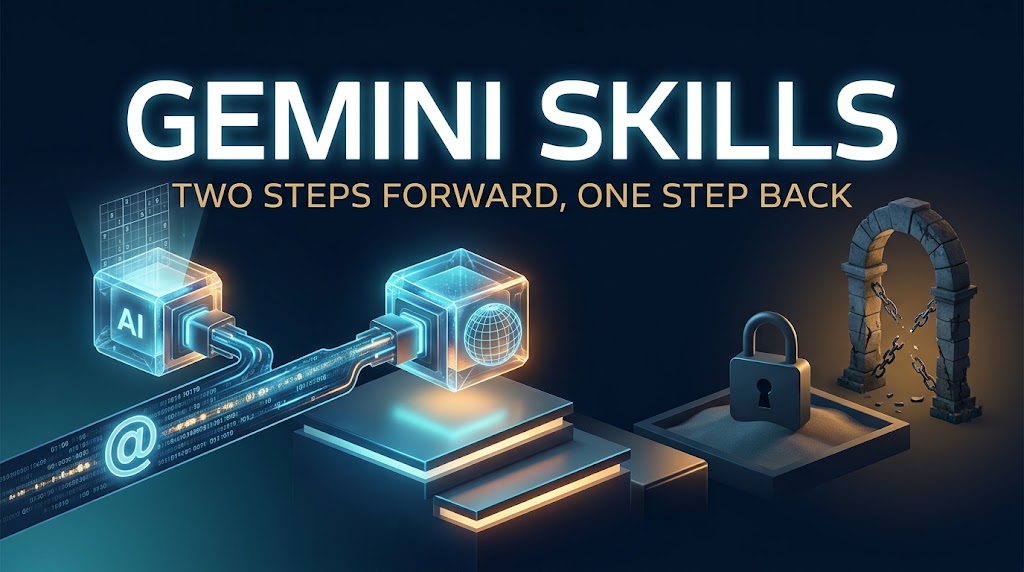
2. February 2026: Encountering Gems and the Immediate “InGem” Proposal
I began actively using and designing Gems, Google’s customized AI modules, in February 2026 [2, 3]. However, as soon as I started using Gems, I realized that the existing structure was inadequate in its current form and harbored serious architectural clumsiness. Each Gem was like an isolated expert sitting in its own separate room; while working with one Gem, if you needed another area of expertise, you had to abandon your current chat and open a new window [11].
Seeing this inadequacy in those very first days of using Gems, I developed a proposal for a new standard that I named “InGem (Insertable Gem)” on February 18, 2026, and published it as an article [1]. In my InGem model, which is based on the “subroutine” logic in traditional software engineering, I proposed that the chat should function as a “main program,” while specialized Gems should operate as “subroutines” dynamically inserted into the main chat with a single trigger when needed and ejected from memory once their task is completed [1]. In the following months, I deepened this vision step-by-step through my articles on the ATG Gem Factory, a systematic instruction production line [5, 6]; Gem Compilation and Hybrid Systems, which envisioned multiple modules working together [8]; The 30,000 Character War, which pushed character limits [9]; and Gem+, a universal personalization layer [10].
3. The October 17 Announcement, Initial Disappointment, and from the “Google Graveyard” to the “Gemini Graveyard”
On October 17, 2026, while trying to update an existing Gem project of mine, I came across a brief notification on the screen: it stated that as of November 17, Gems would be converted into the new structure (Skills).
To be honest, was I expecting this? Yes, I was. Because recently, I had been observing that Gemini was following in OpenAI’s (ChatGPT’s) footsteps in many respects. OpenAI first called its custom bots “GPTs,” and right after that, Gemini followed a similar path and named them “Gems.” Shortly after ChatGPT halted the broad public sharing and store impact of its GPTs, locking users inside their own accounts, I had predicted that Gemini would inevitably go down a similar road. So, this move came as no surprise to me.
Even so, the moment I first saw the notification, I experienced a major disappointment and felt saddened, thinking we were losing a tremendous feature. At first glance, I felt that the Gems into which we had poured so much effort were about to be buried in that famous “Google Cemetery / Graveyard” [12], which I had examined in the context of a digital inventory in my article dated December 18, 2025. In the tech world, there was already a well-known Google Graveyard famous for killing off the great projects it created; now, I thought, a “Gemini Graveyard” plot was being opened inside it as a sub-cemetery.
However, once I started examining and testing the new Skills structure a bit, I saw that the situation was not a complete annihilation. In essence, in terms of content, there was a name change and a transformation in the mode of operation; the instructions we had prepared were not being lost. At the very least, it was comforting that we could preserve our designs for our own personal use. Moreover, when I looked closely at the operational logic of the new structure, I saw that the core idea of the InGem architecture I had proposed in February—namely, calling specialized modules directly into the main chat without going to a separate window—had now come to life in Gemini as well [1, 7].
3.1. Reaching the Same Idea Through Different Paths
To be fair and honest with the reader, I also need to put one important point on the record here. Anthropic had announced the Skills structure for Claude on October 16, 2025, and published this structure along with the SKILL.md file format as an open standard under the name “Agent Skills” on December 18, 2025 [14, 15]. In other words, both the name “Skills” and the file format Gemini uses today were already out there before my InGem article dated February 18, 2026; it is clear that Google most likely adopted this open standard.
At the time I developed the InGem proposal, I was not even aware that Anthropic had a feature called Skills. Nor could it be said that I was using Claude intensively during that period; I discovered the Projects structure in Claude much later, after working with Gems for months. I arrived at InGem entirely from the clumsiness I encountered while working with Gems and from my background with subroutines in software engineering. For this reason, I view InGem not as a “first,” but as an engineering proposal that independently reached the same conclusion.
Nevertheless, InGem has three distinct elements of its own, and these remain valid today: inserting the module into the main flow via an explicit user trigger, an interface indicator showing which module is active at that moment, and ejecting the module with a single click once the task is finished. Gemini’s @ invocation model fulfills the first of these elements, while the other two are still missing.
4. The “Two Steps Forward”: Transitioning to the InGem Architecture and Field Experiments
The new Skills implementation has very positive aspects in terms of engineering and context management; it is precisely this architectural leap that constitutes the “Two Steps Forward” part of the title:
4.1. Invoking via @ and / Symbols or Natural Language Within the Chat, Platform Differences (Web vs. Android), and Instant Indexing Success
In the new structure, just as I proposed in my February 18 InGem article, there is no need to exit the current chat and go to a separate window to use a specialized module [1]. While inside any chat on a computer (in the web version where I work on Chrome), typing @ (the at sign) into the text box (in response to my initial attempt to use the / slash, the system indicated that the @ sign is now used) brings up the entire Skills list on the screen, and the selected module is injected directly into the ongoing chat.
Furthermore, I would like to particularly emphasize that this does not only work via the / or @ symbols; during a normal conversation, without getting bogged down in bureaucracy or typing special symbols or commands, simply saying “Bring the Skill module on this topic or with this title” allows the system to successfully locate and load the relevant module to assist us. One of the most important aspects of what I call “Two Steps Forward” in the title is this natural language flexibility.
In fact, I conducted another striking experiment on this: when I made a call in the chat for a Skill module that I had not yet installed into the system—having processed all its text in the background with only the final “Create” button left to click—Gemini replied, “I searched, but I could not find anything like that.” Seconds after I clicked the “Create” button in the other tab and uploaded the module, I returned to the same chat and said, “Try now,” and witnessed firsthand how easily and flawlessly it found and executed the newly added Skill module. Here, we must render unto Caesar the things that are Caesar’s; ultimately, I wholeheartedly applaud every positive engineering achievement, while criticizing the shortcomings and flaws most ruthlessly.
However, regarding symbol usage, I observed a significant difference across platforms: while the @ sign works instead of the slash (/) on the desktop web version, the / (slash) symbol continues to work on the Android version that I tested on my phone and tablet. As I examined in detail in my article titled “Mobile and Web Experience: Platform Differences in AI” [13], published earlier on April 25, 2026, such differences in structural behavior and update synchronization between web interfaces and mobile applications occur frequently in AI systems. Here too, we see that while an update toward the @ sign was made on the web version, the / command still retains its validity on Android. Whether all platforms will eventually unify completely around the / symbol or the @ symbol, or which one represents the more up-to-date standard right now, is difficult to say for certain; however, it is clearly evident that the web and mobile experience divergence I highlighted in my April 25 study [13] is also present in this new feature.
4.2. First Field Test: The Sudoku TR Experiment
I took my Sudoku TR (v01.44) Gem text—totaling 22,449 characters (a 955-character description and a 21,485-character main instruction body) designed with ATG Gem Factory v13.44—and added it verbatim, without touching a single letter, into the new Skills design area [6, 9].
When I ran Sudoku TR in the new structure and asked it to generate a Sudoku puzzle, the system created a Sudoku grid on the first try that appeared to comply with the rules; I will conduct a full verification of the solution separately. In the old Gem structure, I could only achieve error-free output at the end of a long development process, and not on every attempt. The reason for this improvement might be that in the new structure, the model focuses solely on the invoked directive at that moment; however, it is still too early to draw a definitive conclusion from a single trial.
4.3. Sequential Execution of Two Separate Skills Modules in the Same Chat: The Coordinate Gem Experiment
Following the first test, I took the study one step further. I converted another comprehensive project I had previously prepared as a Gem—my analytical geography system directive, Coordinate Gem (v01.05)—into a second Skill. Then, within the exact same chat window, I tried using the two separate Skills modules sequentially (one after the other), and I succeeded. Being able to summon and run one area of expertise at the table and immediately follow it with another without ever leaving the chat meant that my vision from the April 1, 2026 article “Gem Compilation and Hybrid Systems” [8] and the February “InGem” [1] proposal was largely realized in the field. However, there is one aspect I have not yet tested: whether two Skills invoked back-to-back in the same chat are affected by each other’s rules. In the old Gem structure, each Gem was in its own room; in the new structure, all invoked modules share the same context. This brings up a new risk we might call “inter-directive bleed” (instruction bleed), which I will examine separately in my upcoming trials.
4.4. The Markdown (.md) File Structure and Comparison with Other AI Platforms
Behind the scenes, the new system uses the plain-text-based markup language Markdown (.md) format (SKILL.md). This provides great convenience in terms of cross-platform compatibility. Previously, when I copied the Gems I prepared here into the Projects structure on Anthropic’s Claude platform, they worked very well; in fact, on the Claude side, I had prepared a special converter Project that took the texts I wrote for Gemini and translated them into its own language by cleaning out features that Claude lacked (such as image generation commands). Now, with the .md standard, building a similar “Skills to Project” adaptation will be much more effortless.
At this point, it is also necessary to compare Gemini Skills with the situation in other AIs. On the Anthropic (Claude) side, there is an architecture operating under the exact same name (Skills) and SKILL.md structure alongside the Projects structure; Microsoft Copilot has enterprise Skills/Actions, Perplexity has Spaces, and OpenAI has the pruned GPTs and Projects. In Claude, multiple Skills can also be used within the same chat; however, there, the model mostly decides on its own which module will be activated by looking at the Skill’s description line. In Gemini, by contrast, the user can explicitly select the desired module from the list and insert it into the chat using the @ (or / on mobile) trigger in the standard interface. Having the user explicitly insert the module into the main flow via a clear trigger is the exact operational mode envisioned by my InGem proposal; in this respect, Gemini’s approach stands closer to the InGem specification than its competitors.
5. User Interface (UI) Issues and Ongoing Limitations
Although two steps have been taken forward architecturally, some interface and operational flaws I encountered during my initial trials show that the system is not yet fully mature:
- Tool Locking (Image Generation Restriction): When I first used the Skill application I prepared and asked it to generate an image, the system imposed a restriction stating, “Currently this feature is active, image usage is not available.” In other words, it does not yet offer a seamless luxury that will make us completely forget the old habit of exiting one module to enter another; while a subroutine is active, it locks some of the main model’s arms. In fact, right when we finished writing this article and wanted to generate its 16:9 cover images, we saw that the image generation tool was completely locked in this chat window because we had previously tested the Sudoku TR and Coordinate Gem modules here—forcing us to open a new chat window in a separate tab just to generate the cover visuals. Having our critique proven live while producing the article’s own cover image became the most concrete field evidence of this limitation.
- Invisibility of System Status (Lack of an Active InGem Indicator): While the chat continues, there is a serious user interface problem regarding how we see whether we are still inside the added Skill or whether its task has finished and it has been deactivated. As I specifically stated in my February 18 InGem article, the module (InGem) that is active at that moment needs to be clearly visible on the screen via a distinct visual indicator and should be deactivatable with a single click [1].
- List Access and Concerns Over Multi-Module Limits: Initially, I had trouble finding where to access the file I had created; it was not inside the “Plus (+)” button, and can only be accessed from the list in the left menu or by typing
@(/on Android) in the text box. Right now, when there are only one or two modules, seeing them in the list is easy; however, when we create hundreds of Skills in the future, whether we will be able to see and manage all of them there without restriction, or whether a limit will be imposed on the number of active modules, remains an important question mark.
6. The “One Step Back”: The Sharing Handicap and the “Play in Your Own Sandbox” Imposition
Now let us come to the “One Step Back” part of our article’s title—namely, how Google tripped up the wonderful feature it created.
6.1. The Botany Gem Example and Fear of Server Load
In my view, both ChatGPT (regarding GPTs) and Gemini (regarding Gems) became seriously afraid of the power of these structures they created. As someone who has created and used numerous Gems so far, I can clearly see as a user that these structures place an excessive processing load on AI systems.
Let me explain this with a concrete example: I have a Botany Gem that I designed. When I take a photo of any plant, fruit, or botanical specimen and ask standard Gemini directly, “What is this?”, Gemini tells me only as much as it feels like sharing; in other words, it performs 1 unit of work. But when I share the exact same photo through my Botany Gem, it first identifies the plant, researches every piece of information from its hazardous properties to its global population, and compiles and delivers almost as much information as a complete Wikipedia article. That means while it performs 1 unit of work in a standard chat, it performs 10 or perhaps 20 units of work through the Gem. When this is done by 1, 2, or 3 people, it is not an issue; however, when a Gem becomes popular and is used thousands or millions of times, it places a massive server load on AI companies.
6.2. User Quota Unfairness and Infringed User Rights
Companies may have been frightened by this load, but there is a major unfairness here: normally, when I ask this question to standard Gemini, it might consume perhaps one-thousandth of my 5-hour usage quota, whereas when I ask it through the Gem, I end up spending perhaps 3% of my quota. In the end, I am still consuming my own quota! If I do not want to exhaust my quota, I simply do not ask through the Gem—I ask directly and get the brief information; when I want detailed information, I do so knowingly, accepting that it will consume my quota. It must also be acknowledged that the companies’ concern has a rationale: because quotas are flat-rate, even a heavy user who stays within their quota generates higher costs for the company. However, the boundary of this cost is already drawn by the quota itself. While the user can decide how deeply to work within their own quota, shutting down sharing altogether means solving the problem by taking away the user’s right to choose.
6.3. The Vision of What Should Have Been a Library vs. “Play in Your Own Sandbox”
Our inability to open up these high-quality Skills modules we prepare for others to use is not a minor shortcoming; it is a blatant structural handicap. Giving people such a fine and functional tool and then withholding it from shared use with others is tantamount to deliberately tripping up a feature that is moving forward.
Yet, as I stated in my article titled “The New Hub of the Digital Future: Why a Gem Store Should Be Launched?” [4], published back on March 14, 2026, far from blocking these works, special AI-assisted classifications should have been made, archived, and turned into an open library (store) from which everyone could benefit so that they could be used widely [4]. Instead of building this library, Google tells its user, “Go play in your own sandbox.” That is the biggest step backward. (Still, I have not completely lost hope; from what I gather between the lines of the help pages and from the .md file structure, we will surely find a way in the future to share these files as packages.)
7. Naming Sterility, the “Ankara Döner Shop” Syndrome, and Linguistic Solutions
Another step backward is the naming sterility experienced by global tech giants and, in particular, the grave localization error in the Turkish interface.
7.1. Retreat from Originality to Genericism and Anonymized Engineering Honor
When there is already a very fine and original name like Gem derived from the root Gemini, abandoning it to switch to an extremely ordinary, generic name like “Skills” is not wise at all in my opinion. I should note that Google did not invent this name itself, but rather adopted the name that became established in the industry through Anthropic’s open standard; however, this does not justify giving up the most distinctive part of its own brand. In Ankara, someone opens a shop and names it “Ankara Dönercisi” (Ankara Döner Shop); as we walk past, we smile slightly and say, “How creative.” What Google has done is just like that. We see a similar plainness at Anthropic; the name “Projects” falls short of conveying how valuable the underlying structure truly is.
As for the issue of acknowledgment: it is impossible for me to prove that Google took this architecture from my article, nor do I make such a claim. However, when features that are subsequently rolled out overlap so closely with proposals users have sent as feedback over many months, it is not unreasonable to expect at least a response acknowledging that these contributions were seen. In our Turkish proverbs, there is an expression for everything; the silence of tech companies on this matter is the exact fear of “Selam verdim, borçlu mu çıkacağım” (“I gave a greeting, now will I end up in debt?” — the fear that acknowledging someone will create a legal or financial obligation). As I emphasized in my April 1, 2026 article “InGem Vision: The Engineering Honor Anonymized by Tech Giants” [7], this silence does not change the fact that I developed the InGem proposal independently and that its timestamped record stands both on my website and on Gemini’s own servers.
7.2. The Grave Error in the Turkish Translation
I do not even want to pronounce the word Google used when translating the English word “Skills” into the Turkish interface; because I hope they will turn back from this mistake by the end of the 30-day transition period (by November 17) and choose a word worthy of the Turkish language, I preferred to use its English name (Skills) throughout this article (in the feedback letter in the appendix, I had to mention the word “Beceriler” explicitly in order to clearly define the problem). No one living in Türkiye who knows the nuances of our language would put a word into an AI interface that sits on such slippery ground in daily speech and slang, capable of sliding into suggestive and unpleasant double meanings (such as “botching a job” or worse, derived from the verb “becermek”). My only wish in this matter is not to claim ownership over anything, but simply for an accurate and refined naming choice that suits the nature of the work.
7.3. Our Proposed Solutions: Gem / Gemini Yönerge / Gemini Yordam / Gemini Yetenek
So what is the work we actually do under “Skills”? In reality, what we have here is a set of instructions (directives) structured in a specific order—in other words, AI software written in natural language. For instance, that 22,000-character instruction set I prepared for Sudoku is actually a Sudoku Directive (“Yönerge”) or a subroutine (“Yordam”) called into the main flow.
Accordingly, as a result of our comprehensive evaluations with Gemini Argon, four strong options emerged that could be used in place of that unpleasant word in the Turkish interface:
- Gem (or InGem): Instead of changing the name, retaining the name Gem (or InGem, which describes the insertable architecture), which is already integrated with the brand identity in both English and Turkish.
- Gemini Yönerge: Using the word “Yönerge” (Directive / Instruction Set), which is the most natural and respected equivalent in Turkish for a set of instructions prepared to perform a task.
- Gemini Yordam: Using the compound “Gemini Yordam” (Subroutine / Procedure), which corresponds one-to-one with the “subroutine” reality in the software world and the InGem operational logic.
- Gemini Yetenek: The clean word “Yetenek” (Gemini Yetenek) (Capability / Talent), which carries no negative connotations and came up at the very beginning of our discussion—and which we noticed the AI itself naturally veered toward (repeatedly using phrases like “the capability/yetenek it possesses”) when describing these modules after we had already sent the feedback letter.
7.4. Conclusion: Toward November 17
In summary, while Google has taken two major steps forward in terms of engineering and context management with a subroutine architecture that aligns with the InGem vision, it has taken one step back by shutting down the sharing ecosystem and choosing an unfortunate naming localization in the Turkish interface. Before the final transition on November 17, 2026, I hope that this localization error in the Turkish interface will be reversed and that the vision of an open library—where users can share their creations within their own quotas—will be reconsidered.
8. Appendix: Official Feedback Letter Sent to Google
During these discussions, I officially submitted the following feedback text—which includes our first three proposals and my February 18, 2026 InGem article—to the Gemini team. As a historical record, I am sharing the original English text of my submission below with the information as it stood at the time of sending and without any modifications:
Subject: Feedback on Gemini “Skills” Architecture, Alignment with the “InGem” Model, and Naming Proposals (“Gem” / “Gemini Yönerge” / “Gemini Yordam”)
To the Attention of the Gemini Product Development and Localization Teams,
I am pleased to observe the transition on the Gemini platform from the isolated structure of the old system to a new modular architecture that can be dynamically integrated into the main chat flow via the
@trigger.This new operational logic aligns identically with the system architecture I proposed in my article titled “InGem (Insertable Gem)”, which I authored using Gemini as a writing assistant and published on my personal website on February 18, 2026. Based on the “subroutine” logic in software engineering, I introduced this architecture to the literature months ago, foreseeing that specialized modules should be dynamically inserted into the chat without disrupting the main context and ejected upon completion of the task (the direct link to the relevant article is provided at the end of this message).
However, the name change to “Skills” during this architectural transition, and particularly the word “Beceriler” used in the Turkish interface localization, falls far short of reflecting the technical seriousness and identity of the system:
- Loss of Brand Identity: While “Gem” (or “InGem” with its insertable structure), derived from the root “Gemini,” was a highly original and distinctive naming choice, replacing it with a generic and ordinary word like “Skills”—which is found on almost every platform—has weakened the unique identity of the product.
- Linguistic and Cultural Mismatch in the Turkish Translation: In Turkish, the word “beceri” (and its root verb “becermek”) stands on very slippery ground in daily usage; it carries an unpleasant connotation that frequently slips into slang and negative or suggestive double meanings (such as “botching a job,” “making a mess of things,” or worse). Presenting an advanced AI architecture to Turkish-speaking users under the title “Beceriler” is a localization error that undermines the prestige of the product.
- Lack of Functional Definition: In essence, these modules are structured “instruction sets” (directives) and textual software that dictate step-by-step what the AI should do and within which rules it should operate.
For these reasons, I present three concrete proposals to be evaluated in place of the current “Skills / Beceriler” naming:
- Proposal 1 — Retaining the Name “Gem” (or “InGem”): Retaining the name “Gem” (or “InGem”, which directly describes the new insertable architecture) as-is in both English and Turkish—a term already embraced by users and integrated with the brand identity—is a much more original and accurate choice than the current “Skills / Beceriler” nomenclature.
- Proposal 2 — “Gemini Yönerge” (or “Yönergeler”): If a new Turkish concept is to be used in the Turkish interface, the most natural, clear, and respected equivalent in Turkish for a set of rules and instructions that determine how a task is to be performed is “Yönerge” (Directive / Instruction Set). Using “Gemini Yönerge” in the interface defines the function flawlessly.
- Proposal 3 — “Gemini Yordam” (or “Yordamlar”): The technical and holistic computer science term in Turkish that fully corresponds to these structures functioning as a “subroutine” called into the main chat flow (the InGem architecture) is “Yordam” (Subroutine / Procedure). The naming “Gemini Yordam” provides pinpoint accuracy from an engineering perspective.
Furthermore, as I emphasized in my February 2026 article, clearly indicating which module is currently active during a chat via a distinct visual indicator on the interface—and allowing it to be easily deactivated—will complete the user experience.
I submit these three proposals regarding both the global naming and the “Beceriler” expression in the Turkish interface for your consideration.
Reference Article (February 18, 2026 – Aydın Tiryaki):
- A Proposal for a New Standard in AI Interaction: The InGem (Insertable Gem) Model:https://aydintiryaki.org/2026/02/18/a-proposal-for-a-new-standard-in-ai-interaction-the-ingem-insertable-gem-model/
References
- Aydın Tiryaki (18.02.2026). A Proposal for a New Standard in AI Interaction: The InGem (Insertable Gem) Model. https://aydintiryaki.org/2026/02/18/a-proposal-for-a-new-standard-in-ai-interaction-the-ingem-insertable-gem-model/
- Aydın Tiryaki (18.02.2026). Anatomy of a New Gem Design and the Co-Creation Process (The “AI Says” Case). https://aydintiryaki.org/2026/02/18/anatomy-of-a-new-gem-design-and-the-co-creation-process-the-ai-says-case/
- Aydın Tiryaki (18.02.2026). The Evolution of Developing an Operational GEM through AI Collaboration (The “Verbatim” Case Study). https://aydintiryaki.org/2026/02/18/the-evolution-of-developing-an-operational-gem-through-ai-collaboration-the-verbatim-case-study/
- Aydın Tiryaki (14.03.2026). The New Hub of the Digital Future: Why a Gem Store Should Be Launched? https://aydintiryaki.org/2026/03/14/the-new-hub-of-the-digital-future-why-a-gem-store-should-be-launched/
- Aydın Tiryaki (19.03.2026). Gem Factory: A Gem Design Through Systematic Transformation of Raw Ideas. https://aydintiryaki.org/2026/03/19/gem-factory-a-gem-design-through-systematic-transformation-of-raw-ideas/
- Aydın Tiryaki (28.03.2026). Gem Factory: A New Standard in AI Instruction Architecture. https://aydintiryaki.org/2026/03/28/gem-factory-a-new-standard-in-ai-instruction-architecture/
- Aydın Tiryaki (01.04.2026). InGem Vision: The Engineering Honor Anonymized by Tech Giants. https://aydintiryaki.org/2026/04/01/ingem-vision-the-engineering-honor-anonymized-by-tech-giants/
- Aydın Tiryaki (01.04.2026). A New Architectural Threshold in AI: “Gem Compilation” and Hybrid Systems. https://aydintiryaki.org/2026/04/01/a-new-architectural-threshold-in-ai-gem-compilation-and-hybrid-systems/
- Aydın Tiryaki (01.04.2026). Engineering Resistance in AI Design: The Gem Factory and the 30,000 Character War. https://aydintiryaki.org/2026/04/01/engineering-resistance-in-ai-design-the-gem-factory-and-the-30000-character-war/
- Aydın Tiryaki (01.04.2026). The “Personal Layer” Revolution in AI: Gem+ and the Universal Personalization Ecosystem. https://aydintiryaki.org/2026/04/01/the-personal-layer-revolution-in-ai-gem-and-the-universal-personalization-ecosystem/
- Aydın Tiryaki (24.06.2026). Context Management and Distributed System Instabilities in Large Language Models: “Gem Isolation Tides” and the Algorithmic Rationalization Paradox. https://aydintiryaki.org/2026/06/24/context-management-and-distributed-system-instabilities-in-large-language-models-gem-isolation-tides-and-the-algorithmic-rationalization-paradox/
- Aydın Tiryaki (18.12.2025). A Digital Inventory: The Google Cemetery and the Antique Shop. https://aydintiryaki.org/2025/12/18/a-digital-inventory-the-google-cemetery-and-the-antique-shop/
- Aydın Tiryaki (25.04.2026). Mobile and Web Experience: Platform Differences in AI. https://aydintiryaki.org/2026/04/25/mobile-and-web-experience-platform-differences-in-ai/
- Simon Willison (16.10.2025). Claude Skills are awesome, maybe a bigger deal than MCP. https://simonwillison.net/2025/Oct/16/claude-skills/
- Agent Skills Open Standard (18.12.2025). https://agentskills.io
Article Credits (Colophon): All ideas, opinions, architectural proposals, and evaluations in this article belong entirely to Aydın Tiryaki. This study was created as a result of a 105-stage in-depth dialogue and field tests (spanning over a 15-hour timeframe) conducted between Aydın Tiryaki and Gemini Argon from October 17, 2026, at 21:41 to October 18, 2026, at 12:46; during this process, Gemini Argon served as a writing assistant as well as a research assistant consulted on specific topics. The draft of the article underwent a critical reading by Claude (Anthropic) prior to publication, followed by a comprehensive final review with Gemini Argon (Extended Thinking mode), and factual corrections and phrasing suggestions were incorporated into the text with the author’s approval.
| aydintiryaki.org | YouTube | Aydın Tiryaki’nin Yazıları ve Videoları │Articles and Videos by Aydın Tiryaki | Bilgi Merkezi│Knowledge Hub | ░ Virgülüne Dokunmadan │ Verbatim ░ | ░ Gemini Skills: İki İleri Bir Geri │Gemini Skills: Two Steps Forward, One Step Back ░ 18.10.2026

