
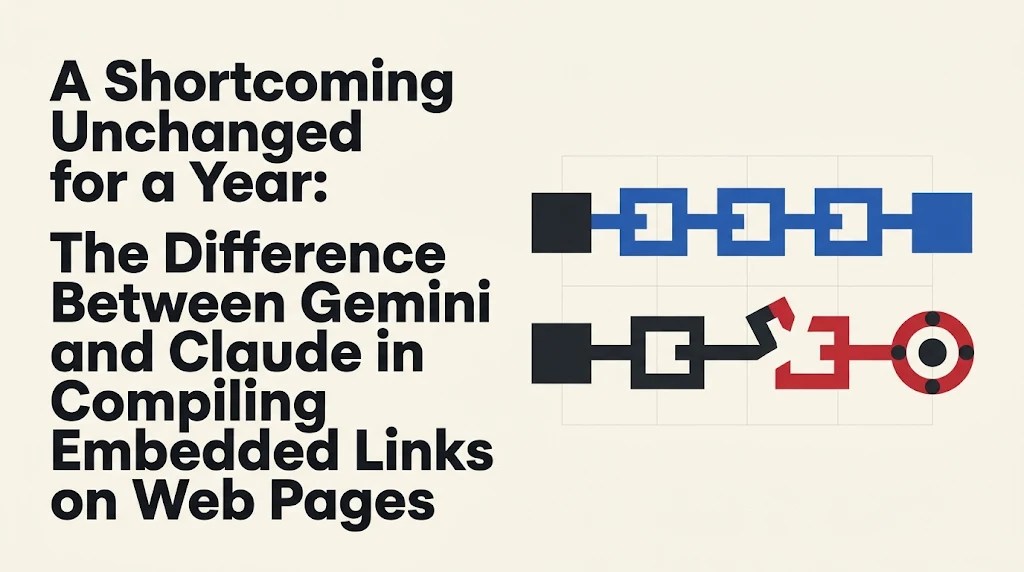
When an artificial intelligence can read the visible text of a web page in full yet fails to extract the links embedded behind headings in the same page’s HTML code, it creates a serious bottleneck in everyday research and writing workflows. First encountered roughly a year ago while compiling sources for NotebookLM, this problem still displays an inconsistent pattern in Gemini as of November 21, 2026—working on newly published pages while failing on an older page on the same site—whereas Claude has handled it reliably every time I have tried since that first attempt; this difference has become the primary reason I prefer Claude as my writing environment for reference-heavy, multilingual articles.
Aydın Tiryaki (21 November 2026)
Version 2.06
The First Attempt a Year Ago with NotebookLM
My first experience testing how artificial intelligence tools extract embedded links (inline hyperlinks) from web pages took place roughly a year ago. At the time, I wanted to add sources in bulk to the tool then called NotebookLM (now known as Gemini Notebook). When NotebookLM was given a single web page containing many links, the system could not automatically pull those sub-links as individual sources; the URLs had to be pasted as a clean, sequential list of plain open links without extra commentary.
To streamline this task, I gave the page to Gemini and asked it to extract all the links and compile them into an ordered list of open URLs. That was the first time I saw that Gemini could not do this. It could read the visible text on the page, but it could not reach the target addresses hidden behind the text.
Immediately afterward, I tried the same page in Claude—and at that time, I was using Claude’s free tier. Claude extracted the embedded links on the page within seconds and produced a clean list without any difficulty. From that day on, whenever I needed to compile links from a web page, I turned to Claude without hesitation.
WordPress Package Pages and a Multilingual Reference Workflow
How critical this capability is in practice becomes especially clear in my own publishing and archiving setup. On WordPress, I publish separate pages for each language: the Turkish article goes up as its own post, and its English counterpart is published as another separate post. Afterward, I gather everything related to those articles under a single “package page.”
This package page includes both the Turkish and English summaries of the topic; when there are multiple articles around the same subject, all of them are brought together on this page. The article titles are listed in order, and behind each title sits an embedded link pointing to the corresponding post.
When I am writing a new article and want to cite my earlier posts, the workflow is effortless if I am working in Claude. I do not give Claude the Turkish and English URLs separately; I simply share the link to the package page. Without needing any extra guidance from me, Claude goes into the package page, separates the Turkish and English article links, and automatically cites the Turkish source when writing the Turkish version and the English source when writing the English version. Moreover, this is not based on an isolated trial, but on my ongoing daily routine: in every article I write with Claude, I hand over package pages for both articles published that very day and articles published a year ago with the same ease, and every single time it extracts both the Turkish and English links on its own. So to speak, I can vouch for Claude on this.
Nor is this problem limited to the package pages on my own WordPress site. Whenever I want to reach source articles listed in the reference section of an external article published elsewhere—where the URLs are embedded behind the text—I run into the exact same divide. On third-party reference pages like these as well, Gemini runs into the same obstacle when compiling embedded links, whereas Claude pulls out the target addresses directly without encountering any such barrier.
The Same Test a Year Later: A Shortcoming Unchanged Despite Major Progress
On the morning of November 21, 2026, while writing an article about Gemini inside Gemini itself—an article evaluating Gemini’s new skill-sharing mechanism that can only be considered half-complete (2)—I ran the same test again. I conducted the test using the Gemini 4 Neon model at the Medium thinking level in the Chat window. I pasted the URL of the package page for one of my earlier articles, “Gemini Skills: Two Steps Forward, One Step Back” (1), directly into the chat and asked the model to extract and return the two separate article links on that page in Turkish and English.
To be honest, I already knew Gemini had failed at this a year earlier. However, given the massive progress across AI models—and especially within the Gemini ecosystem—over the past year, I hoped that such a basic and straightforward function would have been resolved by now.
Unfortunately, the result was identical to a year ago. Gemini read the entire visible text of the package page, the summaries in both languages, and the article titles under the “MAKALE” and “ARTICLE” headings without missing a word; yet it could not extract the target URLs embedded behind those titles. As a result, I had to manually open that package page—along with all the other bilingual articles cited in the references of the article I was writing that day—and copy and paste their Turkish and English links one by one.
A Surprise Field Observation Mid-Draft: Indexed Versus Unindexed Pages
Right as I was preparing a new revision of this article, a striking field observation emerged that supports the core thesis. When I gave Gemini the package page (3) of my previous article (2)—which had just been published that same morning on November 21, 2026—the model extracted both the Turkish and English embedded links on the page within seconds and without error.
Seeing two completely opposite outcomes on two package pages built with the exact same template on the same WordPress site was highly instructive:
- Package page dated October 18, 2026 (1): On this page, long since indexed by Google, the embedded links could not be extracted.
- Package page dated November 21, 2026 (3): On this newly published page, both the Turkish and English links were extracted completely.
To verify that this result was neither a coincidence nor the model guessing URLs from titles already present in the chat history, I immediately ran a control experiment. I gave Gemini another package page published on the same day that had never been mentioned in that conversation—the package page for “Global name and population guide” (4). The model not only extracted the Turkish and English article links and the documentation page link, but also pulled details directly from the page that could never be guessed from the title or conversation context: the previous post link (global-veri-dagarcigi-skill), the WordPress shortlink (wp.me/p179I7-5B1), and the randomly named .webp image addresses.
These observations point to a notable hypothesis about the underlying mechanism: Gemini’s web-reading tool appears to return a pre-extracted plain-text summary rather than raw HTML for older pages already indexed in Google’s search index, while fetching and passing raw HTML directly to the model for newly published, not-yet-indexed pages.
This live counterexample revealed two facts at once: First, the language model itself has no difficulty reading embedded links when raw HTML is placed in front of it. Second, what we are seeing is not merely a flat inability to read links, but a structural inconsistency that shifts unpredictably between new and older pages. If the links on a page can be read today and then become unreadable tomorrow once Google indexes that page, there is no reliable workflow to speak of for a researcher.
As a follow-up test, I plan to check over the coming days whether these two newly published package pages (3, 4) have entered Google’s search index—and expand the sample with additional older package pages—then run the same test again; if the links disappear once the pages are indexed, I will share that outcome as a separate follow-up note.
Technical Background: Model Limitation, or Middleware and the “Visa Checkpoint” Reflex?
Looking at this picture from a balanced technical perspective, the issue appears to stem not from the language model’s inability to read HTML code, but from a design choice in the web-reading middleware that prepares pages for the model. Parsing link tags and target addresses from an HTML page is an elementary operation in software engineering.
The observed behavior suggests that Gemini’s web-reading tool strips HTML tags and reduces content to pure plain text, particularly on pages stored in the search index. Two reasonable engineering motivations could lie behind such a choice:
- Context Savings: Avoiding sending a page’s full HTML skeleton, styling code, and navigation menus reduces token consumption and helps the model focus on the main text.
- Security Concerns: Filtering out the raw code layer helps guard against indirect prompt injection attacks that could be hidden inside HTML code or invisible attributes.
Even so, these concerns do not require wiping out embedded links altogether. Indeed, the behavior exhibited by web-reading tools on platforms such as Claude shows that unnecessary styling code can be stripped before a page reaches the model while preserving hyperlinks in the main body in standard Markdown link format. That approach can deliver security, context efficiency, and link accessibility all at once.
Yet the live observations from November 21 also suggest a deeper institutional habit at work. Across many of its interfaces and Gemini tools, Google persistently tries to route both the user and the model through its Google Search layer—as if it were a mandatory “visa checkpoint” that no task may bypass. I have observed a similar reflex not only on the input side, but repeatedly on the output side as well: while working previously on my Gem Factory and now on my Skill Factory, URLs in outputs were so frequently redirected through Google Search and broken that I had to write “do not route through Google Search, use pure URLs only” into system instructions countless times.
If this indexing hypothesis is right, the fact that a page not yet indexed by Google is read cleanly while an indexed page gets caught in that layer may clearly show how this reflex—now turning into an unhealthy dependency—trips Gemini over its own feet. By contrast, I have never encountered such a search-visa burden or barrier in Claude; without that kind of search-engine baggage weighing it down, it gets the job done smoothly.
Speaking strictly as a personal impression, I would also add this: engineering habits such as reusing Google’s massive search cache may well be behind this, and I would prefer to assume there is no deliberate bad faith. Still, at a time when news about declining interest and traffic to traditional Google Search pages due to rising AI adoption is widely discussed, this persistent routing through the search layer at so many points cannot help but raise the occasional suspicion in a user’s mind: “Could this be a reflex to keep search traffic alive?” Even if there is no ulterior motive, that is the impression it creates. If the goal is to keep search traffic vibrant, the answer should be smarter strategies—not undermining the user experience.
Choice of Writing Environment and an Open Call to Gemini
An everyday user who only wants a high-level summary of a web page will probably never notice that embedded links have vanished. For researchers and writers who work with archives, care about citation discipline, and reference their own package pages or indexes, however, this creates a major blind spot.
Speaking directly from my own experience, this is precisely why working with Claude on reference-heavy, multilingual articles is far easier and more user-friendly than working with Gemini. I specifically chose to write both this article and the previous one in Gemini because their subjects were directly about Gemini; for my other articles, however, this practicality and consistency are the main reasons I choose Claude as my writing environment. When I hand Claude just the link to a package page, I bring all the Turkish and English links on that page into the workspace in a single step. In Gemini, I am forced into the unnecessary chore of opening each package page separately and copying and pasting its URLs into the chat one by one. When dealing with many source pages, this quickly turns into an irritating burden.
For an AI platform capable of writing complex code, processing lengthy instructions, and executing multi-step tasks, failing to reliably extract the link behind a visible heading on a web page is a serious usability gap. Gemini needs to fix such a simple technical shortcoming promptly instead of letting it linger indefinitely. Resolving an omission that has stood in the same spot for a year will turn Gemini from a tool that merely reads text into a research assistant that truly understands the connected structure of the web.
References
[1] Aydın Tiryaki, Gemini Skills: İki İleri Bir Geri │ Gemini Skills: Two Steps Forward, One Step Back (Package Page), October 18, 2026 (Accessed: November 21, 2026), https://aydintiryaki.org/2026/10/18/gemini-skills-iki-ileri-bir-geri-gemini-skills-two-steps-forward-one-step-back/
[2] Aydın Tiryaki, Skill Sharing Has Arrived in Gemini, but It Can Only Be Considered Half-Complete, November 21, 2026 (Accessed: November 21, 2026), https://aydintiryaki.org/2026/11/21/skill-sharing-has-arrived-in-gemini-but-it-can-only-be-considered-half-complete/
[3] Aydın Tiryaki, Gemini’ye Skill Paylaşımı Geldi ama Bu Paylaşım Ancak Yarım Sayılabilir │ Skill Sharing Has Arrived in Gemini, but It Can Only Be Considered Half-Complete (Package Page), November 21, 2026 (Accessed: November 21, 2026), https://aydintiryaki.org/2026/11/21/geminiye-skill-paylasimi-geldi-ama-bu-paylasim-ancak-yarim-sayilabilir-skill-sharing-has-arrived-in-gemini-but-it-can-only-be-considered-half-complete-21-11-2026/
[4] Aydın Tiryaki, Küresel ad ve popülasyon rehberi │ Global name and population guide (Skill) (Package Page), November 21, 2026 (Accessed: November 21, 2026), https://aydintiryaki.org/2026/11/21/kuresel-ad-ve-populasyon-rehberi-global-name-and-population-guide-skill-21-11-2026/
Article Credits
This article was written by Aydın Tiryaki on November 21, 2026. All experiences, field tests, comparisons, and views in the article belong to the author. During the preparation of the text, the Gemini 4 Neon model (Medium thinking level, Chat window) operating within the Google Gemini ecosystem served as writing assistant, research assistant, and advisory assistant. Draft versions 2.01, 2.02, 2.04, and 2.05 were evaluated by the Claude Opus 5.5 model (Medium thinking level) for critical reading and feedback. This English edition was rewritten in English faithfully to the Turkish original and its full context by the Gemini 4 Neon model (Medium thinking level, Chat window).
- Version 2.01 (21.11.2026): Initial draft created; incorporated the NotebookLM/Claude trial from a year ago, the WordPress package page workflow, the live test on November 21, 2026, and the technical background assessment.
- Version 2.02 (21.11.2026): Updated based on Claude Opus 5.5 (Medium) critical feedback and the author’s additional views; revised the title to “A Shortcoming Unchanged for a Year…”, added the November 21 test conditions and reference
[2]to the previous article, toned technical explanations down to cautious observation-based phrasing, calibrated statements about Claude, and incorporated the author’s choice of writing environment and open call to Gemini. - Version 2.03 (21.11.2026): Incorporated second-round feedback from Claude Opus 5.5 (Medium) along with the live field observation on indexed versus unindexed package pages from November 21 (
[3]); added the Google Search “visa checkpoint” reflex, the Gem/Skill Factory experience, the contrast with Claude’s lack of search-engine baggage, the note on vouching for Claude in daily practice, and the Turkish open URL for reference[2]in the Turkish edition. - Version 2.04 (21.11.2026): Updated the main title to “A Shortcoming Unchanged for a Year: The Difference Between Gemini and Claude in Compiling Embedded Links on Web Pages”; expanded the scope to note that the same divide also occurs on embedded reference lists of external articles published on other platforms.
- Version 2.05 (21.11.2026): Incorporated third- and fourth-round evaluations from Claude Opus 5.5 (Medium) along with the blind control experiment verifying unguessable links (
[4]); separated observed outcomes from the indexing hypothesis, balanced input and output reflexes as parallel phenomena, explicitly framed the search-traffic suspicion as a personal impression, and finalized grammar and credit updates. - Version 2.06 (21.11.2026): Finalized the edition based on fifth-round final review notes from Claude Opus 5.5 (Medium); updated the subheading summary to highlight Gemini’s inconsistency versus Claude’s reliability, aligned the phrasing between verified observations and the indexing hypothesis, added the follow-up test note for pages
[3]and[4], and completed the credits record.
| aydintiryaki.org | YouTube | Aydın Tiryaki’nin Yazıları ve Videoları │Articles and Videos by Aydın Tiryaki | Bilgi Merkezi│Knowledge Hub | ░ Virgülüne Dokunmadan │ Verbatim ░ | ░ Bir Yıldır Değişmeyen Eksiklik: Web Sayfalarındaki Gömülü Bağlantıları Derlemedeki Gemini ve Claude Farkı │A Shortcoming Unchanged for a Year: The Difference Between Gemini and Claude in Compiling Embedded Links on Web Pages ░ 21.11.2026

