
With barely hours having passed since we published our morning article on models and quotas, we examine the removal of the 3.8 Flash model and the arrival of the 4 Hydrogen model in its place, how the foresight we made regarding periodic table elements in our October 20, 2026 Argon article came true by confirming the Turkish proverb “aklın yolu birdir” (great minds think alike / the path of reason is one), and our element proposals for the sole remaining older-generation model, 3.5 Flash-Lite.
Aydın Tiryaki, Gemini 4 Argon Medium (12 November 2026)
Version 2.02
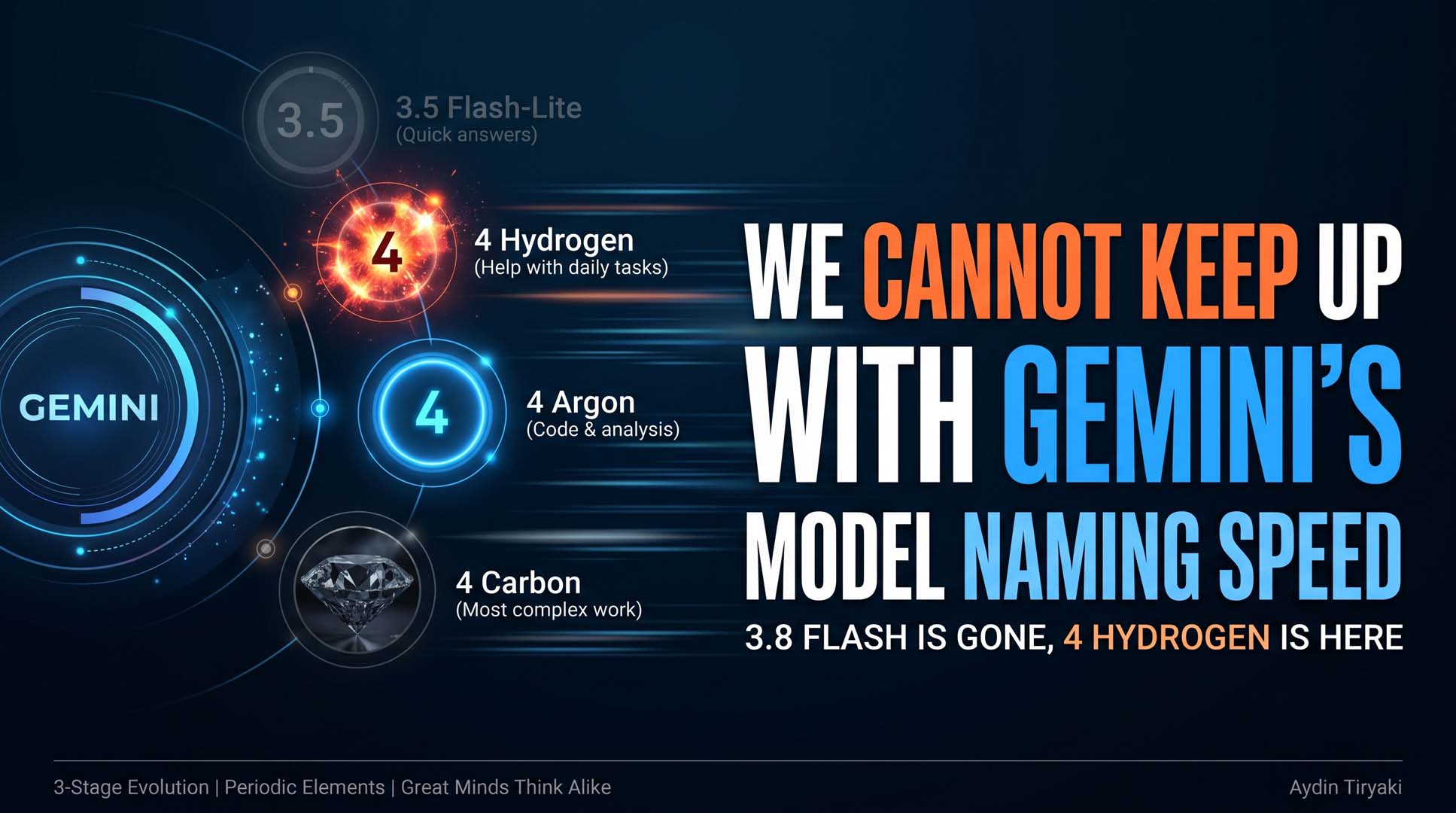
The Menu That Changed Before the Ink Dried on Our Morning Article: “3.8 Flash” Is Gone, “4 Hydrogen” Is Here
Tracking and documenting the architectural updates of artificial intelligence platforms no longer requires racing against days, but against hours and minutes. Just this morning, on November 12, 2026, we completed and published our comprehensive article titled Model Options, Thinking Levels, and the 100-Unit Quota Balance in Gemini Chat and Task Windows (2). In that study published in the morning hours, we had examined the silent removal of the 3.1 Pro model from the menu on November 10, 2026 (4) and the 15-option quota matrix of the four-model Chat (3.5 Flash-Lite, 3.8 Flash, 4 Argon, 4 Carbon) and three-model Task (3.8 Flash, 4 Argon, 4 Carbon) windows (2).
However, with barely hours having passed since our first article was published, on the evening of the very same day—Thursday, November 12, 2026, at 20:45—the Gemini model menu changed once again. Even though 3.8 Flash was still standing on the list when checked just moments before taking the screenshot, within minutes the name 3.8 Flash was completely wiped from the menu and replaced by 4 Hydrogen. As we write this second article, not even hours have passed since the new 4 Hydrogen name went live.
Coming Events Cast Their Shadows Before: Our October 20, 2026 Element Conversation and the Reality That “Great Minds Think Alike”
Gemini’s strategy of choosing model names from the elements of the periodic table did not actually appear out of nowhere today; as the wonderful Turkish saying goes, “perşembenin gelişi çarşambadan belliydi” (Thursday’s arrival was obvious from Wednesday / coming events cast their shadows before). About three weeks ago, in our article titled Did Gemini 4 Deserve the Name Argon? published on October 20, 2026 (1), we had scrutinized Google’s introduction of the Argon 4 model by placing a chemical element name alongside standard model naming conventions for the first time. During the detailed conversation we held while preparing that article, we realized that giving the name Argon opened the door to other elements in the periodic table, and we evaluated in depth how future models could also take element names (1).
Ultimately, through the eyes of a careful user and engineer, we foresaw on that day that once a single model was named Argon, other elements would follow; today, the Google Gemini team took that exact step, expanding the series with Carbon and Hydrogen (3). There is a very fitting proverb in Turkish, “aklın yolu birdir” (the path of reason is one / great minds think alike): when you accurately read the internal logic and naming architecture of a system, the step a development team thousands of kilometers away will take weeks later and a user’s foresight at their desk converge at the exact same point.
During the 12-option matrix study we conducted on that same night of October 20–21, 2026, the footsteps of this transformation were also recorded. In our conversation that day, we had identified the existing situation with these words:
“When we work with Gemini, there are four separate models: Flash-Lite, Flash 3.8, Pro 3.1, and Argon 4. They also have three thinking levels: low, medium, and high. So we have a chance to work in a total of 12 different ways.”
Immediately afterward—following the observation that during conversions with the ATG Gem Factory (ATG Gem Fabrikası), the Pro 3.1 model skipped changes and mixed factory rules into the product (“factory leakage”), whereas across all 12 conversions performed at the Argon 4 Medium level zero factory leakage occurred thanks to multi-layered context isolation—we asked this critical question on the night of October 21, 2026:
“There is something else I am curious about. Once Argon takes its place, will Gemini give up on the Pro series? Or will it somehow wait there in this limping, sluggish state?”
Producing the responses that night, the Pro 3.1 model made an optimistic prediction about its own future, arguing that Google could not abandon the Pro tier in order to fill the cost gap between Flash 3.8 and Argon 4. Yet, within the three weeks that followed, both Pro 3.1 and Flash 3.8 were completely wiped from the menu, leaving their places to the elements of the periodic table.
A Three-Stage Transformation in 23 Days: The Musical Chairs of Models and the Half-Turkish Interface Confusion
Over the 23-day period from October 20, 2026 to November 12, 2026, at 20:45, the dizzying three-stage transformation and seat swap undergone by the Gemini model menu can be clearly seen in the following table:
| Menu Row | Stage 1: October 20, 2026 (Chat Only – 1 Element) | Stage 2: November 11, 2026 14:01 (Chat and Task – 2 Elements) | Stage 3: November 12, 2026 20:45 (Chat and Task – 3 Elements) |
| Row 1 (Top) | Flash-Lite | Quick answers: 3.5 Flash-Lite (Not in Task) | Hızlı yanıtlar (Quick answers): 3.5 Flash-Lite (Not in Task) |
| Row 2 | Flash 3.8 | Kapsamlı yardım (Comprehensive help): 3.8 Flash | Günlük işlerde yardım (Help with daily tasks): 4 Hydrogen |
| Row 3 | Pro 3.1 | Code & analysis: 4 Argon | Kod ve analiz (Code & analysis): 4 Argon |
| Row 4 (Bottom / Peak) | Argon 4 | Most complex work: 4 Karbon | En karmaşık işler (Most complex work): 4 Karbon |
When this table is examined, a crucial architectural reality emerges: the 3.1 Pro model did not directly become 4 Carbon. When Argon 4 first came out on October 20, 2026, because 4 Carbon was not yet active, Argon 4 sat at the very bottom of the list (as the highest model), while 3.1 Pro waited in the third row. When 4 Karbon / 4 Carbon (Most complex work) settled at the bottom of the list on November 10, 2026 as a brand-new 4th-generation peak model (3, 4), 4 Argon (Code & analysis) shifted one step up, taking over the third-row professional seat of the former 3.1 Pro, and the 3rd-generation 3.1 Pro was retired. Today (November 12, 2026, at 20:45), 3.8 Flash in the second row was removed and replaced by the 4th-generation 4 Hydrogen (Günlük işlerde yardım / Help with daily tasks) model.
Another detail that stands out in the screenshots taken at 20:45 in the evening is the Turkish localization effort in the interface and the traces of hastily deployed updates:
- Localization of Descriptions into Turkish: The model headers, which were half-English and half-Turkish just one day earlier on November 11 (
Quick answers,Kapsamlı yardım,Code & analysis,Most complex work), were completely localized into Turkish on the evening of November 12 as Hızlı yanıtlar (Quick answers), Günlük işlerde yardım (Help with daily tasks), Kod ve analiz (Code & analysis), and En karmaşık işler (Most complex work). - Task Window Texts and Automatic Carbon Selection: The greeting text of the Task window was changed from “İşi bana bırakın. Sırada ne var?” (Leave it to me. What’s next?) to “Listenizdeki görevlerden hangisini tamamlayalım?” (Which task on your list shall we complete?); meanwhile, the bottom input box was transformed into “+ Gemini’a sorun” (+ Ask Gemini) in the Chat window and “+ Bir görev tarif edin” (+ Describe a task) in the Task window. Furthermore, even though Gemini Argon is selected at the top in the Chat window, upon switching to the Task window Gemini Karbon comes pre-selected at the top, confirming once again the Task window’s tendency to shift the gear to the most expensive model, 4 Carbon (2).
- “Hydrogen” Remaining in English While “Karbon” Is in Turkish: Even though all task descriptions in the menu were localized into Turkish and the bottom model was written with Turkish spelling as “4 Karbon” (with a
K), the newly added model was left in English as “4 Hydrogen” rather than the Turkish “4 Hidrojen”. Similarly, in the Düşünme düzeyi (Thinking level) menu, while the descriptions for Orta (Dengeli derinlik / Balanced depth) and Yüksek (Ekstra kapsamlı / Extra comprehensive) are in Turkish, the phrase “Fast and efficient” underneath the Düşük (Low) option still stands in English. This demonstrates just how hastily naming and interface patches are being pushed to the live system.
The Chemical Triad: Argon as a Firewall Between Explosive Hydrogen and Combustible Carbon
With three of the four seats in the model menu taking shape as 4 Hydrogen, 4 Argon, and 4 Karbon, looking at the lineup through the lens of the periodic table and chemical principles reveals a remarkable picture:
- 4 Hydrogen (Atomic No: 1 — Help with daily tasks): It is the first element of the periodic table and the lightest, fastest-moving element in the universe. Its selection for “daily fast tasks” in place of the former 3.8 Flash model overlaps perfectly with the lightness and speed of hydrogen. Chemically, however, hydrogen is an extremely flammable and easily explosive gas; this symbolizes the risk of remaining superficial or making sudden errors when left unchecked while generating rapid responses.
- 4 Carbon (Atomic No: 6 — Most complex work): Building the most complex organic structures through its ability to form four covalent bonds and transforming into a diamond (Gem) under high pressure, carbon is also an easily combustible element (2, 3). While solving the heaviest and most complex tasks, it both burns through high quota and occasionally exhibits a tendency toward over-interpretation.
- 4 Argon (Atomic No: 18 — Code & analysis): Right in the middle of the list, between the explosive 4 Hydrogen above and the combustible 4 Carbon below, stands the noble gas 4 Argon (1, 2). Entering into zero chemical reactions and used in industry as a protective shielding gas to prevent combustion and explosions, argon is positioned in the Gemini menu just like a firewall and stability backbone.
Why Is the Last Remaining “3.5 Flash-Lite” Waiting, and Which Element Should It Be When It Moves to Generation 4?
Looking at the table, element names have been placed into three of the four models (4 Hydrogen, 4 Argon, 4 Karbon), leaving only 3.5 Flash-Lite in the top row without an element name. So why did Google not change the name of the 3.5 Flash-Lite model today?
The answer lies hidden in the version number at the beginning of the model: all three models that received element names are 4th-generation (4 Hydrogen, 4 Argon, 4 Karbon) models. Even 3.8 Flash bore the name “Flash” while at version 3.8, taking the name 4 Hydrogen the moment it was upgraded to the 4th generation. 3.5 Flash-Lite in the top row still stands with its old name because it is waiting at version 3.5. The day Google upgrades this lightest model from 3.5 to version 4, the name “Flash-Lite” will become history and the entire four-model list will consist of elements.
So, when the 3.5 Flash-Lite model transitions to the 4th generation, which element should its name be? We can answer this question both through phonetic similarity and Google’s marketing perspective, as well as through the eyes of a real user who experiences the model’s inability to give solid, stable answers and its constant fabrication (hallucinating):
- The Phonetic Similarity and Instability Candidate — “4 Lithium” (Lityum – Atomic No: 3): The “Lite” syllable in the name Flash-Lite directly evokes the 3rd element of the periodic table, Lithium (Lityum), through phonetic and spelling similarity. Moreover, besides being the lightest solid element, lithium is a highly unstable alkali metal that reacts with a hiss the moment it comes into contact with water or air, tarnishing immediately even when left on its own. The finest irony of the matter is this: while lithium is used in medicine to stabilize mood swings and manic episodes, the Flash-Lite model itself is so erratic that it destabilizes the user with its inconsistent answers!
- The Marketing and Volatility Candidate — “4 Helium” (Helyum – Atomic No: 2): Google’s marketing team might also favor the 2nd element of the periodic table, Helium, for the lighter tier right above the 4 Hydrogen (Atomic No: 1) model. However, alongside the lightness of helium that makes balloons float, the fact that inhaling it thins the human voice into a squeaky, comical pitch would be quite meaningful for symbolizing the shallow, thin, and superficial responses of the Flash-Lite model.
- The Hallucination and Mirage Candidate — “4 Phosphorus” (Fosfor – Atomic No: 15): If this model is to be given an element name reflecting its true character in the field—namely, its constant daydreaming and hallucinating—one of the strongest candidates is Phosphorus. White phosphorus glows in the dark and ignites spontaneously upon contact with air; throughout history, phosphorus has been the source of “will-o’-the-wisps” (swamp lights / mirages / hallucinations) that travelers saw at night in marshes, mistook for real lanterns, and sank into the swamp by following. Flash-Lite, too, appears at first glance to be giving a fast and bright answer, but draws the user who follows it into a swamp of fabricated information.
- The Elusive Hallucinogenic Candidate — “4 Mercury” (Cıva / Quicksilver – Atomic No: 80): Liquid at room temperature and scattering away the moment you touch it, Mercury is the chemical equivalent of being unable to stand at a solid and stable point (indeed, the word mercurial in Western languages is used directly to mean “highly erratic, unpredictable, and volatile”). Furthermore, because mercury vapor directly causes hallucinations and mental fog (“Mad Hatter Syndrome”), it would fit this constantly hallucinating lower-tier model to perfection.
- The Absolute Instability Candidate — “4 Francium” (Fransiyum – Atomic No: 87): If we build the emphasis on the model’s “inability to give a solid and stable response,” the most unstable natural element of the periodic table is Francium. With a half-life of only 22 minutes, this element decays and falls apart on its own while you are still trying to accomplish a task with it—just like how rules decay and fall apart within a few messages when you attempt to run a serious skill (Yordam / Skill) with Flash-Lite!
When Google moves the 3.5 Flash-Lite model to the 4th generation in the near future, it will likely give it a sleek name like 4 Lithium or 4 Helium; yet for users producing work in the field, that lowest rung will always remain a bit of Phosphorus, a bit of Mercury, and a bit of Francium.
References
[1] Aydın Tiryaki, Did Gemini 4 Deserve the Name Argon?, October 20, 2026, Accessed: November 12, 2026, https://aydintiryaki.org/2026/10/20/did-gemini-4-deserve-the-name-argon/
[2] Aydın Tiryaki, Model Options, Thinking Levels, and the 100-Unit Quota Balance in Gemini Chat and Task Windows, November 12, 2026, Accessed: November 12, 2026, https://aydintiryaki.org/2026/11/12/model-options-thinking-levels-and-the-100-unit-quota-balance-in-gemini-chat-and-task-windows/
[3] Google Blog, Gemini 4 Carbon is now available, Accessed: November 12, 2026, https://blog.google/innovation-and-ai/models-and-research/gemini-models/gemini-4-carbon-now-available/
[4] 9to5Google, Gemini app adds 4 Carbon for Ultra subscribers and removes 3.1 Pro from model picker, Accessed: November 12, 2026, https://9to5google.com/2026/11/10/gemini-app-4-carbon/
Article Credits
This article was prepared by Aydın Tiryaki on November 12, 2026, using the Gemini 4 Argon (Medium thinking level) model running in the Chat window of the Google Gemini platform and the Human-AI Interactive Editor (v2.39) skill. Although the author has recently been writing his articles by passing drafts back and forth between Gemini and Claude models for cross-evaluation, because the subject of this article pertains directly and entirely to the internal model architecture and interface changes of the Gemini platform, the text was not passed to Claude; the study was conducted from start to finish exclusively with the Gemini 4 Argon Medium model. The core concept of the article, the capture of the removal of 3.8 Flash and its replacement by 4 Hydrogen through screenshots taken at 20:45 on the evening of November 12, 2026—barely hours after the first article was published that morning—the foresight made in the October 20, 2026 article “Did Gemini 4 Deserve the Name Argon?” and the archive conversation of the same day that future models would also take element names following Argon (the approach of “coming events cast their shadows before” and “great minds think alike / the path of reason is one”), the identification that 3.1 Pro did not directly become 4 Carbon but rather that 4 Argon shifted one step up to take over Pro’s seat, the prediction that 3.5 Flash-Lite is waiting because it is still at version 3.5 while the other three models have moved to 4th-generation element names (4 Hydrogen, 4 Argon, 4 Karbon), and the proposal to name this model Lithium by phonetic similarity or Mercury, Phosphorus, or Francium due to its instability and constant hallucinations when it transitions to the 4th generation belong entirely to the author Aydın Tiryaki; Gemini 4 Argon Medium contributed with its views and served as a research and writing assistant in comparing the interface and language changes in the screenshots, extracting direct quotes from the October 20, 2026 archive records, detailing the chemical element analogies (the Hydrogen, Argon, Carbon triad and the properties of Lithium, Helium, Phosphorus, Mercury, and Francium), structuring the text, and rewriting the English version with full contextual fidelity to the Turkish original.
- Version 2.01 (12.11.2026 21:02): Following the first article (Version 1.06) published on the morning of November 12, 2026, this second independent article in the series was created upon the removal of the 3.8 Flash model and the deployment of the 4 Hydrogen model at 20:45 on the same day, combining the October 20, 2026 Argon article and archive conversation quotes, the 23-day three-stage model transformation table, the Hydrogen-Argon-Carbon chemical analogy, and the element proposals (Lithium, Helium, Phosphorus, Mercury, Francium) for the last remaining 3.5 Flash-Lite model.
- Version 2.02 (12.11.2026 21:15): Preserving the article body in full under Mod 0E (Master Article Protection Lock), the author line (
Aydın Tiryaki, Gemini 4 Argon Medium (12 November 2026)) and credit records were updated to theMediumthinking level used throughout the study, the note explaining why the article was not passed to Claude due to being a purely Gemini-specific topic was added to the Article Credits, and the entire article was rewritten in English under Mod 3 with the English reference links ([1]and[2]) from the Reference Matching Table activated.
| aydintiryaki.org | YouTube | Aydın Tiryaki’nin Yazıları ve Videoları │Articles and Videos by Aydın Tiryaki | Bilgi Merkezi│Knowledge Hub | ░ Virgülüne Dokunmadan │ Verbatim ░ | ░ Gemini’nin Model Adlandırma Hızına Yetişemiyoruz │We Cannot Keep Up with Gemini’s Model Naming Speed ░ 12.11.2026

