
We examine the operational structure of the newly introduced 4 Carbon and the stable 4 Argon models within Gemini’s rapidly evolving 4-model Chat and 3-model Task windows, the transition from our October 20, 2026 12-option matrix study to today’s 15-option matrix, the silent removal of the 3.1 Pro model from the menu on November 10, 2026, autonomous model switching in the Task window, and relative quota consumption across a 100-unit scale.
Aydın Tiryaki, Gemini 4 Argon (November 12, 2026)
Version 1.06
The Changing Gemini Interface, Element Names, and Two Distinct Working Windows
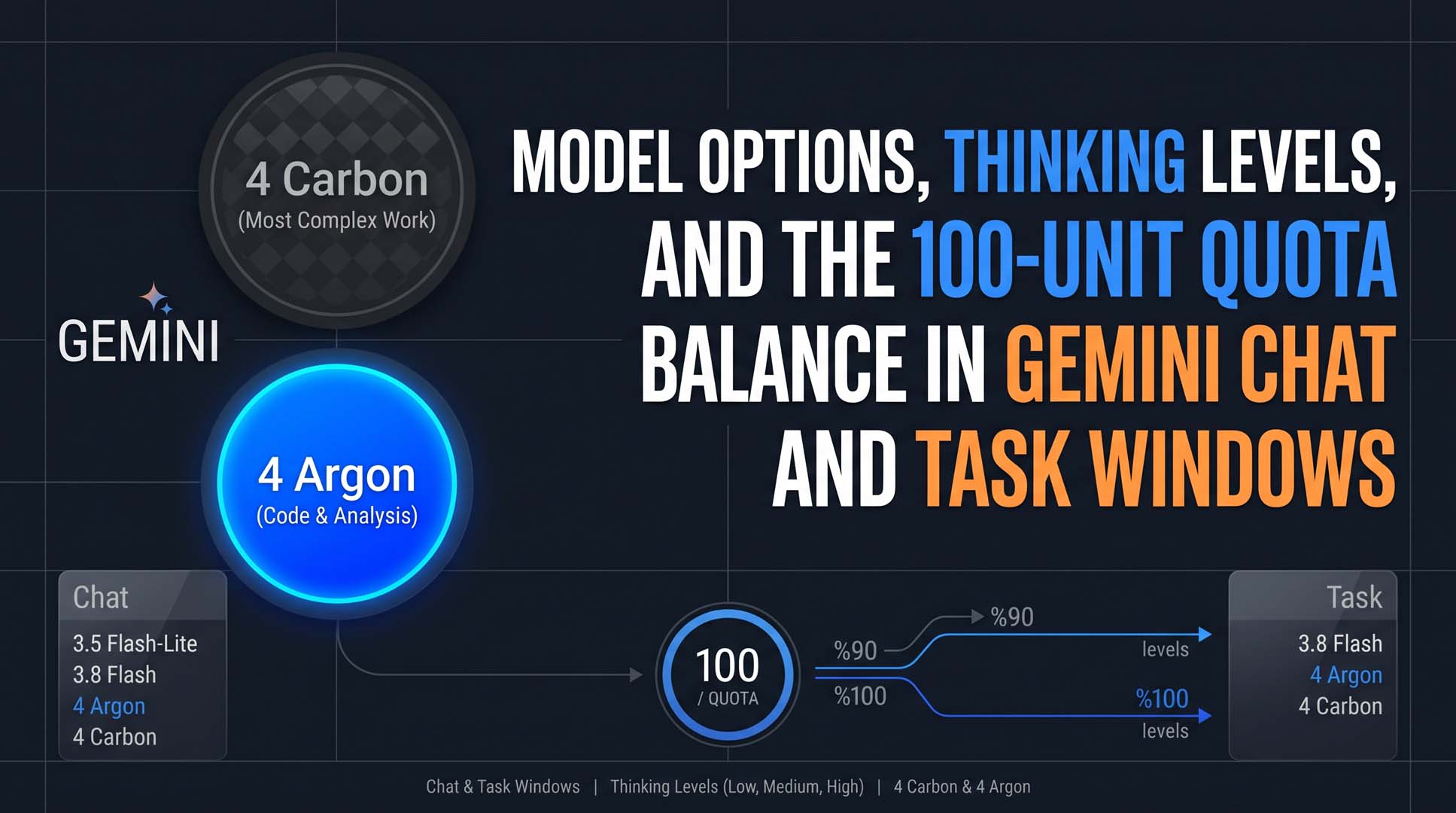
The user interfaces of artificial intelligence platforms and the model options they provide in the background have been updating at a dizzying pace recently. One of the most striking changes directly experienced by users is the structural separation between the Chat (Sohbet) and Task (Görev) windows at the bottom of the Gemini application screen, alongside the newly added element-based naming conventions in the model menu. Next to the standard model names we were accustomed to until recently, we now encounter 4 Argon for code and analysis-focused tasks, and 4 Carbon, which was deployed just a few days ago for the most complex work.
From a chemical perspective, argon is a noble gas located in Group 18 of the periodic table that does not enter into reactions and represents absolute stability. Positioned with the Code & analysis label in the Gemini interface, the 4 Argon model reflects this noble gas stability, aiming to provide a rule-abiding, predictable, and error-free system backbone. Conversely, the element carbon—which is easily combustible and forms the basis of millions of complex organic compounds through its ability to form four covalent bonds—has taken its place in the interface as 4 Carbon under the description Most complex work (1). Carbon’s ability to transform into different crystal structures under high pressure and temperature to become a diamond also establishes a symbolic affinity with the “Gem” ecosystem.
From October 20, 2026 to November 11, 2026: The Silent Farewell of “3.1 Pro” and Capturing Pop-up Menus
To understand this rapid evolution of models and thinking levels, we need to look back three weeks to the study we conducted on October 20, 2026, when neither the Task window nor the 4 Carbon model existed yet. On that date, the Gemini interface presented users with four model tiers—Flash-Lite, Flash 3.8, Pro 3.1, and Argon 4—along with three thinking levels underneath (Low, Medium, and High), creating a total of 12 distinct working combinations in a 4×3 matrix structure. Pro 3.1, which we had used as the superior model for a long time, had aged between two newer-generation models (Flash 3.8 and Argon 4) after the introduction of Argon 4. Particularly in ATG Gem Factory (ATG Gem Fabrikası) conversions—which operate as “instructions that generate instructions”—it had started causing issues such as skipping certain requested changes or leaking factory rules into the final product (“factory leakage”). In contrast, across all 12 conversions performed using the Argon 4 Medium level, zero factory leakage was achieved thanks to multi-layered context isolation.
Right on top of these experiences, during an evaluation on the night of October 21, 2026, the question arose: “Once Argon takes its place, will Gemini give up on the Pro series? Or will it just wait there in this limping, sluggish state?” Producing the responses that day, the Pro 3.1 model made an optimistic prediction about its own future, foreseeing that Google could not abandon the Pro tier in order to fill the cost gap between Flash 3.8 and Argon 4. However, reality on the ground unfolded much faster and more radically: just 20 days after that conversation, on November 10, 2026, Google silently removed the 3.1 Pro model from the Gemini application’s model picker menu while rolling out the 4 Carbon model (5). The role previously held by the Pro tier was split in two: its analytical, stable, and rule-abiding engineering side was handed over to 4 Argon (Code & analysis), while its heaviest, multi-dimensional synthesis side was transferred to 4 Karbon / 4 Carbon (Most complex work).
The most interesting aspect of the matter is the story of how this change was captured. Almost as if there had been a premonition that 3.1 Pro would disappear from the list, an attempt was made a few days earlier to take a screenshot of this model menu on the web interface. However, because the list displaying the models is a pop-up window, the moment the screenshot key was pressed on the computer, focus was lost and the pop-up menu vanished from the screen. Since taking a direct screenshot on the web screen proved impossible, it had to be recorded by taking a photograph of the screen with a phone camera or capturing it via the mobile application. When the images for this study were captured on November 11, 2026, at 14:01 and 14:02, not even 24 hours had passed since 3.1 Pro was removed from the menu (5).
The visual habit illusion here stemmed directly from the number of models in the two windows: while four separate models (3.5 Flash-Lite, 3.8 Flash, 4 Argon, and 4 Carbon) still appeared in the Chat window, only three models (3.8 Flash, 4 Argon, and 4 Carbon) were present in the Task window. Because four models were lined up vertically in the Chat window just like before, at first glance it was assumed that 3.1 Pro was still present in the four-model Chat window and had only been omitted from the three-model Task window. Yet, when the lists of both windows were carefully compared, it became crystal clear that 3.1 Pro had been completely removed from both the Chat and Task windows, and that the sole reason four models appeared in the Chat window while three appeared in the Task window was the exclusion of the 3.5 Flash-Lite model from the Task window.
Structural Differences Between the Four-Model Chat Window and the Three-Model Task Window
When switching between the Chat (Sohbet) or Task (Görev) window via the toggle at the bottom of the Gemini interface, both the number of models in the top model picker menu and the thinking level settings change directly.
Chat Window (4 Models + 3 Thinking Levels = 12 Options): When the Chat window is selected at the bottom, the user is presented with four separate models and a three-tier thinking level menu:
- Quick answers: 3.5 Flash-Lite
- Comprehensive help (Kapsamlı yardım): 3.8 Flash
- Code & analysis: 4 Argon
- Most complex work: 4 Carbon
- Thinking level (Düşünme düzeyi): Low (Fast and efficient), Medium (Balanced depth / Dengeli derinlik), and High (Extra comprehensive / Ekstra kapsamlı).
This structure in the Chat window provides the user with a total of 12 different working options (gears) through the combination of 4 distinct models and 3 separate thinking levels.
Task Window (Only 3 Models = 3 Autonomous Options): When the toggle is switched to the Task window, the number of models on the list drops to three; no other model appears here apart from 3.8 Flash, 4 Argon, and 4 Carbon:
- Comprehensive help (Kapsamlı yardım): 3.8 Flash
- Code & analysis: 4 Argon
- Most complex work: 4 Carbon
In the Task window, the 3.5 Flash-Lite model is completely absent, and the Thinking level selection menu does not appear either. Because the Task window is designed as an “agentic” environment that autonomously plans and executes multi-step jobs rather than single-turn question-and-answer interactions, the system autonomously manages the thinking depth of the three models in this window at a Medium or High level depending on the weight of the task (2). Thus, when the 12 options in the four-model Chat window and the 3 autonomous options in the three-model Task window come together, a total of 15 different usage combinations emerge for the user.
Models Changing on Their Own in the Task Window: Surprises of the Automatic Transmission
In practice, there is a crucial phenomenon frequently encountered while conducting intensive work in the three-model Task window. Even when a user starts working by selecting the 4 Argon model in the Task window and makes no setting changes whatsoever, after a while the system begins using the 4 Carbon model on its own, and occasionally even switches to the 3.8 Flash model.
Although the model picker at the top of the screen is open in top-tier subscriptions (Google AI Ultra), the model selected in the Task window does not remain as an absolute lock. In parallel with the thinking level selection being closed to the user in the Task window, the background task orchestrator dynamically switches among these three models (3.8 Flash, 4 Argon, 4 Carbon) according to the current step of the job being executed:
- Self-Escalation from 4 Argon to 4 Carbon: When the context load becomes heavy during a multi-step skill (Yordam / Skills) execution, long document generation, or comprehensive data analysis in the Task window, the system automatically shifts the gear up to the top model, 4 Carbon, so that the task is not interrupted and complex reasoning can be completed.
- Occasional Drop to 3.8 Flash: Conversely, if a step within the task consists of a more straightforward operation, or if instantaneous response speed and usage quota need to be balanced during back-to-back intensive operations, the system drops down to the 3.8 Flash model again without asking the user.
The fact that automatic routing logic—which can only be toggled on or off via the settings menu in free accounts—operates embedded into the very nature of the Task window in paid top-tier plans without any setting to lock it creates a surprising situation for the user. When the session of a user who believes they started with 4 Argon switches on its own to 4 Carbon, the quota spent per operation suddenly multiplies. Therefore, while working in the Task window, visually monitoring the model header at the top and manually pulling it back to 4 Argon when necessary is of great importance.
October 20 (12 Options) and November 11 (15 Options) Consumption Tables on a 100-Quota-Unit Scale
Even in top-tier artificial intelligence subscriptions, users’ 5-hour and weekly processing capacities are subject to a specific quota budget (3). Leaving monetary costs or complex technical multipliers aside, let us compare the tables of the two periods across a 100-unit quota scale using a purely practical approach.
In our initial study dated October 20, 2026, when the top model of that day, Argon 4 – High = 100 units, was taken as the baseline, the performance ranking, relative quota consumption, and number of operations achievable with a 100-unit quota across the 12 combinations were shaped as follows:
| Perf. Rank | Model and Thinking Combination | Relative Quota Consumption (Argon High = 100) | Number of Jobs per 100 Quota Units | Cost and Performance Characteristic |
| 1 | Argon 4 – High | 100.0 Units | 1 Job | Heaviest parameter network and longest internal verification loop |
| 2 | Argon 4 – Medium | 55.0 Units | 1.8 Jobs | Base weight of the giant model is preserved, internal checks are cut in half |
| 3 | Pro 3.1 – High | 32.0 Units | 3.1 Jobs | Golden Ratio: Delivers higher performance and uses less quota than Argon 4 Low |
| 4 | Argon 4 – Low | 35.0 Units | 2.8 Jobs | Inefficient Zone: Even with short thinking time, base cost of running the Argon engine is high |
| 5 | Pro 3.1 – Medium | 18.0 Units | 5.5 Jobs | At 1/5th the cost of Argon High, balanced consumption for long context and structuring |
| 6 | Flash 3.8 – High | 8.0 Units | 12.5 Jobs | Price/Performance Champion: Provides strict rule checking while using less quota than Pro 3.1 Low |
| 7 | Pro 3.1 – Low | 10.0 Units | 10 Jobs | Due to the base weight of the Pro tier, it costs more than Flash 3.8 High |
| 8 | Flash 3.8 – Medium | 4.0 Units | 25 Jobs | Mainstay step that does not strain quota in daily standard data processing and text tasks |
| 9 | Flash-Lite – High | 2.0 Units | 50 Jobs | Full thinking loop in a lightweight model; head-to-head consumption with Flash 3.8 Low |
| 10 | Flash 3.8 – Low | 2.0 Units | 50 Jobs | Internal thinking cost is minimal; only Flash 3.8 base read/write weight applies |
| 11 | Flash-Lite – Medium | 1.0 Unit | 100 Jobs | 100 separate jobs can be performed with the quota of a single Argon 4 High query |
| 12 | Flash-Lite – Low | 0.5 Units | 200 Jobs | Minimum Consumption: 200 times more economical than Argon 4 High for simple jobs |
With the removal of 3.1 Pro and the placement of 4 Carbon at the summit on November 10, 2026 (5), alongside the addition of the three-model Task window, our reference point was also updated. Assuming that a standard operation performed by our most powerful current model, 4 Carbon, in the Chat window at the High thinking level consumes exactly 100 quota units, the approximate quota units consumed by the 12 options in the four-model Chat window and the 3 options in the three-model Task window (a total of 15 options) are as follows:
| Option Rank | Window Type | Model Name | Thinking Level | Approximate Quota Consumption (On a 100-Unit Scale) |
| 1 | Chat (4-Model) | 4 Carbon | High | 100 Units |
| 2 | Chat (4-Model) | 4 Carbon | Medium | 55 Units |
| 3 | Chat (4-Model) | 4 Carbon | Low | 25 Units |
| 4 | Chat (4-Model) | 4 Argon | High | 60 Units |
| 5 | Chat (4-Model) | 4 Argon | Medium | 33 Units |
| 6 | Chat (4-Model) | 4 Argon | Low | 15 Units |
| 7 | Chat (4-Model) | 3.8 Flash | High | 18 Units |
| 8 | Chat (4-Model) | 3.8 Flash | Medium | 10 Units |
| 9 | Chat (4-Model) | 3.8 Flash | Low | 4.5 Units |
| 10 | Chat (4-Model) | 3.5 Flash-Lite | High | 4 Units |
| 11 | Chat (4-Model) | 3.5 Flash-Lite | Medium | 2 Units |
| 12 | Chat (4-Model) | 3.5 Flash-Lite | Low | 0.8 Units |
| 13 | Task (3-Model) | 4 Carbon | Autonomous (Medium-High) | 135 Units |
| 14 | Task (3-Model) | 4 Argon | Autonomous (Medium-High) | 80 Units |
| 15 | Task (3-Model) | 3.8 Flash | Autonomous (Medium) | 25 Units |
Field Quota Observations: Heavy Text Load, Upfront Deductions, and the Weekly Quota Bottleneck
Although theoretical 100-unit tables on paper are based on single, standard-length queries, there are striking quota realities directly experienced in heavy production workflows such as the ATG Gem Factory, where approximately 30,000 characters of system instructions and 20,000 characters of product text are processed simultaneously:
- Closing of the “High” and “Medium” Quota Gap in Large Texts: While nearly a two-fold quota difference is expected between Argon High and Argon Medium in standard-length operations (100 units vs. 55 units on the October 20 scale; 60 units vs. 33 units on the November 11 scale), in heavy workflows where a 20,000-character full-text output is generated at every step, the two levels have been observed to consume almost equal quota. The reason is that 80–85% of the total quota bill consists of the 50,000-character reading (input) and 20,000-character full-text writing (visible output) load—which is identical in both levels—and that the Medium level pushes its thinking ceiling to the limit when faced with high task difficulty.
- Upfront Quota Deduction and Lack of Refunds on Short Jobs: The moment an instruction is typed and the send button is pressed, the system deducts an upfront percentage from the quota before even performing the job. Furthermore, within the same session, whether a very brief confirmation sentence is written or long, consecutive instructions are listed, nearly the exact same standard slice is deducted due to the weight of the past conversation context; for jobs that finish quickly, the unused portion is not refunded to the quota.
- Quota Left at 90% Reaching 100% on Its Own: It has been observed that a quota left at around 90% within a 5-hour window to be used later reaches 100% and locks up completely on its own after a while, even though the user performs no new operations. The delayed billing of the final operation’s output and the system rounding the counter directly up to 100% because the remaining 10% balance is insufficient to cover the next upfront opening package of the selected heavy model demonstrate that quota measurements are performed with rough rounding rather than a precision scale.
- Weekly Quota Bottleneck, the December 1 Price Hike, and Cross-Platform Migration Risk: Whereas during the older Flash and Pro eras only the 5-hour quotas occasionally filled up even during the most intensive work, with the high consumption of the Argon and Carbon models, the Weekly Quota has for the first time become a real bottleneck (for instance, 29% of the weekly quota being exhausted within barely the first 1.5 days of the weekly period). Moreover, when the introductory discount ends on December 1, 2026, the quota consumption weight of the Argon series will double. This aggressive quota policy pushes advanced users—who are building a massive library of 180 skills (90 Turkish and 90 English)—toward migrating to the Claude platform for text and architectural production while keeping Gemini on a lower subscription tier solely to compensate for visual generation needs.
Which Window and Level Should Be Chosen for Which Job?
Emerging from the 100-unit quota scale and field experiences, this picture offers a strategic roadmap for daily artificial intelligence usage and skill (Yordam / Skills) development processes (4):
- The Invisible Load of the Task Window and Autonomous Switching Risk (From 25 Units to 135 Units): Featuring only the 3.8 Flash, 4 Argon, and 4 Carbon models, the Task window consumes more quota than the Chat window because, upon receiving a single prompt, it autonomously executes planning, tool calling, checking, and verification steps across multiple turns in the background. 4 Carbon, which spends 100 units in the Chat window, reaches approximately 135 units in the Task window due to autonomous loops. Furthermore, even if one starts with 4 Argon (80 units) in the Task window, the system’s ability to switch on its own to 4 Carbon (135 units) can rapidly deplete the quota. Therefore, the Task window should only be used for multi-step file, spreadsheet, and long crossword/code constructions, and one must monitor whether the model picker changes on its own.
- The Golden Ratio in Stability and Quota Savings (4 Argon Low and Medium): In daily text editing, code inspection, and structured skill workflows, the 4 Argon Low (15 units) or 4 Argon Medium (33 units) options utilize the quota 3 to 6.5 times more efficiently than the 4 Carbon High (100 units) option. Moreover, 4 Argon exhibits a much more stable line than both the former Pro 3.1 and 4 Carbon when it comes to zero factory leakage and strict adherence to rules (low hallucination/fabrication rate) (4).
- Cross-Gear and Hybrid Production Strategy: When solving a highly complex problem, using 4 Carbon Low (25 units) consumes less quota than using 4 Argon Medium (33 units). On the other hand, during long skill conversions, conducting the preparation and approval steps on 3.8 Flash and shifting the gear to 4 Argon Medium only for the final full-output step—which requires zero pruning and zero leakage—is the most effective way to preserve the 5-hour and weekly quotas by half.
- Flash Comfort in Daily Use of Produced Skills (From 0.8 Units to 18 Units): Even though 4 Argon is required to build a skill from scratch, when running completed skills in daily life or for simple information queries, the 3.8 Flash (4.5 – 18 units) option in the Chat window and the 3.5 Flash-Lite (0.8 – 4 units) option—which exists exclusively in the Chat window—allow hundreds of operations to be performed while barely eroding the weekly quota at all.
The secret to using artificial intelligence tools efficiently is not running the top model at the highest thinking level for every job, but rather knowing how to select the right model and the right thinking gear between the four-model Chat and three-model Task windows according to the nature of the operation.
References
[1] Google Blog, Gemini 4 Carbon is now available, Accessed: November 12, 2026, https://blog.google/innovation-and-ai/models-and-research/gemini-models/gemini-4-carbon-now-available/
[2] Google Blog, Introducing Gemini 4 Argon: Designed to solve your hardest problems, Accessed: November 12, 2026, https://blog.google/innovation-and-ai/models-and-research/gemini-models/gemini-4-argon/
[3] Google AI Studio, Gemini Developer API Pricing and Token Quotas, Accessed: November 12, 2026, https://aistudio.google.com/docs/pricing
[4] Artificial Analysis, Gemini 4 Carbon vs Gemini 4 Argon Performance and Reasoning Comparison, Accessed: November 12, 2026, https://artificialanalysis.ai/models/comparisons/gemini-4-carbon-vs-gemini-4-argon
[5] 9to5Google, Gemini app adds 4 Carbon for Ultra subscribers and removes 3.1 Pro from model picker, Accessed: November 12, 2026, https://9to5google.com/2026/11/10/gemini-app-4-carbon/
Article Credits
This article was prepared by Aydın Tiryaki on November 11-12, 2026, using the Gemini 4 Argon model running in the Chat window of the Google Gemini platform and the Human-AI Interactive Editor (v2.33) skill. The core concept of the article, the model and thinking level identifications made through screenshots of the 4-model Chat (3.5 Flash-Lite, 3.8 Flash, 4 Argon, 4 Carbon) and 3-model Task (3.8 Flash, 4 Argon, 4 Carbon) windows on the Gemini mobile/desktop interface, the experience of capturing pop-up menus with a phone camera because they vanish when taking screenshots on the web, the comparison of the October 20-21, 2026 12-option matrix (Flash-Lite, Flash 3.8, Pro 3.1, Argon 4) archive study with today’s 15-option matrix, the October 21 foresight regarding the future of the Pro 3.1 model and the visual habit effect created between the 4-model Chat and 3-model Task windows by its removal on November 10, 2026, the chemical properties of the elements (the analogy of Argon’s stability versus Carbon’s combustibility and diamond/gem crystal structure), the field observation that the system switches on its own to 4 Carbon and occasionally to 3.8 Flash despite starting with 4 Argon in the Task window, the inequities in the quota counter (upfront deductions, self-climbing from 90% to 100%, 5-hour and weekly quota bottlenecks, closing of the Medium-High gap in large texts, and the scenario of migrating to Claude), and the framework of comparing all models as 15 separate options on the “Carbon High = 100 Quota Units” scale belong entirely to the author Aydın Tiryaki; Gemini 4 Argon served as a research and writing assistant in researching background technical data and November 10, 2026 model change records, analyzing the October 20, 2026 archive PDF document, calculating the 12-option and 15-option matrices on the 100-unit scale, structuring the text, and rewriting it in English with full contextual fidelity.
- Version 1.01 (11.11.2026 17:48): The first complete article version was created using the Mod 2 (2A-2G) sequence by combining screenshot analyses compiled during the conversation, Argon and Carbon element analogies, and the 15-option (Chat and Task window) comparison table on a 100-quota-unit scale.
- Version 1.02 (11.11.2026 23:54): Preserving the Version 1.01 text in full under Mod 0E (Master Article Protection Lock), the author line was updated, the section examining the system’s autonomous switching to 4 Carbon and occasionally 3.8 Flash while working with 4 Argon in the Task window was added to the main body, and the lead text, conclusion items, and credits were expanded with this finding.
- Version 1.03 (12.11.2026 06:36): Preserving the Version 1.02 text without pruning a single word under Mod 0E, the 12-option matrix data from the 75-page archive study dated October 20-21, 2026, the October 21 foresight on Pro 3.1, the removal of Pro 3.1 from the menu on November 10, 2026 (Reference 5), the experience of pop-up menus vanishing during screenshots and being photographed with a phone camera, the visual habit effect, and field quota observations (closing of the Medium-High gap in large texts, upfront quota deduction, self-climbing from 90% to 100%, weekly quota bottleneck, December 1 price hike, and Claude migration evaluations) were added.
- Version 1.04 (12.11.2026 06:42): The 12-option relative quota consumption, number of jobs per 100 quota units, and performance characteristic data from the October 20, 2026 study were added as a complete table to the article body.
- Version 1.05 (12.11.2026 06:44): The distinction that four models (
3.5 Flash-Lite, 3.8 Flash, 4 Argon, 4 Carbon) appear only in the Chat window while only three models (3.8 Flash, 4 Argon, 4 Carbon) appear in the Task window was clarified across subheadings, body text, the 15-option comparison table, and the Article Credits section. - Version 1.06 (12.11.2026 06:49): All internal JPEG and PDF citation tags were completely removed for clean copy-pasting into WordPress, and the entire article was rewritten in English under Mod 3 with zero summarization, full structural parity, and the English version of Reference 2 activated.
| aydintiryaki.org | YouTube | Aydın Tiryaki’nin Yazıları ve Videoları │Articles and Videos by Aydın Tiryaki | Bilgi Merkezi│Knowledge Hub | ░ Virgülüne Dokunmadan │ Verbatim ░ | ░ Gemini Sohbet ve Görev Pencerelerinde Model Seçenekleri, Düşünme Düzeyleri ve 100 Birimlik Kota Dengesi │Model Options, Thinking Levels, and the 100-Unit Quota Balance in Gemini Chat and Task Windows ░ 12.11.2026

