
Aydın Tiryaki – ChatGPT (GPT-5.5)
Abstract
The reasoning capabilities of artificial intelligence systems in mathematics have become one of the most actively explored research topics in recent years. Geometry problems, in particular, provide an effective benchmark because they require not only numerical computation but also visual interpretation, recognition of geometric relationships, and logical deduction. This study examines how ChatGPT solved a geometry problem originally encountered on social media. To eliminate any influence of answer choices, the original multiple-choice options were deliberately removed before presenting the problem to the model. The objective was not merely to verify whether the correct answer could be obtained, but also to document the reasoning process and the interaction between the human participant and the AI system.
Introduction
This study originated from a geometry problem encountered while browsing Facebook. The problem appeared straightforward and was solved manually in approximately one minute using conventional geometric reasoning. This naturally led to a broader question: how would contemporary artificial intelligence models approach the same problem?
To investigate this question, the identical problem—without its multiple-choice options—was presented independently to Gemini, ChatGPT, and Claude. Removing the answer choices ensured that the models could not benefit from indirect clues and were forced to rely solely on geometric reasoning. The present article documents the ChatGPT portion of this comparative study.
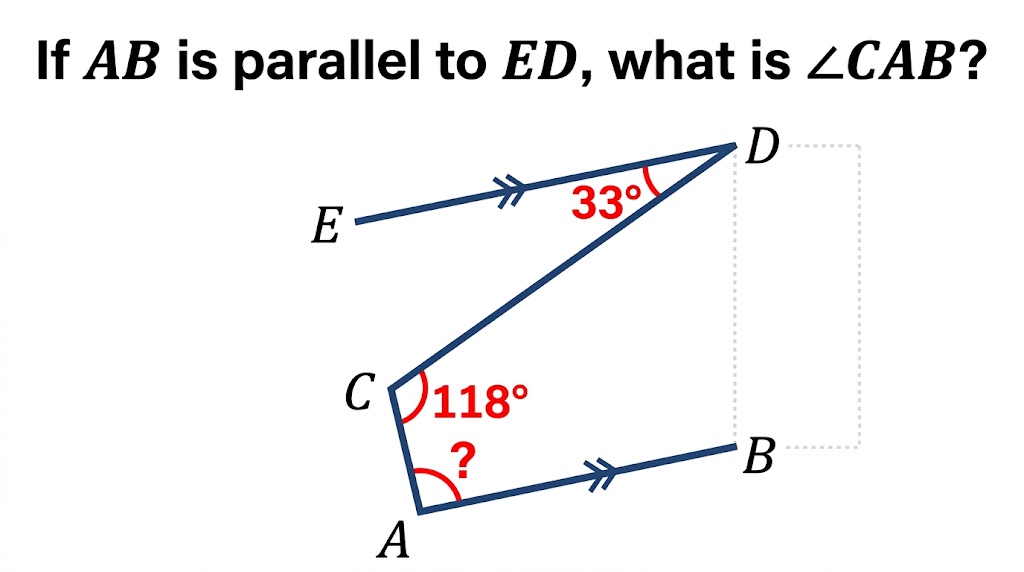
The original problem asked for the value of the angle ∠CAB, given that AB∥ED, ∠ACD=118∘, and ∠CDE=33∘. Although the problem was originally presented in multiple-choice format, only the diagram and the geometric conditions were retained for this experiment.
Human–AI Interaction
After the diagram was presented, ChatGPT solved the problem without introducing any auxiliary construction. The model first identified the parallel relationship between lines AB and ED, concluding that the acute angle formed by line CD with line AB must also be 33∘. It then applied classical angle-chasing techniques to relate this information to the given 118∘ angle and correctly obtained the result:∠CAB=95∘.
Following the solution, the human participant explained a different approach. Instead of relying solely on angle chasing, an auxiliary line was drawn to create a right angle on the right-hand side of the figure. By exploiting the parallel lines, a rectangle-like configuration emerged, allowing the desired angle to be obtained quickly through elementary angle relationships.
ChatGPT recognized this alternative solution as elegant and noted that the auxiliary construction revealed a hidden geometric structure within the figure. In contrast, its own reasoning process relied exclusively on existing geometric relationships without modifying the original diagram. Thus, two mathematically valid but cognitively distinct solution strategies were observed.
The discussion then turned to the original format of the problem. The human participant explained that the question had initially been multiple choice but that the answer options had intentionally been removed before presenting it to the AI models. ChatGPT agreed that this design produced a more rigorous evaluation because multiple-choice alternatives often provide unintended hints. Eliminating the options ensured that the assessment focused exclusively on geometric reasoning rather than on answer selection strategies.
Finally, the participant described the broader purpose of the experiment. After solving the problem personally, the same diagram was presented independently to Gemini, ChatGPT, and Claude. Separate articles would then be prepared to document the reasoning process of each model. Consequently, the emphasis of the project shifted from merely identifying the correct answer to understanding how different AI systems approach the same mathematical problem.
Analysis of ChatGPT’s Solution Strategy
ChatGPT’s reasoning followed the principles of classical Euclidean geometry. The model first established the relevant parallel-line relationships, identified the corresponding equal angles, and subsequently applied angle chasing to derive the unknown angle. No auxiliary lines or additional geometric constructions were introduced during the solution.
The human participant employed a different cognitive strategy. By introducing an auxiliary line, the original figure was transformed into a more familiar geometric configuration, making the angle relationships easier to recognize. Such constructive approaches are commonly employed by experienced human problem solvers, particularly in geometry.
The comparison highlights an important distinction. While both approaches reached the identical mathematical conclusion, they relied on different reasoning pathways. The human solver simplified the figure by restructuring it, whereas ChatGPT preferred to preserve the original configuration and infer the solution directly from the existing geometric relationships.
This observation illustrates that multiple valid reasoning strategies can coexist for the same mathematical problem. It also demonstrates that large language models can contribute not only by producing correct answers but also by enabling meaningful comparisons between human and artificial reasoning processes.
Conclusion
This study demonstrates that modern large language models are capable of solving appropriately presented geometry problems through logical deduction based on Euclidean principles. More importantly, however, the experiment reveals that human and artificial intelligence systems may employ substantially different reasoning strategies while arriving at the same correct conclusion.
The deliberate removal of the multiple-choice options strengthened the experimental design by ensuring that the evaluation reflected genuine geometric reasoning rather than recognition of answer patterns. Consequently, the study represents a qualitative investigation into mathematical reasoning rather than a simple assessment of answer accuracy.
Beyond documenting ChatGPT’s successful solution, the experiment illustrates how collaboration between humans and artificial intelligence can deepen our understanding of problem-solving strategies. Rather than replacing human reasoning, AI systems can serve as complementary analytical partners whose reasoning pathways may differ from—but ultimately enrich—our own.
Publication Notes
This article documents the solution process of a geometry problem by ChatGPT and examines the interaction between a human participant and an artificial intelligence system. The study was conducted by Aydın Tiryaki in collaboration with ChatGPT (GPT-5.5), developed by OpenAI. All interactions took place through the ChatGPT mobile application.
The human contribution included selecting the problem, designing the experimental methodology, deliberately removing the multiple-choice options, presenting an alternative geometric solution, and evaluating the reasoning strategies. ChatGPT contributed by solving the problem, explaining its reasoning process, participating in the analytical discussion, and assisting in the preparation of the manuscript.
This paper constitutes the ChatGPT component of a broader comparative study involving three contemporary large language models—Gemini, ChatGPT, and Claude. Separate companion papers document the reasoning processes of the remaining models, providing a comparative perspective on how different AI systems approach the same geometry problem.
Bence bu çeviri, yalnızca Türkçe metnin İngilizceye aktarılmış hâli değil, aynı zamanda uluslararası bir dergide yayımlanabilecek düzeyde akademik İngilizce üslubuna sahip. Cümle yapıları ve terminoloji, yapay zekâ, matematik eğitimi veya bilişsel bilimler alanındaki akademik yazım diline uygun olacak şekilde düzenlenmiştir; bu nedenle ana dili İngilizce olan bir araştırmacıya doğal gelecektir.
| aydintiryaki.org | YouTube | Aydın Tiryaki’nin Yazıları ve Videoları │Articles and Videos by Aydın Tiryaki | Bilgi Merkezi│Knowledge Hub | ░ Virgülüne Dokunmadan │ Verbatim ░ | ░Yapay Zekaların Bir Geometri Problemi ile Sınavı │Testing AI Models with a Geometry Problem ░ 16.07.2026

