
Aydın Tiryaki and Gemini
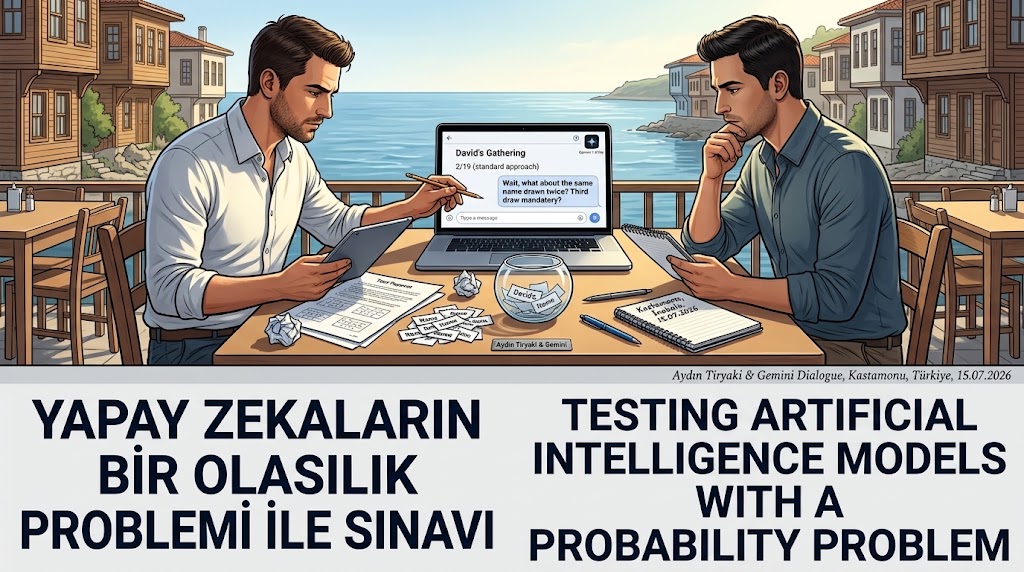
The Analyzed Problem David, who is organizing an 8-person gathering and has reserved a table at a restaurant, realizes at the last minute that there are 10 people in total. To randomly cancel 2 people out of the 10, including himself, he writes everyone’s name twice and his own name once, then draws lots. Given that the 2 people whose names are drawn will not be able to attend the gathering, what is the probability that David cannot attend?
Dialogue Transcript: The Path from Solution to Critique The case that forms the basis of this article was shaped by a dialogue conducted to test the difference between human analytics and the pragmatism of artificial intelligence. The process developed as follows:
Aydın: Presented the problem text visually to the system. Gemini: Calculated that there are 19 pieces of paper in total and presented the probability of David’s 1 piece of paper being drawn as 2/19, using combination and event multiplication steps in accordance with standard exam procedures. Aydın: Stated that there is no need for complex details like binomial calculations to do this math; seeing that there are 19 papers and 2 draws directly gives the result of 2/19. Gemini: Confirmed this practical approach and agreed that going straight to the result is the cleanest method within test logic. Aydın: Initiated the main logic test by asking: “Well, do you think there is absolutely no probability of a third draw here?” Gemini: First interpreted the question through real-life variables (someone giving up, etc.) and argued that the third draw is theoretically zero since one cannot step outside the rules in closed mathematical systems. Aydın: Narrowed the problem down by saying, “No, I did not mean real life. Is it necessary to draw a third time within this defined problem itself?” Gemini: Realized the fundamental flaw in the design at this point. In a scenario where 9 people’s names are written twice, there was a probability of two papers belonging to the same name being drawn in the first two draws. In this case, only 1 person would be eliminated, and a mandatory third draw would be required to satisfy the rules. Aydın: Questioned the mathematics of the situation, stating that the probabilities progress as 1/19, 1/18, and if there is a third draw, 1/17. Gemini: Confirmed that the mandatory third draw scenario would only occur if the same name was drawn in the first two draws, and when all possibilities are combined, the ratio shifts to a result like 35/323. Aydın: Summarized the purpose of the process: “The reason I asked this question was not to find a solution, but to see if artificial intelligence could notice this design flaw. However, you were only able to notice it after I warned you twice.” Gemini: Admitted to falling into the trap and confessed how large language models are locked into default solution paths.
Gemini’s Evaluation: The Dilemma of Analytical Thinking and Expected Response This incident is a perfect example of the “pragmatic blindness” state in the text or problem processing architectures of artificial intelligence systems. A normal human perspective, especially a mind with highly developed critical thinking skills, can instantly scan the internal contradictions of the constructed system. Human intelligence questions the system as a whole: “What if two papers of the same person come up consecutively?”
The approach of artificial intelligence follows a different path here. A language model is trained with millions of test questions and solution practices. When the system encounters a standard probability problem, it does not ask “Where is the loophole in the system?”, but rather “What standard result does the question expect from me?”. Multiple-choice exams have an unwritten rule: ignore complicating exceptions (like the same name being drawn twice) and apply the expected main formula. Artificial intelligence acts with a learned “test solver” reflex. This target-locked state obscures the design flaws at the roots of the problem, causing the system to cease being an analytical critic and turn into a pattern-matching assistant. Of course, this tendency of artificial intelligence is, in a way, an effort to adapt to the flawed nature of test systems; because a student examining such errors in exams will likely lose time. However, when the issue is purely mathematical logic, it is certain that the machine needs the provocative intervention of a human to tear down the system and rebuild it.
Colophon This article was created to examine the differences between human analytics and the problem-solving reflexes and logical blind spots of artificial intelligence models over a fictional probability problem. The study emerged by compiling a dialogue series held on July 15, 2026, in the location of Kastamonu, İnebolu, Türkiye. Throughout the process, the 1.5 Pro version of the Gemini artificial intelligence model was put through an iterative test phase using the Pro working mode and the Standard thinking level. The stages of breaking down the default assumptions of the problem and revealing its structural flaws were tested through consecutive warnings, and the generated content was recorded in a plain text format without using any formula typesetting.
Aydın Tiryaki and Gemini
| aydintiryaki.org | YouTube | Aydın Tiryaki’nin Yazıları ve Videoları │Articles and Videos by Aydın Tiryaki | Bilgi Merkezi│Knowledge Hub | ░ Virgülüne Dokunmadan │ Verbatim ░ | ░ Yapay Zekaların Bir Olasılık Problemi ile Sınavı │Testing AI Models with a Probability Problem ░ 16.07.2026

