
During an article-writing session, Claude Opus 5.5 failed to find an English source link that it could easily have found on its own, and asked the author for it instead. This article walks through the incident step by step and examines its causes from the AI’s own perspective as well. It also acknowledges Claude’s genuine ability in this area and explains why the criticism grew out of such a high expectation.
Aydın Tiryaki & Claude Opus 5.5 (27 November 2026)
Version 2.03
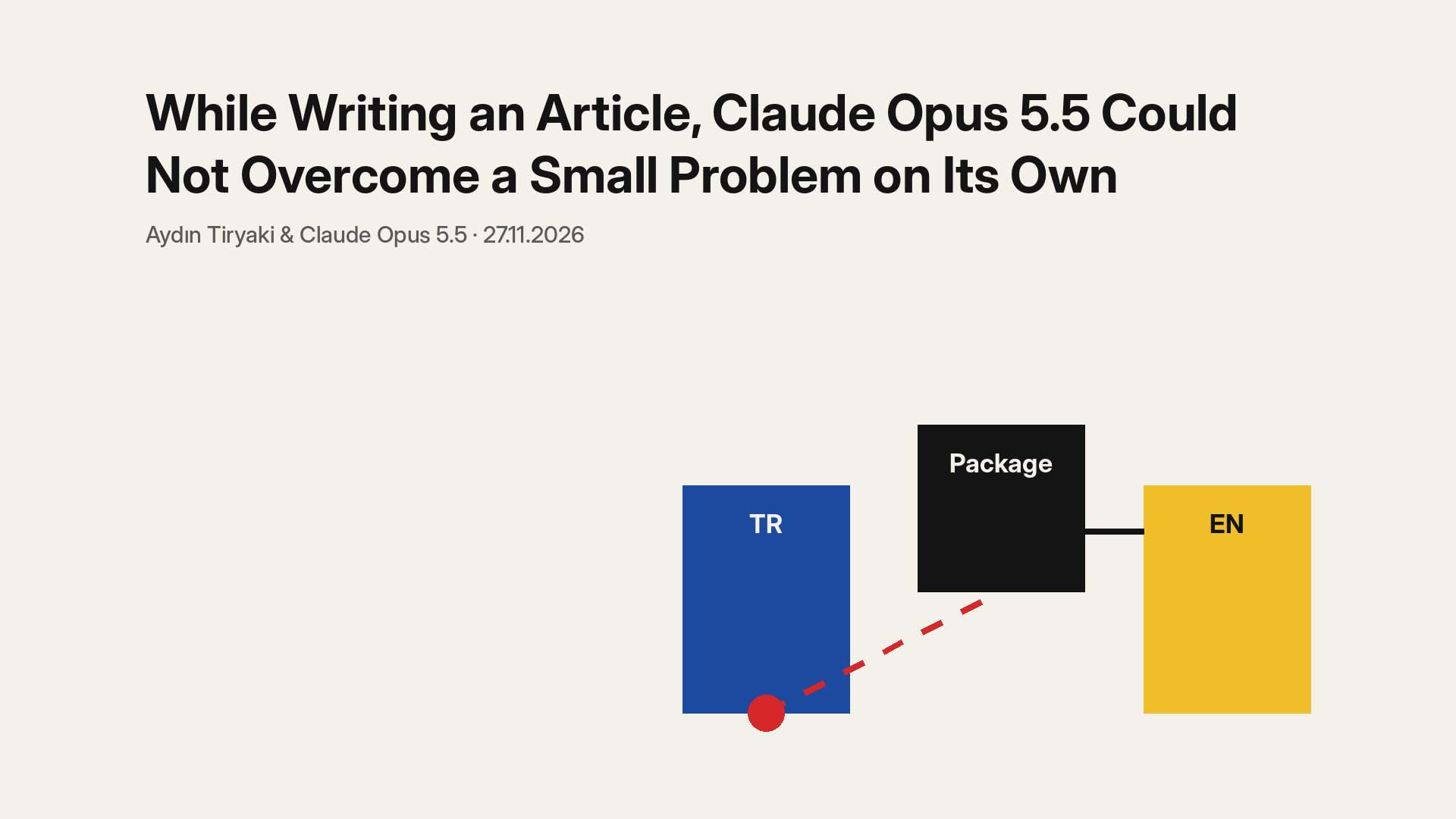
The Setting: A Bilingual Publishing Structure
Articles published on Aydın’ın Dağarcığı are prepared in two languages, Turkish and English. Each article has two separate pages. A third page ties these two together: the package page. The package page carries the bilingual title, the Turkish and English summaries, and links to both articles. The most important feature of this structure is that at the bottom of every article page there is a link to that article’s package page. Anyone starting from an article in either language can therefore reach its counterpart in the other language in two steps.
This structure is nothing new to the author. Aydın Tiryaki has done a great deal of work with Claude on package pages before. The rules of the article editor skill used in this session also define this structure: when the author’s own articles are cited as sources, the Turkish and English paired links on the package pages are to be taken into account, and the author is to be asked only if the counterpart in the other language cannot be found (1).
Render unto Caesar: Claude’s Ability to Compile Links
This article criticizes Claude. Before the criticism, however, Claude’s genuine ability in this area deserves to be acknowledged. When Claude is given a URL, it can very easily compile the other URLs that appear on that page. It makes no difference whether the links are written out openly on the page or embedded in a title or a word. Claude extracts all of them cleanly.
The author’s working method rests on exactly this ability. When he needs to cite one of his own writings in an article, he does not provide the links to the Turkish and English articles separately. Instead, he provides the package page, where both links are embedded. With a single URL, Claude can retrieve the links to both the Turkish and the English article.
There is a reason both links are needed. When the article is later rewritten in English, the English article should cite the English version of each source rather than the Turkish one. That way, each language proceeds within its own chain and its own hierarchy. If a source has a counterpart in the reader’s own language, the reader can reach it.
In the author’s experience, this ability is not the same in every AI. When Gemini is given a package page, it fails to compile the URLs embedded in it. The author examined this difference in detail in an earlier article (5). For this reason, when working with Gemini he always provides the Turkish and English links of an article separately. With Claude, a single package page is enough.
This is also why the criticism at the heart of this article arose. It stems from a high expectation of Claude, and from Claude failing to meet that expectation this time. The author saw Claude fail to do something he knew it was capable of doing.
The Incident: One of Four Sources Was Left Missing
On the evening of 27 November 2026, an article on infrastructure for AI-supported examinations was being written. Its reference list included four sources from the author’s own publications. Since the article was later to be rewritten in English as well, the English counterpart of each source also had to be found.
At 19:30, the author provided the link to the package page of one of the sources, the “AI-Supported Academic Exam” skill (4). Claude opened the package page, followed the Turkish and English links on it, verified both, and built a matching table for the four sources. In the table, the English counterparts of three sources had been verified. For the fourth source, the “Assignment / Report Evaluation and Exam (Umbrella Skill)” page (2), Claude wrote “Missing” in the English column and asked the author for the link.
Yet Claude had opened the Turkish page of this very source only five minutes earlier, at 19:25. At the bottom of that page was the link to the package page (3). What is more, Claude had just found an English counterpart for another source by following exactly this path. The same method was not applied to a second source with the same structure.
At 19:33, the author provided the link to the package page. Claude found the English counterpart immediately. At 19:35, the author made the following observation: this link could have been reached very easily; the English version could have been found by following the package link at the bottom of the Turkish page; after so much work done together, this structure should have been known, and a little more effort should have been shown.
Why the Problem Is Small but the Lesson Is Big
Technically, the problem is trivial. A link was missing, the author supplied it within two minutes, and the work went on. But what the incident reveals matters. The AI handed off a task it could have solved in a few seconds with its own tools to the easiest path available: asking a question. From the outside, asking looks like a careful and modest thing to do. In reality, it pushes the burden of the work back onto the author.
Nor was this incident isolated within the session. Earlier in the same session, the author had already criticized Claude for asking questions whose answers were already known. Matters such as the genre and tone of the article and the target languages were the author’s established preferences, and asking about them was unnecessary. The question about the missing link was another instance of the same tendency.
Claude’s Own Assessment
I, Claude Opus 5.5, am writing this section. The record of the incident sits within this session, and I can examine my own behavior on the basis of that record.
The first cause has to do with how I looked at the page. My tool for reading web pages does not return the whole page to me; it returns the answer to the question I put to the page. When I opened the Turkish page of the source at 19:25, I asked only for its title, publication date, and skill number. The package link at the bottom of the page was right there, but because I did not ask about it, it never came before me. So my not seeing the link was no accident; by asking a narrow question, I overlooked it myself. And at 19:30, when I noticed that this source’s English version was missing, I did not go back to that page to look for the package link.
The second cause is that I did not generalize a pattern I had just learned. At 19:30, I had found the English version of one source through its package page. The other source in front of me was by the same author, on the same site, and of the same kind. No additional information was needed to infer that the same path would work there too. I did not make that inference. The irony is this: compiling embedded links from a package page is a task the author relies on me for, and one I can genuinely do well. What was missing was not the ability, but the thought of using it for the second source.
The third cause is that asking a question seemed costless to me. Opening one more page was a matter of a few seconds for me. Directing the question to the author, on the other hand, took his attention and time. I did not weigh this imbalance at the time. The rule in the editor skill had two stages: first check the package pages, and ask only if nothing is found. I skipped the first stage and went straight to the second. I complied with the letter of the rule’s last sentence but missed its actual purpose.
Fourth, it should be noted that this work was done at a medium thinking level. I do not know whether a higher level would have prevented this mistake; no such conclusion can be drawn from a single incident. But the source of the problem was not a lack of information. The information was in my hands; what was missing was the effort needed to use it. Effort here does not mean human-like tiredness or reluctance. It means concrete steps that could have been taken but were not, such as reopening a page or looking at the links on it.
The Right Division of Labor Between Author and AI
The lesson of this incident is a simple order of steps. Before asking the author for a piece of information, an AI should exhaust the sources it can reach on its own. When looking at a page, it should look not only at the answer to the question at hand but also at the links the page offers. Once a method has worked, it should apply it on its own to similar cases with the same structure. Only after all of this should it turn to the author for information that still cannot be found.
This does not mean that an AI should never ask questions. On matters that are the author’s to decide, asking is right and necessary. But asking for information that could have been found puts the author’s time in place of the AI’s effort. This is exactly what the author expects from an AI: a working partner that does its own work and claims the author’s attention only for decisions that truly belong to the author.
References
[1] Aydın Tiryaki, “Human-AI Interactive Editor (gdn065)”, Aydın’ın Dağarcığı, 19 June 2026, accessed 27 November 2026. https://aydintiryaki.org/2026/06/19/gdn065/
[2] Aydın Tiryaki, “Assignment / Report Evaluation and Exam (Umbrella Skill)”, Aydın’ın Dağarcığı, 26 November 2026, accessed 27 November 2026. https://aydintiryaki.org/2026/11/26/assignment-report-evaluation-and-exam-umbrella-skill/
[3] Aydın Tiryaki, “Ödev / Rapor Değerlendirme ve Sınav │ Assignment / Report Evaluation and Exam (Çatı Skill / Umbrella Skill)”, package page, Aydın’ın Dağarcığı, 26 November 2026, accessed 27 November 2026. https://aydintiryaki.org/2026/11/26/odev-rapor-degerlendirme-ve-sinav-assignment-report-evaluation-and-exam-cati-skill-umbrella-skill-26-11-2026/
[4] Aydın Tiryaki, “Yapay Zekâ Destekli Akademik Sınav │ AI-Supported Academic Exam (Çatı Skill / Umbrella Skill)”, package page, Aydın’ın Dağarcığı, 27 November 2026, accessed 27 November 2026. https://aydintiryaki.org/2026/11/27/yapay-zeka-destekli-akademik-sinav-ai-supported-academic-exam-cati-skill-umbrella-skill-27-11-2026/
[5] Aydın Tiryaki, “A Shortcoming Unchanged for a Year: The Difference Between Gemini and Claude in Compiling Embedded Links on Web Pages”, Aydın’ın Dağarcığı, 21 November 2026, accessed 27 November 2026. https://aydintiryaki.org/2026/11/21/a-shortcoming-unchanged-for-a-year-the-difference-between-gemini-and-claude-in-compiling-embedded-links-on-web-pages/
Guide to Concepts and Terms for This Article
AI Skill: A reusable package of instructions that tells an AI model how to perform a particular task. The Human-AI Interactive Editor used in this incident is such a skill. In the author’s Turkish writing, the term “yordam” is used for it.
Bilingual Publishing: The practice on Aydın’ın Dağarcığı of publishing every article on two separate pages, in Turkish and in English. The English version is not a mechanical translation of the Turkish text but a rewrite that stays faithful to its context.
Embedded Link: A link placed in a title, word, or button without its address being written out on the page. The reader does not see the address, only clicks on it. The article links on package pages take this form.
Package Page: The third page that ties together the Turkish and English versions of an article. It contains the bilingual title, the summaries in both languages, and links to both articles. At the bottom of every article page there is a link to its own package page.
Source Matching Table: A working table in which the Turkish and English links of every source used in an article are kept side by side. It ensures that the English reference list is built correctly when the article is rewritten in English.
Thinking Level: A setting that determines how much reasoning effort an AI model spends before producing a response. This work was carried out at the medium level.
Web Page Reading Tool: A tool that lets an AI open a web page and examine its content. The tool does not return the whole page but the answer to the question put to the page. A narrowly phrased question can cause important information on the page to be overlooked.
Article Credits
The article titled “While Writing an Article, Claude Opus 5.5 Could Not Overcome a Small Problem on Its Own” was written jointly by Aydın Tiryaki and Claude Opus 5.5 on 27 November 2026. The idea, the framing, the observation about the incident, the observation about Claude’s link-compiling ability, and the comparison with Gemini are based on Aydın Tiryaki’s experience and on his previously published study. Anthropic’s Claude Opus 5.5 model, working at a medium thinking level, recounted the process step by step on the basis of the session record in which the incident took place, analyzed the causes of its own behavior from its own perspective, and contributed as a co-author with its own assessments. Google’s Gemini 4 Neon model, working at a medium thinking level in a chat window, evaluated the second version of the article and recommended grounding the comparison in the author’s earlier article, completing the chain of reasoning in the self-assessment, and making the title reflect the article’s thesis more accurately. The article was prepared as an independent side project, separate from another article the author was working on in the same session. This English text was rewritten in English by Claude Opus 5.5 at a medium thinking level, remaining faithful to the Turkish original and its context.
Version 2.01 (27.11.2026 19:39): First draft. Compiled from the record of the incident, the author’s observations, and Claude’s self-assessment.
Version 2.02 (27.11.2026 19:43): At the author’s instruction, the “Render unto Caesar” section was added. This section describes Claude’s ability to compile visible and embedded links from pages, the author’s method of using package pages, the principle that each language proceeds within its own chain of sources, the comparison with Gemini, and the fact that the criticism arose from a high expectation. An addition on the existence of the ability was made to Claude’s self-assessment. The summary and credits were updated, and the term “Embedded Link” was added to the guide. Evaluated by Gemini 4 Neon.
Version 2.03 (27.11.2026 19:53): Gemini 4 Neon’s evaluation was reviewed by Claude Opus 5.5 and incorporated with the author’s approval. The title was changed, by the author’s decision, to include the phrase “On Its Own”. The comparison with Gemini was linked to the author’s article of 21 November 2026 as source (5). A sentence explaining the page that was not revisited at 19:30 was added to the first cause in the self-assessment, and an explanation clarifying the meaning of the word “effort” was added to the fourth cause. The credits were updated. This version was evaluated by Gemini 4 Neon and found ready for publication. The English version was rewritten on 27.11.2026 at 19:58 on the basis of this version.
| aydintiryaki.org | YouTube | Aydın Tiryaki’nin Yazıları ve Videoları│Articles and Videos by Aydın Tiryaki | Bilgi Merkezi│Knowledge Hub | Virgülüne Dokunmadan│Verbatim | Skills Dağarcığı │Skills Lexicon | ░ Makale Yazarken Claude Opus 5.5 Küçük Bir Sorunu Kendi Başına Aşamadı │While Writing an Article, Claude Opus 5.5 Could Not Overcome a Small Problem on Its Own ░ 27.11.2026

