
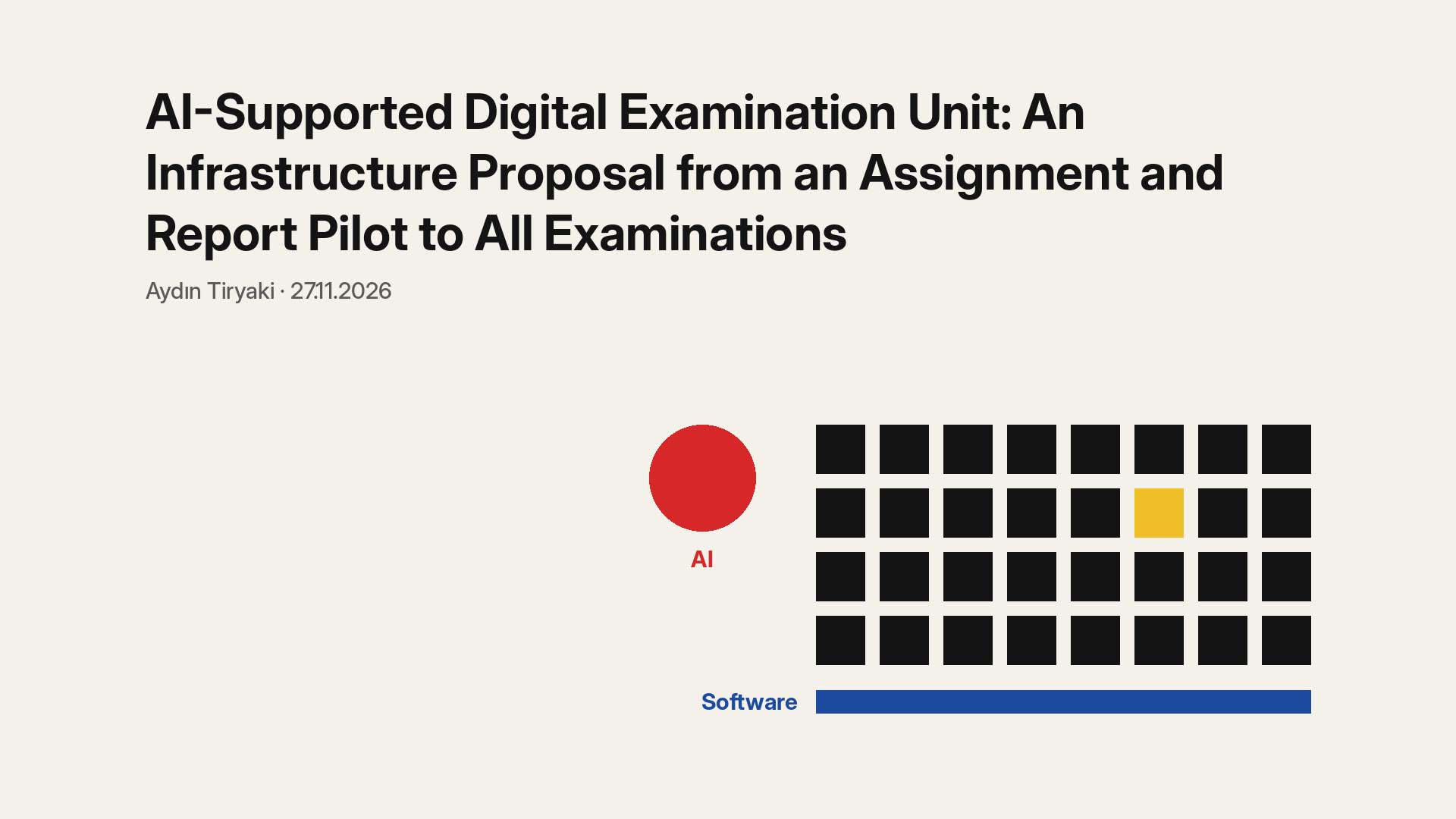
The method developed for AI-supported assessment of assignments and reports is now ready. To apply it smoothly in practice, however, an infrastructure made up of software, hardware, and physical space is needed. This article treats assignment and report assessment as a pilot application and proposes the concept of an “examination unit” at the scale of a single examination room, ready for all types of examinations and based on a division of labor between AI and software.
Aydın Tiryaki (27 November 2026)
Version 1.05
A Method Is Ready, but It Is Not Yet a System
In my previous article on assessing assignments and reports in the age of AI, I argued that AI text detectors cannot serve as a reliable basis for assessment (1). The real question is not whether a student wrote a text with AI. The real question is whether the student truly commands the content, logic, and sources of the work they submitted. To measure this, I proposed a three-module method. The first module evaluates the document in depth. The second administers a hidden-diagnosis exam generated solely from the student’s own document. The third provides a holistic class-wide analysis. The method has also been made available as an openly published AI skill (3).
I then tested the method in a controlled experiment across two disciplines and two languages (2). The results were promising: all errors deliberately planted in the documents were caught in both languages. But the field also revealed difficulties that did not stem from the method itself. Mandatory manual export created an extra burden in daily use (2). A chat window proved inadequate for running a timed exam (1). Because an answer sheet embedded in the exam file offers no cryptographic protection, that mode had to be restricted to low- and medium-stakes exams (2).
For this reason, we cannot say that “everything is done.” The method is ready, but it is not yet a system. The question to ask now is this: How can we run this method smoothly in practice without creating new difficulties while trying to make things easier? What kind of infrastructure should we build for it?
A Three-Layer Infrastructure: Software, Hardware, and Space
The answer to this question lies not in a single tool but in three complementary layers. There needs to be software, there needs to be hardware, and there even needs to be a physical space.
Software
The first layer is software that will support the AI-supported skill structure built so far, make the system practical to use, and ensure its security. The existing method already defines several security principles. Graded exams should be held in a clean session, separate from the assessment chat, and preferably in kiosk mode. In graded exams, the answer key should not be present in the exam file in front of the student; this approach is called a keyless client. Student identities should never be uploaded to AI; each student should be given a random code, and the mapping between code and identity should be stored only in a locally kept identity file (File-0). This pseudonymization method reduces risk, but because it does not make the data anonymous, obligations under Türkiye’s Personal Data Protection Law (KVKK) still apply (1). Today, most of these principles depend on the user’s attention and on manual steps. The task of the software is to make these principles a self-operating part of the system and to eliminate the manual transfer steps that create the greatest burden in the field.
Hardware
The second layer consists of computers whose security has been ensured. The number of these computers should be definable according to need. During an exam, the device in front of the student should be dedicated solely to running the exam and its security should be verified in advance.
The hardware should not consist of keyboard computers alone. The application environments defined in the academic exam skill show that the room must be ready for different forms of examination: a pen or tablet for solutions in digital handwriting, a high-speed scanner for digitizing exams taken on paper, and headphones and microphones for oral exams should all be part of the room’s equipment (4). Headphones should be standard equipment at every exam station, not only for oral exams. Every computer has a pair of headphones whose security and hygiene have been ensured. In this way, the room’s acoustic problem is solved by these headphones, with no need for separate spatial arrangements.
Space
The third layer is an examination room prepared to implement such a system. In fact, the existing method already carries the seed of this idea. In the scenario described in the previous article, students first submitted their work digitally and then took a personalized exam on laboratory computers, optionally with headphones or in a silent written mode (1). What is proposed here is to turn this scenario from a temporary arrangement into a permanent and accredited space.
The Division of Labor Between AI and Software
The core principle of this infrastructure is a clear division of labor between AI and software. The system does not rely on AI alone. AI performs the tasks that require knowledge and that fall within the scope of what AI does today: evaluating the document, generating questions, organizing question chains, and interpreting answers. Beneath this lies software that provides the framework. Everything that can be fixed by rules is handled by software: the flow of the exam, time management, matching identities and codes, recording answers, and security.
This separation resolves a significant share of the problems encountered in the field today on its own. Having a task performed the same way every time by software, rather than reinterpreted each time by AI, increases both reliability and predictability. Technical details are resolved as needed; for example, encryption is applied wherever encryption is required.
The Examination Unit Concept
When these three layers come together, the result is a technological, computer-supported examination unit. In this unit, software, AI support, and hardware coexist. The examination unit has three goals: to reduce workload, to ensure security, and ultimately to make everyone satisfied. The burden on teachers and instructors should lighten, students should have a fair and reliable environment, and for the institution, examination processes should become traceable and secure.
Rooms should be designable in small, medium, and large sizes. Since each will be a secure room accredited in every respect, any type of examination can be held in them.
A Single Room: A 32-Station Thought Model
At this stage we are not building anything; we are thinking through a model. I am constructing the model around a single room with 32 stations. The choice of 32 is a matter of preference; the convenience of working with the binary system makes the number a natural fit. If the model is actually implemented, the real numbers will emerge according to need. A single 32-station room may suffice for a smaller department, while another department may need five such rooms. For this reason, the room should be thought of as a modular unit that can be replicated as needed.
The focus of this article is the micro-scale planning of this single room. However, this room should always be designed as part of a larger idea. I briefly mention this larger idea at the end of the article.
A Room That Works Every Day of the Week
Certain usage rules can be introduced so that such a room is used as efficiently as possible. For example, on weekdays the department itself uses the room and holds its regular exams, assignments, and all its assessments there. On Saturdays, the room is reserved for the university’s general examinations. On Sundays, it is used for national examinations. A separate arrangement can also be introduced for evening hours. The rooms are used by everyone on a booking basis.
In this way, the examination room ceases to be a place that opens only during exam weeks. It becomes a system that can be used for many hours of the day, every day of the week and of the year.
From the Pilot to the Real Goal: Moving All Examinations into a Digital Environment
This infrastructure should not be thought of as a room prepared only for checking assignments. Assignment and report assessment is a pilot application. Let us assume that we have launched the pilot through assignments and reports. The real, larger goal is to conduct examinations entirely digitally, in a computing environment.
Toward this goal, AI, working with software support, takes on the role of asking questions, organizing question chains, and, when necessary, conducting an interactive examination. The examination designs of the existing method offer a starting point in this direction. Among them are presenting questions one at a time, not allowing students to go back or see upcoming questions in advance, time limits based on reading speed, and accessibility accommodations taking precedence over the default rules (1). The goal is to ensure that all examinations are conducted in this environment both securely and in the way that measures most accurately.
As the first step on the software side of this goal, I prepared the “AI-Supported Academic Exam” skill (4). The skill consists of four modules: exams based on a specific document, exams with a defined framework, individual exam assessment, and class-wide assessment. Ten examination methods are defined in the skill. Some of them are different forms of the written exam: the standard exam in which everyone gets the same questions, equivalent booklets with shuffled question and option order, the parametric twin exam with numerical data generated specifically for each student, and personalized question sets drawn from a pool. The others carry measurement in different directions: computerized adaptive testing (CAT), the open-book and open-AI exam, the two-stage exam, the Socratic oral defense, the chained case exam, and the multi-station practical exam. As application environments, it offers four options: a keyboard-based digital environment in a kiosk room, digital handwriting with a pen or tablet, digitizing paper exams in the room with a high-speed scanner, and oral exams with headphones (4). These environments defined in the skill also outline which forms of application the room must be ready for.
The Bigger Picture: From Department to National Network
A single room is the first link in a larger structure. It is possible for rooms in departments to be connected and work in an integrated way at the university scale for central examinations, and across universities for national examinations. The details of this integration are the subject of another study; this article remains at the micro scale, at the level of a single room.
The Final Word Stays with Humans
However advanced the proposed infrastructure may be, the core principle of the method does not change: AI reduces the teacher’s workload but does not eliminate it. Reviewing error lists, pedagogical judgment, and approving the final grade remain human tasks (1). The examination unit is designed not to replace this human judgment, but to provide it with a secure, efficient, and scalable foundation.
References
[1] Aydın Tiryaki, “Evaluating Assignments and Reports in the Age of AI: Real Mastery, Hidden-Diagnosis Exams, and a Holistic Analysis Method”, Aydın’ın Dağarcığı, 26 November 2026, accessed 27 November 2026. https://aydintiryaki.org/2026/11/26/evaluating-assignments-and-reports-in-the-age-of-ai-real-mastery-hidden-diagnosis-exams-and-a-holistic-analysis-method/
[2] Aydın Tiryaki, “A Controlled Experimental Study on Evaluating Assignments and Reports in the Age of AI: Dual-Discipline and Bilingual Field Findings”, Aydın’ın Dağarcığı, 27 November 2026, accessed 27 November 2026. https://aydintiryaki.org/2026/11/27/a-controlled-experimental-study-on-evaluating-assignments-and-reports-in-the-age-of-ai-dual-discipline-and-bilingual-field-findings/
[3] Aydın Tiryaki, “Assignment / Report Evaluation and Exam (Umbrella Skill)”, Aydın’ın Dağarcığı, 26 November 2026, accessed 27 November 2026. https://aydintiryaki.org/2026/11/26/assignment-report-evaluation-and-exam-umbrella-skill/
[4] Aydın Tiryaki, “AI-Supported Academic Exam (Umbrella Skill)”, Aydın’ın Dağarcığı, 27 November 2026, accessed 27 November 2026. https://aydintiryaki.org/2026/11/27/ai-supported-academic-exam-umbrella-skill/
Guide to Concepts and Terms for This Article
Accreditation: The approval by an authorized body that an institution, space, or process conforms to defined standards. In this article it refers to certifying that the examination room is suitable for all types of examinations in terms of security, equipment, and operation. The word comes from the French accréditation, derived from a Latin root meaning “to trust, to believe.”
AI Skill: A reusable package of instructions that tells an AI model how to perform a particular task. In this article, the skills prepared for assignment and report assessment and for academic exams are the first steps on the software side of the examination unit. In the author’s Turkish writing, the term “yordam” is used for it.
Computerized Adaptive Testing (CAT): An examination method in which the difficulty of the next question is increased or decreased in real time according to the student’s answers.
Examination Unit: The computer-supported, accredited examination structure proposed in this article, in which software, hardware, AI support, and physical space come together.
Hidden-Diagnosis Exam: An exam generated solely from the student’s own assignment or report, which also measures whether the student can notice the errors in their own work. The aim is not to catch the student but to understand whether they truly command their work.
Keyless Client: A mode of operation in which the exam file in front of the student does not carry the answer key and only records the student’s answers and timings. Scoring is done outside the exam file, in the instructor’s session.
Kiosk Mode: A mode of operation in which a computer is locked to run only a single application, and the user cannot access other programs or system settings. It ensures that the student sees only the exam screen during the exam. As an interesting note, the English word kiosk came by way of French from the Turkish word “köşk.”
KVKK: Türkiye’s Personal Data Protection Law, No. 6698. It sets the rules for processing personal data in Türkiye. In this article, it forms the legal framework for protecting student identities and exam data.
Parametric Twin Exam: An examination method in which the concept, structure, difficulty, and solution path of a question remain the same for everyone, while the numerical data are generated specifically for each student or group. The solution logic is shared; the result is personal.
Pilot Application: The first application in which a method or system is tried in a limited area before being applied on a large scale. In this article, assignment and report assessment is treated as the pilot application for the goal of moving all examinations into a digital environment.
Pseudonymization and File-0: The use of a random code in place of a student’s identity information. The mapping between code and identity is stored only in a locally kept “number 0” identity file that is never uploaded to AI. Pseudonymized data is not considered anonymous; therefore, KVKK obligations continue to apply.
Article Credits
The article titled “AI-Supported Digital Examination Unit: An Infrastructure Proposal from an Assignment and Report Pilot to All Examinations” was written by Aydın Tiryaki on 27 November 2026. The ideas and the main framework in the article belong to the author. Anthropic’s Claude Opus 5.5 model served as a research and writing assistant at a medium thinking level. The model organized and structured the ideas the author conveyed orally during the conversation, examined the author’s two previously published articles and the AI skills he prepared and linked the relevant information to the text with citations, prepared the guide to concepts and terms, and presented suggestions from external evaluations for the author’s approval. Google’s Gemini 4 Neon model, working at a medium thinking level in a chat window, evaluated versions of the article and recommended adding the guide to concepts and terms, completing the match of terms between the text and the guide, and making the hardware section more concrete. This English text was rewritten in English by Claude Opus 5.5 at a medium thinking level, remaining faithful to the Turkish original and its context.
Version 1.01 (27.11.2026 10:35): First draft. Compiled from the ideas the author conveyed in the conversation and the findings of the two previous articles. Evaluated by Gemini 4 Neon.
Version 1.02 (27.11.2026 19:19): A new section describing the division of labor between AI and software was added. The four modules, ten examination methods, and four application environments of the academic exam skill were incorporated into the text and references. At the author’s instruction, the national-scale section was reduced to a brief mention, and the focus of the article was drawn to the micro scale of a single room. The guide to concepts and terms was added. The summary was updated. Evaluated section by section by Gemini 4 Neon.
Version 1.03 (27.11.2026 19:28): Gemini 4 Neon’s evaluation was reviewed by Claude Opus 5.5 and incorporated with the author’s approval. The terms in the guide (keyless client, File-0, pseudonymization, KVKK, CAT) were linked into the main text. The equipment defined in the academic exam skill was added to the hardware section. The ten examination methods were presented in two groups. The phrase “ready for all types of examinations” was added to the summary. The title of reference [3] was corrected to the page’s original title, and a publication date was added to reference [4].
Version 1.04 (27.11.2026 20:17): Reference [4] was changed from the academic exam skill’s documentation page to its Turkish publication page. The link was verified by following the skill’s bilingual package page. The Turkish and English counterparts of all four sources were thus ready for the English rewrite. This version was evaluated by Gemini 4 Neon and found ready for publication.
Version 1.05 (27.11.2026 20:27): At the author’s addition, the hardware section now states that headphones are standard equipment at every exam station, that every computer has a pair of headphones whose security and hygiene have been ensured, and that the room’s acoustic problem is solved by these headphones with no need for separate spatial arrangements. The English version was rewritten on 27.11.2026 at 20:29 on the basis of this version.

