
Below you will find the details of the AI-Supported Academic Exam Umbrella Skill, designed to modernize academic assessment in the age of AI. The Skill Documentation Page and the Google Drive Gemini and Claude folder links containing the downloadable SKILL.md file are provided at the end of the article.
Aydın Tiryaki
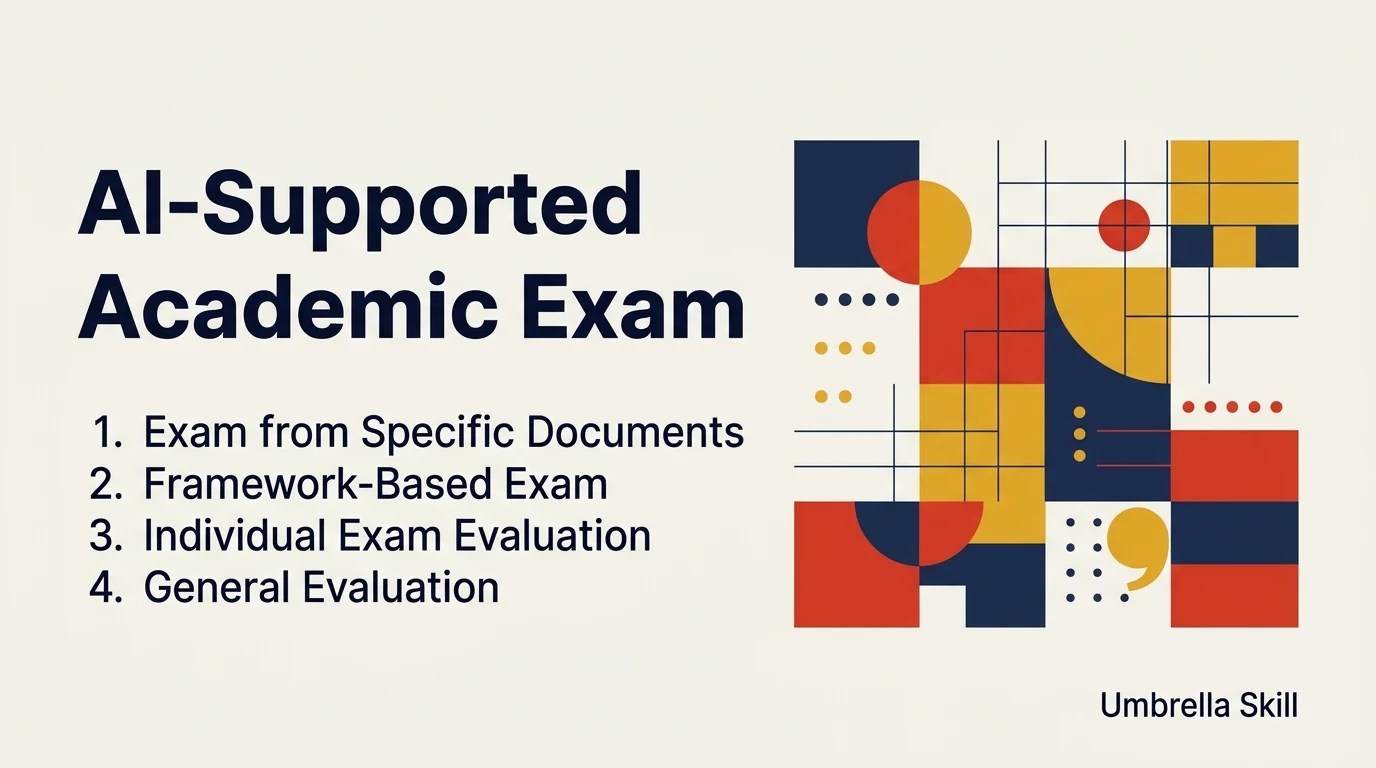
Designing rigorous exams, administering them fairly, grading open-ended work consistently, and extracting actionable insights from class-wide results require substantial academic effort. AI-Supported Academic Exam is a four-module Umbrella Skill built for instructors, teaching assistants, and self-studying learners to unify these four stages within a single structured workflow.
At the core of the design is a flexible three-tier level calibration matrix combining Educational Level and Grade Tier (Primary/Middle School Grades 5–8, High School Grades 9–12, Associate, Undergraduate Years 1–4, Master’s, Doctoral/PhD, and Professional Certification), a 1–5 Difficulty Scale, and Bloom’s Cognitive Taxonomy (Remembering through Creating). To safeguard student privacy under KVKK/GDPR standards, a locally stored zero-numbered identity file and unique institutional codes (KOD-001, KOD-002…) are enforced across all modules, paired with a respectful, objective, and non-accusatory academic tone.
Module 1️⃣: Exam from Specific Documents
This module creates exams strictly bounded by the documents uploaded by the user — including PDFs, Word files, slides, handwritten lecture notes, scans, spreadsheets, source code, or web links. Under an absolute zero-external-question lock, 100% of questions are derived solely from the provided materials, with source section and page traceability recorded in the Instructor Preparation View.
Before generating any exam, a mandatory setup menu confirms level calibration, question format (All Multiple-Choice, All Open-Ended, Mixed, or Sequential/Chained Exam), question counts, and point weights. Strict format locking prevents unwanted question types from leaking into single-format exams. For classroom security, equivalent A/B/C booklets with shuffled question and option orders and separate answer keys can be produced; by default, exams are delivered as standalone interactive single-file HTML5 interfaces featuring one-way flow, dynamic per-question time limits based on reading and reasoning load, a prominent final 60-second countdown, and a hidden embedded answer schedule (or an optional Keyless Client Mode for high-security exam halls).
Module 2️⃣: Framework-Based Exam
When an instructor or learner wants to create an exam without uploading source documents, Module 2️⃣ builds the assessment directly from a topic framework, subtopics, learning outcomes, and explicit scope boundaries. Optional textbook titles, journal citations, standards, or web references may be supplied, and the system verifies scientific accuracy through live academic search.
Prior to item generation, a structured Exam Blueprint mapping subtopics to Bloom’s cognitive levels and point weights is verified in Python. Quantitative problems and intermediate steps are programmatically checked prior to delivery, and the Instructor View provides worked solutions, distractor rationales, and verified source links. All A/B/C booklet, HTML5 delivery, dynamic timing, and accessibility capabilities from Module 1️⃣ apply seamlessly here as well.
Module 3️⃣: Individual Exam Evaluation
Individual student submissions — whether HTML5 exports, scanned written papers, handwritten photos, PDF/Word sheets, or oral transcripts — are ingested strictly by code number. While multiple-choice and true/false items are scored cleanly against the answer key, short-answer, open-ended, case analysis, and problem-solving responses are always graded with transparent, rubric-based partial credit rather than rigid all-or-nothing scoring.
All scores and 100-point conversions are verified in Python, with every report emphasizing that the final grade authority belongs exclusively to the instructor. Each student receives constructive question-by-question feedback, a topic and Bloom mastery profile, and verified remediation resources. Reports are delivered both on screen and as printable PDFs featuring an official Exam Hall Officer / Proctor Approval Section and an Instructor Final Grade Approval line.
Module 4️⃣: General Evaluation
Coded class-wide exam results are ingested in a single batch or in parts to produce comprehensive class analytics. Mean, median, mode, standard deviation, quartiles, pass distributions, and A/B/C booklet equivalence comparisons are computed accurately in Python.
For each question, item difficulty index (p), upper-lower 27% discrimination index (r), distractor selection rates, and average solving times are analyzed to highlight items needing revision. Recurring class-wide misconceptions are synthesized into a prioritized next-lecture teaching roadmap, accompanied by high-resolution Python data charts (score distribution histogram, item difficulty/discrimination plot, and topic × Bloom mastery heatmap) delivered both on screen and as an archivable PDF report.
📄Skill Documentation Page: https://aydintiryaki.org/2026/06/19/gdn046/
The Gemini 4 Neon AI model was used in the development of this Umbrella Skill.
Google Drive Folder Links and [invalid URL] File
You can go to the folders below to download and directly use the [invalid URL] file from these folders. If you cannot access these folders or file, it means the link is temporarily suspended because the development of the relevant Skills is currently in progress; please try again later.
📁 Google Drive Gemini Folder Path (EN): https://drive.google.com/drive/folders/1_gE_1RUb8VRhWAbZaQGLYRKVvohOIjci
📁 Google Drive Claude Folder Path (EN):
Note: You can make your own developments and edits on the [invalid URL] file you obtain from here. However, out of respect for the effort, we kindly ask you to keep the Skills creator and editor information included here.
This Umbrella Skill design and the views in this article belong to Aydın Tiryaki and were developed with the joint architecture of ATG1 Skill Factory v15.17 and ATG5 Umbrella Integration Unit v01.13; editorial drafting and compilation support was provided by the Gemini 4 Neon model. (27.11.2026 11:22)
📘 Aydın Tiryaki Skill Archive User Guide: https://aydintiryaki.org/2026/11/20/aydin-tiryaki-skill-archive-user-guide/
| aydintiryaki.org | YouTube | Aydın Tiryaki’nin Yazıları ve Videoları│Articles and Videos by Aydın Tiryaki | Bilgi Merkezi│Knowledge Hub | Virgülüne Dokunmadan│Verbatim | Skills Dağarcığı │Skills Lexicon | ░ Yapay Zekâ Destekli Akademik Sınav │AI-Supported Academic Exam (Çatı Skill / Umbrella Skill) ░ 27.11.2026

