
A Digital Crossword Studio Constructing Classic Square and Rectangular Newspaper Crosswords via Python and AI Collaboration, Delivering Complete Text Matrices, Clues, and 9:16 Full-Page Visuals (At the end of this article, you will find the Skills Documentation Page and the Google Drive folder link containing the SKILL.md file that anyone can directly download and use.)
Author: Aydın Tiryaki
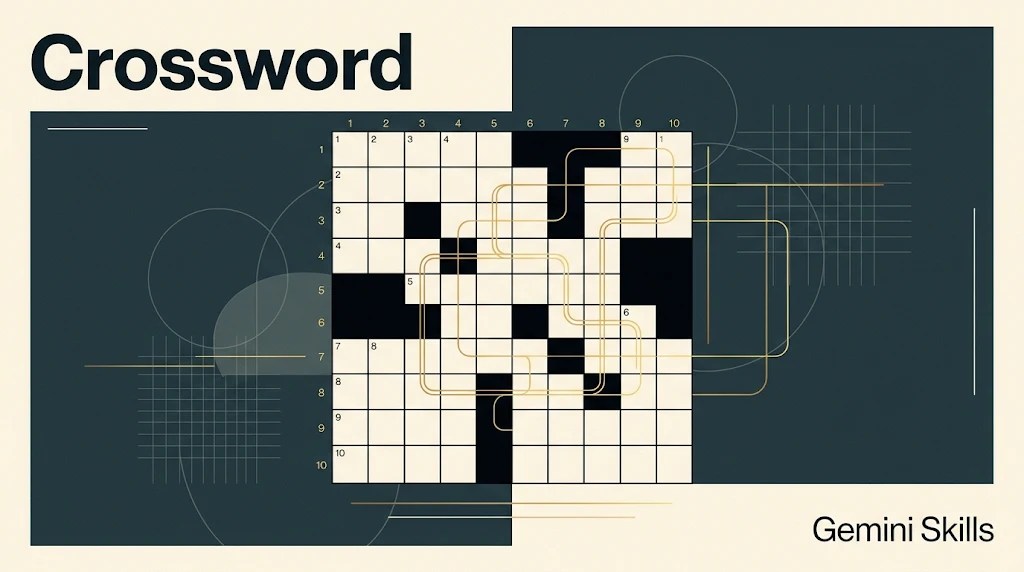
Crossword (Gemini Skills) is a specialized AI skill developed to construct classic newspaper and magazine crosswords—where clues are numbered outside the grid under “ACROSS” and “DOWN” headings—with zero meaningless letter sequences and 100% intersection accuracy. Because constructing a complete, valid crossword grid requires intensive background verification that cannot succeed in a standard chat window, the system begins by advising the user right at launch to perform the work in the task screen (task mode). Users can customize their crossword at startup across four core parameters: size, language, subject/theme, and difficulty level. When no specific preferences are given, the system automatically applies its standard defaults: 10×10 size, English language, General Knowledge theme, and Medium difficulty. Moreover, puzzles are not restricted to square grids like 8×8, 10×10, or 12×12; the system also supports rectangular dimensions such as 10×12, 10×14, or 12×15 with full algorithmic and visual compatibility. True to the tradition of classic crosswords, this system never forces black cells into artificial decorative patterns or rigid symmetry, nor does it pre-place black cells before selecting words. Instead, the entire placement process is driven by continuous back-and-forth interaction between Python software and the AI (Language Model). While full-row or full-column words can naturally be used in 8×8, 10×10, or 12×12 grids, larger grids do not require full-length words across an entire row or column. Rather than placing initial long words symmetrically (such as always in the first and last columns or second rows from top and bottom), the algorithm places initial long words completely randomly and asymmetrically across distant rows and columns (for instance, one in the first row and another in the third column from the left) so that no predetermined layout is visible. It then proceeds alternately one row and one column at a time, finding new meaningful words that match the intersecting letters, placing black cells where words terminate, and naturally filling the remaining end spaces with shorter meaningful words (including 4-letter, 3-letter, and when necessary 2-letter words). Every pair of words in the same row or column is mandatorily separated by a black cell, with no black cell present only when a single word spans the entire row or column. In keeping with classic crossword aesthetics, the algorithm avoids excessive blacked-out cells and keeps them minimal while using as many black cells as needed so the puzzle never becomes impossible to complete. While it strives to avoid placing black cells horizontally or vertically adjacent to one another, there is no rigid ban when required, and black cells touching at their corners (diagonally) is treated as completely natural. Hundreds of silent iterations take place in memory until every horizontal and vertical word is verified to be 100% meaningful and unique, without ever printing intermediate trials on screen. The user receives only the completed final state. First, the system outputs the complete text-based package: the outer-edge numbered empty puzzle matrix, the copy-paste friendly “ACROSS” and “DOWN” clues separated by tall vertical bars ( │ ) for multiple words on the same row or column, and the filled solution matrix. Immediately following the text output, without waiting for an extra command, the system automatically generates both a standard matrix visual and a 9:16 vertical full-page magazine visual (.jpg or .png). In the 9:16 vertical visual, the empty puzzle matrix occupies 60%-70% of the width at the top-right corner, while the clues begin in the top-left 40%-30% narrow column and expand into two wide columns once the bottom edge of the puzzle matrix ends. Font sizes are dynamically calculated to be the largest possible (optimum) size that fills 100% of the page down to the footer without overflowing or leaving any bottom gap; only when a puzzle is very large and cannot fit onto a single page with readable text does the AI use multiple pages (continuing on a second page). 📄Skills Documentation Page: https://aydintiryaki.org/2026/06/19/gdn072/ The Crossword (Skills Edition) v01.38 design was designed by Aydın Tiryaki with ATG Gem Factory (Skills Edition) v14.19 and developed using the Gemini 4 Argon AI model. Google Drive Folder Link and SKILL.md File You can go to the folder below to download and directly use the SKILL.md file from this folder. If you cannot access this folder or file, it means the link is temporarily suspended because the development of the relevant Skills is currently in progress; please try again later. 📁 Google Drive Folder Path (EN): https://drive.google.com/drive/folders/1X40F5A1Rom2J6OwHceOrcS5Inwi8Xsl1 Note: You can make your own developments and edits on the SKILL.md file you obtain from here. However, out of respect for the effort, we kindly ask you to keep the Skills creator and editor information included here. The Crossword (Gemini Skills) design introduced in this article and all content, methodology, and views in the text belong to Aydın Tiryaki; the editorial assistance for this article was performed by the Gemini 4 Argon model (09.11.2026 15:45).
| aydintiryaki.org | YouTube | Aydın Tiryaki’nin Yazıları ve Videoları │Articles and Videos by Aydın Tiryaki | Bilgi Merkezi│Knowledge Hub | ░ Virgülüne Dokunmadan │ Verbatim ░ | ░ Kare Bulmaca │Crossword (Gemini Skills) ░ 08.11.2026

