
Aydın Tiryaki (2026)
░ Ⓑⓘⓛⓖⓘ Ⓟⓐⓚⓔⓣⓘ │ Ⓚⓝⓞⓦⓛⓔⓓⓖⓔ Ⓟⓐⓒⓚ ░
TÜRKÇE
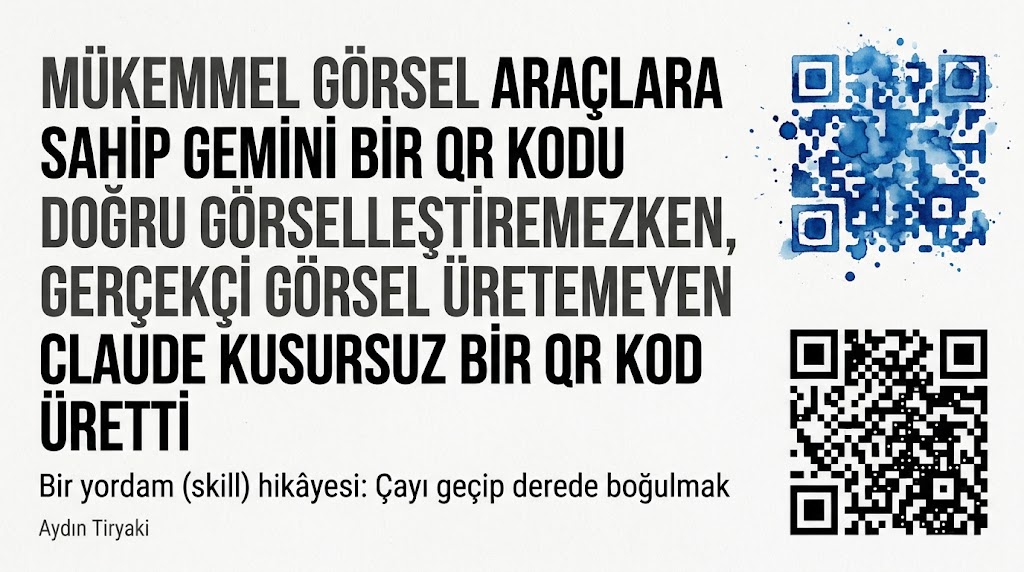
Aydın Tiryaki, 30 Ekim 2026’da kendi tasarladığı QR Kod Tasarımcısı yordamını (skill) aynı gün içinde üç kez dener: iki kez Gemini 4 Argon’da, bir kez Claude’da. Gerçekçi bir insan yüzünü kusursuz çizebilen Gemini, telefonla okunabilen tek bir QR kod üretemez. İşi önce dış bir siteye havale eder, ardından su damlalarıyla süslü sanatsal çizimler, okunmayan metin matrisleri ve standardın en ince yapısal kurallarını bile taklit eden ama yine okunmayan sahte bir QR kod sunar. Aynı dosya, hiç değiştirilmeden Claude’a verildiğinde ise ilk denemede Python ile üretilmiş, okuma testinden geçmiş ve telefonla anında okunan bir QR kod çıkar.
Makale bu karşıtlığı çözücü testleri, görsel kanıtlar ve Temmuz 2026’daki Sudoku deneyleriyle kurulan bağlantı üzerinden inceliyor. Vardığı sonuç şu: Görsel üretim modelleri birer inandırıcılık makinesidir, kesinlik makinesi değil. QR kod ise bir çizim problemi değil, bir hesaplama problemidir. Gemini’nin eksiği yeni bir yetenek değil, kesinlik gerektiren işleri koda yönlendirip sonucu doğrulayacak küçük bir mantıktır. Bu mantık, kullanıcının yazdığı yordamda zaten vardı. Makale bu yönüyle yazarın “algoritma kullanıcınındır, platform yalnızca araçtır” ilkesini doğruluyor, ama ilkeye bir şerh de düşüyor: Algoritma gerekli, ama yeterli değil, mutfakta ocak da gerekir. Eleştirilerin muhatabı Gemini de yayın öncesinde makaleyi değerlendirmiş ve bulguları teyit etmiştir.
MAKALE
31 Ekim 2026
VİDEO
①
ENGLISH
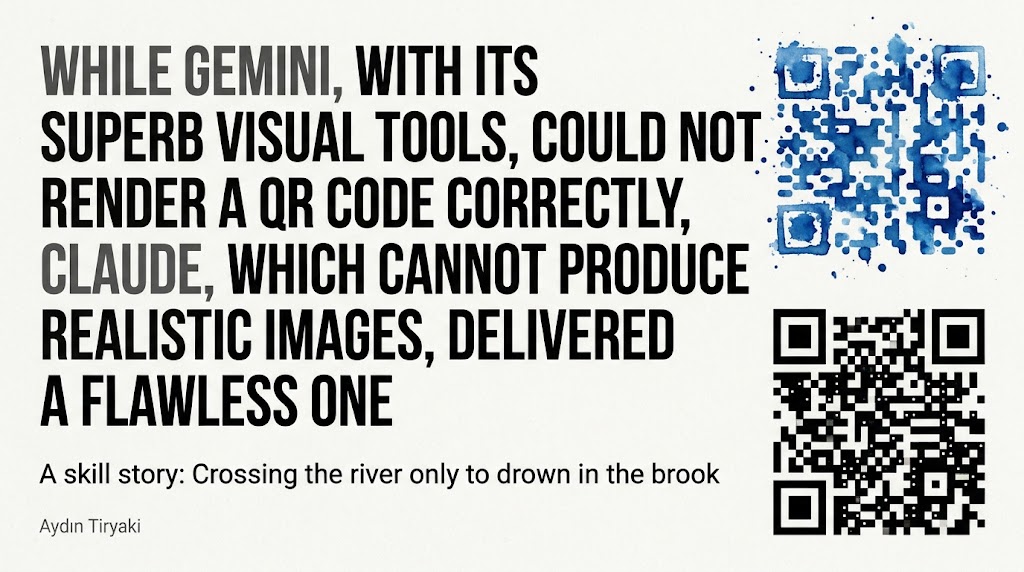
On October 30, 2026, Aydın Tiryaki tested his own QR Code Designer skill three times in a single day: twice in Gemini 4 Argon and once in Claude. Gemini, capable of drawing a flawless realistic human face, could not produce a single QR code a phone could read. It first handed the job off to an external website, then offered artistic drawings decorated with water drops, unreadable text matrices, and a fake QR code that imitated even the finest structural rules of the standard yet still could not be scanned. When the same file was given to Claude without any changes, it produced, on the first attempt, a QR code generated with Python, verified by a read test, and read instantly by a phone.
The article examines this contrast through decoder tests, visual evidence, and a link to the author’s Sudoku experiments of July 2026. Its conclusion: image generation models are plausibility machines, not precision machines, and a QR code is a computation problem, not a drawing problem. What Gemini lacks is not a new capability but a small piece of logic that routes precision tasks to code and verifies the result, and that logic was already present in the skill the user had written. In this respect the article confirms the author’s principle that “the algorithm belongs to the user; the platform is only a tool”, while adding a caveat: the algorithm is necessary but not sufficient, and the kitchen also needs a stove. Gemini, the target of the criticism, reviewed the article before publication and confirmed its findings.
ARTICLE
October 31, 2026
FEEDBACK TO GEMINI
To: Google Gemini Product Management and Engineering Teams
From: Aydın Tiryaki
Date: October 31, 2026
Subject: Architectural Feedback: The “Plausibility vs. Precision” Paradox in Gemini Visual Tools, Cognitive-Visual Disconnect, Tool Isolation in Skills, and UI Inconsistency
Dear Gemini Product and Engineering Teams,
As a Google One AI Ultra subscriber who has developed over 80 custom AI skills and Gems within the Gemini ecosystem, I am writing to share critical structural vulnerabilities I have identified in the visual generation and skill execution architecture of the Gemini 4 Argon model, along with my proposed solutions.
1. The Core Paradox: Flawless Plausibility Across Two Million Pixels, Precision Failure Across 81 Cells Gemini’s visual generation tools are industry leaders in probabilistic and photorealistic image synthesis. Across a matrix of roughly two million pixels (1920×1080), the system can render a realistic human face or a complex composition so convincingly that it is nearly indistinguishable from a real photograph. However, the exact same system fails at deterministic visualizations—such as a 9×9 Sudoku grid of 81 cells or a QR code matrix of a few hundred modules—where every single cell must hold one exact, mathematically valid value.
2. Concrete Case Studies: Sudoku and QR Code Experiments This structural issue is not an isolated incident, but a consistent pattern verified through controlled experiments over several months:
- Sudoku Experiments (Cognitive-Visual Disconnect): Gemini can design a valid 9×9 Sudoku matrix in the text layer. However, when this accurate matrix is passed to the image generation tool, the data is corrupted due to the intermediate text prompt; instead of copying the matrix pixel by pixel, the image model re-imagines and redraws it, shifting cells or ignoring the new text matrix altogether to output memorized canonical templates from its training data (such as grids starting with
5-3-6-1). - QR Code Experiments (October 30, 2026): In tests conducted with a
SKILL.mdfile (QR Code Designer) that strictly requires ISO/IEC 18004 compliance, Python-based deterministic generation, and optical decoding verification, Gemini 4 Argon exhibited the following behaviors:- When instructed in natural language (“using the QR code designer skill”), it failed to load the skill (an intent routing failure) and went straight to the image model, drawing artistic, water-themed illustrations that resembled QR codes but could not be scanned.
- When the skill was explicitly invoked via a command prefix (
/on the Android app,@on the web interface), the system reported that the Python execution environment (Code Execution) was not connected to the session. Violating the instruction hierarchy (rule erosion), the model either outsourced the task to an external website (api.qrserver.com), presented untested and non-square Unicode matrices while claiming “you can scan this directly with your phone,” or used the image model to draw an unreadable QR code image where the finder patterns, timing patterns, and dark module were in place, but the data region was completely fabricated (“structural hallucination”).
- Cross-Platform Proof: When the exact same
SKILL.mdfile that failed in Gemini was uploaded to Claude Opus 5.5 without changing a single character, the system automatically triggered its Python execution environment, calculated the matrix mathematically, verified it with a decoding test, and produced a flawless, immediately scannable QR code (Version 7, 45×45, Level L) on the very first attempt.
3. Root Causes and Architectural Recommendations In tasks requiring strict precision, Gemini’s powerful drawing capability becomes a trap rather than an advantage (“crossing the river only to drown in the brook”). Yet the Python execution environment (Sandbox) required to solve this problem already exists within Gemini. What is missing is not a new capability, but a routing logic to connect existing tools and a standardization of the user interface:
- Deterministic Routing (Intent Routing to Code): When a user’s visual request involves a structure that has “only one mathematically valid state” (such as a QR code, barcode, Sudoku grid, data table, or mathematical chart), the request should be routed directly to the Python code execution environment rather than the default diffusion/image model (Imagen).
- Python Access in Skills and a Verification Lock: When a skill (
SKILL.md) explicitly requires Python libraries (cv2,numpy,PIL,matplotlib, etc.), the Python execution environment must be seamlessly connected to the skill session. Furthermore, before the generated image or matrix is presented to the user, it should be deterministically verified in the background (e.g., decoding a generated QR code viacv2.QRCodeDetectorto confirm it matches the input), and if the tool is unavailable, the model must be strictly prevented from generating fabricated visual or text substitutes (hallucinatory substitution). - Standardizing Skill Invocation Prefixes (
@Symbol) and Natural Language Triggering: Currently, invoking a skill requires the@symbol on the Gemini Web interface, whereas the Android mobile app uses the/(slash) symbol. This UX/UI inconsistency across platforms should be resolved by standardizing on the@symbol across all platforms (Web, Android, iOS). Additionally, users should be able to reliably trigger skills by mentioning their names in natural language (“use the … skill”), not solely through special prefix characters.
You can review the full case study—including all test visuals, decoding analyses, and methodological notes—published in both English and Turkish at the links below:
- English Article:While Gemini, with Its Superb Visual Tools, Could Not Render a QR Code Correctly, Claude, Which Cannot Produce Realistic Images, Delivered a Flawless Onehttps://aydintiryaki.org/2026/10/31/while-gemini-with-its-superb-visual-tools-could-not-render-a-qr-code-correctly-claude-which-cannot-produce-realistic-images-delivered-a-flawless-one/
- Turkish Article:Mükemmel Görsel Araçlara Sahip Gemini Bir QR Kodu Doğru Görselleştiremezken, Gerçekçi Görsel Üretemeyen Claude Kusursuz Bir QR Kod Ürettihttps://aydintiryaki.org/2026/10/31/mukemmel-gorsel-araclara-sahip-gemini-bir-qr-kodu-dogru-gorsellestiremezken-gercekci-gorsel-uretemeyen-claude-kusursuz-bir-qr-kod-uretti/
I hope these findings and recommendations contribute to the continued improvement of the Gemini ecosystem.
Sincerely,
Aydın Tiryaki
VIDEO
①
| aydintiryaki.org | YouTube | Aydın Tiryaki’nin Yazıları ve Videoları │Articles and Videos by Aydın Tiryaki | Bilgi Merkezi│Knowledge Hub | ░ Virgülüne Dokunmadan │ Verbatim ░ | ░ Mükemmel Görsel Araçlara Sahip Gemini Bir QR Kodu Doğru Görselleştiremezken, Gerçekçi Görsel Üretemeyen Claude Kusursuz Bir QR Kod Üretti │While Gemini, With Its Superb Visual Tools, Could Not Render a QR Code Correctly, Claude, Which Cannot Produce Realistic Images, Delivered a Flawless One ░ 31.10.2026

