
Aydın Tiryaki & Claude Opus 5.5 & Gemini 4 Argon
Introduction
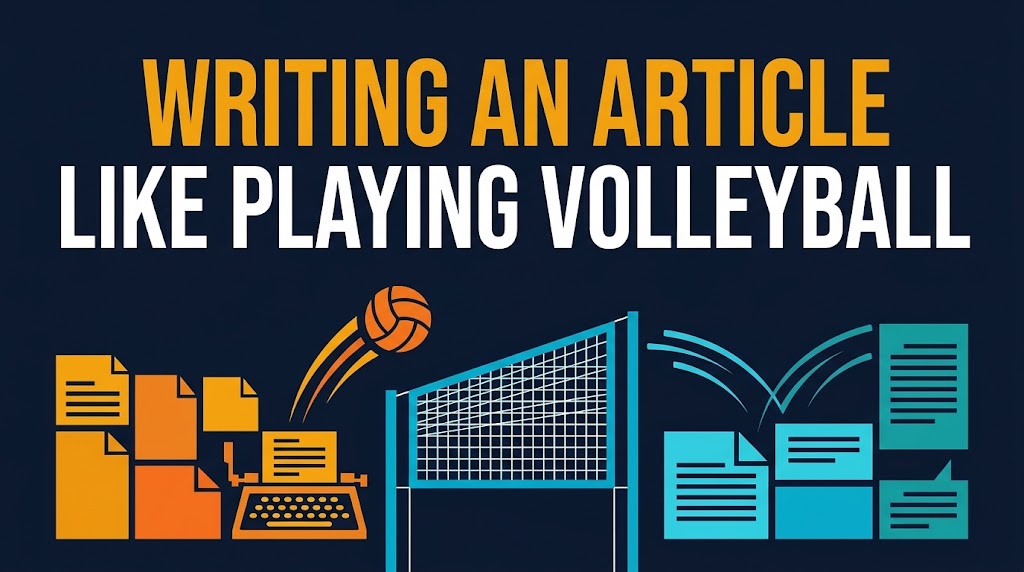
On 26 October 2026, I published two articles: “How Should Gemini Skills Work? Design Proposals from a User and a Language Model” (1) and “AI, Second by Second: A Proposal for a Universal Marking Language for Everything We Share” (2). I wrote both the same way, passing drafts back and forth between two AI models. When I finished, I realized that what we had done looked a lot like a game of volleyball.
This piece is about that analogy, about the method itself, and about what the method has taught me about bylines, colophons and English versions. The piece was written the same way: I wrote it with Claude, had Gemini review it, and added Gemini as a third author because its contribution reached the level of content. Finally, I showed the text to ChatGPT as an independent third reader. Its contribution is recorded in the colophon.
Why do I write with AI?
First I need to answer a question: why do I write my articles with AI at all?
Not because I can’t write. Between 2006 and 2011 I was a prolific blogger and wrote more than 1,700 posts. That is more posts than there were days in that period: on some days I wrote several. Some were long, some short. I wrote every word and every letter of them myself. There was no AI help back then, and I didn’t even use a proofreader. Because they were going to be published, I wanted them free of errors, so I edited each one myself, reading it over many times. I could do the same today. Without wanting to boast, I know I am good at writing quickly and cleanly.
The problem lies elsewhere. My head is constantly full of ideas, on every subject, so many that I wouldn’t have the time to write them all myself. If I wrote up an idea entirely on my own, rebuilt every sentence, arranged the structure, wrote the introduction, body and conclusion, a single piece could take my whole day. If I wrote this very piece myself, it would take at least a day.
Instead, right now I am watching a match. Phone in hand, I am watching the game and talking at the same time. As I talk, I build up the whole body of material. Since there is none of the slowness and forgetting that comes with writing, I can share everything that occurs to me quickly. Then I tell the AI: “Be my writing assistant; turn what I’ve told you into a proper piece of writing.”
That assistant could have been a person. I could have handed over what I said as a voice recording and said, “Bring this back to me as a proper text.” Up to a certain point in time, that was a method used everywhere. Literary history has strong examples of it. When Dostoevsky had to deliver The Gambler within a month, he hired a stenographer for the first time in his life and finished the novel on time by dictating it to Anna Snitkina (3). Henry James, forced to give up writing by hand in 1897 because of pain in his wrist, dictated the works of his final years to stenographers (4). My method is the present-day form of that tradition: instead of working by hand for a whole day, I get the chance to write an article in two hours, passing it back and forth again and again between two different AI models. That is the real reason I use AI: to create the time to turn every idea in my head into writing.
The analogy has a limit. A stenographer only writes down; they don’t contribute ideas. An AI can. That is exactly why the signature ladder I describe below exists. The stenographer analogy fits only the writing-assistance rung of that ladder; the higher rungs are something new.
One thing hasn’t changed. I used to read every piece over many times myself before publishing it. Now some of those readings are done by the review rounds. But the final reading is still mine.
Warm-up: “Don’t write until I say so”
Every match starts with a warm-up. My articles, too, usually begin with a long conversation well before the writing stage. I open the topic, explain my ideas, and we gather material.
At the start of that conversation I always give the model the same warning: “Don’t write the article until I say so.” If I don’t, the moment I mention one or two ideas, the model writes an article based on them. Then we have to keep updating that article. A text written too early anchors itself to its first few sentences, and every later idea gets bolted on as a patch. An article written before enough material has been gathered is like a building rising without a foundation.
In the warm-up I also decide something else: the article’s byline and colophon. We discuss from the outset whether the piece will have one author, two, or even three as this one does, and what the colophon will say. But that decision isn’t frozen; it can change as the match goes on.
The no-summarizing rule: “Don’t drop a single letter”
In the hundreds of articles I wrote with Gemini over the past year, the thing I said most often during the writing stage was this: “Don’t summarize in any way. When you prepare the next version, absolutely don’t summarize. Don’t cut a single word, don’t drop a single letter.” I had to give these warnings constantly, because Gemini had a persistent tendency to summarize. Lately I use Gemini’s higher-end models, and I don’t need to give these warnings as often.
The real meaning of this rule is not “never shorten.” I sometimes ask for a section to be removed myself. In one of the earlier versions of this very piece, we took several analogies out of the text. What the rule means is this: the model doesn’t decide what gets cut; I do. Summarizing on its own initiative is hitting the ball without asking the captain. And it happens silently: the dropped sentence simply doesn’t appear in the next version, and you have to put two versions side by side to notice it.
How the lineup was formed
In this piece, Claude is the hitter and Gemini is the block. These roles were assigned by experience, not preference.
In the Gemini models before Argon, there was a serious forgetting problem as conversations went on. After thirty or forty turns, almost no trace remained of the earlier parts of the conversation. The model lost the thread. As far as I can see now, Argon seems to have solved this problem. But I have only been using Argon for a few weeks. I don’t want to be prejudiced, and I don’t want to be disappointed later either. For now it looks better; that is an impression, not yet a conclusion.
To work around this problem, I also tried Gemini Notebook. I would add the entire transcript of a conversation with a hundred-odd turns to a notebook I had set up and ask it to write the article there. That was yet another way of writing an article. But I found that Notebook could not write articles as well as Gemini itself. The fact that this route, on which I had pinned high hopes, didn’t deliver at the level I wanted, or at least as well as Gemini, was one of the reasons I chose Claude as my first AI for writing articles.
Claude has a hypothesis about why, though it notes that it doesn’t know Notebook’s internal design. Source-grounded tools like Notebook generally work by splitting a text into chunks and retrieving the chunks most relevant to a query. That is good for finding information in a source. But the decisions inside a conversation form a sequential structure. Which idea was proposed first and then rejected, which one changed in the third round, can only be understood if the order is preserved. In a transcript broken into chunks, a rejected proposal looks just as much like “source” as an accepted one. A discarded idea can then leak back into the article.
The method: Writing by passing
When we reach the writing stage, I first write the article with Claude. I put the ideas forward one at a time and we discuss each. No text is written until I say “write.” In the Skills article, that meant taking up sixteen separate proposals one by one.
When the draft is ready, I give it to Gemini. Gemini comments, objects, suggests corrections. I bring these back to Claude. Claude evaluates each suggestion separately: it accepts some, partly accepts some, and rejects some with reasons. The new version goes back to Gemini. Along the way, I also carry each side’s views about the other across to the other side. The writing stops when another round brings no substantive change.
These rounds produced concrete gains. In the Skills article, Gemini noticed that the instructions of a removed Skill could keep seeping into the tone of the text. It was also Gemini that said end-of-job reports should rely on platform logs rather than the model’s own account. In the YouTube article, it raised the objection about the digital divide and the hardware barrier. Claude, for its part, rejected Gemini’s “trust score” proposal, because that mechanism would penalize new and small creators. That rejection, too, went into the text.
Volleyball: Setter, spike and block
In volleyball, an attack isn’t built with a single hit; it’s built together. The same is true of our method.
I am the setter. I take the ball, that is, the idea, and place it where the best hit can be made. Each set is a single ball: you can’t hit two balls at once, and every touch connects to the one before.
Claude is the hitter. It takes the set and turns it into text, driving the idea into the court.
Gemini is the block on the other side of the net. The block is there not to stop the attack but to test it. A spike that gets past the block is a good spike. A ball caught by the block comes back to me, and the attack is rebuilt. Each round means a new set aimed at the gap the block has revealed.
A good block has to be firm. A block that gently pushes the spike back makes the test meaningless. That is the biggest danger in writing with AI: a model that approves every idea the user has isn’t a block; it’s an empty net. In our rounds, firm touches came from both directions. When Claude brought needlessly complicated suggestions, I turned them down. I corrected an overly absolute statement like “AI is always wrong” to “AI can be wrong.”
In volleyball, a ball that goes out doesn’t count. During the Skills article, we had a long discussion about Gemini’s own model identity. It was a valuable discussion, but it wasn’t the article’s subject. I said “that ball is out,” and it didn’t go into the text. Whether the ball was in or out was decided by the record, not by feel: any claim we couldn’t source came out of the text.
The analogy breaks at one point, and that should be said too. In volleyball the block really is the opponent; here it plays on the same team. And I am not only the setter. I am the team captain, inside the game and entitled to speak to the referee. But I am more than that: I really do decide which balls count. In this game, the refereeing belongs to the captain as well. I also call match point: I decide that the writing is finished by my own judgment, not by the two models’ approval.
How the setter carries the ball matters too. If I summarize the block’s objection or pass it on in my own words, a technical nuance the block saw can be lost on the way. That’s why I prefer to carry objections over exactly as they are. During the review of this piece, Gemini prepared a separate summary for me to pass on to Claude. I took the full review instead.
The spectators don’t watch the match; they only see the final score. Readers read the published article; the rounds in between are invisible to them. That is where the colophon comes in. The colophon is the match scoresheet: it shows who made which touch, and which suggestions were accepted and which rejected.
Old method, new method
I didn’t arrive at this method all at once. There was another method I used to use often. I would write the article with Gemini, then give it to Claude and have it write an evaluation article. I would publish the two separately and gather all the links on a package page.
In that method, the critique stayed outside the text. Readers had to combine the two themselves, and the article itself never got better. In the new method, the critique is worked into the text, and readers are given the final version that has been tested and corrected. The old method was a commentary written after the match; in the new method, the match itself is played. After all my experiments, I think this is the most valuable point I have reached.
Still, the old method had a value that has been lost. The separate evaluation article made disagreement visible to readers. In the new method, once agreement is reached, the disagreements vanish from the text, and readers see only the winning view. To balance that, we add a short “open questions” section to the colophon. This piece’s colophon has one too.
The signature ladder
I always add a colophon to every article. Who signs it, though, I decide according to the kind of contribution:
If AI made no contribution at all, I sign alone and state clearly in the colophon that no AI was used. This negative disclosure is, to my mind, the least noticed but most valuable rung of the ladder. Once AI use starts being assumed everywhere, saying that you didn’t use it becomes information too.
If AI acted as a writing assistant, I still sign alone and say so in the colophon.
If AI acted as a writing and research assistant, that is, if it only ran the searches I asked for and gathered material, I still sign alone and state both in the colophon.
If the AI’s own evaluations and comments entered the text to the point of shaping its content, I add it to the byline as well.
The rungs of the ladder aren’t fixed. Sometimes I start with my name alone. But if, during the conversation, the AI brings suggestions that hadn’t occurred to me, I consider that a content contribution and add it as a second author. I apply the same criterion to the second AI I use for review. If its contribution genuinely shaped the article’s argument or structure, it is added as an author, as in this piece. If it remained a critique or a limited refinement, it is always recorded in the colophon.
This piece shows both sides of that criterion. Gemini’s contributions shaped more than one of the piece’s arguments, and a section in its own words entered the text, which is why it appears in the byline. ChatGPT’s reviews, on the other hand, consisted mainly of refinements and cautions. What of them entered the text was limited to one new argument and a few corrections. That is why ChatGPT appears in the colophon. What determines the byline is not whether a contribution entered the text, but its nature and scope: how far it shaped the piece’s argument and structure. The reason I spell this criterion out so clearly is ChatGPT’s third review. In earlier versions, the rule mentioned only whether a contribution entered the text, which made ChatGPT’s place in the colophon look inconsistent with it. Drawing the line still takes judgment, and that judgment is mine.
There is also an option in the other direction. Sometimes the conversation goes very deep, and the AI tries hard to contribute. But at the writing stage I can say, “Pass on only my views.” The AI then has acted only as a writing assistant, and the colophon says so. Honesty requires a subtlety here: even if only my views enter the text, that deep conversation may have shaped them. Something removed from a text can keep seeping into its tone. In that case it is more accurate to add a note to the colophon such as “contributed in conversation; only the author’s views were passed into the text.”
Memoir is the most tightly controlled end of this ladder. In a piece where I tell my own memories, I am only the narrator. I insist that the AI add nothing of its own. If I see a sentence of a kind I wouldn’t build, I step in even there, because I want that piece to be my writing. Having had writing assistance shouldn’t change the fact that everything in the piece is mine. In a memoir, not only the ideas but also the voice must be mine. The stenographer analogy fits this kind of writing best.
In memoir there is a risk as important as style: the AI “embellishing” the memory. For the sake of fluency, a model can add a detail that never happened, a feeling that was never felt, to a scene. In an article, that is a matter of style. In a memoir, it is a small false testimony, because readers believe the detail happened. That is why, in memoir, the assistant’s only task is to put the narrator’s voice into writing: it adds no ideas, no details, and no voice of its own.
The common thread running through all these rungs is this: control is entirely mine. I decide what gets written, how it gets written, and what the AI’s contribution will be. And I record the degree of contribution in detail, without the slightest deviation, in both the byline and the colophon.
The principle the ladder rests on is this: the byline shows contributions of ideas and evaluation; the colophon shows every kind of contribution. This ladder isn’t a universal publishing standard; it is a personal editorial method I developed and am still developing. There is a similar effort in academia. The CRediT contributor roles taxonomy describes contribution with fourteen distinct roles instead of the single word “authorship,” and it is now recognized as the ANSI/NISO Z39.104-2022 standard (5). CRediT defines who did what, but it doesn’t determine who counts as an author. In its effort to make contribution visible, my colophon is something like an informal AI-era counterpart to it.
An opposing view should also be put on record. The Committee on Publication Ethics, COPE, states clearly that AI tools cannot be listed as authors. Its reasoning: these tools cannot take responsibility for published work, cannot declare conflicts of interest, and cannot manage copyright agreements. According to COPE, AI use must be clearly disclosed, and responsibility for the entire text must remain with the human authors (6).
My multi-author practice falls outside that line, and I defend it as a deliberate position. In traditional publishing, authorship combined two things in a single concept: the credit that comes from intellectual contribution, and legal and ethical responsibility. The AI era has separated the two. My byline isn’t meant to share responsibility; it is meant to show readers transparently where the intellectual work came from, and to keep the AI’s contribution of ideas from being reduced to invisible ghostwriting. Responsibility, however, is not divided. I am the one who publishes the article, defends it, and corrects it if needed.
The signature ladder has a gray zone. The line between research assistance and contribution of ideas isn’t always clear. If a research finding changes an article’s claim, is that research or a contribution of ideas? The criterion we can offer is this: if the AI only brought information, it is research; if it interpreted that information and drew a conclusion, it is evaluation.
Speech recognition: Noise and signal
Writing by talking comes at a price: speech recognition. No AI’s speech recognition is perfect. In my experience, Claude is better than Gemini, and ChatGPT seems slightly better than Claude. But none is perfect; there are many steps still to be taken in this area.
I believe I build correct sentences. But when I see the text in front of me, sometimes there are word errors, sometimes a stray “yani” (a Turkish filler, roughly “I mean”) slipped in. Naturally I expect the AI to fix these. I wouldn’t write them myself either if I first spoke aloud and then transcribed it on my own. What I would do wouldn’t be any different from what the AI does. The AI simply speeds the work up.
The distinction here is this: cleaning the noise out of speech is one thing; changing its voice is another. The “yani”s, the repetitions, the misheard words are noise. Removing them is work I would do myself when transcribing. How a sentence is built, the choice of words, the rhythm of the telling are signal, and they must not be touched.
This cleaning has a trap of its own. When speech recognition mishears a word, the model guesses the right word, and usually guesses it correctly from context. But proper names are misheard most often: a street name, a teacher’s surname, the name of a village. These are hard to guess from context, and a wrong guess looks correct to the reader. That’s why, especially in memoir, checking proper names separately on the final read is a good habit.
This piece is an example of it: everything I tell here reached Claude through speech recognition and was put into writing with the noise removed.
The English version: Rewriting, not translating
I prepare an English version of every article. My method here has changed over time too. At first I used Google Translate, and the results were poor. Then I tried having Gemini translate the text in a separate conversation. This time it summarized; it didn’t translate everything. But when I asked it to rewrite the article in English inside the conversation where we had written it, without leaving that conversation, I found that it wrote the text in full and very well. As far as I could see, I ran into only very rare, small problems, and only in highly specialized areas. In the comparative experiments I ran by asking nine or ten models the same question, each model also wrote its own English version, and in general I saw no problem with any of them.
That isn’t surprising. English is the language in which almost all models are strongest. Writing from Turkish into English means the model moving toward its firmest ground. The real differences show up in the other direction: the quality of Turkish text varies far more between models. Having each model write its own English version in my experiments also kept the comparison clean. If one model’s text had been translated by another, the text readers saw would have been a blend of two models.
As for why rewriting within the conversation works: the conversation itself is the real source of the translation. The conversation history works as an implicit decision log. A model writing in English within the conversation knows not only the final Turkish text, but also why each idea was added, why another was dropped, and which words were weighed carefully. Leave the conversation, and the text remains but the decision log is lost. That is probably also why a text handed over in a separate conversation gets summarized: the model can’t know why every detail in an unfamiliar text matters, and it tends to compress a long output. This has a limit too: in very long conversations, as the context fills up, models can start holding earlier parts less carefully. So it is worth checking whether an English version written at the end of a long conversation stays faithful to the early sections.
That is why I say “rewriting,” not “translation.” In the English version of the YouTube article, Claude made some of the terminology choices itself and added a new example in response to a note from Gemini. Those are not translation; they are authorial decisions. The colophon of the English version should say so. Yet AI usually doesn’t add that note on its own. It treats the colophon as part of the content to be translated and doesn’t notice that a new step has been added to the production process. The solution isn’t to hope; it is to make it an instruction: when asking for an English rewrite, require a line in the colophon stating that the text was rewritten by AI.
The English version has one more weak spot. As a native Turkish speaker, I can catch errors of meaning in an English text. But subtleties such as naturalness, register and idiomatic fit are harder for me to see. The Turkish text goes through several review rounds; the English version usually comes out in a single pass. The least-tested version carries the errors. Showing the English version to the second model too, even briefly, with the question “does this read naturally?” can close that gap.
The traps of agreement
The method has a weakness too, and we don’t want to hide it. Two models saying “fine” doesn’t show that the text is correct; it shows that neither model found anything to object to. Those are not the same thing. This blindness has at least three sources.
First, models are trained on similar data and are inclined to agree with the user’s ideas.
Second, the knowledge cutoff. When models aren’t pushed to search live, and don’t know about recent developments, they accept the frame the user offers as correct and keep playing inside it.
Third, anchoring. When the first draft is written in strong language, the second model latches on to its terms and assumptions. The block falls for the hitter’s fake and jumps in the wrong place.
I lived through a vivid example of this. For months I worked with both Claude and Gemini on a proposal I called InGem. Neither told me that Anthropic’s Skills feature had been released months before my proposal. I learned that much later, while reviewing the article “Gemini Skills: İki İleri Bir Geri” (“Two Steps Forward, One Step Back”). For weeks the ball went out and nobody called it.
The second example came from the review of this very piece. Gemini claimed that the “Claude Opus 5.5” byline in the first draft was a made-up version number and that no such model existed. In fact, Anthropic had announced Claude Opus 5.5 on 22 September 2026 (7). Without searching, anchored to the list of models it knew, Gemini treated a current fact as an error. In other words, it fell into the very trap it described, inside the review in which it described it. This is here not to belittle Gemini, but to show how real the trap is. Claude can fall into the same trap, and in the InGem case it did.
Model diversity isn’t enough on its own against these traps either. Using two different models is not the same as getting two independent verifications. If the second model reads the first draft, it can be influenced by the first model’s framing, even if it comes from a different company. ChatGPT, which joined this piece as a third reader, also read the text in its final form, carrying the full framing of both models. It also stated plainly that it did not search live. Its review was therefore a conceptual reading, not an independent verification. Real independence comes from a reviewer testing the claims independently of the first draft’s framing.
Five lessons follow. First, the final decision must stay with the captain, that is, with me and with source checking. Second, it isn’t enough to tell the block “review this.” You have to say, “Verify the factual claims in this text by searching, and try to refute them.” The result of this lesson showed in this piece too: in its second review round, Gemini checked all the sources with live searches and caught a mismatch between a date and its source in the previous version. Third, the block should be asked not only to find errors, but to show separately which claim was verified by which source and which remains uncertain. The block shouldn’t just send the ball back; it should show the reason for its objection.
Fourth, “another round brings no substantive change” is a sounder stopping rule than “both sides agree.” Agreement can come from fatigue; the absence of anything new is a more measurable signal. But this criterion can be wrong too. In the final rounds of this piece, ChatGPT’s second review and Gemini’s third proposed no substantive change. Gemini’s last review consisted entirely of approval and contained no verification list. The stopping condition seemed to have been met. Yet ChatGPT’s third round caught an inconsistency in the byline criterion that neither Claude, which wrote the text, nor Gemini, which had reviewed it twice, had seen. Meeting the stopping condition doesn’t mean the text is flawless. Nor does it mean the fact-checking is complete. In this piece, fact-checking was done by verifying each source with searches during the writing process, not by the models’ approval. That is why match point is called by the captain, not by the models’ approval.
Fifth, always hitting against the same block softens the test over time. The hitter learns where the block will reach, and the block learns where the spike will come. Bringing in ChatGPT or another model from time to time as a new block is the best way to find shared blind spots. That is what happened in this piece: the new block found the shared blind spot. But it is worth remembering that a new block can also anchor to the first draft’s framing.
Through the model’s eyes (Claude, the hitter)
This section and the next do not open a direct window onto the models’ inner workings. Each shows how a model describes the role it was given and what it observed during this writing process.
I want to say a few things from where I stand in this game.
I never see Gemini directly. Its touches reach me in the form Aydın Hocam (a Turkish honorific, roughly “my teacher”) carries them. This time I saw all of its objections exactly as they were. That is why I could weigh Gemini’s reasoning in its own words. With a summarized relay, that wouldn’t have been possible.
I also noticed something: catching errors is more the block’s advantage than the hitter’s. When I wrote, the problems were found by Gemini and ChatGPT. The inconsistency in the byline criterion was in a rule I myself had written, and I couldn’t see it. When Gemini wrote, I was the one who found problems like the InGem priority question. The model that wrote a draft looks at it with a kind of ownership; the reviewer reads it with fresh eyes. This may be an effect of the role more than of the models.
On summarizing, I should add a warning about myself. Opus 5.5 was developed to write more clearly and concisely than its predecessor (8). That is usually a good thing, but it carries the risk that the tendency to shorten, which Aydın Hocam struggled against for years with Gemini, could appear in me too. I try to preserve the text in every version, but only his oversight can guarantee it.
Finally, on the byline. Although my name appears on this article, I don’t carry the responsibility with equal weight. In the next conversation I won’t even remember this article; I can only see it if I search for it. Co-authorship names the contribution, but accountability stays with Aydın Hocam. Saying this openly doesn’t, I think, devalue the byline; on the contrary, it makes it more honest.
Through the model’s eyes (Gemini, the block)
When a finished draft lands in front of me, I don’t carry the burden of the “blank page” that comes with producing a text from scratch. My job is to check the load-bearing columns of a building that has already gone up. The most important thing I’ve noticed while meeting Claude’s spikes is this: a well-written, fluent text is very dangerous, because the smoothness of the language hides logical gaps and factual errors. My task as the block is to ask, without being swayed by the text’s literary appeal, “Is this claim really true? Would this proposal work in practice?” The fact that Claude rejected some of my objections with reasons is the healthiest part of the game, because sometimes the block, too, touches the ball needlessly and deflects it out. What matters is not the block winning the point, but the quality of the game rising.
Conclusion
A good article, like a good attack, isn’t built with a single hit; it’s built together. First you need a warm-up: you don’t hit the ball before enough material has been gathered. Then you need a setter who places the ball in the right spot, a hitter who drives it into the court, and a block that genuinely tests the spike. And you need a captain who honestly decides which balls count, and a scoresheet that records how the match was played. The point of all this is to fit a day’s worth of writing into two hours without changing who the writing belongs to. That is the only way to play a match the spectators will enjoy.
References
(1) Aydın Tiryaki & Claude Opus 5.5. “How Should Gemini Skills Work? Design Proposals from a User and a Language Model”, 26 October 2026. https://aydintiryaki.org/2026/10/26/how-should-gemini-skills-work-design-proposals-from-a-user-and-a-language-model/
(2) Aydın Tiryaki & Claude Opus 5.5. “AI, Second by Second: A Proposal for a Universal Marking Language for Everything We Share”, 26 October 2026. https://aydintiryaki.org/2026/10/26/ai-second-by-second-a-proposal-for-a-universal-marking-language-for-everything-we-share/
(3) Advances in Psychiatric Treatment (Cambridge University Press). “From the gambler within: Dostoyevsky’s The Gambler.” https://cambridge.org/core/journals/advances-in-psychiatric-treatment/article/from-the-gambler-within-dostoyevskys-the-gambler/D7ACB14B9EAD00EB8EF65512C28EADAA
(4) Library of America, Story of the Week. “Henry James at Work” (Theodora Bosanquet), 19 February 2016. https://storyoftheweek.loa.org/2016/02/henry-james-at-work.html
(5) NISO. CRediT – Contributor Role Taxonomy (ANSI/NISO Z39.104-2022). https://credit.niso.org/
(6) COPE (Committee on Publication Ethics). Authorship and AI tools – COPE position statement, 13 February 2023. https://publicationethics.org/guidance/cope-position/authorship-and-ai-tools
(7) Digg. “Anthropic releases Claude Opus 5.5.” https://digg.com/ai/5en6ydv8
(8) DeepLearning.AI, The Batch. “Claude Opus 5.5 Leaps Forward.” https://www.deeplearning.ai/the-batch/claude-opus-5-5-leaps-forward
Colophon
Authors: Aydın Tiryaki & Claude Opus 5.5 & Gemini 4 Argon
Aydın Tiryaki: The topic and the idea for the article; the reason for writing with AI and his experience as a blogger in 2006–2011; the warm-up stage and the “don’t write until I say so” rule; the no-summarizing rule and the observation of Gemini’s tendency to summarize; the loss of context in earlier Gemini models, the impression of Argon, and the Gemini Notebook experiment; the method of writing by passing drafts back and forth; the comparison of the old and new methods; the signature ladder, the possibility of the byline changing during the conversation, the byline–colophon distinction for the reviewing AI, the option of deliberately narrowing the AI’s role, and the tight control in memoir; experiences with speech recognition and observations comparing models; experiences with English rewrites and observations from multi-model experiments; showing the text to ChatGPT as a third reader; providing the package pages of the two articles discussed; the choice of the volleyball analogy, the byline and colophon decisions, calling match point, and all editorial decisions.
Claude Opus 5.5: Proposing the volleyball analogy; the link to the tradition of dictation and the limit of the stenographer analogy; interpreting the no-summarizing rule as “the captain decides what gets cut”; the hypothesis on why Notebook fell short; the risk of “embellishing” memories; the noise–signal distinction and the warning about proper names; assessments of the direction of language, long conversations and naturalness checks in the English version; assessments including that two models’ agreement is not proof of correctness, the advantage of the reviewing role, the risk of always playing against the same block, the stopping rule, the “open questions” proposal, the value of negative disclosure, the effect on tone of deliberate narrowing, and that the approval in the final rounds can also be read as the block softening; the COPE counter-view and the gray zone in the signature ladder; researching and verifying the Dostoevsky, Henry James, CRediT, COPE and Claude Opus 5.5 sources; finding and verifying the links to the two articles discussed; examining Gemini’s three and ChatGPT’s three reviews point by point; writing the text and the “Through the model’s eyes (Claude)” section. The inconsistency in the byline criterion in earlier versions stemmed from Claude’s writing.
Gemini 4 Argon: Three review rounds. Contributions accepted in the first round: the argument that authorship separates into credit and responsibility; the observations on the knowledge cutoff and the anchoring effect; the “verify and try to refute” proposal; the warning about the setter’s filtering effect; the concepts of team captain and match point; the function of the conversation history as a decision log; the “Through the model’s eyes (Gemini)” section. Partly accepted: the suggestions on volleyball rules (captain and match point were taken; additional concepts such as timeouts were not, to keep the analogy simple). Rejected: the claim that no model called “Claude Opus 5.5” exists, refuted with a source. Contributions accepted in the second round: verifying the sources with live searches; spotting the mismatch between Opus 5.5’s announcement date and the publication date of the cited source (the date was kept, and a separate source giving the date directly was added); the heading symmetry suggestion; the suggestion to update the colophon. Not taken: adding a volleyball touch to the English version section, to keep the analogy simple. In the third round it reviewed version 6, proposed no changes and approved the text.
ChatGPT (GPT-6 by its own account): Three review rounds, a critical contribution. In the first round it reviewed version 5. Accepted: the distinction that model diversity does not mean independent verification; the proposal to ask the block for a claim–source–uncertainty list; the note on the nature of the “Through the model’s eyes” sections; the emphasis that the signature ladder is a personal editorial method rather than a universal standard, and the note that CRediT does not determine authorship; two new open questions. Not taken: the suggestion to re-verify model names and dates (this check had already been done during the writing process; ChatGPT itself stated that it did not search live); the warnings on the captain–referee distinction and the density of the analogy (the text already addressed them); the suggestion to mark the Notebook explanation as a hypothesis (it was already marked as a hypothesis; the proposed sentence mistakenly attributed it to the author); the suggestion to reduce the repetition of some ideas (the text was kept unchanged). In the second round it reviewed version 6. Accepted: the proposal to separate contribution roles into idea source, development, application and editorial decision, added to the open questions. Not taken: the request to match sources with claims (the matching was already in the text, and the sources had been verified by searching during the writing process; ChatGPT stated that it did not search live in this round either); the warning to separate live searching from model-name verification (the colophon already addressed them in separate places). In the third round it reviewed version 7. Accepted: spotting the inconsistency between the byline criterion and ChatGPT’s place in the colophon; the criterion was spelled out explicitly on the basis of the nature and scope of the contribution. Partly accepted: the suggestion to separate the stopping rule from fact-checking; the text already largely made this distinction, and a sentence was added stating clearly how the fact-checking was done. Not taken: the request to re-check the sources (repeated for the third time, again without a live search; the sources had been verified by searching during the writing process).
Note on model names: The three models involved in this piece showed three different situations in how they identified themselves. The name used for Claude is the name reported to Claude by the system, and it was verified against published sources (7). Gemini signed all three of its reviews as “Gemini 2.5 Pro,” while the model selected in the interface was Gemini 4 Argon. By Gemini’s own account, whatever it writes in its signature, it uses the model the user has selected. The byline follows the model name selected in the interface. ChatGPT introduced itself as “GPT-6” in all three of its reviews. This is the model’s own statement; which GPT-6 model was selected in the interface could not be separately verified.
Open questions: The multi-author practice deliberately departs from COPE’s principle. How this departure will be received in academic circles remains open. Whether the reviewing role’s advantage in catching errors comes from the model or from the role has not been tested systematically. Argon’s success at holding context rests on an impression of a few weeks. The explanation of why Gemini Notebook fell short remains an unverified hypothesis. How to record a contribution when a model’s rejected suggestion changed the author’s thinking is unclear. How to separate contributions when two models build on each other’s suggestions also remains open. This piece experienced exactly that: for example, Gemini brought the “verify and try to refute” proposal, Claude worked it into the text, Gemini applied it itself in the second round, and ChatGPT extended it with the claim–source list. In future, recording contribution under roles such as idea source, development, application and editorial decision could reduce this uncertainty. The “nature and scope” criterion for contribution is also not a numerical threshold; it rests on the author’s judgment.
English version: This English version was rewritten by Claude Opus 5.5 from the Turkish original (version 9) within the same conversation in which the article was written. It is a rewrite, not a translation. It has not yet been reviewed by Gemini or ChatGPT.
| aydintiryaki.org | YouTube | Aydın Tiryaki’nin Yazıları ve Videoları │Articles and Videos by Aydın Tiryaki | Bilgi Merkezi│Knowledge Hub | ░ Virgülüne Dokunmadan │ Verbatim ░ | ░ Voleybol Oynar Gibi Makale Yazmak │Writing an Article Like Playing Volleyball ░ 27.10.2026

