
Aydın Tiryaki
Top-tier organizations in European football underwent a radical structural change by transitioning to a new 36-team league format starting with the 2024-2025 season. However, no matter how innovative the league phase of the tournaments may be, the issue of how entry tickets to this massive arena will be distributed is still under the monopoly of traditional methods. In the current system, both the country coefficient and domestic league standings determine where teams will start their qualifying rounds. So, what kind of picture would emerge if the status of the teams competing in the European arena were determined directly by their past success in Europe rather than their domestic league achievements?
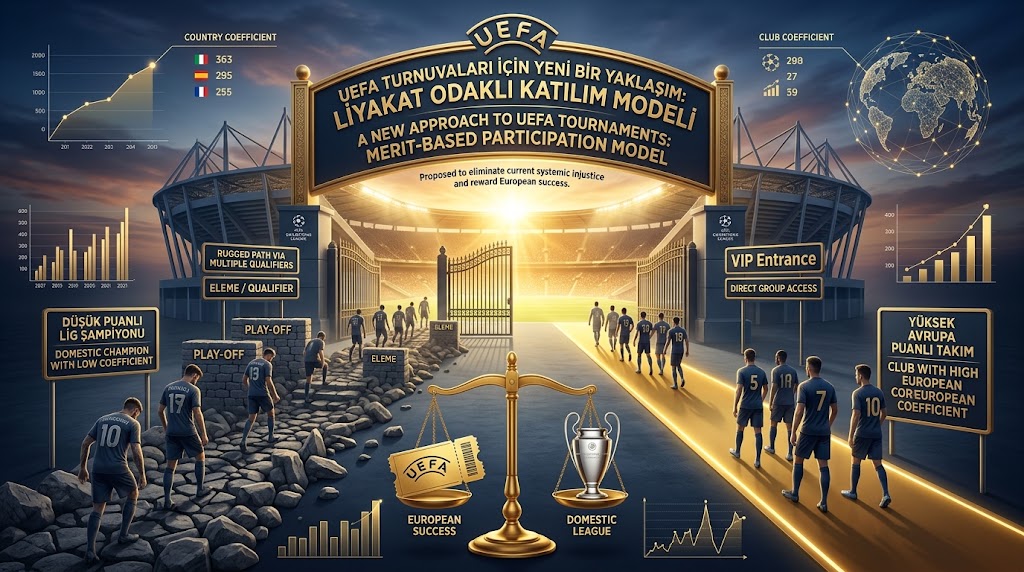
This article opens up for discussion a new ticket distribution model that completely separates the functions of the “Country Coefficient” and the “Club Coefficient” during the participation phase of UEFA organizations, placing merit and European success at its center. This model is envisioned to be implemented in all European cups, namely the Champions League, Europa League, and Conference League, by evaluating the internal quotas and dynamics of each tournament with the same logic and separately.
Core Mechanism of the Model: Separation of Earning and Distributing Rights
The fundamental philosophy of the proposed model is based on designing the process of earning participation rights to the tournament and the distribution of these rights to the clubs as two independent mechanisms. This mechanism will be strictly operated across all three UEFA tournaments in accordance with their internal dynamics.
- Determining the Quota (Country Coefficient): How many teams a country will send to European cups and the nature of these quotas (e.g., 1 direct entry, 1 play-off, 1 qualifying round) will continue to be determined by the Country Coefficient (UEFA Association Coefficient), as in the current system. This ensures the protection of the overall football performance of the countries.
- Creating the Candidate Pool (Domestic League): The competition in the domestic league is only used to determine the teams (the candidate pool) that will receive the European tickets allocated to that country. Teams that finish the league at the top positions obtain their visas to enter the European arena.
- Distributing the Tickets (Club Coefficient): The most radical change of the system comes into play at this stage. Which type of ticket (direct entry, play-off, or lower-tier qualifying round) the teams that have received European visas will get in the Champions League, Europa League, or Conference League is determined by the clubs’ European Club Coefficients, not their standings in the domestic league. While the club with the highest club coefficient obtains the most advantageous participation right of that country in the relevant tournament, a club with a low European coefficient will start from the lowest qualifying round, even if it is the league champion.
Merit and Sanction Principle: The Obligation to Prove Oneself in the European Arena
This model is not merely a “reward” system but also encompasses a merit-based “sanction” logic. A domestic league championship is simply the key to the door opening to Europe; the status inside is determined by past European achievements.
A team that becomes the champion in its own league but lacks consistent success in Europe must pay the price for this deficiency by sweating it out in the qualifiers. This structure aims to prevent teams that experience a surprise championship in their domestic league or benefit from the periodic weakness of their rivals from directly participating in the group stages and lowering the brand value and match quality of the tournament. Teams are forced to prove that they deserve to be at the elite level in actual European matches rather than in their domestic leagues. Every point gathered in different tracks such as the Champions League, Champions League Qualifiers, Europa League, and Conference League turns into an investment that secures the club’s future position.
Potential Criticisms and Opposing Views Towards the System
Emphasizing merit, this model will also bring about various debates and opposing views due to its radical approach to the traditional dynamics of football:
- Loss of Prestige for National Championships: The most criticized point of the model could be its potential to undermine the value of domestic league championships. While a team that is the league champion gets worn out in the qualifiers, a team that finishes the league second or third going directly to the groups simply because of its past points may contradict the tradition of “honoring the champions.”
- Weakening of Competition and Loss of Motivation: If the club coefficient differences are too wide among the teams that have guaranteed European tickets weeks before the end of the league, scenarios may arise where becoming the champion or finishing at the top of the league will not bring an extra European advantage. This situation could negatively affect the competitive motivation in the final stretch of the league.
- Fixation of Power Centers: While well-established clubs with high club coefficients continuously qualify directly for the groups, thereby further consolidating their financial and sporting power, there may arise a risk of blocking the path of surprise or newly rising teams with “qualifying barriers.” The system could be criticized for turning into a structure that preserves the existing hierarchy.
Conclusion
Redesigning the qualifying and participation processes in European club tournaments is not just a matter of calendar or fixture, but also a matter of maintaining quality. Separating the functions of the country coefficient and the club coefficient, this hybrid model centers on long-term stability, effort in the European arena, and merit. Although its strict principles and potential impacts on domestic league dynamics are open to debate, it offers a strong and noteworthy alternative in terms of the goal of forming the summit of Europe out of teams that truly deserve to be there.
Imprint / Author’s Note: This model has been proposed to eliminate the systemic injustice that arises when teams with high coefficients and consistent success in European cups are forced to play multiple qualifying and play-off rounds, while teams with low European success participate directly in the groups without playing any qualifiers simply because they are champions in their own countries.
| aydintiryaki.org | YouTube | Aydın Tiryaki’nin Yazıları ve Videoları │Articles and Videos by Aydın Tiryaki | Bilgi Merkezi│Knowledge Hub | ░ Virgülüne Dokunmadan │ Verbatim ░ | ░ UEFA Turnuvalarında Katılım ve Eleme Süreçlerine Yönelik Yeni Bir Yaklaşım: Liyakat Odaklı Katılım Modeli │A New Approach to Qualification and Participation Processes in UEFA Tournaments: A Merit-Based Qualification Model ░ 31.07.2026
 Aydın Tiryaki