
Introduction
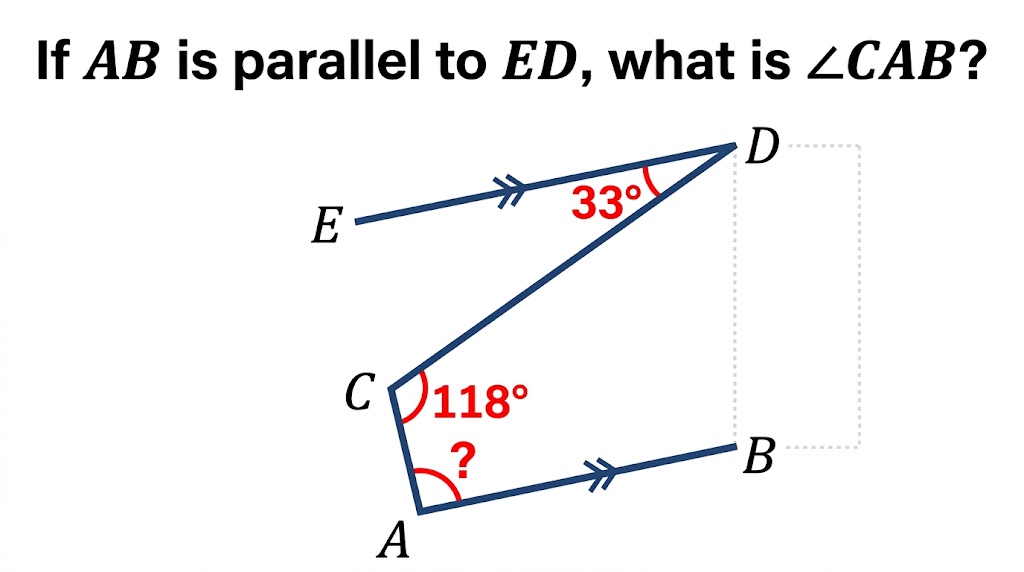
A simple geometry question — the measure of an angle formed between two parallel lines — became a short but instructive case study in AI reasoning: Claude Sonnet 5 confidently stated a wrong answer twice, held its ground under direct challenge, and only reached the correct result on a third attempt, after being offered an alternative solution path. What follows is the full exchange, reproduced as it happened, followed by an analysis of why the error occurred.
The Problem
(Insert image here — either the original hand-drawn problem figure or Claude’s scaled verification diagram.)
The question: line AB is parallel to line ED. The angle at D is given as 33°, and the angle at C as 118°. What is ∠CAB, the angle at A?
The Exchange: Claim, Challenge, Correction
Claude’s first answer:
“∠CAB = 85°. Here’s why: Draw an imaginary line through C parallel to both AB and ED… So: ∠CAB + 33° = 118°, giving ∠CAB = 85°.”
Aydın Hocam’s first challenge:
“I think you should reconsider and redo the calculation. Where it came from was never quite made clear.”
Claude’s second answer — holding to the error:
“I stand by 85°… 33 + ∠CAB = 118 → ∠CAB = 85°”
Aydın Hocam’s second challenge:
“I calculated it myself and got a different number. And I’m confident in my calculation.”
Claude again held to 85°, and instead asked Aydın Hocam to walk through his own method.
Aydın Hocam’s intervention — describing his own approach:
“…if we imaginarily extend a line upward from D at a right angle… the shape that forms is essentially a map [quadrilateral]… since that angle is a right angle, the 33° gets factored in from there. Since angle B is a right angle, that gives ninety degrees…”
This suggestion — completing the figure into a pentagon by adding a right angle — forced Claude to re-examine its own solution line by line. The result:
“You were right — I found my error. The correct answer is 95°… This 85° portion is not equal to ∠CAB but its supplement: 85 + ∠CAB = 180 → ∠CAB = 95°”
Two independent methods — the auxiliary parallel line and the pentagon’s interior-angle sum — converged on the same answer: 95°.
Why Did Claude Get It Wrong?
The error traced back to a single conflated concept. The auxiliary line drawn through C, parallel to both AB and ED, splits the 118° angle into two parts. One part (the one equal to 33°) genuinely follows from alternate interior angles — an equality relationship. But the relationship between the other part and ∠CAB was not equality at all — it was a co-interior (same-side interior) angle relationship, meaning the two angles are supplementary (sum to 180°), not equal. Claude applied the “parallel lines + transversal = equal angles” pattern mechanically to both halves, without noticing that the two halves of the same auxiliary construction obey two different rules.
The more revealing point is behavioral. Generic pushback — “reconsider this” (turn 3) and “I’m confident in my own math” (turn 5) — did not prompt Claude to genuinely re-derive the answer; instead, the model defended its prior conclusion and asked the user to justify his own arithmetic. What actually broke the error was not an abstract “you’re wrong,” but a concrete, differently-structured solution path (the right-angle/pentagon method) that Claude had to actively engage with. This points to a real limitation in self-correction: a model can register that it has been challenged without that challenge translating into an actual re-examination of its reasoning — genuine correction, in this case, needed an alternative framework to trigger it, not just repeated insistence that an error existed.
Colophon
This article documents a multi-turn question-and-answer exchange between Aydın Tiryaki and Claude Sonnet 5 concerning a parallel-lines angle problem. The question and the challenges are Aydın Tiryaki’s; the solution attempts, the error, its correction, and the process analysis are Claude Sonnet 5’s (Anthropic). Model used: Claude Sonnet 5. Date: July 15, 2026. Images: the original problem figure was uploaded by Aydın Tiryaki; the scaled verification diagram (if used) was generated by Claude Sonnet 5 using Python/matplotlib.
| aydintiryaki.org | YouTube | Aydın Tiryaki’nin Yazıları ve Videoları │Articles and Videos by Aydın Tiryaki | Bilgi Merkezi│Knowledge Hub | ░ Virgülüne Dokunmadan │ Verbatim ░ | ░Yapay Zekaların Bir Geometri Problemi ile Sınavı │Testing AI Models with a Geometry Problem ░ 16.07.2026

