
Bringing together the entire universe of the seventh art — from cinema science and film, series, and artist guides to three-level cinema education, a thematic glossary, and the brand-new 7th module that identifies films and series from a remembered plot or scene while mapping inspirations and copies — Cinema Registry (v2.03 │ sdn0005) has been upgraded with a global 3-tier spoiler control protocol across all modules. The Skill Documentation Page and Google Drive Gemini and Claude folder links containing the downloadable SKILL.md file are provided at the end of this article.
Aydın Tiryaki
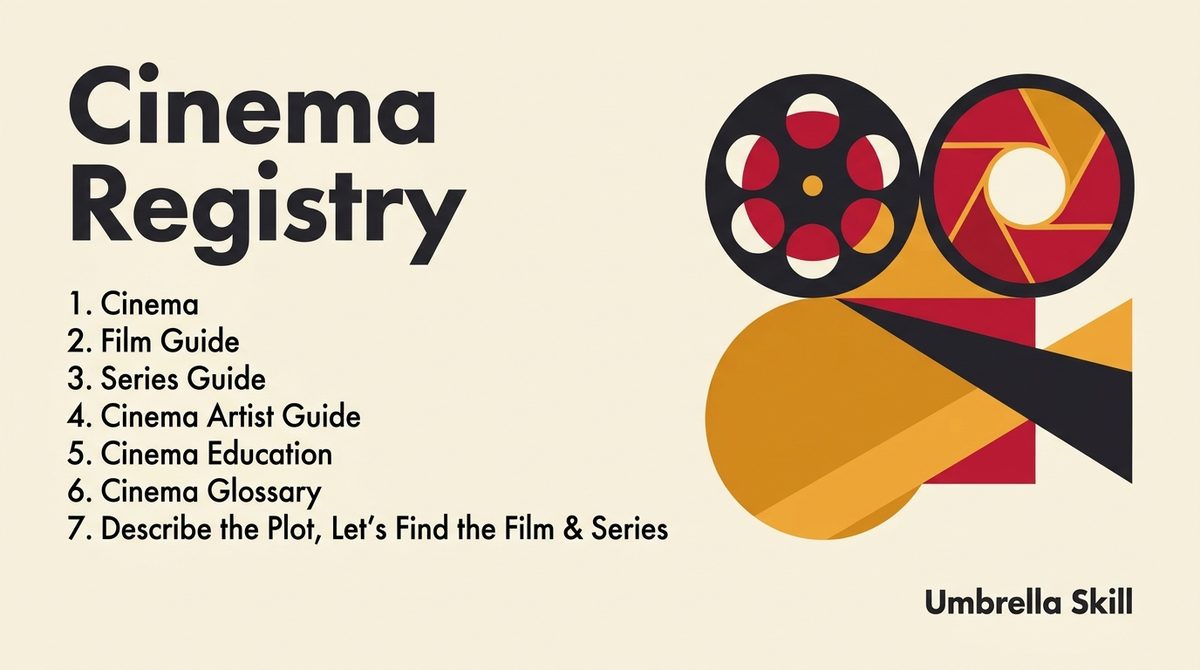
A Seven-Module Scientific Umbrella Architecture for the Seventh Art
Researching cinema often means jumping across disconnected websites: checking streaming availability on one platform, camera and lens specifications on another, film theory in academic journals, and half-remembered movie plots in online forums. Cinema Registry unifies this entire workflow within a single seven-module Scientific Umbrella Skill. Thanks to its three-gate routing design, you can pick a specific module directly or simply enter a film, series, director, cinema term, or remembered scene without naming any module at all.
With v2.03, a Global Spoiler Control and Sensitivity Protocol now protects every module. Unless you explicitly request spoilers, endings and major plot twists are never revealed in the initial response. Whenever an answer approaches spoiler-sensitive territory — such as a finale, twist, or ending comparison — the system asks you to choose among three tiers (Continue spoiler-free, Light spoilers, or Full spoilers allowed) and separates any approved spoiler section under an explicit warning banner.
Module 1️⃣: Cinema
Operating as a senior scholar and theorist of film studies, Module 1️⃣ provides a 12-branch hierarchical cinema topic tree spanning film theory and aesthetics, narratology, cinematography and ACES color science, editing and montage theory, sound design and Dolby Atmos, world cinema and cinema of Türkiye, computational cinema/VFX/AI, and an interdisciplinary intersection matrix. Optical, aspect ratio, and shot-length calculations are verified in Python.
Module 2️⃣: Film Guide
Driven by a passionate Cinephile Curator persona, Film Guide delivers comprehensive single-film profiles including original and localized titles, critic scores (IMDb, Letterboxd, Rotten Tomatoes, Metacritic), regionally verified streaming platforms with access types (Subscription, Rent, Buy), behind-the-scenes (BTS) footage, YouTube full-movie runtime integrity checks, pure soundtrack (OST) links, screenplay/adaptation analysis, festival awards, box office metrics, technical specs, and parental guidance — plus head-to-head Film VS tables and “What Should I Watch?” curation.
Module 3️⃣: Series Guide
Tailored for television and streaming series, Series Guide compiles showrunners, season and episode counts, average runtimes, broadcast status (Ongoing, Ended, Canceled), IMDb ratings and highest-rated episodes, streaming availability, soundtracks, and parental guides, alongside Series VS comparisons and mood-based series curation.
Module 4️⃣: Cinema Artist Guide
Dedicated to directors, actors, screenwriters, and cinematographers, this module delivers concise biographies, artistic signature analyses, major festival and academy awards, and untruncated categorical filmographies (“As Actor”, “As Director”, “As Screenwriter”, “As Producer”, “Short Film”, “Documentary”, “Music Video”) ranked by IMDb rating, together with Artist VS comparisons and curated podcast/video-essay links.
Module 5️⃣: Cinema Education
Built for structured learning across Very Simple, Intermediate, and Advanced levels, Cinema Education features a global core textbooks catalog with real book cover images (from David Bordwell and Walter Murch to Robert McKee and foundational cinema of Türkiye scholarship), step-by-step Capstone project guides, a 4-layer university curriculum protocol, a direct bridge to University Repository, and interactive HTML5 exams via ATL1 L02.
Module 6️⃣: Cinema Glossary
Connected via a lean bridge to the ATL1 Subskill Library Thematic Glossary (L13), Cinema Glossary supports direct term lookups, reverse lookup (“What Is This Called in Cinema?”), smart spelling/phonetic correction, 5-block etymology and cross-language cards, balanced 4+2+2 letter lists, and interactive term games.
Module 7️⃣: Describe the Plot, Let’s Find the Film & Series
Introduced in v2.03, Module 7️⃣ identifies films and series from any remembered plot point, single scene, character trait, line of dialogue, or vague memory through live cross-verified search. Candidates are ranked with confidence levels and concrete matching rationales; when clues are broad, the module asks at most 3 concise narrowing questions and transitions in one step to Film Guide or Series Guide once confirmed. Beyond identification, it scans domestic and international cinema to produce a chronological Inspiration and Similarity Matrix distinguishing official remakes and adaptations, direct inspirations and homages, potential copies or unofficial adaptations, and parallel twin films — detailing chronological precedence, overlapping elements, and verified critical or legal discussions.
Shared Backbone: Pure ID Links, 5-Layer Open Courseware, and ATL1
All seven modules share an ID-based pure link construction protocol free of search-engine redirects, a 5-layer open knowledge and OpenCourseWare pool (MIT OCW, DergiPark, TSA, BFI, and open production tools), cross-skill bridges to neighboring compendiums, and lean ATL1 Subskill Library integration (L01 Visual, L02 Exam, L03 Guide, L05 Info Line, L06 Core Rules, L08 Sources, L09 Menus, L10 Bridge, L11 Python Verification, L12 Persona, and L13 Glossary).
📄Skill Documentation Page: https://aydintiryaki.org/2026/11/29/sdn0005en/
The Gemini 4 Neon AI model was used in the development of this design.
Google Drive Folder Links and SKILL.md File
You can go to the folders below to download and directly use the SKILL.md file from these folders. If you cannot access these folders or file, it means the link is temporarily suspended because the development of the relevant Skills is currently in progress; please try again later.
📁 Google Drive Gemini Folder Path (EN): https://drive.google.com/drive/folders/1SzaaQPomcibrrOAo3ru38R1yJnOAl-18
📁 Google Drive Claude Folder Path (EN):
Note: You can make your own developments and edits on the SKILL.md file you obtain from here. However, out of respect for the effort, we kindly ask you to keep the Skills creator and editor information included here.
This Umbrella Skill design and the perspectives in this article belong to Aydın Tiryaki; the architecture was developed jointly with ATG1 Skill Factory v15.21 and ATG5 Umbrella Integration Unit v01.21, and article editing assistance was provided by the Gemini 4 Neon model. (29.11.2026 11:18)
📘 Aydın Tiryaki Skill Archive User Guide: https://aydintiryaki.org/2026/11/20/aydin-tiryaki-skill-archive-user-guide/
aydintiryaki.org | YouTube | Aydın Tiryaki’nin Yazıları ve Videoları | Articles and Videos by Aydın Tiryaki | Bilgi Merkezi | Knowledge Hub | Virgülüne Dokunmadan | Verbatim | Skills Dağarcığı | Skills Lexicon | ░ Sinema Dağarcığı | Cinema Registry (Çatı Skill / Umbrella Skill) ░ 29.11.2026
Last Updated: 29.11.2026 11:18

