
Music Repertoire is a comprehensive Scientific Umbrella Skill that unifies seven specialized modules—from musicology and music education to song/album/artist curation, music history, instruments, audio production, and the music industry—under a single roof. The Skill Documentation Page and Google Drive Gemini and Claude folder links containing the downloadable SKILL.md file are provided at the end of this article.
Aydın Tiryaki
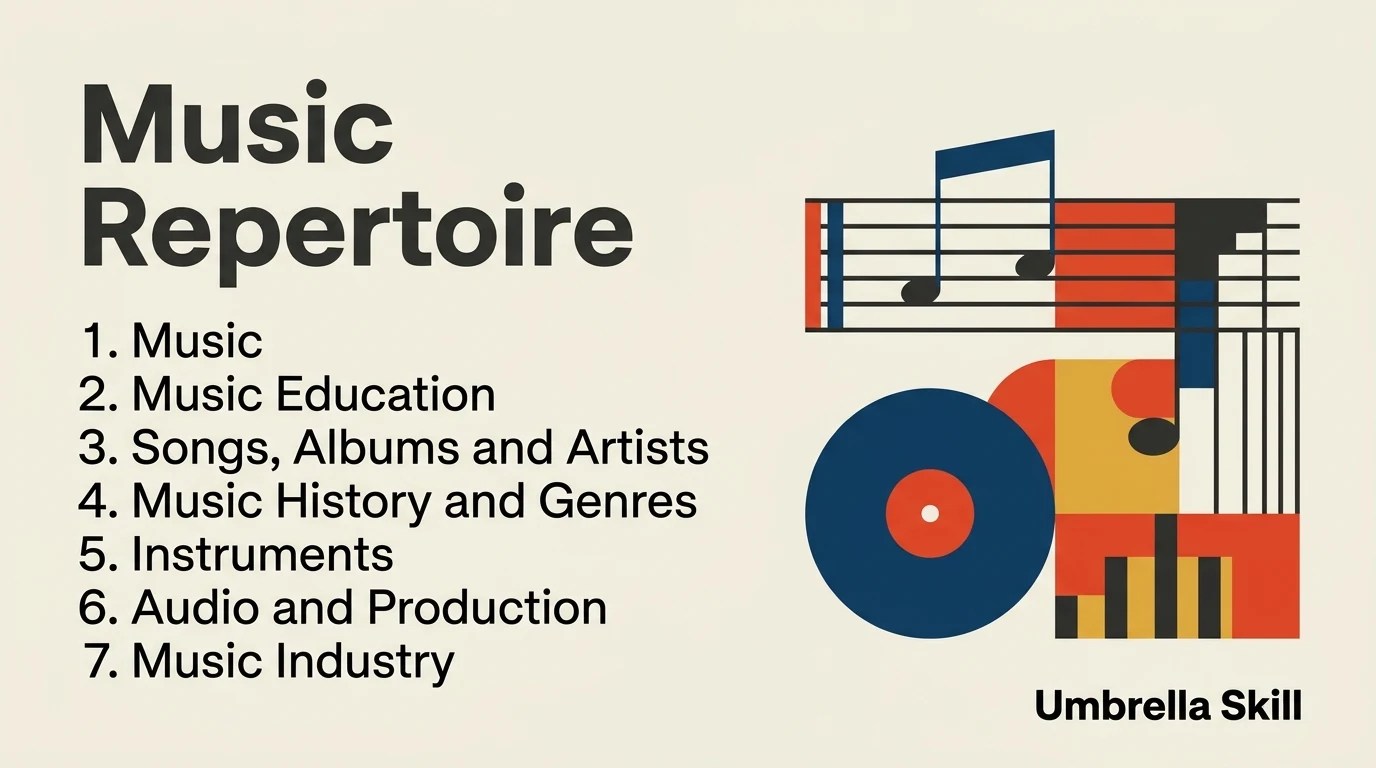
Listeners, conservatory students, audio engineers, and researchers often have to jump across disconnected tools—checking a song’s discography in one place, harmony theory in another, instrument acoustics somewhere else, and copyright frameworks on yet another site. Music Repertoire brings these domains together under seven specialized modules backed by a shared 5-layer open courseware/open resource ecosystem and seamless bidirectional module switching.
Module 1️⃣: Music
The Music module delivers a 12-branch hierarchical topic tree spanning musicology, music theory, harmony and counterpoint, musical form, acoustics and psychoacoustics, ethnomusicology, performance science, music psychology, notation and digital musicology, stage/opera/film music, sociology of music, computational music and AI, and interdisciplinary studies. It pairs clean plain-text acoustic and frequency formulas with Python verification, international standards (ISO 16, EBU R128, MIDI 2.0), and structured interdisciplinary matrices.
Module 2️⃣: Music Education
The Music Education module explains every topic across three pedagogical levels—Very Simple, Intermediate, and Advanced—guiding learners from auditory intuition to research-level analysis. It curates global core textbooks with verified links and real book cover images, step-by-step Capstone/recital project guides, historical case studies, a 4-layer conservatory curriculum framework, a direct bridge to University Repository, and interactive HTML5 quizzes.
Module 3️⃣: Songs, Albums and Artists
Preserving the full curatorial heritage of Music Repertoire with zero loss, this module analyzes songs, albums, composers, and bands with BPM, Mood, key, dominant instruments, a Rhythmic Cohesion Note, and lyric/thematic insights. It prioritizes official videos or iconic live performances on YouTube with top-5 video view breakdowns, official channel subscriber counts, cumulative streaming statistics, 8-item interactive work lists, decade filters, genre evolution, tour schedules, iconic covers/duets, cinematic soundtrack scenes, vinyl/cassette/CD pressings, and clean ID-based canonical platform links.
Module 4️⃣: Music History and Genres
Covers the chronological arc from Antiquity, Medieval, Renaissance, Baroque, Classical, and Romantic eras through 20th-Century and Contemporary music alongside a global genre atlas spanning classical, jazz, blues, rock, metal, electronic, hip-hop, pop, Anatolian/Turkish Art and Folk traditions of Türkiye, and world traditional musics. Builds side-by-side structural comparison tables across eras and genres.
Module 5️⃣: Instruments
Examines musical instruments through both the Hornbostel-Sachs (MIMO) scientific taxonomy (idiophones, membranophones, chordophones, aerophones, electrophones) and orchestral/traditional families. Details sound production acoustics, pitch ranges, tuning systems, luthier materials, maintenance and selection guidance, signature repertoire, and landmark performers.
Module 6️⃣: Audio and Production
Explores studio recording chains, microphone types and polar patterns, DAW workflows, mixing (EQ, compression, spatial effects), mastering loudness targets (LUFS, dBFS, True Peak), room acoustics, sound synthesis (subtractive, FM, wavetable, granular), MIDI/MPE, digital signal processing (DSP), live PA systems, and AI audio tools with Python-verified acoustic and delay calculations.
Module 7️⃣: Music Industry
Breaks down major and independent record labels, music publishing, digital distribution and streaming royalty models, ISRC/ISWC/UPC identifiers, concert/festival economics, and physical edition markets alongside copyright law, neighboring rights, sync/mechanical licensing, and collecting societies (MESAM, MSG, MÜ-YAP, MÜYORBİR in Türkiye; globally ASCAP, BMI, PRS, GEMA, WIPO).
📄Skill Documentation Page: https://aydintiryaki.org/2026/06/19/gdn030/
This Umbrella Skill was developed using the Gemini model.
Google Drive Folder Links and SKILL.md File
You can go to the folders below to download and directly use the SKILL.md file from these folders. If you cannot access these folders or file, it means the link is temporarily suspended because the development of the relevant Skills is currently in progress; please try again later.
📁 Google Drive Gemini Folder Path (EN): https://drive.google.com/drive/folders/11966PqD3NNbJLp1rtnLo_8UIX4q1L-VX
📁 Google Drive Claude Folder Path (EN):
Note: You can make your own developments and edits on the SKILL.md file you obtain from here. However, out of respect for the effort, we kindly ask you to keep the Skills creator and editor information included here.
This design and the views expressed in this article belong to Aydın Tiryaki and were developed with the joint architecture of ATG1 Skill Factory and ATG5 Umbrella Integration Unit; article editing and writing assistance were performed by the Gemini model. (26.11.2026 00:12)
📘 Aydın Tiryaki Skill Archive User Guide: https://aydintiryaki.org/2026/11/20/aydin-tiryaki-skill-archive-user-guide/
| aydintiryaki.org | YouTube | Aydın Tiryaki’nin Yazıları ve Videoları│Articles and Videos by Aydın Tiryaki | Bilgi Merkezi│Knowledge Hub | Virgülüne Dokunmadan│Verbatim | Skills Dağarcığı │Skills Lexicon | ░ Müzik Dağarcığı │Music Repertoire (Çatı Skill / Umbrella Skill) ░ 26.11.2026

