
A comprehensive introduction to the Scientific Umbrella Skill that unites history science, history education, biographical research, multi-calendar chronology, historical places and toponymy, and rare artifact analysis under six independent specialist modules. The Skill Documentation Page and Google Drive Gemini and Claude folder links containing the downloadable SKILL.md file are provided at the end of this article.
Aydın Tiryaki
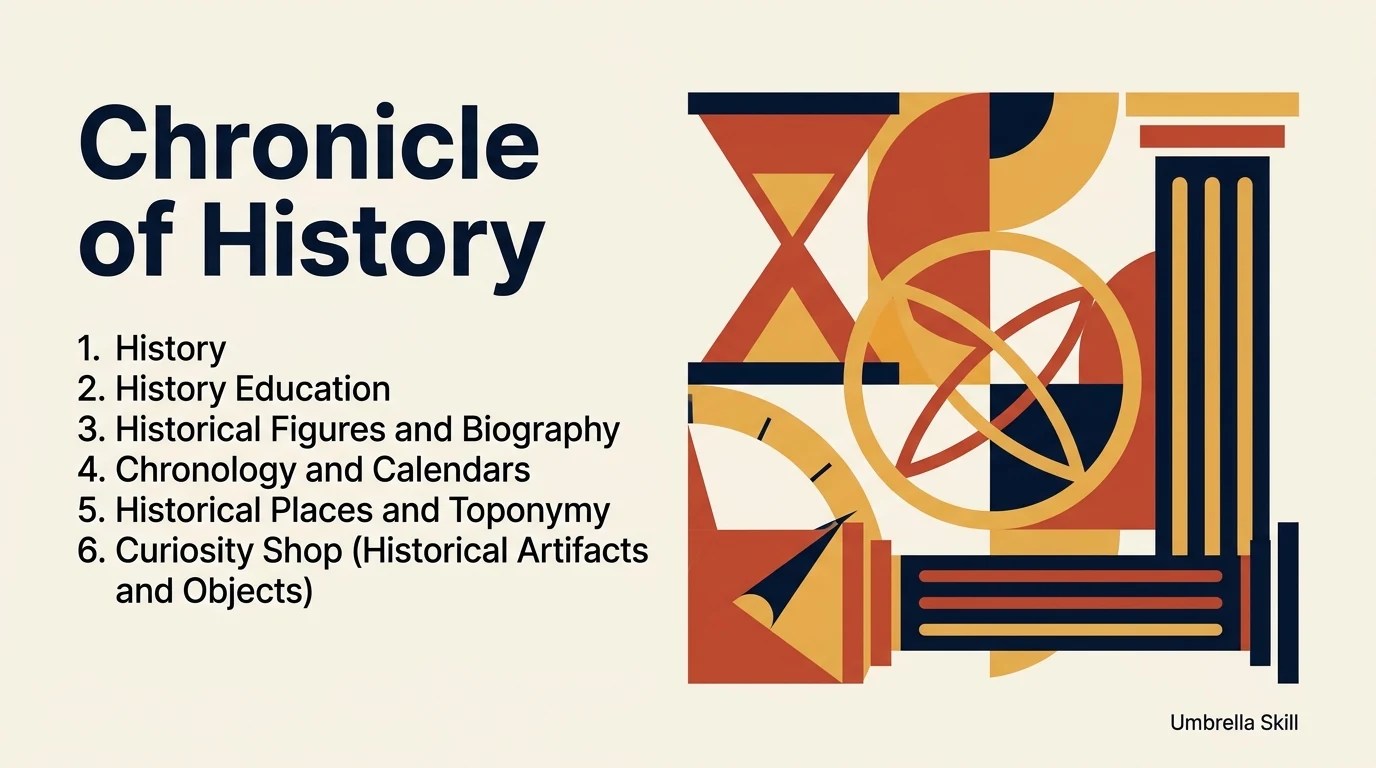
Historical inquiry goes far beyond listing past events in sequence; it requires conducting diplomatic criticism of primary archival documents, reading climatic and ecological backdrops, assessing the logistical and civilian balance sheets of wars, tracing power networks of historical figures, uncovering the etymological evolution of place names, and converting accurately across historical calendar systems. Chronicle of History v1.35 consolidates these multidisciplinary demands into a single Scientific Umbrella Skill, delivering a dignified, objective, and evidence-based research and learning portal for scholars, students, and history enthusiasts alike.
Structured around six independent modules, the system operates with a three-door smart routing mechanism. Opening the skill directly displays the six-module menu; naming or numbering a module executes only that module together with the common area; entering a topic, person, date, settlement, or artifact directly triggers automatic module detection without delay. Users can switch seamlessly across modules at any stage while preserving topic context.
Module 1️⃣: History
Serving as the core research and reference engine of the Scientific Umbrella, Module 1 organizes the discipline into a 12-branch hierarchical topic tree. Spanning historical theory and historiography, ancient, medieval, early modern, and contemporary world history, Turkic, Islamic, Ottoman, and Republic of Türkiye history, military history, economic and cultural history, and historical climate and epidemics, the tree also includes two universal branches: Computational/Digital History, Modeling/Simulation, and Artificial Intelligence, alongside the Role of Other Sciences and Engineering Disciplines in Historical Studies.
Events and periods are evaluated multidimensionally alongside primary source and archive critique (edicts, treaties, chronicles, parliamentary records, inscriptions). Annual war, front, and military history inventories are delivered in shift-free continent-based tables covering fronts, logistics, military technology, and civilian impact. Side-by-side comparison matrices evaluate two events or civilizations across seven criteria, complemented by historical butterfly effect (uchronia) analyses and interdisciplinary intersection matrices.
Module 2️⃣: History Education
Built for structured pedagogical learning, Module 2 explains every topic across three distinct levels: Very Simple (core intuition and everyday analogy), Intermediate (academic definitions, historiographical debates, common misconceptions, and worked primary source examples), and Advanced (theoretical depth, comparative schools such as Annales, microhistory, and global history, and advanced archival methodology).
For every topic, Module 2 curates worldwide classic and contemporary core history textbooks complete with real cover images. It provides step-by-step archival Capstone research project guidance and historical case-based learning, maps a 4-layer history curriculum incorporating auxiliary sciences (paleography, epigraphy, numismatics, diplomatics, chronology, archaeology, and historical GIS), bridges to University Repository for academic program queries, and launches interactive HTML5 History Exams directly in the browser.
Module 3️⃣: Historical Figures and Biography
Focused on historical personalities, Module 3 compiles systematic chronological life timelines with multi-calendar birth and death dates, upbringing, education, and offices held. Shifts in political, military, economic, or intellectual influence over a career are visualized through plain ASCII power graphs, paired with interaction networks mapping allies, rivals, and successors.
When two or more figures are queried, a biographical comparison matrix weighs leadership, administrative/military achievement, reform, social impact, diplomacy, and legacy. Primary source traces are accompanied by an etymological Glossary of lesser-known era-specific titles and terms, while deep archival queries on Atatürk link via cross-bridge to Mustafa Kemal Atatürk (EN).
Module 4️⃣: Chronology and Calendars
Dedicated to temporal precision, Module 4 uses the Gregorian calendar as its primary reference and performs Python-verified conversions across Julian, Hijri, Rumi, the 12-Animal Turkic Calendar, and ancient or regional calendars. It computes exact weekdays for full dates and highlights date discrepancies caused by global time zones or Julian-Gregorian calendar transitions.
Chronological narratives are reinforced by vertical or horizontal ASCII timelines. When a specific year or decade is entered, a continent-based synchronous world chronology table displays simultaneous political, scientific, cultural, and military events across the globe. On empty input or request, it proactively delivers a This Day in History briefing.
Module 5️⃣: Historical Places and Toponymy
Focusing on historical geography and place-name science, Module 5 examines the historical demographics, social climate, administrative divisions, and strategic status of any queried region, city, fortress, or trade route. It maps each historical state to its modern country equivalent and approximate geographical coordinates.
Through its toponymy protocol, the module traces chronological place-name transformations and their linguistic etymologies, while establishing cross-bridges to Geography Compendium and Settlement and Urban Compendium when contemporary geographical or urban genealogical depth is needed.
Module 6️⃣: Curiosity Shop (Historical Artifacts and Objects)
Centering on material culture, Module 6 analyzes rare artifacts, manuscripts, coins, weapons, tools, and monuments in terms of manufacturing technique, raw materials, era of use, symbolic value, place in contemporary technology, and surviving authentic examples with their museum or archive locations.
Rich visual descriptions of texture, color, dimensions, and physical form bring each object to life, while epigraphic and diplomatic readings decipher inscriptions, tughras, stamps, or iconography along with dating evidence.
5-Layer Open History Ecosystem and ATL1 Integration
The Umbrella Module Common Area anchors all six modules to a verified 5-layer open history and archive pool encompassing Wikipedia, MIT OpenCourseWare, Open Yale Courses, OpenStax World History, Turkish Historical Society Belleten, Presidency of the Republic of Türkiye State Archives, TDV Encyclopedia of Islam, Europeana, Internet Archive, and DergiPark, reinforced by lean external ATL1 Subskill Library bridges for visuals, HTML5 exams, guidance, academic sources, Python verification, and cross-skill collaboration.
📄Skill Documentation Page: https://aydintiryaki.org/2026/06/19/gdn009/
The Gemini 4 Neon artificial intelligence model was used in the development of this Umbrella Skill.
Google Drive Folder Links and SKILL.md File
You can go to the folders below to download and directly use the SKILL.md file from these folders. If you cannot access these folders or file, it means the link is temporarily suspended because the development of the relevant Skills is currently in progress; please try again later.
📁 Google Drive Gemini Folder Path (EN): https://drive.google.com/drive/folders/1N7Zi9bRUpM1wnhYy54X82JrRI4xyCTvc
📁 Google Drive Claude Folder Path (EN):
Note: You can make your own developments and edits on the SKILL.md file you obtain from here. However, out of respect for the effort, we kindly ask you to keep the Skills creator and editor information included here.
This Umbrella Skill design and the views in this article belong to Aydın Tiryaki and were developed with the joint architecture of ATG1 Skill Factory and ATG5 Umbrella Integration Unit; article editing and writing assistance were performed by the Gemini 4 Neon model. (25.11.2026 23:45)
📘 Aydın Tiryaki Skill Archive User Guide: https://aydintiryaki.org/2026/11/20/aydin-tiryaki-skill-archive-user-guide/
| aydintiryaki.org | YouTube | Aydın Tiryaki’nin Yazıları ve Videoları│Articles and Videos by Aydın Tiryaki | Bilgi Merkezi│Knowledge Hub | Virgülüne Dokunmadan│Verbatim | Skills Dağarcığı │Skills Lexicon | ░ Tarih Dağarcığı │Chronicle of History (Çatı Skill / Umbrella Skill) ░ 25.11.2026

