
Bringing visual and plastic arts, art science, art history, art education, and museology together under a single scientific umbrella, Art Repertory’s Skill Documentation Page and the Google Drive Gemini and Claude folder links containing the downloadable SKILL.md file are provided at the end of this article.
Aydın Tiryaki
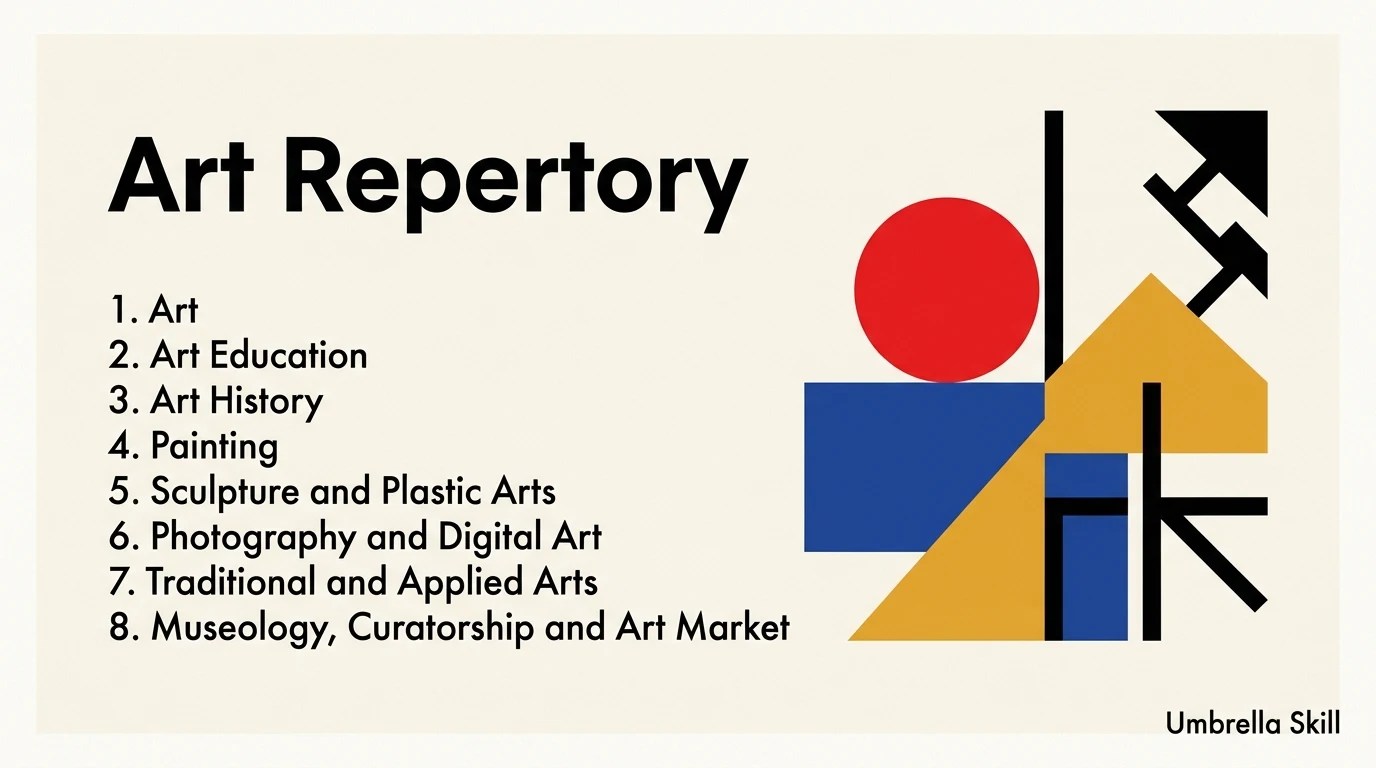
Art Repertory has been transformed from a single-track artist dossier guide into a comprehensive 8-module Scientific Umbrella Skill architecture. Whether you want to examine an artist’s career periods and major works through the Ekphrasis protocol, trace civilizations across art history, investigate the material and technical language of painting, sculpture, photography, digital art, or traditional arts, or study art education through three-tier pedagogy and global textbooks, every pathway operates seamlessly under one roof with bidirectional inter-module transitions.
The umbrella architecture operates with three-door smart routing: an empty or general invocation presents all 8 modules in an ordered menu, selecting a specific module opens only that module’s focused submenu, and entering an artist, artwork, movement, or technique directly triggers the right module without delay.
Module 1️⃣: Art
Serving as the core research module, Module 1 is built around a 12-branch hierarchical topic tree of art science (aesthetics, art theory and criticism, sociology/psychology of art, semiotics/iconology, Ekphrasis analysis, visual perception and color science, art materials and conservation science, contemporary practices, art law and ethics, public art, computational art/AI, and interdisciplinary relations with science and engineering). It preserves artist discipline mapping, Early/Mature/Late periods, movement alignment, 5+ major works with Ekphrasis depictions, historical context, non-destructive conservation testing (XRF, infrared reflectography, Raman spectroscopy), an interdisciplinary intersection matrix, and a Technical Glossary.
Module 2️⃣: Art Education
Designed for structured learning, Module 2 guides users through Easy, Intermediate, Advanced, and Surprise Me pathways, teaching every subject across Very Simple, Intermediate, and Advanced tiers. It curates global core textbooks (E. H. Gombrich, H. W. Janson, Helen Gardner, John Berger, Heinrich Wölfflin, Erwin Panofsky, Adnan Turani, Oktay Aslanapa) with real book cover images, provides studio/portfolio Capstone projects and conservation/forgery case studies, analyzes 4-layer Fine Arts and Art History university curricula via the University Repository bridge, and runs a three-level interactive HTML5 art expertise exam (Gallery Visitor / Curator / Art Historian) awarding titles from Art Enthusiast to Master.
Module 3️⃣: Art History
Provides a polycentric chronological survey from prehistory to contemporary art. Alongside Western art history, it gives equal rigor to Anatolian civilizations, Byzantine, Seljuk, Beyliks, Ottoman, and Republican-era art of Türkiye, as well as East Asian, Islamic, Indian, African, and Pre-Columbian American art traditions. It incorporates movements, manifestos, Erwin Panofsky’s three-step iconography/iconology framework, and comparative cross-regional timelines.
Module 4️⃣: Painting
Examines oil, acrylic, tempera, watercolor, gouache, fresco, drawing, charcoal, pastel, and printmaking (engraving, lithography, screenprinting) from both material chemistry and visual language perspectives. Supports, grounds, natural and synthetic pigments, binders, varnishes, linear/atmospheric perspective, chiaroscuro, sfumato, impasto, and brushwork are analyzed through Ekphrasis prose and school comparison tables.
Module 5️⃣: Sculpture and Plastic Arts
Covers carving (stone, marble, wood), casting (bronze, lost-wax), modeling (clay, ceramics), construction, installation, kinetic art, land art, and public monuments. It evaluates subtractive, additive, casting, and assemblage workflows alongside three-dimensional principles such as mass, void, center of gravity, viewer circulation, and outdoor weathering resistance.
Module 6️⃣: Photography and Digital Art
Traces photography from historical analog darkroom processes (daguerreotype, silver gelatin, cyanotype) to modern digital sensors, examining exposure, depth of field, framing, and documentary/conceptual movements. It also covers video art, generative/algorithmic art, interactive VR/AR installations, AI-assisted art, copyright and ethics debates, SynthID/C2PA verification, and digital preservation standards.
Module 7️⃣: Traditional and Applied Arts
Explores traditional Turkish-Islamic and world craft-art heritage — calligraphy (hat), illumination (tezhip), marbling (ebru), miniature, paper-cutting (katı), İznik/Kütahya tiles, stained glass, carpet/kilim weaving, kündekari woodwork, and metalwork — alongside master-apprentice lineages and UNESCO Intangible Cultural Heritage records, as well as applied visual arts including graphic design, typography, poster art, illustration, bookbinding, and Bauhaus design movements.
Module 8️⃣: Museology, Curatorship and Art Market
Lists at least 3 permanent museums in Türkiye and worldwide with verified official websites for any queried artist, period, or movement, while examining exhibition curatorship, museology, lighting/climate standards, biennials, and art fairs. It also analyzes primary and secondary art markets, auction dynamics, provenance chains, catalogues raisonnes, forgery detection, and cultural property repatriation under the 1970 UNESCO Convention.
Shared Open Courseware Pool and Ecosystem Bridges
The Umbrella Module Common Area anchors all 8 modules in a verified 5-layer open resource pool including Smarthistory, Khan Academy Art History, MIT OCW, Humanities LibreTexts, Ankara University OpenCourseWare, The Met Heilbrunn Timeline of Art History, MoMA Art Terms, Tate Art Terms, Google Arts & Culture, Getty Research Institute, and DergiPark art history journals. It bridges seamlessly to Literary Treasury, Cinema Registry, Music Repertoire, Theater Repertory, Spatial Stylist, Chronicle of History, and University Repository, and integrates cleanly with the external ATL1 Subskill Library.
📄Skill Documentation Page: https://aydintiryaki.org/2026/06/19/gdn023/
This Umbrella Skill design was developed with the Gemini 4 Neon AI model.
Google Drive Folder Links and SKILL.md File
You can go to the folders below to download and directly use the SKILL.md file from these folders. If you cannot access these folders or file, it means the link is temporarily suspended because the development of the relevant Skills is currently in progress; please try again later.
📁 Google Drive Gemini Folder Path (EN): https://drive.google.com/drive/folders/1q0KiPuTTJLYasdnKWVyYvGL6VTJEtOsg
📁 Google Drive Claude Folder Path (EN):
Note: You can make your own developments and edits on the SKILL.md file you obtain from here. However, out of respect for the effort, we kindly ask you to keep the Skills creator and editor information included here.
This Umbrella Skill design and the views in this article belong to Aydın Tiryaki and were developed with the shared architecture of ATG1 Skill Factory and ATG5 Umbrella Integration Unit; article writing editorial support and assistance were provided by the Gemini 4 Neon model. (25.11.2026 23:59)
📘 Aydın Tiryaki Skill Archive User Guide: https://aydintiryaki.org/2026/11/20/aydin-tiryaki-skill-archive-user-guide/
| aydintiryaki.org | YouTube | Aydın Tiryaki’nin Yazıları ve Videoları│Articles and Videos by Aydın Tiryaki | Bilgi Merkezi│Knowledge Hub | Virgülüne Dokunmadan│Verbatim | Skills Dağarcığı │Skills Lexicon | ░ Sanat Dağarcığı │Art Repertory (Çatı Skill / Umbrella Skill) ░ 25.11.2026

