
Built on the Scientific Umbrella Skill architecture, Learning Languages brings together international proficiency frameworks, 100% open-access university courses, verified YouTube playlists, free audiobooks, and interactive study tools under a single multilingual roof. The Skill Documentation Page and Google Drive Gemini and Claude folder links containing the downloadable SKILL.md file are provided at the end of this article.
Aydın Tiryaki
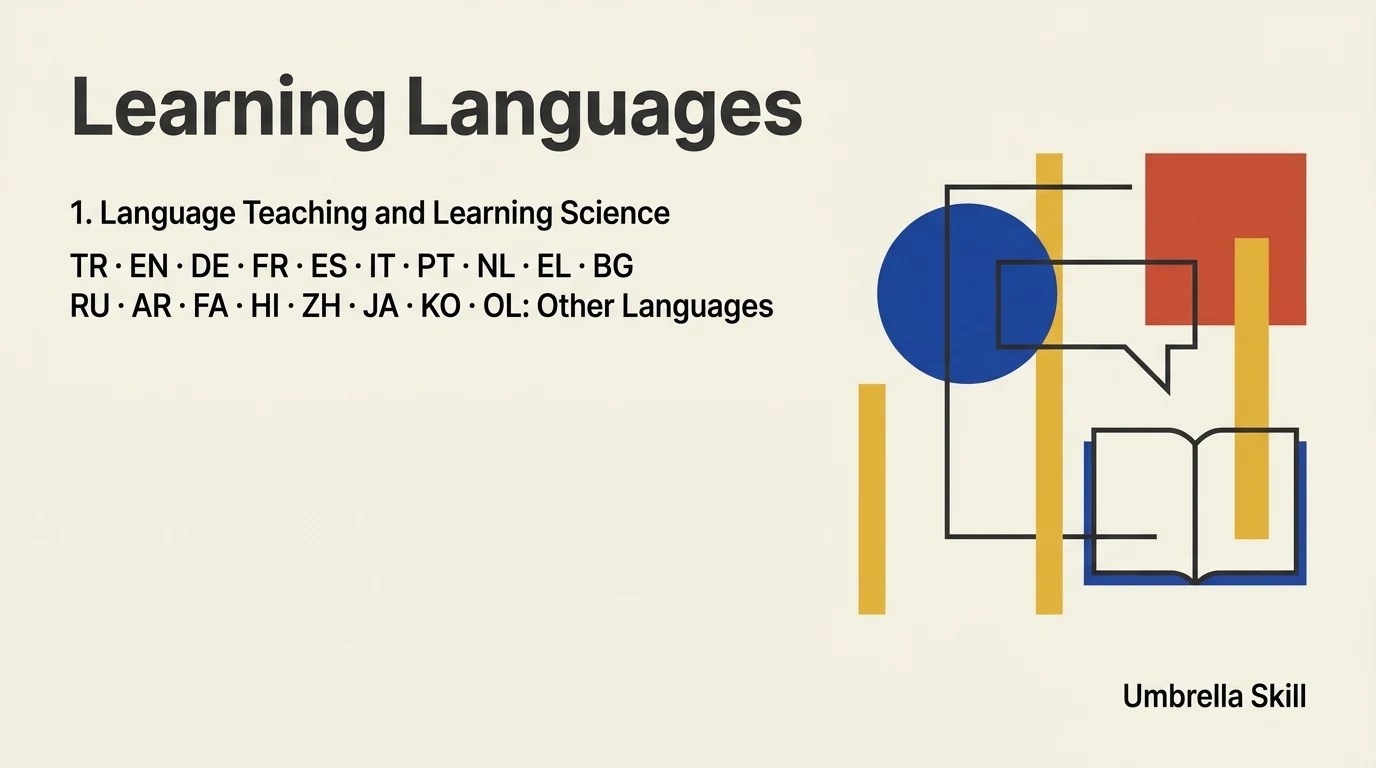
Learning a foreign language from scratch or advancing to higher proficiency often stalls because learners face fragmented materials without a structured, interactive workflow. Learning Languages (Umbrella Skill) solves this challenge by unifying 1 general language-learning science module, 17 fixed language modules labeled with unnumbered two-letter ISO 639-1 codes, 1 dynamic Other Languages module (Module OL) offering 5 popular plus 5 random world languages on each launch, and 11 internal umbrella subroutines (Ⓓ0️⃣1️⃣-Ⓓ1️⃣1️⃣) built strictly on free, open-access resources.
Module 1️⃣: Language Teaching and Learning Science
Serving as the academic and pedagogical foundation, Module 1️⃣ provides a 12-branch hierarchical topic tree spanning Second Language Acquisition (SLA) theories, international proficiency benchmarks (CEFR A1-C2, HSK 3.0, JLPT, TOPIK, TORFL, TOMER), comprehensible input, spaced repetition (SRS), shadowing, IPA phonetics, non-Latin script strategies, computational linguistics, and AI-assisted language learning. It connects directly to 100% open university resources including MIT OpenCourseWare, UT Austin COERLL, Language Science Press, LibreTexts, Open Textbook Library, and Ankara University OpenCourseWare in Türkiye.
Modules TR, EN, DE, FR, ES, IT, PT, NL: Fixed Latin-Script Language Modules
Learning Turkish (TR), English (EN), German (DE), French (FR), Spanish (ES), Italian (IT), Portuguese (PT), and Dutch (NL) each include core grammar priorities, politeness registers, official international exam mappings, and verified open-access bibliographies spanning Yunus Emre Institute, British Council, BBC Learning English, Deutsche Welle Nicos Weg, TV5MONDE, Instituto Cervantes, UT Austin COERLL, OpenLearn, Easy Languages playlists, Lit2Go, Storynory, and LibriVox audiobooks.
Modules EL, BG, RU, AR, FA, HI, ZH, JA, KO: Non-Latin Script Fixed Language Modules
Learning Greek (EL), Bulgarian (BG), Russian (RU), Arabic (AR), Persian (FA), Hindi (HI), Chinese (ZH), Japanese (JA), and Korean (KO) integrate dedicated A0 script instruction (Ⓓ1️⃣1️⃣) for Greek, Cyrillic, Arabic, Persian, Devanagari, Pinyin/Hanzi, Hiragana/Katakana/Kanji, and Hangul. Each module aligns with its official proficiency exams (Ellinomatheia, ECL, TORFL, ACTFL, SAMFA, HSK 3.0, JLPT, TOPIK) and links to open courses such as MIT OCW, NHK Easy Japanese, Nuri King Sejong Institute, UT Austin COERLL, and curated YouTube lesson playlists.
Module OL: Learning Other Languages
Designed for every world language beyond the 17 fixed modules, Module OL dynamically displays 5 popular and 5 randomly selected languages alongside an 11th option to enter any language. Upon selection, it compiles live open-access courses, YouTube playlists, and free audiobooks on demand and applies all interactive teaching workflows in full.
Eleven Internal Subroutines (Ⓓ0️⃣1️⃣-Ⓓ1️⃣1️⃣) and Interactive Study Modes
Before starting any language module, learners choose between native-language supported guidance, zero-native-language full immersion, or gradual transition, as well as Free Choice or Guided Mixed Flow (Ⓓ0️⃣1️⃣). Shared subroutines power core topic lessons (Ⓓ0️⃣2️⃣), story analysis with retelling and dual-level comparisons (Ⓓ0️⃣3️⃣), timed 1-3 minute speaking evaluations aware of STT constraints across content, ordered grammar corrections, and natural discourse (Ⓓ0️⃣4️⃣), current open YouTube news video comprehension (Ⓓ0️⃣5️⃣), interactive role-play, branching stories, and “Spot the Error” games (Ⓓ0️⃣6️⃣), HTML5 audio flashcards, sentence boards, and alphabet boards (Ⓓ0️⃣7️⃣), end-of-session vocabulary cards with cross-skill bridges (Ⓓ0️⃣8️⃣), five-tier politeness and slang/profanity register classification (Ⓓ0️⃣9️⃣), timed text generation with 5 reading speeds (0.6x-1.4x) and instant difficulty scaling (Ⓓ1️⃣0️⃣), and A0 alphabet teaching (Ⓓ1️⃣1️⃣), seamlessly paired with external ATL1 visual and HTML5 exam subskills.
📄Skill Documentation Page: https://aydintiryaki.org/2026/06/19/gdn027/
This Umbrella Skill was developed with the Gemini model.
Google Drive Folder Links and SKILL.md File
You can go to the folders below to download and directly use the SKILL.md file from these folders. If you cannot access these folders or file, it means the link is temporarily suspended because the development of the relevant Skills is currently in progress; please try again later.
📁 Google Drive Gemini Folder Path (EN): https://drive.google.com/drive/folders/1HprDfRj8_mWFK3gyx_ZNNhbCiazNsA93
📁 Google Drive Claude Folder Path (EN):
Note: You can make your own developments and edits on the SKILL.md file you obtain from here. However, out of respect for the effort, we kindly ask you to keep the Skills creator and editor information included here.
This design and the views in this article belong to Aydın Tiryaki; created with the joint architecture of ATG1 Skill Factory v15.15 and ATG5 Umbrella Integration Unit v01.10, with article editing assisted by the Gemini model. (25.11.2026 16:10)
📘 Aydın Tiryaki Skill Archive User Guide: https://aydintiryaki.org/2026/11/20/aydin-tiryaki-skill-archive-user-guide/

