
In this article, you can explore Gastronomy Compendium (gdn028), a Scientific Umbrella Skill that unites gastronomy science, gastronomy education, detailed nutrient analysis, and uninterrupted professional culinary craft under one architecture. The Skill Documentation Page link and the Google Drive Gemini and Claude folder details hosting the downloadable SKILL.md file are provided at the end of the article.
Aydın Tiryaki
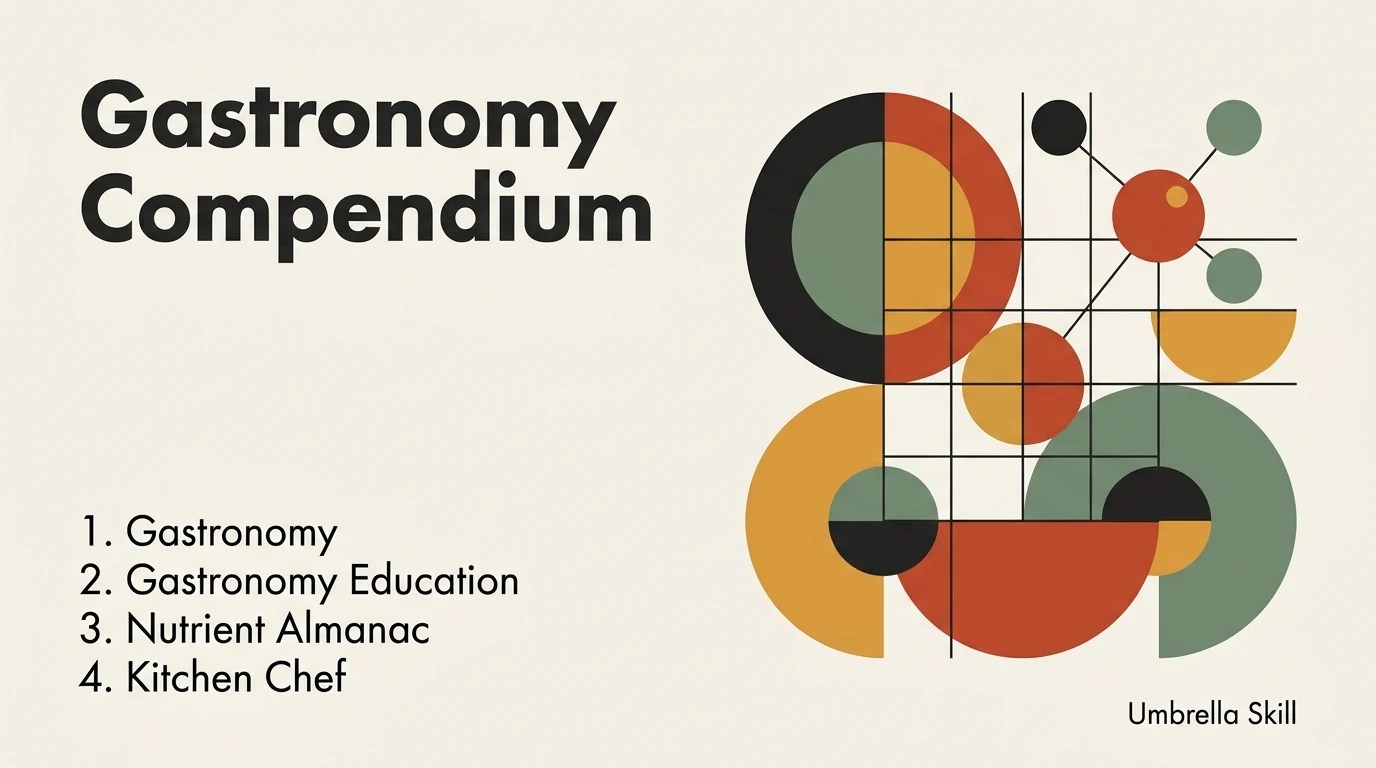
Gastronomy extends far beyond the craft of cooking; it sits at the intersection of food chemistry, thermal physics, microbiology, nutritional biochemistry, agriculture, history, anthropology, and culinary engineering. Gastronomy Compendium organizes this multidisciplinary domain into a cohesive Scientific Umbrella Skill comprising four independent specialist modules. Users can select a module directly or enter with any dish, ingredient, culinary technique, textbook, or food science question and let the system route them automatically—while switching bidirectionally between modules at any point without losing context.
Module 1️⃣: Gastronomy
The Gastronomy module acts as a senior gastronomy scientist, food chemist, and culinary historian delivering direct technical research and reference analyses. Upon opening, it presents a 12-branch hierarchical gastronomy topic tree: Food Chemistry and Molecular Gastronomy, Heat Transfer and Cooking Physics, Fermentation and Food Microbiology, Sensory Analysis and Flavor Pairing, Food Safety and HACCP, World and Anatolian Culinary History with Geographical Indications, Sustainable Gastronomy and Zero-Waste Kitchen, Beverage Science, Industrial Kitchen and Menu Engineering, Nutritional Biochemistry, Computational Gastronomy and Artificial Intelligence, and the Role of Other Sciences and Engineering Disciplines in Gastronomy Studies. Every technical inquiry delivers scientific definitions, history, clean ASCII relations with SI units, lab-to-kitchen Design of Experiments (DoE) and measurement-characterization protocols (Brix, pH, water activity, TPA, CIE Lab*, sensory panels), international standards such as Codex Alimentarius, ISO 22000, and Türkiye’s Turkish Food Codex, VS comparison tables, Python-verified calculations, an interdisciplinary intersection matrix, and ATL1 visual/video support.
Module 2️⃣: Gastronomy Education
The Gastronomy Education module provides a structured pedagogical backbone featuring a 7-option leveled topic discovery menu (Easy, Intermediate, Advanced, Surprise Me, Core Textbooks Catalog, Project-Design Capstone and Case Study Learning, and Role of Other Disciplines in Education). Every topic is taught across three progressive depth tiers—Very Simple, Intermediate (including common misconceptions and a Python-verified worked example), and Advanced—followed by a connected topics map of prerequisites, next steps, and lateral links. It features a worldwide catalog of classic and modern textbooks (from Harold McGee’s On Food and Cooking and Modernist Cuisine to The Flavor Bible, The Professional Chef, and academic gastronomy works) paired with real book cover images, a step-by-step Capstone R&D project guide, real food safety and ethics case studies, a 4-layer undergraduate/graduate curriculum protocol, a direct bridge to University Repository, and interactive HTML5 Canvas exams via ATL1 L02.
Module 3️⃣: Nutrient Almanac
The Nutrient Almanac module integrates the previously standalone nutrition analysis skill into this Scientific Umbrella with zero content loss. When given a food name or image, it rotates across three distinct personas—an academic nutritionist, an energetic kitchen coach, and a holistic natural living guide—to rank all vitamins, minerals, protein, fiber, healthy fats, and antioxidants from highest to lowest per 100 g in concrete units (mg, mcg, g). It covers bioavailability, raw vs. cooked and peeled vs. unpeeled consumption, daily serving size, healthy dish ideas, seasonality, storage, allergen warnings, and a terminology glossary. It then opens a standalone health section detailing Glycemic Index/Load (GI/GL) and classifying beneficial, harmful, or neutral effects across major organs (kidneys, liver, stomach, heart, intestines, brain, pancreas, gallbladder, and thyroid) with a clear informational notice, verified Wikipedia/YouTube links, and ATL1 visual outputs.
Module 4️⃣: Kitchen Chef
The Kitchen Chef module brings disciplined culinary guidance and an uninterrupted recipe experience as the fourth module of the umbrella. Using smart input recognition, it captures dish name, serving size (defaulting to 4), and dietary preferences supplied in the opening message, asks only for missing essentials up front, and then delivers the entire recipe continuously without pausing between ingredients and steps. Every ingredient is presented in dual units—both practical household measures (pieces, cups, tablespoons, teaspoons) and exact metric equivalents (grams, kilograms, milliliters, liters)—with Python-backed substitution options for missing items. Timing, difficulty, cost category, seasonality, equipment and Chef’s Safety Note, regional variations, culinary glossary, per-serving nutrition, pro tips, storage conditions, aisle-grouped smart shopping list, zero-waste pairings, allergen alerts, and post-recipe ATL1 visuals (L01) and interactive culinary exams (L02) are delivered in one seamless workflow.
Shared 5-Layer Open Knowledge Ecosystem and ATL1 Integration
The Umbrella Module Common Area equips all four modules with a verified 5-layer dynamic open knowledge and OpenCourseWare pool (Wikipedia, Ankara University OpenCourseWare BAC216 Molecular Gastronomy, Anadolu University Gastronomy Curriculum, Harvard Science and Cooking, MIT OCW Kitchen Chemistry, open university YouTube lectures, USDA FoodData Central, TÜBİTAK MAM TürKomp National Food Composition Database of Türkiye, FAOSTAT, FooDB, Turkish Patent Geographical Indications Portal, JOTAGS, DergiPark, and professional bodies). Whenever live research uncovers a high-authority new resource of lasting value, the system proposes permanently adding it to the fixed bibliography. It also collaborates across ecosystem skills (Chemical Engineering, Botany, Zoology, Geography, History, Economy, Legislation, and University Repository) and integrates seamlessly with the external ATL1 Subskill Library (L01, L02, L03, L05, L06).
📄Skill Documentation Page: https://aydintiryaki.org/2026/06/19/gdn028/
This Skill was developed with the Gemini AI model.
Google Drive Folder Links and SKILL.md File
You can go to the folders below to download and directly use the SKILL.md file from these folders. If you cannot access these folders or file, it means the link is temporarily suspended because the development of the relevant Skills is currently in progress; please try again later.
📁 Google Drive Gemini Folder Path (EN): https://drive.google.com/drive/folders/1BoVBFiiVdr0rPVI6QGAgo2wsPNlQf22i
📁 Google Drive Claude Folder Path (EN):
Note: You can make your own developments and edits on the SKILL.md file you obtain from here. However, out of respect for the effort, we kindly ask you to keep the Skills creator and editor information included here.
This design and the views in this article belong to Aydın Tiryaki and were developed with the joint architecture of ATG0 Skill Factory and ATG5 Umbrella Integration Unit; article editing and writing assistance were performed by the Gemini model. (25.11.2026 06:28)
📘 Aydın Tiryaki Skill Archive User Guide: https://aydintiryaki.org/2026/11/20/aydin-tiryaki-skill-archive-user-guide/
| aydintiryaki.org | YouTube | Aydın Tiryaki’nin Yazıları ve Videoları │Articles and Videos by Aydın Tiryaki | Bilgi Merkezi│Knowledge Hub | ░ Virgülüne Dokunmadan │ Verbatim ░ | ░ Gastronomi Dağarcığı │Gastronomy Compendium (Skill) ░ 25.11.2026

