
In this article, we explore Economy Compendium (v2.03), a Scientific Umbrella Skill uniting five specialized modules—from foundational economic research and multi-tier academic education to inflation/welfare analytics in Türkiye and worldwide and historical purchasing power calculation. You can find the Skill Documentation Page and Google Drive Gemini and Claude folder links containing the downloadable SKILL.md file at the end of the article.
Aydın Tiryaki
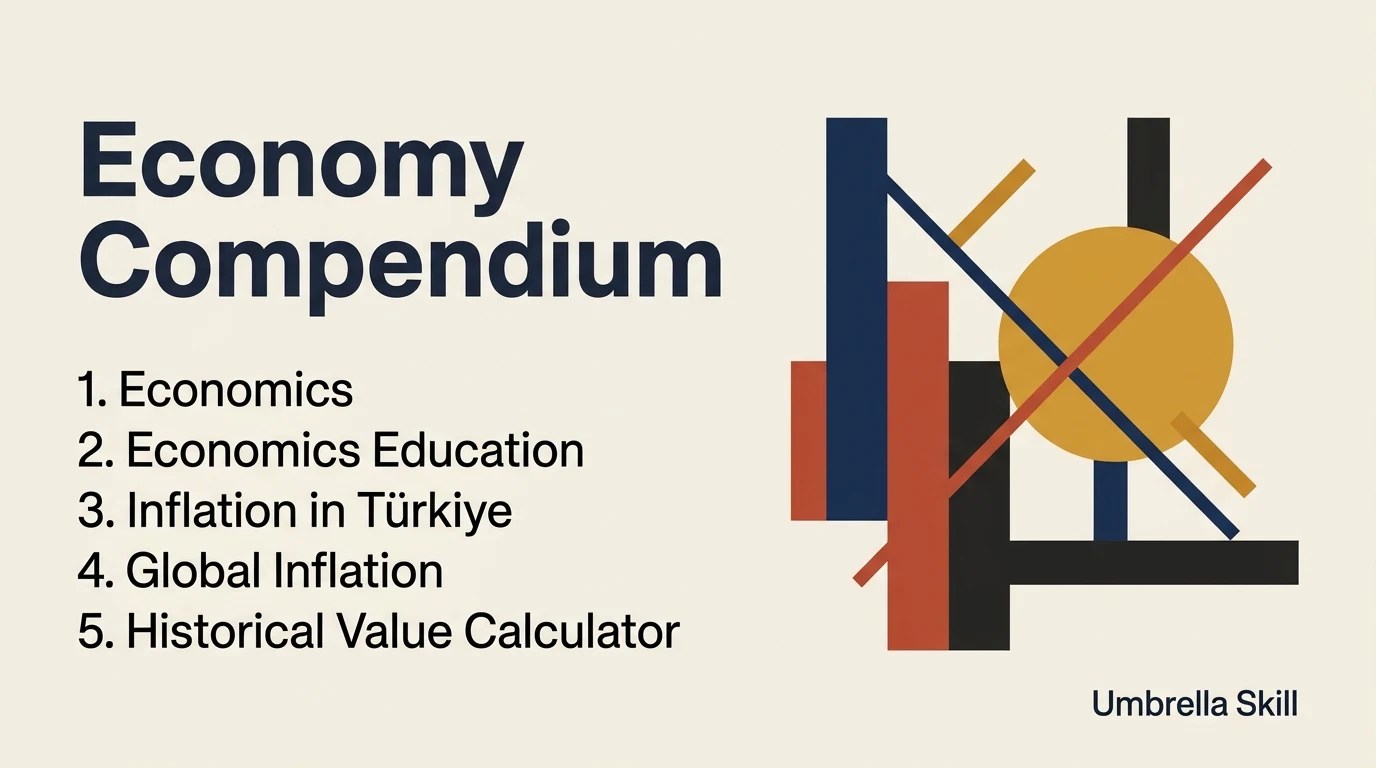
Economics is a living discipline shaping everyday life—from grocery prices and household wages to central bank policy rates and global growth trajectories. Yet exploring economic topics often splits theoretical foundations, academic study materials, live inflation statistics, and historical purchasing power comparisons across fragmented tools. Economy Compendium brings these dimensions together in a single five-module Scientific Umbrella Skill built on a unified analytical backbone.
Upon opening Economy Compendium, users immediately see an ordered five-module menu. They can select a module by number or name, or simply type an economic theory, an inflation date range, or a monetary figure from a vintage film or book to trigger the relevant module right away. Context-preserving single-step transitions allow moving seamlessly between theoretical research, education, and applied empirical modules.
Module 1️⃣: Economics
Serving as the scientific research and technical reference pillar, Module 1️⃣ operates with a senior economist and econometrician perspective. When selected, it opens a 12-branch hierarchical topic tree spanning microeconomics, macroeconomics, monetary economics, public finance, international trade and exchange rate regimes, growth and institutional economics, econometrics, financial economics, behavioral economics and game theory, labor/environmental/energy economics, computational economics and AI, and interdisciplinary intersections with other sciences and engineering fields.
For every queried concept, the module delivers theoretical mechanisms, schools of economic thought, plain ASCII equations, causal empirical research designs (RCT, DiD, RDD, instrumental variables), and international statistical standards (SNA 2008, IMF SDDS, BPM6, ILO). Comparative evaluations generate structured VS tables, while elasticities, compounding, NPV, and econometric computations are verified in the background with Python.
Module 2️⃣: Economics Education
Designed for structured learning and academic depth, Economics Education supports direct topic entry as well as leveled discovery across easy, intermediate, and advanced tiers. Every topic is taught across three progressive levels: intuitive everyday explanation with no prerequisites, undergraduate academic models with common misconceptions corrected and Python-verified worked examples, and advanced theoretical depth covering boundary cases and current literature.
Each lesson concludes with a connected topics map of prerequisites and next steps, alongside a curated global and Turkish foundational textbooks catalog (including Mankiw, Samuelson, Varian, Blanchard, Wooldridge, Acemoğlu, CORE Econ, and OpenStax) with real cover images. It also features research and policy Capstone project guides, historical economic crisis case studies (from the 1929 Great Depression to the 2001 and 2008 crises), a four-layer curriculum analysis of adjacent disciplines, a bridge to University Repository, and interactive HTML5 exams.
Module 3️⃣: Inflation in Türkiye
Dedicated to real welfare analysis in Türkiye, this module cross-examines inflation, real GDP growth, and wage changes using a mandatory four-source protocol: official TurkStat (TÜİK) data, independent ENAG figures, the ITO Wage Earners Cost of Living Index, and a TurkStat+ENAG hybrid series. Rather than estimating from annual averages, it compounds every single month in the queried range.
Minimum wage and retiree pension changes are benchmarked against cumulative inflation and real GDP growth to compute the “Required Ideal Increase” and “Real Purchasing Power Change,” accompanied by sectoral breakdowns (food, housing, etc.), peak/inflection detection, and an analytical welfare essay.
Module 4️⃣: Global Inflation
Provides comparative cumulative inflation and real welfare analyses for any foreign country or economic bloc such as the EU, Eurozone, G7, G20, and OECD over identical date ranges. Where multiple datasets exist, official statistics and independent/shadow series are presented side by side.
Through monthly compounding, wage-inflation lag analysis, growth-share diagnostics, and institutional methodology briefings (Eurostat, FED, ECB, BLS, ONS, World Bank, IMF), the module delivers a consistent global comparison matrix.
Module 5️⃣: Historical Value Calculator
Calculates what past monetary amounts—whether from historical dates or classic films, novels, and archival documents—are worth in today’s purchasing power. For foreign currencies, it enforces a two-stage local-global methodology: first translating the historical amount into today’s value within its own country across official CPI, gold, minimum wage, public salary, stock index, basic cost-of-living basket, GDP per capita, severance/retirement bonus, and contextual commodity criteria, and only then converting to current Turkish Lira, USD, and EUR at today’s exchange rate.
By accounting for structural currency shifts such as the redenomination of the Turkish Lira (six zeros removed), the transition to the Euro, and historical official vs. free-market exchange rate gaps, it produces a comprehensive comparative valuation table and an economic timeline of the era.
5-Layer Open Knowledge Ecosystem and Shared Standards
All five modules share a verified 5-layer open economics resource pool: core Wikipedia articles, university OpenCourseWare and open textbooks (MIT OCW, METU OCW, Ankara University OCW, CORE Econ, OpenStax, Khan Academy), open lecture video archives, official economic databases and working paper repositories (FRED, World Bank Open Data, IMF Data, Eurostat, CBRT EVDS3, RePEc/IDEAS, DergiPark), and academic societies such as the Turkish Economic Association (TEK). Cross-skill bridges also connect queries to neighboring specialist skills when needed.
📄Skill Documentation Page: https://aydintiryaki.org/2026/06/19/gdn022/
This Skill was developed using the Gemini 4 Neon artificial intelligence model.
Google Drive Folder Links and SKILL.md File
You can go to the folders below to download and directly use the SKILL.md file from these folders. If you cannot access these folders or file, it means the link is temporarily suspended because the development of the relevant Skills is currently in progress; please try again later.
📁 Google Drive Gemini Folder Path (EN): https://drive.google.com/drive/folders/14QlO8GB-6MzpCEYjTbbv3rNC0dhG-H4d
📁 Google Drive Claude Folder Path (EN):
Note: You can make your own developments and edits on the SKILL.md file you obtain from here. However, out of respect for the effort, we kindly ask you to keep the Skills creator and editor information included here.
This Skill design and the views in this article belong to Aydın Tiryaki and were developed with the joint architecture of ATG1 Skill Factory v15.15 and ATG5 Umbrella Integration Unit v01.10; article editing and compilation assistance were provided by the Gemini 4 Neon artificial intelligence model. (25.11.2026 15:15)
📘 Aydın Tiryaki Skill Archive User Guide: https://aydintiryaki.org/2026/11/20/aydin-tiryaki-skill-archive-user-guide/
| aydintiryaki.org | YouTube | Aydın Tiryaki’nin Yazıları ve Videoları │Articles and Videos by Aydın Tiryaki | Bilgi Merkezi│Knowledge Hub | ░ Virgülüne Dokunmadan │ Verbatim ░ | ░ Ekonomi Dağarcığı │Economy Compendium (Çatı Skill / Umbrella Skill) ░ 25.11.2026

