
Bringing together original mathematical problem construction, five-stage engineering and multimodal analysis, live-market geometric material cost calculation, and chained multi-level mathematics learning under a single Umbrella Skill architecture, Mathematics Compendium provides students, educators, engineers, and lifelong learners with a Python-verified analytical workspace. You can find the Skill Documentation Page as well as the Google Drive Gemini and Claude folder links containing the downloadable SKILL.md file at the end of this article.
Aydın Tiryaki
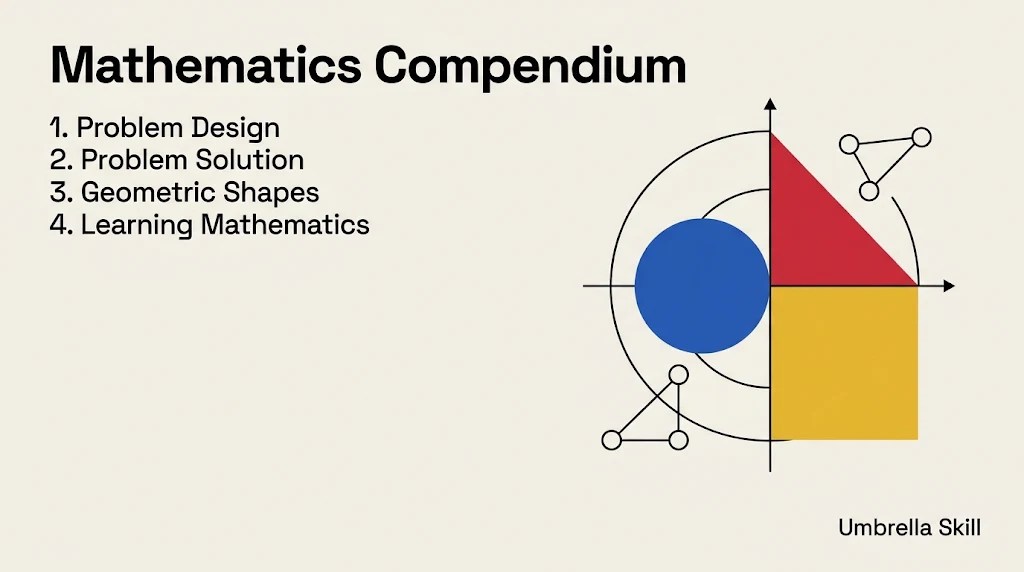
Working with mathematics often forces users to jump between disconnected tools: authoring a rigorous exam or Olympiad question demands one mindset, solving a multimodal engineering problem with dimensional consistency and sensitivity checks requires another, estimating the live multi-currency material cost of a geometric solid calls for real-time market data, and learning an unfamiliar mathematical concept from scratch needs structured pedagogy. Mathematics Compendium unites all four workflows under a cohesive Umbrella Skill architecture.
Through its smart three-gate routing system, users can either select one of the four modules directly from the startup menu or enter a topic, problem, or geometric shape right away to let the system launch the matching module automatically. Every formula is formatted in clean, copy-safe plain text and ASCII notation without LaTeX clutter, while silent background Python execution guarantees mathematical consistency and zero calculation guesswork.
Module 1️⃣: Problem Design
Deep mastery begins with well-crafted questions. Module 1️⃣ constructs original, technically rich problems from scratch across Mathematics, Physics, Engineering, Finance, and Statistics at High School, Undergraduate/BSc, and Olympiad levels. Users can choose among open-ended classic problems, 5-option multiple-choice questions with algorithmic distractors, or real-world engineering case studies, tailored to either an academic or an everyday narrative style.
When multiple-choice format is selected, distractors are never chosen at random; instead, they are algorithmically derived from common sign, unit conversion, and algebraic pitfalls. Right before presenting the problem, the system solves it silently in Python to confirm that it is well-posed and yields a unique, meaningful answer. Users are then invited to request 3-step progressive conceptual hints, submit their own solution for step-by-step auditing, or transition directly to the full solution module.
Module 2️⃣: Problem Solution
Designed for text, voice, and visual inputs such as photos of handwritten notes or screenshots, Module 2️⃣ executes a disciplined five-stage analytical solution protocol. For image inputs, it first transcribes every symbol, number, and statement verbatim for raw OCR confirmation, identifies the scientific discipline and sub-field, and standardizes all quantities into SI or domain-appropriate engineering units while checking dimensional consistency.
After declaring the definitive result with its exact unit, the module lays out step-by-step plain-text ASCII derivations backed by symbolic and numerical Python verification (sympy, numpy, scipy). Whenever functions, equations of motion, probability distributions, or financial curves are involved, true-scale technical plots are generated; finally, mandatory Boundary Conditions (Extreme Value) Testing and Sensitivity Analysis reveal how the model behaves at limits and which input parameter dominates the outcome.
Module 3️⃣: Geometric Shapes
Module 3️⃣ bridges pure solid geometry with real-world manufacturing and material economics under a strict zero-estimation rule. Combining geometric parameters such as radius, height, edge lengths, and wall thickness with physical properties like material type, density, and infill ratio, it computes exact surface area, net volume, and mass step by step in ASCII notation with independent Python verification.
On the economic layer, projections and fabricated figures are strictly prohibited: material unit prices and exchange rates are queried live from authoritative sources including LME, Fed, ECB, CBRT in Türkiye, and Bloomberg. If live market pricing cannot be retrieved, the workflow pauses to request manual unit price input rather than guessing, and reports total costs across USD, EUR, GBP, and TRY alongside directly clickable source links and timestamps.
Module 4️⃣: Learning Mathematics
Added as the fourth pillar of the umbrella architecture, Module 4️⃣ turns mathematical study into an approachable, curiosity-driven journey. Users may enter any mathematics topic directly or ask for “any mathematics topic” to receive curated topic suggestions organized across Easy, Intermediate, Hard, and Surprise Me options spanning arithmetic, algebra, geometry, calculus, probability, number theory, discrete mathematics, linear algebra, and topology.
Each selected concept is taught across three progressive depth tiers: the Very Simple Level builds intuition from zero background using everyday analogies and concrete numerical examples; the Intermediate Level introduces formal definitions, ASCII relations, common misconceptions, and a Python-verified worked example; and the Hard Level explores axiomatic foundations, proof ideas, boundary cases, and advanced applications in engineering, computer science, cryptography, and finance.
Immediately following every explanation, a Connected Topics and Continued Learning Map outlines prerequisite foundations, natural next-step continuation topics, and lateral interdisciplinary links. Because these connected topics are dynamically placed into the two-layer suggestion chips at the bottom of every response, learners can tap from one concept to the next in an unbroken chain of discovery, jump to Module 1️⃣ to generate practice problems, or launch a standalone browser-ready HTML5 Canvas quiz.
Umbrella Module Common Area and ATL1 Integration
All four modules share an instructive academic and chief-engineer persona alongside verified reference standards. Relevant Wikipedia articles, academic resources, and YouTube videos or playlists are delivered as directly clickable canonical links without search-engine redirect URLs. Through external ATL1 Subskill Library integration, each module provides 9-option visual and video generation (plus HTML5 quizzes in Module 4️⃣), supported by a living interactive guide, process tracking info bar, and two-layer quick option chips.
📄Skill Documentation Page: https://aydintiryaki.org/2026/06/19/gdn036/
The Gemini 4 Neon artificial intelligence model was used in the development of this Umbrella Skill.
Google Drive Folder Links and [invalid URL] File
You can go to the folders below to download and directly use the [invalid URL] file from these folders. If you cannot access these folders or file, it means the link is temporarily suspended because the development of the relevant Skills is currently in progress; please try again later.
📁 Google Drive Gemini Folder Path (EN): https://drive.google.com/drive/folders/1-TT0dgI79toVtn7AO7I6ha4W8I0cVOFr
📁 Google Drive Claude Folder Path (EN):
Note: You can make your own developments and edits on the [invalid URL] file you obtain from here. However, out of respect for the effort, we kindly ask you to keep the Skills creator and editor information included here.
This Umbrella Skill design and the views in this article belong to Aydın Tiryaki; the design was developed within the joint architecture of ATG0 Skill Factory and ATG5 Umbrella Integration Unit, with article editorial and writing assistance performed by the Gemini 4 Neon artificial intelligence model (24.11.2026 00:13).
📘 Aydın Tiryaki Skill Archive User Guide: https://aydintiryaki.org/2026/11/20/aydin-tiryaki-skill-archive-user-guide/
| aydintiryaki.org | YouTube | Aydın Tiryaki’nin Yazıları ve Videoları │Articles and Videos by Aydın Tiryaki | Bilgi Merkezi│Knowledge Hub | ░ Virgülüne Dokunmadan │ Verbatim ░ | ░ Matematik Dağarcığı │Mathematics Compendium (Skill) ░ 24.11.2026

