
Bringing together technical research, process design, interdisciplinary engineering analysis, and three-tier academic education in chemical engineering under a single Umbrella Skill architecture, the Skill Documentation Page and Google Drive Gemini and Claude folder links containing the downloadable SKILL.md file for Chemical Engineering Compendium are provided at the end of this article.
Aydın Tiryaki
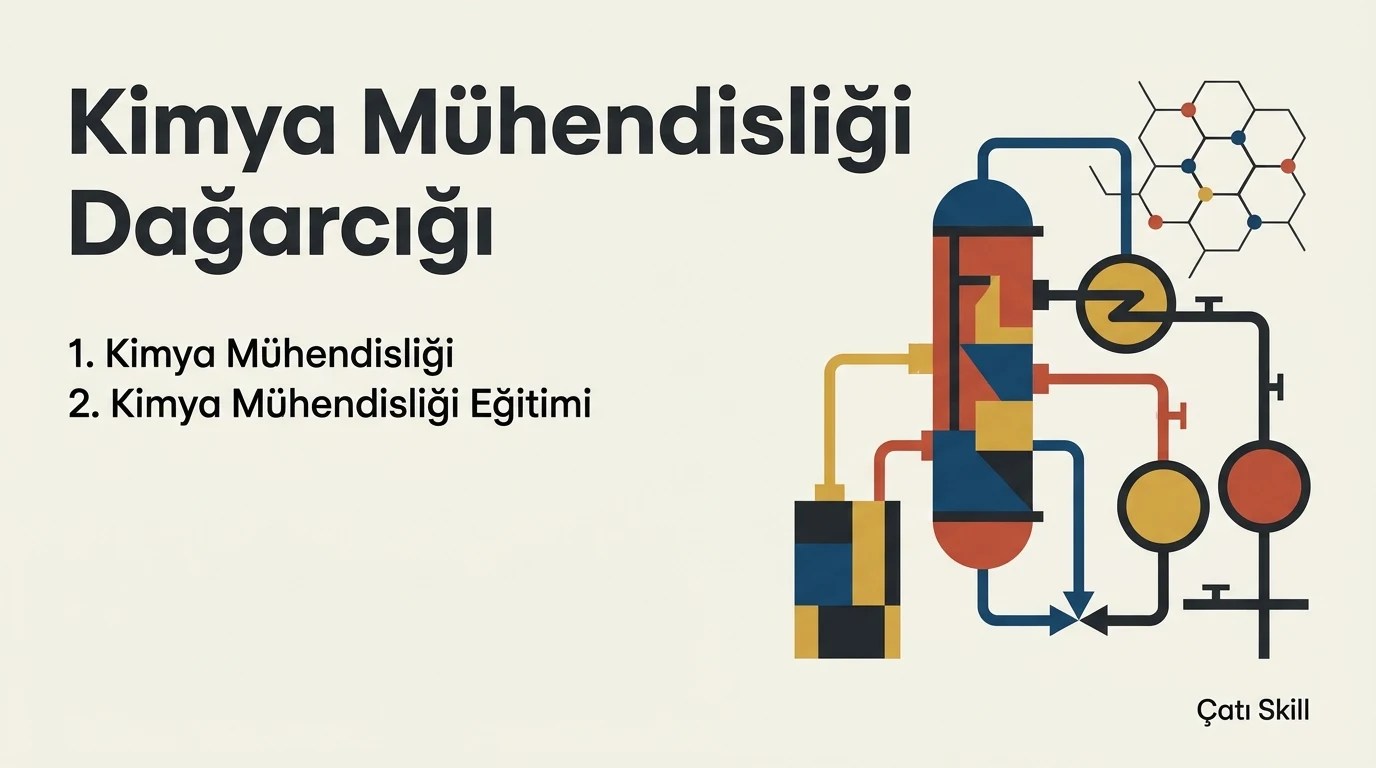
Chemical engineering is a multidisciplinary field that translates laboratory-scale scientific discoveries into safe, sustainable, and economically viable industrial processes. Chemical Engineering Compendium (v1.04) unifies this broad domain inside a structured Umbrella Skill, serving practicing engineers who need rigorous technical references as well as students and educators seeking layered pedagogical guidance. Users can switch seamlessly back and forth between its two modules at any point while preserving full topic context.
Module 1️⃣: Chemical Engineering
Operating with the perspective of a Senior Process and Chemical Engineer & Academic, this module delivers evidence-based technical research and engineering reference reports rather than classroom lecturing. Upon selection, it opens a 12-branch hierarchical topic tree spanning the entire discipline: Mass and Energy Balances, Transport Phenomena, Unit Operations and Separation Processes, Chemical Engineering Thermodynamics, Chemical Reaction Engineering, Process Design-Pilot Plants-Modeling and Control (including DoE and inline PAT), Process Safety-Corrosion and Risk Analysis (HAZOP, LOPA, ASME/API/ATEX), Industrial Sectors-Environmental Processes and Energy Transition (LCA, ZLD, hydrogen, carbon capture, battery recycling), Materials-Polymer and Bioprocess Engineering, Engineering Economics and Plant Management (Pinch analysis, NPV/IRR), Computational Chemical Engineering-PSE and AI (CFD, digital twins, open-source simulators), and the Role of Other Scientific and Engineering Disciplines in Chemical Engineering Practice.
Each technical report systematically covers engineering definitions and history, governing physical and thermodynamic principles, clean ASCII equations with SI units and dimensionless numbers, equipment and BFD/PFD/P&ID design parameters, industrial applications in Türkiye and worldwide, and process safety risk profiles. A dedicated VS comparison mode generates structured Markdown tables for competing processes, reactors, separators, or simulators, while numerical engineering calculations are verified in the background with Python. The module also maps the exact division of responsibilities and multidisciplinary plant coordination across basic sciences (chemistry, physics, mathematics/statistics, biology) and sibling engineering fields (mechanical, metallurgical-materials, electrical-electronics/automation, computer/data, environmental, industrial, civil) as well as economics and regulatory compliance.
Module 2️⃣: Chemical Engineering Education
Designed for structured learning, the second module supports both direct topic entry and tiered discovery (Easy, Intermediate, Advanced, or Surprise Me). Every topic is explained across three layers: Very Simple (everyday and plant intuition with zero prerequisites), Intermediate (standard undergraduate definitions, ASCII equations, common misconceptions, and Python-verified worked examples), and Advanced (differential/thermodynamic derivation logic, non-ideal deviations, and scale-up constraints). Beneath each explanation, a Connected Topics Map organizes prerequisites, follow-up steps, and interdisciplinary links into chained suggestion chips.
Module 2 also introduces dedicated educational workflows for 6-step Plant Design Capstone (Senior Design) projects and Case-Based Process Safety Learning grounded in historical industrial incidents and CSB investigations. Under the Role of Other Disciplines in Chemical Engineering Education, it breaks down Years 1–4 curriculum layers—from foundational chemistry, physics, and mathematics to service courses from other engineering departments, laboratory/design integration, and double major, minor, or graduate tracks. For every subject, it curates globally recognized reference textbooks with authors, editions, multilingual counterparts, and verified genuine cover images, bridges directly to University Repository for department and accreditation queries, and generates standalone interactive HTML5 browser quizzes on demand.
5-Layer Dynamic Open Knowledge Ecosystem and Visual Support
Both modules draw from a shared 5-layer verified open knowledge pool: Wikipedia/Vikipedi core entries, university OpenCourseWare (METU OCW, Ankara University Open Courseware, MIT OCW, TU Delft OCW, NPTEL, LearnChemE, LibreTexts), open lecture videos and CSB safety animations, open-access journals, preprints, databases, and open-source tools (DergiPark JOTCSB, ChemRxiv, NIST Chemistry WebBook, PubChem, ECHA CHEM, CSB, NIOSH, NOAA CAMEO alongside DWSIM, Cantera, CoolProp, Thermo, and OpenFOAM), and open engineering communities and societies (TMMOB KMO, IChemE, AIChE, Reddit, Stack Exchange). Live web scanning ensures up-to-date coverage on every query and proactively proposes permanently adding newly discovered authoritative sources. Both modules also integrate external ATL1 visual/video generation.
📄Skill Documentation Page: https://aydintiryaki.org/2026/06/19/gdn031/
The Gemini AI model was used in the development of this Skill design.
Google Drive Folder Links and SKILL.md File
You can go to the folders below to download and directly use the SKILL.md file from these folders. If you cannot access these folders or file, it means the link is temporarily suspended because the development of the relevant Skills is currently in progress; please try again later.
📁 Google Drive Gemini Folder Path (EN): https://drive.google.com/drive/folders/14EzWO5mNTuaSHafeqFQTy7rIoXLOJjBB
📁 Google Drive Claude Folder Path (EN):
Note: You can make your own developments and edits on the SKILL.md file you obtain from here. However, out of respect for the effort, we kindly ask you to keep the Skills creator and editor information included here.
This Umbrella Skill design and the views in this article belong to Aydın Tiryaki, built on the joint architecture of ATG0 Skill Factory and ATG5 Umbrella Integration Unit, with editorial drafting assistance provided by the Gemini model. (24.11.2026 22:37)
📘 Aydın Tiryaki Skill Archive User Guide: https://aydintiryaki.org/2026/11/20/aydin-tiryaki-skill-archive-user-guide/
| aydintiryaki.org | YouTube | Aydın Tiryaki’nin Yazıları ve Videoları │Articles and Videos by Aydın Tiryaki | Bilgi Merkezi│Knowledge Hub | ░ Virgülüne Dokunmadan │ Verbatim ░ | ░ Kimya Mühendisliği Dağarcığı │Chemical Engineering Compendium (Skill) ░ 24.11.2026

