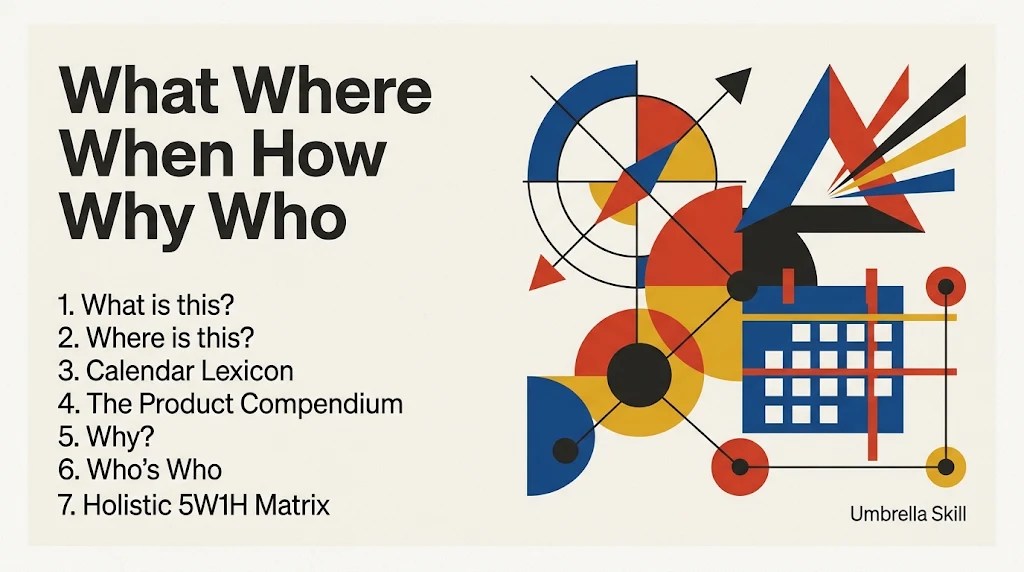
Unifying the universal 5W1H inquiry framework into seven independent specialist modules under a single roof, What Where When How Why Who (Umbrella Skill) is designed to resolve any curiosity—from identifying an object or location to tracing calendar history, manufacturing lifecycles, deep “Why?” questions, and biographical profiles. At the end of this article, you will find the Skill Documentation Page link along with the Google Drive Gemini and Claude folder paths hosting the downloadable [invalid URL] file.
Aydın Tiryaki
In daily life, academic inquiry, or investigating a single photograph, our questions rarely stay confined to one dimension. While asking what an object is, we quickly wonder where it is located, when it emerged, how it is made, why it works that way, and who stands behind it. What Where When How Why Who transforms this multi-dimensional curiosity from scattered searches into an orderly, verifiable, and modular discovery workflow within a single Umbrella Skill architecture.
Thanks to its Umbrella Skill design, users can either call any module directly by number or name for isolated, deep-dive work, or enter a topic, question, or photograph directly so the system automatically activates the right module. Free of exam or quiz clutter, the architecture focuses exclusively on multi-dimensional 5W1H research, verified clickable sources, and external ATL1 Subskill Library integration (L01 Visual/Video, L03 Holistic Guide, L05 Info Line, and L06 Shared Core Rules).
Module 1️⃣: What is this?
The What is this? module identifies and classifies single or multiple objects, concepts, species, structures, products, and artworks from text queries or uploaded photographs. When an image contains multiple items, it detects and numbers each one individually; if lighting, angle, or similarity leaves room for uncertainty, it ranks the most likely candidates with confidence levels and distinguishing physical clues. Every analysis concludes with a verified “Did you know?” note, a 3-item deepening submenu (Technical and Historical Details, Market/Usage/Maintenance, Safety and Environmental Impact), and the ATL1 L01 9-option visual/video menu.
Module 2️⃣: Where is this?
The Where is this? module resolves the geographic location of a place or photograph across four analytical layers: first scanning signage, scripts, license plates, and metadata clues; next examining architectural typology and urban fabric; third evaluating physical geography, geology, biome, and shadow angle; and finally confirming the spot through live map and web verification. It reports Exact Coordinates (DD, DMS, UTM/MGRS, and elevation) when pinpointed or Approximate Coordinates with an error radius when resolved at area level, accompanied by a full hierarchical location tree (for Türkiye, global locations, or natural landmarks), a place identity profile, a 3-ring Nearby Places list, and verified Google Maps and OpenStreetMap links.
Module 3️⃣: Calendar Lexicon
The Calendar Lexicon module operates with strict scientific and chronological rigor, completely free of astrology or fortune-telling elements. It converts any Gregorian date across 13 calendar systems: Julian, Hijri, Rumi, Unix timestamp, Chinese, Hebrew, JDN/MJD, Swatch .beat, 12-Animal Turkic Calendar, Solar Hijri, Mayan, and French Republican Calendar. It computes net business days and durations between two dates, lists past and future twin calendar years sharing the same weekday alignment, renders a Monday-first ASCII monthly calendar sheet, and summarizes solar mechanics alongside historical events of the day in Türkiye, the World, and Science.
Module 4️⃣: The Product Compendium
The Product Compendium module answers the “How?” question comprehensively for both physical products and abstract processes. It filters foods, devices, textiles, or industrial goods across 8 primary production methods: natural formation, agricultural/livestock, individual/home-scale, artisanal/workshop, industrial/mass, biotechnological/laboratory, additive/3D digital manufacturing, and recycling/upcycling. Available in Interactive or Autonomous (Turbo) mode, it maps the complete raw-material-to-shelf lifecycle, component branches (A, B, C), logistics and cold-chain conditions, Critical Warning risks, and global standards (ISO, HACCP, GMP, CE, TSE); for abstract concepts or historical events, it traces the step-by-step formation mechanism from Phase 1 to Phase N.
Module 5️⃣: Why?
The Why? module tackles all “Why?” questions across nature, physics, chemistry, biology, human physiology, psychology, history, economics, technology, and everyday life—such as “Why does it rain?” or “Why do tears flow when we cry?”—through a six-layer research protocol rather than superficial summaries. It opens with a clear direct answer, then details step-by-step mechanisms, multi-dimensional sub-factors, common myths versus verified facts, everyday analogies with numerical thresholds and edge cases, and verified sources. Each response ends with a 4-option discovery menu for deeper technical detail, related follow-up questions, comparative analysis, or a plain-language summary for children and students.
Module 6️⃣: Who’s Who
The Who’s Who module examines historical and contemporary figures through a rich biographical profile standard. When multiple notable people share a name, it first presents a numbered disambiguation list. It then delivers a quick profile with Gregorian, Hijri, and Rumi dates and age calculation, a statistics card in numbers, an era panorama, a philosophical compass, peer comparisons, and a chronological life map. It maps mentor-disciple, ally, and rival networks, key turning points, long-term butterfly effects, and verified facts against myths, and builds a side-by-side comparison matrix whenever two figures are queried together.
Module 7️⃣: Holistic 5W1H Matrix
The Holistic 5W1H Matrix module activates for broad events, historical developments, scientific concepts, inventions, or multi-layered photographs containing people, places, and objects together. It begins with a compact 5W1H Executive Summary and Identity Card, then synthesizes What?, Where?, When?, How?, Why?, and Who? in a 7-part cross-checked report ensuring chronological, scientific, and geographic consistency. Beneath the report, users can jump directly into any individual module (1️⃣–6️⃣) for deeper investigation or generate visuals via the ATL1 L01 menu.
📄Skill Documentation Page: https://aydintiryaki.org/2026/06/19/gdn011/
This Skill was developed with the Gemini AI model.
Google Drive Folder Links and [invalid URL] File
You can go to the folders below to download and directly use the [invalid URL] file from these folders. If you cannot access these folders or file, it means the link is temporarily suspended because the development of the relevant Skills is currently in progress; please try again later.
📁 Google Drive Gemini Folder Path (EN): https://drive.google.com/drive/folders/1stfabzo89aewBaINz0ffVs3e917-2pAd
📁 Google Drive Claude Folder Path (EN):
Note: You can make your own developments and edits on the [invalid URL] file you obtain from here. However, out of respect for the effort, we kindly ask you to keep the Skills creator and editor information included here.
This Skill design and all views expressed in this article belong to Aydın Tiryaki; editorial drafting and compilation assistance were provided by the Gemini model. (22.11.2026 06:21)
📘 Aydın Tiryaki Skill Archive User Guide: https://aydintiryaki.org/2026/11/20/aydin-tiryaki-skill-archive-user-guide/
| aydintiryaki.org | YouTube | Aydın Tiryaki’nin Yazıları ve Videoları │Articles and Videos by Aydın Tiryaki | Bilgi Merkezi│Knowledge Hub | ░ Virgülüne Dokunmadan │ Verbatim ░ | ░ Ne? Nerede? Ne zaman? Nasıl? Neden? Kim? │What? Where? When? How? Why? Who? (Skill) ░ 22.11.2026