
A concrete numerical constraint—such as Gemini’s limit of at most 100 active Skills—often sparks a new architectural way of thinking. In this article, we examine the Umbrella Skill approach developed specifically for the Gemini ecosystem, exploring its module independence principle, four-layer internal architecture, three-door runtime routing protocol, the five-task assembly pipeline of the ATG5 Umbrella Integration Unit, and concrete transformation data from the first 30 skills.
Aydın Tiryaki (22 November 2026)
Version 1.03
The 100 Active Skill Limit and the Birth of the Need
As personal AI assistants and custom task procedures (Skills) become more widespread, users who work across multiple domains quickly begin building an expansive ecosystem of tools. As separate skills are created for distinct needs—ranging from research and literature to geography, visual design, data compilation, and word games—Gemini’s technical boundaries also come sharply into focus.
One of the most tangible thresholds encountered in the Gemini ecosystem is the cap of 100 Skills that can remain active simultaneously. For a user working with only a handful of assistants, this ceiling may seem distant; however, in a production environment where new skills are regularly designed, updated, and maintained in both Turkish and English, the 100-skill limit quickly turns into a direct bottleneck.
The Umbrella Skill (Çatı Skill) approach emerged not for other platforms, but specifically as a user-devised way to overcome this practical constraint in Gemini and give a growing archive of skills a sustainable structure. The goal is not merely to work around a numerical cap, but also to manage neighboring areas of expertise without falling into mental or structural clutter.
A Two-Tier Ecosystem: Standard Skills and Umbrella Skills
With the adoption of this approach, custom skills are no longer uniform; instead, they operate within a two-tier ecosystem. The first group consists of standard (single-purpose) skills focused on one dedicated domain, as traditionally built. Skills that carry an extensive rule set and deep workflows on their own—such as cinema, history, botany, transportation, visual design, or interactive article editing—remain in this standard structure.
The second group consists of skills built under the Umbrella Skill architecture. In this structure, relatively shorter, focused topics that are closely related or belong to the same conceptual family are united inside a single Skill file. In doing so, the system preserves the autonomy of deep, comprehensive skills while preventing smaller yet highly functional skills from rapidly consuming the 100 active Skill quota.
Why “Umbrella”? Independence, Four-Layer Architecture, and Three-Door Routing
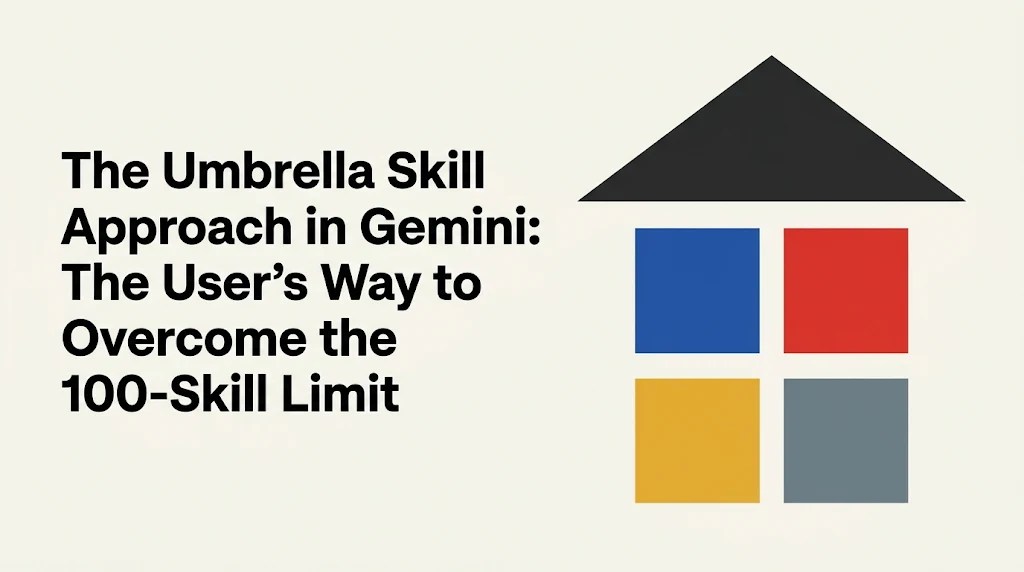
Gathering multiple topics into a single file may look at first glance like a simple text merge, yet the essence of the Umbrella Skill concept is the exact opposite. The deliberate choice of the term “umbrella” (or “roof” in Turkish, Çatı) emphasizes that the combined subjects do not dissolve into a single flat block of instructions; rather, each one continues to exist as an independent Skill in its own right.
Much like separate rooms under one roof carrying out their distinct functions without interfering with one another, every sub-module inside an Umbrella Skill maintains its own rules, its own workflow, and its own domain boundaries. Every Umbrella Skill built within a single instruction body follows a standard four-layer layout: the first layer contains the Umbrella Entry, Module Map, and Smart Routing block (Section 1); the second layer houses sequential, independent Sub-Module blocks (Module 1, Module 2, Module 3…); the third layer forms the Umbrella Module Common Area, holding only the rules that are 100% identical across all modules alongside mandatory shared subroutines (Guide, Info Line, Core Rules); and the fourth layer carries the shared credit signature (1, 4).
Rather than relying on potentially confusing letter codes, each module is explicitly defined by its number, full name, and section scope range. Across the entire single instruction body, all section and sub-item numbers increase continuously without resetting or colliding across modules. Personas, specialized data fields, and module-specific external subroutine calls (such as Visuals, Exams, or Article Graphics) remain isolated inside each module’s own scope; moreover, so that every sub-module can be invoked directly by name while active, all sub-module names are explicitly written into both the opening line and the functional description of the Umbrella Skill (4).
This architectural separation gives the user three-door routing flexibility at runtime (1, 4):
- Empty or General Invocation Door: When the user invokes the Umbrella Skill by name without further detail, all modules are listed immediately as a numbered, selectable menu without lengthy introductions.
- Direct Module Name or Number Door: When the user selects a module or directly calls a sub-module by its name or number, all other modules are ignored and only the relevant module’s section scope and the Umbrella Module Common Area are executed; if that module has its own internal sub-menus, they are displayed immediately.
- Direct Topic Entry Door: When the user enters directly with a question or topic without naming a module, the AI detects the matching sub-module and runs it without delay; if the topic fits more than one module, it suggests the relevant candidates for selection, and at the end of every module output it offers a “0 Umbrella Main Menu” option to switch to other modules.
The Engine Sustaining the Architecture: ATG5 Umbrella Integration Unit
When uniting numerous independent skills inside a single SKILL.md body, the greatest risks are overlapping instructions, colliding section numbers, or inadvertently damaging an existing module during an update. For this reason, Umbrella Skill production is not left to ad-hoc manual edits; it has been standardized through the ATG5 Umbrella Integration Unit, a dedicated assembly unit that has reached a 24,281-character architecture as of version v01.03 (1, 2, 4).
ATG5 does not improvise rules in an ad-hoc format; it serves as the active orchestrator and delegates all component production to the ATG0 Skill Factory through an eight-service factory mapping (GFH1–GFH8) (4). Isolation and version sealing (GFH1), identity and GDN registration (GFH2), description building that fits all sub-module names within the 1,024-character ceiling (GFH3), module formatting (GFH4), shared header/footer injection (GFH5), Python-based exact character counting and anti-pruning validation (GFH6), full version output packaging (GFH7), and 1-to-1 full translation with system registration (GFH8) all run through this shared pipeline (4).
The ATG5 Umbrella Integration Unit structures every build in the “Umbrella Skill – Module 1..N – Umbrella Module Common Area” layout and operates through five core integration tasks that can be controlled in a single move via a continuous 1-to-10 numbered opening menu (1, 2, 4):
- Create New Umbrella Skill (Task 51): Builds a new Umbrella Skill by merging existing single skills via their names or GDN numbers, defining new modules from scratch, or combining both. The user has full control over the GDN number; a brand-new umbrella starts at version 01.01, whereas an umbrella formed from existing skills inherits the highest version number among them and continues cleanly with a +0.01 increment.
- Edit Umbrella Skill and Module Discovery (Task 52): Analyzes skills that were originally written as single units—yet carry natural potential to be split—with zero content loss, presenting a numbered module discovery proposal. The designer may turn all candidates into separate modules, reorder them, merge selected numbers into another module, or choose to leave the skill as a single unified piece.
- Add New Module (Task 53): Places all existing modules inside an Umbrella Skill under a freeze lock without touching a single character, appending the new module sequentially to the umbrella, common area, and description.
- Update and Remove Single Module (Task 54): Freezes all other modules to modify or remove only the chosen module; if a shared rule in the common area later diverges in behavior for one module, ATG5 detects the divergence, removes the rule from the common area, and distributes tailored versions into each module independently.
- Umbrella Documentation and Visual Package (Task 55): Without updating the underlying Umbrella Skill itself, directly generates detailed Turkish and English articles featuring a dedicated subheading for every sub-module, comprehensive summaries listing all modules, concise introductory paragraphs, and 16:9 Bauhaus minimalist article visuals. On these custom visuals, the top-left displays the Umbrella Skill’s full title followed by a numbered list of all its modules, while the bottom-right carries the label “Çatı Skill” in Turkish and “Umbrella Skill” in English instead of the standard “Skill” tag.
Concrete Data from the Field: 10 Umbrellas and 37 Modules in the First 30 Skills
The Umbrella Skill approach did not remain a theoretical design proposal; it was rapidly applied across a broad skill archive and tested in practice. Updates completed on the first 30 skills in the Aydın Tiryaki Skills Lexicon demonstrate the tangible impact of this architecture in numbers (3).
Within the archive, Umbrella Skills are marked with a dedicated notation (🧩#: Umbrella Skill – #: Number of Modules) so readers can see at a glance how many independent modules each entry houses (3). The 10 Umbrella Skills within the first 30 entries and the 37 independent modules gathered beneath them are summarized in the table below:
| GDN | Umbrella Skill Name | Module Count | Independent Modules Under the Umbrella |
| 003 | Settlement and Urban Compendium | 3 | World Cities, Türkiye City and District Demographics Guide, Urban Memory |
| 004 | Literary Treasury | 4 | Literary Treasury, Poetry Compendium, Book Repository, Vocabulary Atlas |
| 006 | Science and Technology Compendium | 2 | Artificial Intelligence Compendium, Periodic Table |
| 008 | World Compendium | 3 | World Compendium, Coordinate Analysis and Grid Calculation, Sea Surface Temperature and Coastal Comfort Analysis |
| 011 | What Where When How Why Who | 7 | What Is This?, Where Is This?, Calendar Compendium, Product Compendium, Why?, Who Is Who Compendium, Holistic 5W1H Matrix |
| 013 | Something Compendium | 2 | Two Things, Any Knowledge |
| 015 | Smart Exam and Quiz Treasury | 2 | Exam, Quiz |
| 018 | University Repository | 2 | University Institutional Profile, University Departments and Preference Guide |
| 020 | Playing with words | 9 | First Letter–Last Letter, Worth It or Not, Find the Synonym, Find the Antonym, Hidden Word, Sentence Builder, Two-Language Game, Word Derivation, Emoji Translator |
| 026 | YouTube Compendium | 3 | YouTube Video Compilation, YouTube Playlist Compilation, YouTube Channel Analysis |
This table stands out for two reasons. First, within the first 30 skills alone, fitting 37 distinct capabilities into 10 active slots yields a saving of 27 active Skill slots. Second, the consolidations do not follow a single rigid mold; three distinct grouping patterns emerge: domain-family merges uniting branches of the same field (Literary Treasury, Settlement and Urban Compendium, YouTube Compendium), game-cluster merges bringing similar interactive formats together (Playing with words, housing nine separate games under one roof), and conceptual-umbrella merges uniting a broad inquiry framework (the seven-module What Where When How Why Who).
Seeking Balance: When to Stay Single, When to Build an Umbrella
Like any architectural solution, the Umbrella Skill approach works best within a healthy balance. Although grouping closely related tasks under one roof brings substantial relief to the active Skill quota, forcing every skill into an umbrella does not produce good results.
When too many large, complex modules are packed into a single SKILL.md file, the total volume of instructions grows significantly. That growth can force the model to carry a heavier context load, blur the triggering boundaries between adjacent modules, and complicate ongoing maintenance. Conversely, when relatively compact, clearly bounded modules with a natural conceptual kinship are combined, file size remains manageable and users can locate the exact tool they need far more easily under one clear heading.
The practical decision threshold is therefore straightforward: skills that already carry multilayered, heavy workflows on their own should remain standard single-purpose skills, while shorter, independent functions that naturally gather around a shared theme should be united under the Umbrella Skill architecture.
Gemini Constraints, User Creativity, and a Look Ahead
A natural question that arises when reflecting on the Umbrella Skill approach is how Gemini itself might view this method and whether it could introduce countermeasures. Although it may appear at first glance like a workaround for the 100 active Skill ceiling, there is no exploitation of a system loophole here. All it does is define multiple related tasks inside a single skill file in a clean, readable, and modular manner.
From a technical standpoint, one of the primary reasons behind the 100 active Skill cap is that every active skill’s description continuously occupies space in the system’s top-level routing layer. Consolidating three or four related skills under a single Umbrella Skill actually reduces clutter in that routing layer and lightens the system’s top-level load. Even so, while Gemini is unlikely to ban the Umbrella Skill concept outright, it is quite plausible that stricter limits on the maximum character or token size of an individual SKILL.md file could be introduced in the future.
Ultimately, this experience highlights a fundamental truth: when a platform like Gemini introduces numerical or structural limits, users and skill designers do not have to halt their work inside those walls—they can devise cleaner, more creative architectural ways to move past them. The Umbrella Skill approach stands as a concrete example of user-driven creativity born from a constraint and matured into a lasting design discipline.
References
[1] Aydın Tiryaki, ATG5 Umbrella Integration Unit (Skill), 21 November 2026, Accessed: 22 November 2026, https://aydintiryaki.org/2026/11/21/atg5-umbrella-integration-unit-skill/
[2] Aydın Tiryaki, ATG5 Çatı Entegrasyon Birimi │ ATG5 Umbrella Integration Unit (Skill) — Knowledge Pack, 21 November 2026, Accessed: 22 November 2026, https://aydintiryaki.org/2026/11/21/atg5-cati-entegrasyon-birimi-atg5-umbrella-integration-unit-skill-21-11-2026/
[3] Aydın Tiryaki, Aydın Tiryaki Skills Dağarcığı │ Skills Lexicon, 14 March 2026 (Updated Archive), Accessed: 22 November 2026, https://aydintiryaki.org/2026/03/14/gem-dagarcigi/
[4] Aydın Tiryaki, ATG5 Umbrella Integration Unit Skill Documentation Page and v01.03 SKILL.md Architecture (gdn021), 21 November 2026, Accessed: 22 November 2026, https://aydintiryaki.org/2026/06/19/gdn021/
Article Credits
The conceptual framework, architectural design, and all perspectives presented in the article titled The Umbrella Skill Approach in Gemini: The User’s Way to Overcome the 100-Skill Limit belong to Aydın Tiryaki. The drafting, structuring, and compilation process was carried out on 22 November 2026 with the guidance of the Human-AI Interactive Editor and the support of Gemini 4 Neon (Medium thinking level). This English edition was rewritten in English faithfully to the Turkish original and its context by Gemini 4 Neon (Medium thinking level).
Version 1.01 (22 November 2026): The first complete draft was produced, covering the 100 active Skill limit, the distinction between standard and Umbrella Skills, the module independence principle, the core tasks of the ATG5 Umbrella Integration Unit, the 10 Umbrella Skills / 37 modules table from the first 30 skills, the balance analysis, and the outlook on platform constraints, together with references.
Version 1.02 (22 November 2026): The main title was finalized around the Gemini-focused Umbrella Skill framing; the text’s scope was centered directly on the Gemini ecosystem; architectural details from the ATG5 Umbrella Integration Unit v01.03 SKILL.md file—including the four-layer single body, three-door routing protocol, eight-service factory mapping (GFH1–GFH8), highest-version inheritance, module freeze lock, and Task 55 (Umbrella Documentation and 16:9 Bauhaus Visual Package)—were incorporated; and Gemini 4 Neon (Medium thinking level) details were added to the credits.
Version 1.03 (22 November 2026): At the author’s explicit instruction, the closing paragraph of the “The Engine Sustaining the Architecture: ATG5 Umbrella Integration Unit” section regarding rollback safety and retaining merged legacy single skills in a disabled state was removed completely.
| aydintiryaki.org | YouTube | Aydın Tiryaki’nin Yazıları ve Videoları │Articles and Videos by Aydın Tiryaki | Bilgi Merkezi│Knowledge Hub | ░ Virgülüne Dokunmadan │ Verbatim ░ | ░ Gemini’de Çatı Skill (Umbrella Skill) Yaklaşımı: 100 Skill Sınırını Aşmak İçin Kullanıcının Bulduğu Yol │The Umbrella Skill Approach in Gemini: The User’s Way to Overcome the 100-Skill Limit ░ 22.11.2026

