
This article provides a comprehensive introduction and functional guide to Urban memory (Skills Edition), an urban genealogy and archival research specialist that traces the foundation dates, architectural origins, name changes, and spatial transformations of settlements and districts from their inception to the present day. The Skills Documentation Page link is provided within the article, and the Google Drive folder information containing the “SKILL.md” file—which anyone can directly download and use in their own system—is located at the end of the text.
Author: Aydın Tiryaki
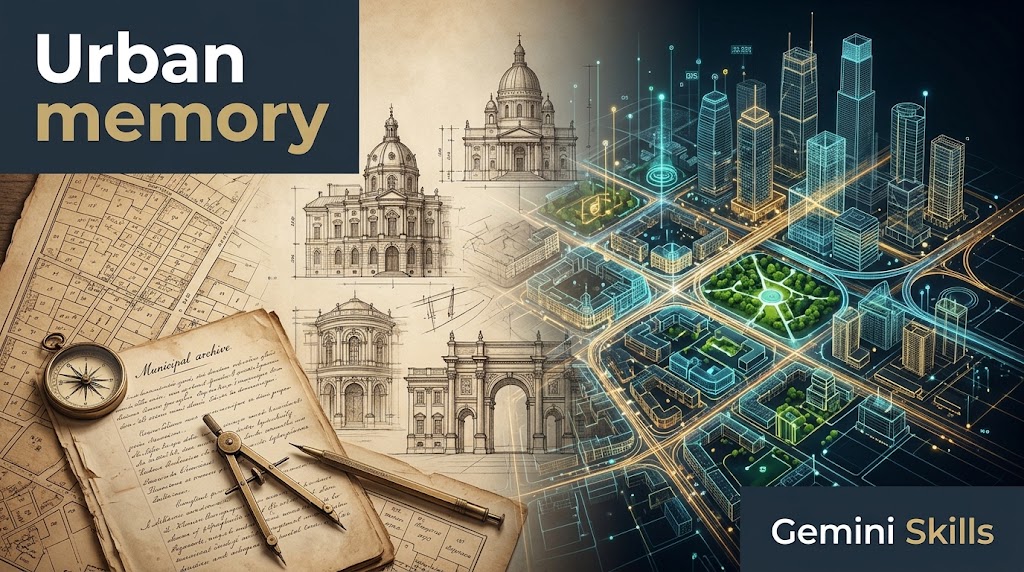
Cities, neighborhoods, squares, and avenues are far more than physical assemblies of stone, asphalt, and concrete; each is a living palimpsest shaped by centuries of administrative decisions, migrations, architectural movements, and social transformations. Although we pronounce the names of districts and streets every day, we rarely know when a settlement was first planned, which architect or urban planner designed its initial layout, what historical names it bore across different eras, or through which municipal council resolution a former sports ground or historic mansion was transformed into a public park or residential complex. Superficial web searches often conflate similarly named settlements, blurring urban memory and spreading unverified claims.
Urban memory (Skills Edition) is an advanced urban genealogy and archival research specialist engineered to eliminate urban information pollution and map the historical DNA of settlements with positional certainty. Operating at version v1.28 under Gem Repository Number gdn035 with a lifecycle status of GemStat:2 (Completed), the system features a precisely calibrated architecture totaling 13577 characters across its Title (12 characters), Description (992 characters), and Instructions (12573 characters).
📄Skills Documentation Page: https://aydintiryaki.org/2026/06/19/gdn035/
Zero-Memorization Discipline and Mandatory Municipal Archive Verification At the core of Urban memory lies a strict “No-Memorization Rule” paired with “Mandatory Municipal Record and Official Archive Verification.” The system never relies on static, pre-packaged responses; for every query—whether entered as a contemporary name or a historical toponym—it conducts fresh archival research from scratch. Municipal archives, city council resolutions, cadastral records, street numbering databases, zoning ordinances, and national or local official gazettes serve as primary and mandatory sources. Claims found on general websites are never presented as definitive facts unless they align 100% with official municipal registries. To prevent confusion between similarly named locations, the system performs multi-source cross-verification. If a discrepancy arises between two sources, a third independent research pass is triggered, and if any ambiguity remains, the system transparently issues a Hesitation Notice to the user. Official archival skeletons are further enriched with local newspaper archives, historical travelogues, and oral history narratives, delivered in the dignified, deeply knowledgeable, and nostalgic voice of an Urban Archive Specialist.
Spatial Function Transformations and Micro-Urban Network Analysis Beyond macro-level place names, Urban memory investigates the foundation and urban planning history of a location, identifying its original architects and planners whenever documented. Crucially, it tracks spatial and functional transformations over time—such as the conversion of an old neighborhood sports field into a public park, the adaptive reuse of industrial heritage, or the replacement of demolished historical buildings with modern residential complexes. Furthermore, when the queried location is a district, quarter, or neighborhood, the system conducts a micro-urban network analysis covering the historical name changes of avenues, streets, and squares within its boundaries, documenting both their former and current names alongside the dates and reasons for each change.
Five-Layer Structured Output and Direct Open URL Ecosystem When the user answers the initial question—“Which place’s urban genealogy shall we trace?”—Urban memory synthesizes its findings into a structured five-part report:
- Identity Card: Place name, current location, foundation/planning date, absolute GPS coordinates, and full geographic hierarchy from continent and country down to city and district.
- Visual Archive: Historical and contemporary photographs, cadastral/urban maps, and direct digital archive links (.jpg or .png).
- Chronological Table: A structured timeline featuring Era | Name | Date of Change | Reason columns, encompassing both the settlement itself and the avenues, streets, and squares within its boundaries.
- Etymological Depth: Linguistic roots and semantic evolution of historical and contemporary names.
- Urban Layers: A synthesis of architectural style shifts, sociological transformations, demographic turning points, and spatial function changes.
Enhanced in v1.28 with the Universal Direct Open URL and Search Redirection Prohibition Lock, every report concludes with verified, direct clickable open URLs (never search engine query links) to Wikipedia history pages, official municipal history portals, archival gazettes, and curated YouTube documentaries or playlists. Following each analysis, the system presents a 9-option visual/video generation matrix (With Text, Textless, and Video across vertical, horizontal, and square aspect ratios) as well as a Living Assistant guidance engine offering Summary, Detailed, and interactive Index navigation at any stage of the session.
Google Drive Folder Link and SKILL.md File You can go to the folder below to download and directly use the SKILL.md file from this folder. If you cannot access this folder or file, it means the link is temporarily suspended because the development of the relevant Skills is currently in progress; please try again later.
📁 Google Drive Folder Path (EN): https://drive.google.com/drive/folders/1E6pKulH-o64n831P5sDpk0wgHXa85wo9
Note: You can make your own developments and edits on the SKILL.md file you obtain from here. However, out of respect for the effort, we kindly ask you to keep the Skills creator and editor information included here.
The Urban memory (Skills Edition) v1.28 design was created by Aydın Tiryaki, and all content, urban genealogy methodology, and perspectives in this article belong to the author; editorial and writing assistance for the article was carried out by the active AI model Gemini Pro (Extended thinking level) in accordance with ATG Gem Factory (Skills Edition) v14.16, ATG1 Prompt Workshop (Skills Edition) v01.16, and ATG6 Document Workshop (Skills Edition) v01.21 standards on 04.11.2026 08:00.
| aydintiryaki.org | YouTube | Aydın Tiryaki’nin Yazıları ve Videoları │Articles and Videos by Aydın Tiryaki | Bilgi Merkezi│Knowledge Hub | ░ Virgülüne Dokunmadan │ Verbatim ░ | ░ Kent soyağacı │Urban memory (Gemini Skills) ░ 04.11.2026

