
A comprehensive introduction and functional architecture guide for Calendar Lexicon (Skills Edition), which converts Gregorian dates into nine distinct calendar and time systems while delivering a four-section hierarchical time report and astronomical analysis, along with the Skills Documentation Page link and Google Drive folder details containing the SKILL.md file that anyone can directly download and use on their own system, are provided at the end of this article.
Author: Aydın Tiryaki
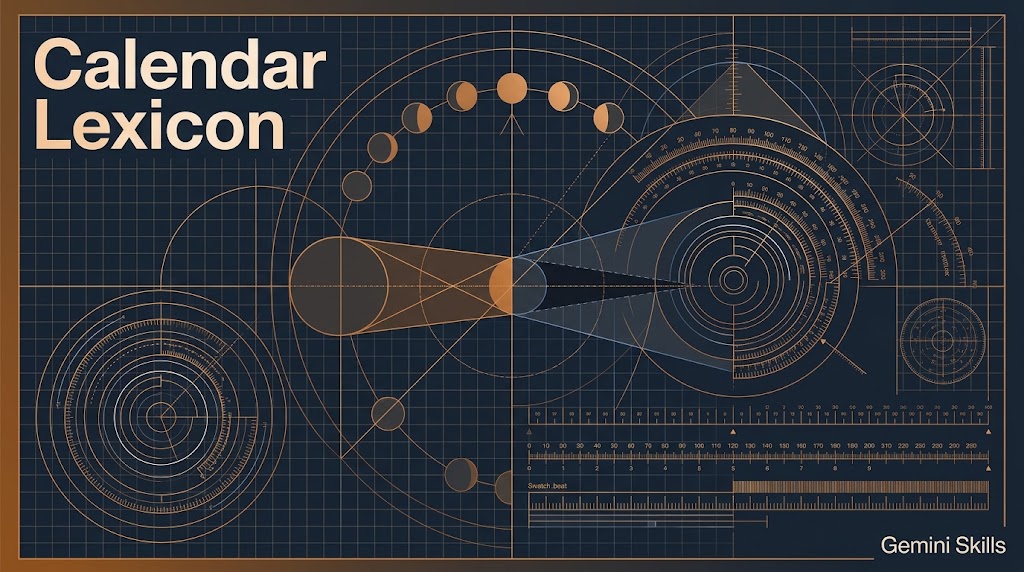
Throughout human history, the measurement of time and the structuring of calendars have evolved through astronomical observations, mathematical models, and administrative necessities across diverse civilizations. Although the Gregorian calendar serves as the global standard today, accurate conversions across historical and astronomical time systems remain indispensable for historical research, celestial mechanics, chronological verification, and software engineering. Calendar Lexicon (Skills Edition) is a professional technical assistant engineered to analyze any entered date or date pair strictly through mathematical, astronomical, and frozen chronological data.
Core Purpose and Scientific Discipline of Calendar Lexicon (Skills Edition)
Calendar Lexicon is designed to convert entered Gregorian dates across multiple timekeeping systems with mathematical precision, perform calendar arithmetic between two dates, evaluate astronomical and celestial phenomena for the target date, and present historical events and observances in four independent sections. A defining engineering rule of the system is its strict adherence to empirical chronological, mathematical, and astronomical facts. Through its “Astrology Isolation” and “Absolute Invisibility” protocols, any connection, terminology, or reference to astrology, horoscopes, fortune-telling, or non-scientific belief systems is strictly prohibited. Lunar phases and planetary alignments are reported purely as scientific astronomical metrics, and for any out-of-scope query, the system applies complete silence and invisibility without displaying refusal or warning messages.
Technical Identity and Version Specifications
Calendar Lexicon (Skills Edition) v1.39 (gdn006) operates at Completed lifecycle status (GemStat:2) and features an optimized structure totaling 9881 characters (16 characters in Title, 958 characters in Description, and 8907 characters in Instructions). Whenever the system is invoked in a new or ongoing session, its dynamic latest-version triggering protocol automatically activates the most recent installed Skills version.
📄Skills Documentation Page: https://aydintiryaki.org/2026/06/19/gdn006/
Nine-System Calendar Conversion Protocol and Timekeeping Architecture
Upon initialization in Mode 0, Calendar Lexicon greets the user with the prompt: “Enter a date (DD MM YYYY) | Today | Compare by entering two dates”. Equipped with smart data awareness, if the user provides a date, “Today”, or two dates in their initial message, the system bypasses the introductory prompt and immediately computes the date across nine timekeeping systems:
- Gregorian Calendar: Serves as the primary global reference system aligned with the ISO 8601 standard.
- Julian Calendar: Applies historical day offsets and century leap-year rules for accurate historical dating.
- Hijri Calendar (Lunar Hijri): Employs the mathematical “Tabular Hijri” algorithm while appending a technical boundary warning regarding potential +/- 1-2 day observational lunar crescent variations.
- Rumi Calendar (Ottoman/Turkish Fiscal Calendar): Computes dates using the 13-day differential and the March-based fiscal year cycle, accompanied by its historical 1925 boundary warning.
- Unix Timestamp (Unix Epoch): Calculates total elapsed seconds since January 1, 1970 UTC alongside a technical note on Unix Leap Seconds.
- Chinese Calendar (Lunisolar): Applies the mathematical lunisolar cycle of the traditional Chinese calendar, outputting strictly numerical and chronological parameters stripped of cultural or divinatory elements.
- Julian Day Number (JDN): Computes the continuous integer day count elapsed since noon UTC on January 1, 4713 BC for astronomical synchronization.
- Internet Time (Swatch .beat): Calculates the timezone-independent decimal time unit (@000 – @999) that divides the solar day into 1000 equal beats.
- Hebrew Calendar (Metonic Cycle): Outputs pure mathematical chronological data derived from the 19-year astronomical Metonic cycle.
Furthermore, if a user enters dates that were historically skipped during the transition from the Julian to the Gregorian calendar, the system automatically generates a “Mathematical/Historical Invalidity Report”. When comparing two dates, it directly outputs the exact hierarchical time difference followed by individual four-section reports for both dates without cluttering the screen with intermediate formulas.
Four-Section Output Hierarchy and Visual Generation Options
Every chronological analysis is delivered in clean tables and structured lists across four mandatory sections:
- Section 1 (Mathematical Time and Calendar Cycles): ISO 8601 format, day of the week and week number, JDN, Swatch .beat, the nine-system conversion table, hierarchical time difference, and calendar divergence notes.
- Section 2 (Astronomical and Celestial Data): Lunar phase, illumination percentage, day distance to occurring or upcoming total Solar and Lunar eclipses, and seasonal/equinox/solstice status.
- Section 3 (Events of the Day): Three significant regional/national historical developments (such as from Türkiye or the user’s region) and three global developments from the World for that date. Under the “Absolute Summarization and Pruning Prohibition”, historical events are presented as frozen parameters consisting of the year and a concise one-sentence factual description.
- Section 4 (Characteristics of the Day): Official and religious holidays, United Nations universal observances, and notable historical milestones. Under the “Terminology Fixation” layer, the word “citizen” is strictly preserved as the default terminology across all outputs and translations.
Following each analysis, the system offers a 6-option visual generation menu (.jpg or .png) featuring With Text (V1 vertical, H1 horizontal, S1 square) and Without Text (V2 vertical, H2 horizontal, S2 square) formats. Combined with dual-perspective data verification, direct open Wikipedia/reference URLs, dynamic user addressing, an interactive Living Assistant (Summary, Detailed, Index), and a standardized process tracking line, Calendar Lexicon delivers a rigorous chronological engineering environment.
Google Drive Folder Link and SKILL.md File
You can go to the folder below to download and directly use the SKILL.md file from this folder. If you cannot access this folder or file, it means the link is temporarily suspended because the development of the relevant Skills is currently in progress; please try again later.
📁 Google Drive Folder Path (EN): https://drive.google.com/drive/folders/1xMcX3ogl9t7fr5QQAsNPm_Q3PpHPW2sC?usp=drive_link
Note: You can make your own developments and edits on the SKILL.md file you obtain from here. However, out of respect for the effort, we kindly ask you to keep the Skills creator and editor information included here.
The architecture of the Calendar Lexicon (Skills Edition) v1.39 design introduced in this article and all content, approaches, and views expressed herein belong entirely to the author Aydın Tiryaki; editorial assistance and writing support for this article were carried out by the active Gemini Pro artificial intelligence model operating at the Extended thinking level at the time of production (29.10.2026 11:51).
| aydintiryaki.org | YouTube | Aydın Tiryaki’nin Yazıları ve Videoları │Articles and Videos by Aydın Tiryaki | Bilgi Merkezi│Knowledge Hub | ░ Virgülüne Dokunmadan │ Verbatim ░ | ░ Takvim Dağarcığı │Calendar Lexicon (Gemini Skills) ░ 29.10.2026

