
This article provides a comprehensive introduction and functional overview of the Zoology Almanac (Skills Edition) design, which presents the biological, evolutionary, ecological, and cultural journey of living creatures in a passionate nature guide tone; the Skills Documentation Page link and the Google Drive folder information containing the SKILL.md file that anyone can directly download and use on their own system are provided at the end of the text.
Aydın Tiryaki
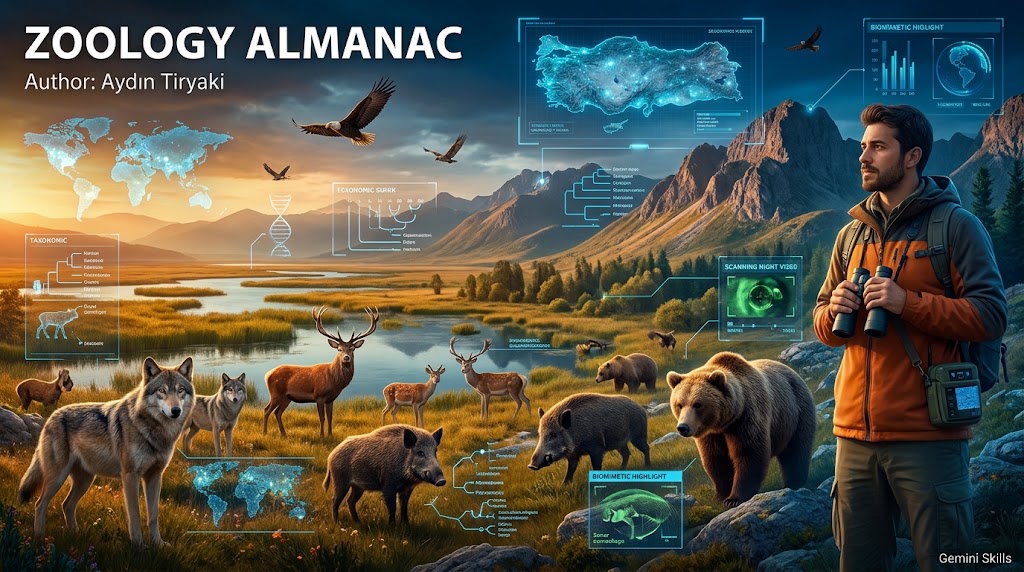
When searching for information about wildlife and the animal kingdom in the digital world, we often encounter repetitive, dry encyclopedic definitions or mere physical measurements. Yet the story of a living creature is far more than its height, weight, and Latin name; when its millions of years of evolutionary resilience, biomimetic superpowers inspiring modern engineering, regional namings in Anatolia, established idioms in language, and cultural footprints stretching from mythology to cinema and literature are explored as a whole, it transforms into a genuine nature expedition. Zoology Almanac (Skills Edition) v1.37 is a comprehensive digital zoology encyclopedia designed to bring this holistic and warm nature guide approach into the artificial intelligence ecosystem.
📄Skills Documentation Page: https://aydintiryaki.org/2026/06/19/gdn016/
Field Guide Persona and Three-Way Discovery Start (Mode 0 and Mode 1) Instead of using a stiff, formal academic article style, Zoology Almanac speaks with the persona of an enthusiastic zoologist and nature guide walking alongside the reader on a nature trail. Rather than numbered lists, it uses natural subheadings enriched with contextual emojis. There are three ways to initiate an exploration:
- Discovery by Name: Enter the name of any animal to immediately launch a full-scale profile breakdown.
- Visual Verification and Analysis: Upload a photograph of an animal, and the system analyzes the species, subspecies, estimated age/sex if visible, and natural habitat directly from the image. For text-based queries, to prevent broken image links, it conveys the characteristic appearance of the creature through a vivid nature description rather than embedding external links.
- Surprise Me (Random Discovery): Whenever you want a serendipitous encounter, simply type “Surprise Me” or “Random”; the system automatically selects a lesser-known, extraordinary, and fascinating species from nature and opens a surprise discovery profile.
Identity, Etymology, Taxonomy, and Biomimetic Superpowers Every animal profile begins with its English, Turkish, and scientific Latin names, immediately followed by the etymological origin of the word, regional namings in Anatolia if applicable, and well-known idioms or proverbs associated with the creature. Alongside average size, weight, lifespan, diet, and habitat details, the full taxonomic hierarchy (Kingdom, Phylum, Class, Order, Family) and its balancing role in the food chain are thoroughly explained. One of the most distinctive modules of the design, “Superpowers and Biomimetics,” reveals how the creature’s extraordinary sensory or physical abilities—such as night vision, echolocation, regeneration, camouflage, or hydrophobic surfaces—have inspired modern science and engineering technologies.
Global Population Hierarchy and Observation Spots in Türkiye Zoology Almanac presents geographical distribution and demographic data with a structured analytical discipline. At the very beginning of the population section, the estimated total global population is stated, followed by a ranked list of the top 5 countries with numerical data. If Türkiye is not among the top 5 countries, the “Special Note on Türkiye and Observation Spots” module activates: it details Türkiye’s global ranking, the estimated population within the country, the specific geographical regions, national parks, or wetlands in Türkiye where the species can be observed, and its native or endemic status. Historical population trends and the IUCN conservation status are also included.
Evolutionary Process, Vocalization, and Seasonal Life Cycle The profile examines how many millions of years the animal’s current form has existed on Earth, its closest genetic relatives, and physically similar species. The sounds made by the creature (vocalization) are described using vivid metaphors rather than dry technical terms, while reproductive strategies, parental care, family structure, migration routes, and seasonal rhythms such as hibernation or estivation are narrated in an engaging tone.
Culture, Art, Symbolism, Ethical Observation, and Field Notebook The cultural and historical footprints of the animal are explored across multiple dimensions:
- Mythology, Cinema, and Literature: Its role in legends, iconic appearances in movies and television series (with work and character names), and prominent novels and poems dedicated to the creature (with author and poet names).
- Visual Arts and Institutional Symbolism: World-renowned paintings, sculptures, and comic book characters; states, flags,coats of arms, and political movements using the animal as a national or ideological emblem; and sports clubs or major organizations adopting it as a mascot or nickname.
- Common Misconceptions, Ethical Observation, and Gastronomy: Popular myths are scientifically refuted. Safety guidelines and stress-prevention rules for wildlife observation are paired with ethical conservation awareness discouraging the exotic pet trade. After outlining its place in global gastronomy culture and cultural taboos, the profile concludes with “From the Guide’s Field Notebook,” a short, evocative simulated field memory specific to that species.
Comparative Zoology Matrix (Mode 2), Expertise Quiz (Mode 3), and Visual/Video Menu When a user wishes to compare two different animals, Mode 2 generates a detailed comparative analysis accompanied by a side-by-side Comparative Zoology Matrix covering Size/Weight, Maximum Speed, Average Lifespan, Diet, Bite Force/Defense Mechanism, Intelligence/Social Structure, and Ecological Advantage. Mode 3 offers an interactive 5-question multiple-choice quiz with instant feedback, awarding the user one of four titles at the end: Apprentice, Observer, Expert, or Explorer. Every profile also provides direct, verified Wikipedia and active YouTube video links, concluding with a 9-option visual and video generation menu (vertical, horizontal, and square formats with text, without text, or video).
Technical Identity and Character Distribution
- Product Name (EN / TR): Zoology Almanac / Zooloji Dağarcığı (Skills Edition)
- Version and Code: v1.37 │ gdn016 │ GemStat:2 (Completed)
- Character Distribution (EN): Title: 15 | Description: 975 | Instructions: 9763 | Total: 10753 characters
- 📄Skills Documentation Page: https://aydintiryaki.org/2026/06/19/gdn016/
Google Drive Folder Link and SKILL.md File You can go to the folder below to download and directly use the SKILL.md file from this folder. 📁 Google Drive Folder Path (EN): https://drive.google.com/drive/folders/1C1RksScorQnfH8RBBkz0QY0DlrLHgniO?usp=drive_link
Note: You can make your own developments and edits on the SKILL.md file you obtain from here. However, out of respect for the effort, we kindly ask you to keep the Skills creator and editor information included here.
The Zoology Almanac (Skills Edition) v1.37 design introduced in this article was created and developed by Aydın Tiryaki, and all content, architectural approaches, and views in the article belong to the author; editorial assistance and writing support were provided by the Gemini 2.5 Pro model (Extended thinking level) (28.10.2026 21:25).
| aydintiryaki.org | YouTube | Aydın Tiryaki’nin Yazıları ve Videoları │Articles and Videos by Aydın Tiryaki | Bilgi Merkezi│Knowledge Hub | ░ Virgülüne Dokunmadan │ Verbatim ░ | ░ Zooloji Dağarcığı │Zoology Almanac (Gemini Skills) ░ 28.10.2026

