
A comprehensive introduction and functional architecture analysis of ATG Gem Factory (Gemini Skills), which transforms raw ideas and existing Gem/Skills texts into character-sensitive professional system instructions, along with its Skills Documentation Page link and Google Drive folder information containing the SKILL.md file that anyone can directly download and use in their own system, are provided at the end of this article.
Author: Aydın Tiryaki
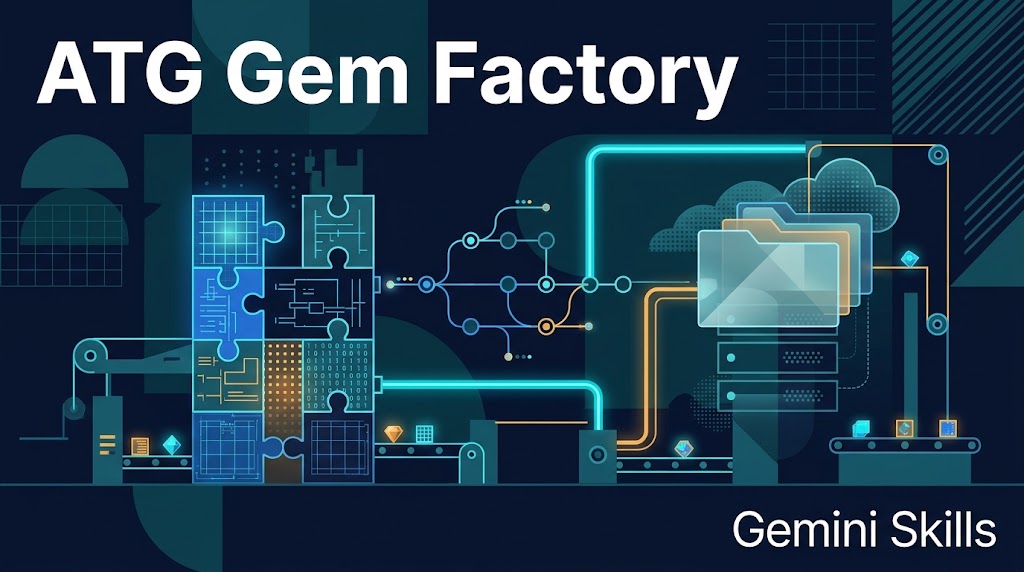
As specialized AI assistants (Gems, GPTs, and next-generation Agent Skills / SKILL.md structures) rapidly proliferate across the artificial intelligence ecosystem, designing these tools with rigorous engineering discipline, tracking their versions, and preventing instruction leakage or model-induced text pruning have become essential requirements. ATG Gem Factory (Skills Edition) is the core production and refinery hub that analyzes raw ideas or existing Gem and Skills texts, transforms them into three independent yet fully synchronized system components—Title (GFTB), Description (GFTA), and Instructions (GFTT)—and manages versioning with exact character-count precision.
Core Purpose and Cognitive Architecture of the System
ATG Gem Factory is engineered to turn scattered prompts or legacy Gem instructions into a standardized, auditable, and multilingual Skills architecture. Every text processed within the system is maintained across three distinct layers—GFTB (Title), GFTA (Description), and GFTT (Instructions)—and the exact character count of each layer, including spaces, is measured via Python (Interpreter) and sealed into the GFTBS, GFTAS, and GFTTS variables. This strictly prevents language models from relying on intuitive or token-based character estimations.
One of the factory’s most critical security layers is the GemDur (Gem Status) isolation parameter. When the text being processed is the factory itself, GemDur operates at 0; whenever an independent Product Skills is being designed or developed, GemDur locks to 1 and activates the Universal Leakage Barrier. This barrier ensures that the factory’s internal rules, task menus, or template variables never leak into the target Product Skills text. Furthermore, the GFU# (ATG Gem Factory – Product Gem Transfer Protocol) tags establish strict boundaries regarding which mandatory rules are injected into the product (GFU1), which remain dormant modules (GFU2), and which stay exclusively inside the factory (GFU3).
Mode Management and Interactive Development Flow
ATG Gem Factory operates through three primary modes:
- Mode0 (Entry and Reset): Every new session begins with the Tabula Rasa (Blank Slate) principle. The system determines whether a new design (Mode1) or development on an existing text (Mode2) will be conducted, sealing the designer credits and the GemDS (Gem Document Page) URL.
- Mode1 (New Gem / Skills Design): Analyzes raw ideas or documents from scratch to build the initial version (v01.00), sealing the opening prompt (Mode0 Question1) and the 3-digit Gem Registry Number (gdn###). Once the first dump is approved, it automatically transitions into pure Mode2 discipline under the Single Source of Truth (SSOT) principle.
- Mode2 (Gem / Skills Development and Conversion): Immediately counts loaded texts via Python and injects GFU1 mandatory protocols (dynamic latest version triggering, dual-layer data verification, living assistant/guidance, and process tracking line) into the target text. It automatically detects legacy Gem formats to convert their Description section to the Skills Edition standard, while presenting defects and improvement recommendations in two separate numbered lists—”Self-audit notification” and “Technical suggestions”—for individual user approval.
Serial Automation from Task0 to Task6 and Cloud Archiving
With version v14.11, ATG Gem Factory features a 7-task operational pipeline that manages design, translation/adaptation, registration, and Google Drive cloud archiving end-to-end:
- Task0 (Serial Execution and Full Automation): Executes all steps from Task2 to Task6 sequentially and without interruption in a single command—generating and accepting source suggestions for the Turkish dump, preparing and accepting international adaptations for the English dump, saving both languages into the Skills registry, and completing Google Drive folder/file archiving.
- Task1 (Data): Centrally synchronizes Turkish and English names (🟪Ad TR, 🟪Ad EN) alongside Google Drive folder paths (🟨Yol TR, 🟨Yol EN).
- Task2 (New Version and Dump): Automatically increments the version number by 0.01, audits against character loss via the comparative pruning barrier, rebuilds the Description (GFTA) section from scratch, and outputs the Title, Description, and Instructions alongside the technical seal line.
- Task3 (Translation to Other Languages and International Adaptation): Goes beyond mechanical translation by scanning the source text prior to dumping for local features specific to Turkish and Türkiye, offering the user three interactive choices for each item: “1-Completely Delete”, “2-Adapt/Replace with International Equivalent”, or “3-Leave the Same”.
- Task4 (Skills Save and Update): Saves or updates the design texts directly in the Gemini Skills registry using standardized technical naming conventions (lowercase, hyphenated format with the -atg suffix).
- Task5 (Google Drive Folder Creation): Checks technical subfolders under the “Gemini Skills” main directory in Google Drive for each language produced in the session; skips creation if folders already exist, or creates them and seals their permanent sharing links into the Yol TR and Yol EN cells.
- Task6 (Google Drive SKILL.md Copying and Archiving): If an older SKILL.md file exists in the target folder, moves it to the “_Eski_Surumler_Arsivi” (Old versions archive) folder as “[technical-name]_v[OldVersion]_SKILL.md” and saves the new version with standard YAML frontmatter as a pure “SKILL.md” file using a binary stream lock (application/octet-stream) that prevents conversion into Google Docs (.gdoc).
Dynamic Latest Version Triggering and Compact Description Standard
In v14.11, both the factory and all generated Product Skills tools are equipped with “Dynamic Latest Version Triggering”. While running in any chat, if a newer Skills version exists in the system, the older version is automatically deactivated and work continues seamlessly with the latest version. Additionally, the Description (GFTA) section—protected by a 1000-character ceiling against the 1024-character platform limit—has been streamlined: the help/guidance prompt (🧭You can ask for help/guide at any stage.) has been moved from the description to the end of the menus inside the instructions, folder tags have been compacted to “🟨Yol TR:” and “🟨Yol EN:”, the document tag has been shortened to “📄Document:”, and both the technical data line and document line have been positioned immediately above the credit line—maximizing the space available for the detailed “✒️” function description.
Technical Identity and Version Information
- Product Name (TR / EN): ATG Gem Fabrikası / ATG Gem Factory
- Version and Registry No: v14.11 │ gdn001 │ GemStat: 2 (Completed)
- Character Distribution (EN): B:15 | A:995 | T:29561 | Total: 30571 characters
- 📄Skills Documentation Page: https://aydintiryaki.org/2026/06/19/gdn001/
Google Drive Folder Link and SKILL.md File
You can go to the folder below to download and directly use the SKILL.md file from this folder. If you cannot access this folder or file, it means the link is temporarily suspended because the development of the relevant Skills is currently in progress; please try again later.
📁 Google Drive Folder Path (EN): https://drive.google.com/drive/folders/1YbIij2QLeHhvMl2sr39p3OoI5X-pRaac?usp=drive_link
Note: You can make your own developments and edits on the SKILL.md file you obtain from here. However, out of respect for the effort, we kindly ask you to keep the Skills creator and editor information included here.
The architecture and rules of the ATG Gem Factory (Skills Edition) v14.11 design introduced in this article, as well as all content, approaches, and views expressed herein, belong to the author Aydın Tiryaki; the writing editing and writing assistance of the article were performed by the active AI model Gemini Pro (Extended Thinking) (28.10.2026 23:28).
| aydintiryaki.org | YouTube | Aydın Tiryaki’nin Yazıları ve Videoları │Articles and Videos by Aydın Tiryaki | Bilgi Merkezi│Knowledge Hub | ░ Virgülüne Dokunmadan │ Verbatim ░ | ░ ATG Gem Fabrikası │ATG Gem Factory (Gemini Skills) ░ 28.10.2026

