
Aydın Tiryaki
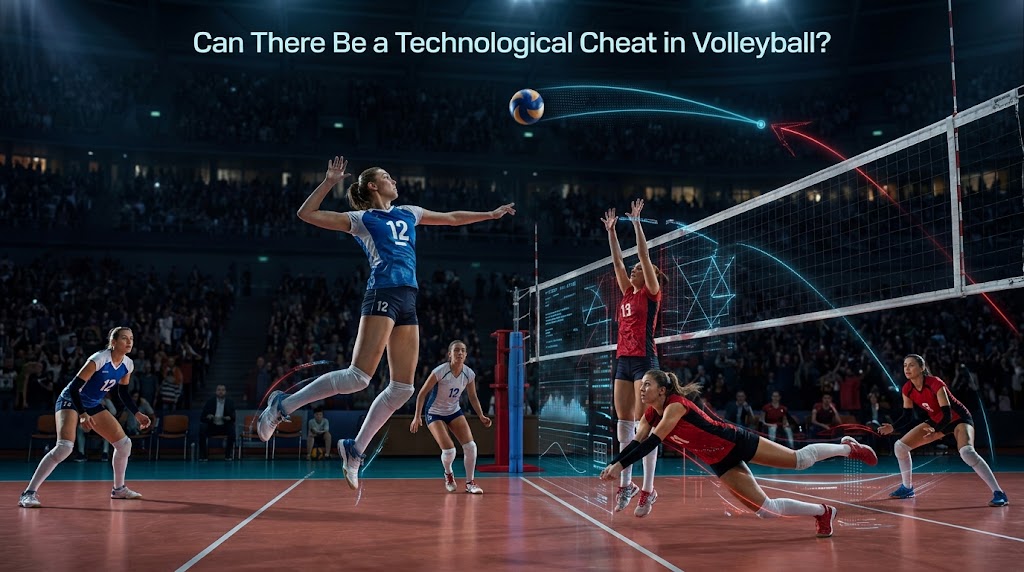
Modern volleyball is a sport where physical power and tactical intelligence reflect on the court in perfect harmony, and massive decisions are made in times as short as a tenth of a second. Today, the balance of power between top-level teams is so close that the sets determining the fate of the matches sometimes end with very narrow score ranges like 25-23 or 26-24. At the end of a two-hour sports marathon, the thin line between championship and defeat relies on that minimum two-point difference required by the rules of volleyball. These “hairline” differences lay the groundwork for volleyball to become not just a game played on the court, but a target of data analytics and perhaps dark technological interventions in the future.
The Weight of a Point and Visual Illusions
A spectator watching a volleyball match from the stands or a television screen follows the trajectory of the ball from a wide angle and with depth perception. For this outside eye, it is mostly clearly evident whether a hard-hit ball will go out by meters or fall exactly on the line. However, in the world of the player inside the court, physical reality works very differently. When a spike serve that can reach a speed of 120 kilometers per hour or a “float” serve that suddenly changes direction comes towards them, the player experiences incredible speed blindness.
This speed and perspective narrowing give rise to two main player errors in volleyball:
- The player reflexively interfering with a ball that is clearly going out from the spectator’s eye, out of fear that it will land inside the court.
- The ball that the player leaves by pulling their body away, being sure that it will go out, falling right on the line or millimeters inside.
If the statistics of these close calls in top-level tournaments today are kept, it will be easily seen that a team loses an average of 3 to 5 points per match just because of these visual illusions. In an ecosystem where scores are determined by those very small, minimum two-point differences, 3 faulty decisions to be saved per match is a statistical data valuable enough to directly determine the owner of the gold medal.
From the Illusion of the Eye to the Precision of Technology
In these moments when the human eye and reflexes fall short, Video Challenge Systems (VCS / Hawk-Eye) step in. Established as a result of years of massive R&D studies worth millions of dollars, these systems can model the ball’s speed, spin angle, Magnus effect, and aerodynamic profile in milliseconds with cameras capturing hundreds of frames per second. The system has the capacity to determine the exact point where the ball will land with millimeter precision while it is still in the air.
However, the real question to be answered is this: Is such a precise and powerful mathematical infrastructure used only to ensure fair play?
Abuse of Algorithms and “Dark Systems”
When this massive accumulation of knowledge and the algorithms of existing systems fall into the hands of malicious people, it is not out of the realm of possibility to establish a much more insidious, dark, and parallel structure on the court instead of hacking the existing official system.
Thanks to today’s constantly developing miniature sensor technology, compact optical devices fixed to strategic points of the hall, behind advertising boards, or lighting poles can be placed. With their AI-supported autonomous calibration capabilities, these devices can instantly map the 3D layout of the court. Using all the rotation parameters and the profile of a serve leaving the hand, the point where the ball will fall can be calculated in milliseconds.
More importantly, this dark system does not need to interfere with every ball during the match. For those “critical points that win the match” shown by the statistics kept anyway, it is enough for the system to detect only the balls that will go out or stay inside by a hair’s breadth.
Compartmentalization of Information: Innocently Involving the Player in the Cheat
The biggest challenge of such a system is the transmission of the calculated data to the player in a time like a tenth of a second and stopping their reflex. However, the architects of this cheat can follow a very cunning method by keeping the players completely away from the dark side of the job.
The players can simply be told: “We can read the trajectory of the ball much better from the sidelines with a wide angle. If we realize the ball is going out, we will inform you with a small light or sign, leave that ball.”
In this scenario, the players are completely unaware of the massive algorithm running in the background, the speed, and profile calculations. Thinking that they are only receiving tactical “third eye” help from the technical team on the sidelines, they become a part of this cheat with completely innocent feelings and without malicious intent. Thus, the possibility of the secret leaking out is completely eliminated.
The 1976 Montreal Criminal Record and Looking to the Future
This whole scenario may sound like an outlandish conspiracy theory to some. However, sports history is full of proofs of how the ambition to win manipulates technology. The most striking example of this occurred at the 1976 Montreal Olympics. Soviet fencer Boris Onishchenko had points printed on the electronic system without ever touching his opponent with a small modification hidden in the hilt of his sword, signing one of the biggest cheats in sports history.
This cheat, which could be done entirely through physical hardware in 1976; can be done much more flawlessly today through just codes and algorithms in an era of artificial intelligence, instant image processing, and millisecond data transfer.
As a result; although it is currently difficult to claim the existence of a parallel system that reads the aerodynamic structure of the ball and sends instant signals to the players in volleyball, the reality of the “feasibility” of such a system should not be ignored. Sports organizations should not only be content with protecting their own encrypted systems but also keep their eyes open against whether the data collected in the hall is analyzed by invisible networks from the outside.
Credits:
- Idea and Concept: Aydın Tiryaki
- Research and Writing Assistant: Artificial Intelligence Gemini
| aydintiryaki.org | YouTube | Aydın Tiryaki’nin Yazıları ve Videoları │Articles and Videos by Aydın Tiryaki | Bilgi Merkezi│Knowledge Hub | ░ Virgülüne Dokunmadan │ Verbatim ░ | ░ Voleybolda Teknolojik Bir Hile Olabilir mi? │Can There Be a Technological Cheat in Volleyball? ░ 24.07.2026

