
Aydın Tiryaki (October 26, 2008)
The article ended with the note “to be continued…” I waited for the series of articles—which spoke of the places I lived, my loved ones, and myself—to conclude before writing about these memories. The series finished three weeks ago, but my writing was delayed as it coincided with a very busy period for me.
I began reading the articles, taking notes on the memories they evoked, and writing. I initially aimed to finish and publish the entire piece at once. When I realized it would never end that way, I decided to publish it in installments. I have planned this series in six parts.
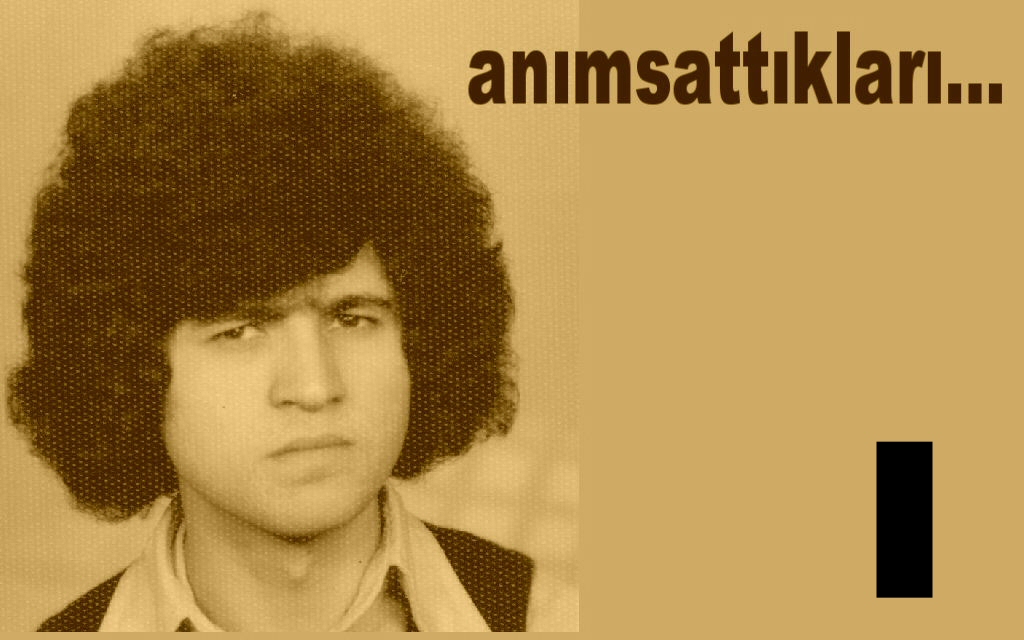
In this first part, I wrote about encountering Hızır Abi on Milliyet Blog and my days in İçcebeci, Ankara.
In the 70s and 80s, I looked like I do in the photo. I would go to the barber very rarely, and my hair would grow upward like that. Thirty years later, I still go to the barber infrequently, but when my hair grows out now, it is not nearly as thick.
PART I: ANKARA – CEBECİ
Looking at Hızır Kabil’s homepage on Milliyet Blog now, I found that I noticed him on April 27, 2008. I immediately wrote a message that day:
“The 1970s…
Hello… When I saw the name Hızır Kabil, I wondered if it could be the Hızır Abi who lived on Uzungemiciler Street in İçcebeci, Ankara, in the 1970s. Sincerely, Aydın Tiryaki.”
The reply came immediately:
“Dear Mr. Aydın, as you recalled, I am indeed that Hızır Kabil—your uncle’s classmate, whom we occasionally meet in Istanbul to reminisce about with longing, and whose successes we take pride in. I follow you through your writings on Milliyet Blog. In the coming days, I am considering writing a memoir about Inebolu. We hadn’t been able to talk with Mr. Hayri for a long time. After receiving this message from you, I will inform him as well. I congratulate you for your attentiveness and for remembering me; I am very happy that our paths crossed on Milliyet Blog and I kiss your cheeks, wishing you continued success. h.kabil”
When I got into university in 1976, my Uncle Hayri (Hayri Tiryaki) had just finished his degree. My uncle is from the generation of ’68. He started university in Istanbul in 1968, but those were difficult years. After a while, he left university and went to Berlin, returning a few years later to enroll in the German Philology Department at Ankara DTCF. I remember that enrollment process very well. It was 1972. There was a university exam, but central placement had not yet begun. At night, after the 11:00 PM news on Ankara Radio (TRT), vacant quotas and minimum scores for universities would be broadcast. One night, he learned from the news that his score was sufficient for Erzurum Atatürk University. He set out the next morning, traveling through who knows how many bus transfers to complete his pre-registration. Later, his scores for Ankara were also sufficient, and he enrolled there.
In the summer of 1976, when it became clear that I had been accepted to METU in Ankara, the suggestion that I join the student house my uncle was leaving felt welcoming. I knew my uncle’s friends. Those in the house were Emin Abi, Hızır Abi, and Hızır Abi’s relatives. I met them and moved in when school opened toward the end of December ’76. When a nine-month boycott began at METU in mid-February ’77, I returned to Inebolu. I stopped by a few times for a few days until we vacated the house in September.
Uzungemiciler Street was reached by climbing a slope next to the İçcebeci Mosque. Back then, I would climb that slope many times a day. It was the late nineties. The funeral ceremony for the mother of one of our professors was at the İçcebeci Mosque. While waiting there, I quickly climbed the slope to see my old street, which I hadn’t seen in 20 years. Finding myself out of breath, I understood the difference between being 18 and 40 years old.
The few months I lived there in ’76-’77 were a period of complete hesitation and adjustment for me. Coming to a big city from a small place, being away from family for the first time, and being a 17-year-old university prep student made for difficult times. I easily overcame those hard days with the help of my Uncle Ali—who lived in Ankara then—and my housemates, who were experienced with hardships. My Uncle Ali was a teacher at an evening middle school in İskitler; they lived in Demetevler. I would visit them often. I would take bus number 17 or 21 from Cebeci to Kızılay and wait in the long, 5-6 fold queue for the bus going to Demetevler. The length of the line was intimidating, but the buses came frequently.
One day when I came home from school, I saw glass shards inside my ground-floor room facing the road and looked at the window with curiosity and fear. The glass was intact, but it was clear from its cleanliness that one of the panes had been newly replaced. When I asked my housemates, I received the answer I was afraid to hear: “They sprayed the house with bullets,” they said, and I wasn’t very surprised. A moment later, I learned it was a joke; children playing in the street had broken it with a ball. One of the friends had caught those who broke it and had a glazier install it before I even got home. Even the jokes of those years contained dark humor.
(to be continued)
Ankara, September 20, 2008 – September 25, 2008
What Hızır Abi’s İnebolu Articles Remind Us Of (II)
Aydın Tiryaki (October 26, 2008)
In the first part, I shared our encounter with Hızır Abi on Milliyet Blog and my days at the house in Cebeci.
What Hızır Abi’s İnebolu Articles Remind Us Of (I): http://blog.milliyet.com.tr/Blog.aspx?BlogNo=140268
As I continued writing, more memories from those days surfaced. I have shared these in the second part:
PART II: ANKARA – CEBECİ
The area around İçcebeci Mosque was the marketplace of that district. I was waiting there at a glazier’s shop to have a frame made. The day before, an explosion had occurred at a weapons factory in Kırıkkale, shattering the windows of many houses. At that time, Kırıkkale was a district of Ankara. A man entered the shop and tried to convince the glazier to go to Kırıkkale for work. He said he had a large pickup truck. He claimed they could load it with glass, install it in Kırıkkale, and make a lot of money, but he couldn’t convince the glazier. The glazier kicked the man out, explaining how shameful opportunism was. In later years, during times when opportunism became a way of life, I always shared the story of that glazier as an exemplary figure…
Our home was a typical student house. It was unassuming, with rooms containing only a few essential pieces of furniture. I went into one of the shops on the main street to buy a small folding table. As a 17-year-old youth whose entire shopping experience up to that point had been limited to buying items from the local grocer, I set out to shop. I liked a table, and while I was trying to decide, another customer arrived. He decided to buy the exact same table and started bargaining. Having never shopped before, I didn’t know how to bargain. In fact, I have never been able to bargain in any shopping trip since. Anyway, the man managed to lower the price by nearly half through sharp bargaining. He paid and left the shop. When I asked, “How much should I pay now?” and received the answer “The same as the previous customer,” my first shopping experience concluded quite profitably. I never had such luck in my subsequent purchases.
I was a Preparatory class student at METU. Classes would start at noon. Our blue METU buses, which are still in service, used to depart from Sıhhiye, where the current Abdi İpekçi Park is located. I would leave home, first walk down the slope to the main street, then cross the bridge over the railway, and reach Sıhhiye via routes I had learned were safe. In those times, walking on an unsafe road could pose life-threatening risks. To learn which routes were safe, I would ask my housemates, the older brothers whose experiences I trusted—Hızır Abi, Emin Abi… On the avenues I walked, I would see posters for films with comical titles in front of cinemas showing those notorious movies of the 70s.
When I arrived at METU, I would first go to the cafeteria and eat my lunch. When I left school in the evenings, it would already be dark. The roads I walked towards noon did not feel very secure in the evening darkness. So, I would walk from Sıhhiye to Kızılay and take a bus from there.
In İnebolu, where I spent my childhood, it would snow but never freeze. Because it was humid, we would trudge through the snow. However, in Ankara, after it snowed and the sun came out, it would freeze so hard in the evening that walking on the slopes felt like being a tightrope walker. One evening, after struggling to climb an icy slope because of my slippery shoes, I decided to buy a pair of non-slip boots.
While going from Sıhhiye to Kızılay, if I had time, I would definitely stop by Zafer Bazaar. On the evening of the day my shoes slipped, I entered a shoemaker there. When he asked what I was looking for, I said, “As long as they don’t slip, it’s enough.” The next day, I walked comfortably on the ice without slipping. However, one of them was pinching my foot. Shortly after, when a boycott started at METU, I returned to İnebolu and didn’t wear those boots until the following winter. By the time winter started again in Ankara at the end of the year, I was living in Bahçelievler. It was almost the end of the next winter when I finally realized the problem with the boots that pinched my foot. It turned out I had bought one in size 43 and the other in size 42. I had worn them for that long without noticing. Every time I buy shoes, this memory comes to mind.
In those years, having a television in a student house was a luxury. We didn’t have a television in our house either. I had a radio that played cassettes. On this radio, which I had used for years in İnebolu, there were Long Wave, Medium Wave, Short Wave, and FM bands. In İnebolu, I had never encountered any radio station on the FM band. In Ankara, there were radios broadcasting on FM: TRT3 and Police Radio. TRT3 would broadcast with a program similar to the current one. Police Radio would start broadcasting in the evenings and usually play an entire album from start to finish.
I only lived in Cebeci for 2 months, yet that short period gathered many memories.
(to be continued)
Ankara, September 25-26, 2008
What Hızır Abi’s İnebolu Articles Reminded Me Of (III)
Aydın Tiryaki (October 28, 2008)
In the first two parts, I described our meeting with Hızır Abi on Milliyet Blog and my days at the house in Cebeci:
What Hızır Abi’s İnebolu Articles Reminded Me Of (I): http://blog.milliyet.com.tr/Blog.aspx?BlogNo=140268
What Hızır Abi’s İnebolu Articles Reminded Me Of (II): http://blog.milliyet.com.tr/Blog.aspx?BlogNo=140413
PART III: ARTICLE SERIES ON MILLIET BLOG
After thirty years, following a brief greeting with an old acquaintance, a quiet month passed until one day an article was published: “Memories of İnebolu”… It was a piece describing a journey he took to İnebolu in 1975, and it was clear from the “to be continued…” note at the end that it was part of a series. When he published the other two articles in the series in June and August, the sequence was complete:
- Hızır Kabil “Memories of İnebolu” (27-5-2008): http://blog.milliyet.com.tr/Blog.aspx?BlogNo=111687
- Hızır Kabil “Memories of İnebolu II” (10-6-2008): http://blog.milliyet.com.tr/Blog.aspx?BlogNo=113926
- Hızır Kabil “Memories of İnebolu III” (30-8-2008): http://blog.milliyet.com.tr/Blog.aspx?BlogNo=128861
Hızır Kabil described his journey to İnebolu in July 1975 in his first and second articles, while in the third piece, he wrote about developments after graduation in 1976, his memories concerning me, and his observations. He had read the blogs I wrote and made very kind evaluations of them. Thank you, Hızır Abi…
(to be continued)*
Ankara, October 28, 2008
Author’s Note: In my 2008 post, I mentioned that it was “to be continued,” but I never actually followed up. Although I started working on the fourth installment, I never managed to finish it.
APPENDIX A
Memories of İnebolu – Part I
Hızır Kabil (May 27, 2008)
Just like my other writings, I had to construct this one by projecting back into the past. After all, that is how a memoir piece should be… Journeying back to my university years, to our student house on Uzungemiciler Street in Ankara, where we spent the greater part of our days with our friends. Both the street we lived on and our house held a very significant place in my life, as they did in the lives of many of my friends. So many people came and went from that house. The event I am about to narrate concerns one of the exceptional individuals among those who passed through… Once you read it, you will realize how important it was. This street and house were spaces where collective memories were formed and shared. With its bitter and sweet memories, we spent four full years in this house starting from the early 1970s. Because we paid rent, we would often return from our family homes early, before the holidays were even over. It was July 1975, the year we moved into our final year. I had returned to Ankara early to get away from the effects of some unpleasant events I experienced in Rize and to rest. There was still a considerable amount of time before the school opened and the normal summer conditions ended. While thinking about how to spend this time, my housemate Hayri suddenly came to mind. Two of the other residents of our house were my relatives. However, Hayri, who was not a relative, shared so many extraordinary similarities in our life paths that our friendship and bond of love went beyond kinship, added to the fact that we enrolled in the same department and he was the first classmate I met. We had formed a sort of new nuclear family, having different mothers and fathers, without a sociological definition. With the courage I drew from this intimacy, I decided to go to Hayri’s family in İnebolu to spend the remainder of the holiday.
I was going to Kastamonu, a place I had never visited before, and from there to İnebolu. I was experiencing the rush and excitement of discovering new places and wondering how I would be received. Despite having general knowledge about the region, the fact that Atatürk announced the hat and dress revolution, which crowned the Republican administration he founded, in İnebolu (1) and that passenger ships sailing in the Black Sea dropped anchor there, taking a break as if in response to the “heyamol” (2) folk song unique to İnebolu sailors, had long increased my interest in this coastal town. Later, when I learned about the role İnebolu played in the War of Independence and the fact that a town was awarded the Medal of Independence for the first time, I began to evaluate the reasons for Atatürk’s visit to İnebolu more soundly. (3) Any contribution I could make to the promotion of such a famous town with what I wrote would be a mere drop in the ocean. Moreover, there are such skillful, competent, equipped, and respected pens that weave it like lace that what we write would pale in comparison.
I had come to Kastamonu via Karabük – Safranbolu. I had to complete the rest of the journey by a minibus. The situation turned out quite differently than I expected. On the contrary, a former resident of İnebolu returning to his hometown took me as a companion in his private vehicle. My greetings to this old companion, whose name I cannot recall now but who described himself as an İnebolu enthusiast; may he rest in peace if he has passed away. I remember passing through a flat and straight road as we approached the settlement called Ecevit after leaving Kastamonu. In the following section, I couldn’t even answer my companion’s questions because I was busy watching the curves. I remember continuing the journey through pine trees. When we approached Küre, I noticed my horizon brightening and İnebolu appearing through the pine trees whose scent I had smelled until then. On my right, a rock mass with a different geomorphological structure, surrounded by oak trees adorned with flowers at the summit of the mountain, caught my attention. (4) The cable car line transporting the pyrite ore extracted from Küre to the port of İnebolu was another striking artificial feature. This line was a very long road consisting of steel wires on which the buckets carrying ore moved in succession, acting as a bridge connecting Küre and İnebolu to national and international distant lands. Perhaps it was binding İnebolu to the land, as if preventing the passion of the people of İnebolu to open up to the sea. Passing through Küre, it would be impossible not to mention our friends from Ankara, Emin and Hasan from Küre, who were studying civil engineering. It was slowly getting dark. Descending through the winding roads surrounded by pine trees, watching the magnificent state of İnebolu illuminated by lights at night from high slopes gave a different pleasure. We entered İnebolu enjoying this pleasure to the fullest. Only, we couldn’t watch the sunset over the sea from the hills, which is worth seeing. Word was sent to Hayri to inform him of my arrival. My loyal İnebolu companion did not leave me alone until Hayri arrived. Finally, we bid farewell to my companion to go to Hayri’s house. In İnebolu, where I had planned to stay for a few days, I stayed for two full weeks that I could never forget, thanks to the unique hospitality of my host, dear Hayri, and his parents, whom I remember with mercy, and the extraordinary natural beauties of İnebolu…
APPENDIX B
Memories of İnebolu Part II
Hızır Kabil (June 10, 2008)
I had become a member of the family; they had embraced me without any hesitation. Truth be told, I felt like a part of them as well. It is a fact that, besides coming from the same regional cultural background, the warm hospitality of my hosts played a significant role in this closeness. As I remember them once again with mercy and respect, I consider it an inevitable duty to dedicate this article to their cherished memory. Hayri and I, like two brothers, were staying on the ground floor, which was an independent section of the newly renovated three-story wooden house. We would go upstairs for breakfast and dinner, eat with his three nephews whose parents were in Germany, and then head back downstairs at bedtime. Usually, we would return home after spending time in cafes where live music was played until late hours. During the day, in a certain routine, we would take our place on the beach with large rocks on the harbor shore, in the shelter of the breakwater, to sunbathe and swim. This spot was right next to the Etibank Copper Enterprises, where Hayri’s father also worked, in front of the steep slope facing the Abana side of the hill at the coastal exit of İnebolu. From where we lay on our backs to sunbathe, we could watch the movement of the cable car buckets traveling through the air to the harbor and see the outer districts of Abana. The name Abana reminded me of the foreign language summer schools opened there by Limasollu Naci in those years. One of the regulars of our fixed spot on the beach, where acquaintances sometimes joined us, was Hayri’s eldest nephew. He was a high school student whom I observed with great admiration—a true gentleman of the world whom both of us appreciated and respected. His beard hadn’t even started growing at that time. He was a young man who should be taken as an example; far more mature than his peers in terms of discipline, dignity, kindness, attitude, and behavior, with his manners and honesty written all over his face. He never neglected to bring a book with him almost every day when coming to swim. First, he would dig into the sand to create a place to lie down, cover his body with sand leaving his arms out, and then adjust his book to his eye level for comfortable reading. He wouldn’t pay any attention to us as we stood by and talked incessantly; he would only enter the sea after a few hours when he took a break from reading. I don’t know how many books he finished while I was there. All I know is that he internalized the correct conclusions he drew from what he read and integrated them into his soul. It was a windy day when the waves muddied the seawater in the coastal area. Even now, when I remember that day, I feel my knees go weak with fear. Hayri was in front and I was behind, swimming toward the end of the breakwater. The rocks at the tip of the breakwater, open to the Black Sea, would appear and disappear under the influence of the swelling waves, and the water hitting the rocks would foam and scatter with a frightening roar. As we approached the tip, we wanted to get ashore as soon as possible due to exhaustion. However, because it was difficult to check the depth of the water, we couldn’t predict what situation we would face. There was a risk of hitting the rocks or drowning while getting out of the water. We had no strength left to turn back. Hayri, who knew those waters better than I did, finally set foot on land. However, I, whose strength and stamina were depleted, grew even more fearful, thinking the waves were getting fiercer. While my desperate struggles continued, Hayri was trying to encourage me from the outside. I was so exhausted that I didn’t have the strength to stay above the water. When I let myself go, I realized my feet touched the ground. How a warm sense of security it gives a person to step on earth while the sea is terrifying… I wonder if it’s because we prefer being earth to drowning in the sea… Even this dangerous situation I experienced could not deter me from the idea of swimming there.
On another day when Hayri and I went home, we encountered an unfamiliar man. Before even asking who he was, we sensed something fishy from the giggles of the nephews. It turned out the children had painted their grandmother and dressed her in men’s clothes… This event, which could be described as comical, is actually a striking example of family communication and education based on love, respect, and tolerance. This approach of the family elders, which eliminates the generation gap, is a very important factor that makes a positive contribution to children’s psychological development and personality formation.
It was a day when the Women’s Market was open. So as not to leave without seeing it, I went to visit the market. When I saw the village girls in their traditional clothes, wearing colorful silk loincloths (peştemal) (5), they were like models rather than sellers with their stance next to the products they marketed. These local garments, which created a riot of colors and were not at all foreign to me from my own region, only had differences in the way they were worn. Here, the loincloths were knotted in the front, while in Rize, they were knotted in the back. I believe these local clothes, which we are familiar with, would especially attract the interest of foreigners.
According to what Hayri’s father told us, some men from İnebolu, who woke up early under the pretext of going to morning prayers, had made it a habit to go and eat “güveç” (casserole) instead of praying. Getting the chance to eat from the limited amount of güveç prepared required waking up very early. This interesting breakfast custom became a topic of conversation and jokes among the men of İnebolu in those years. Although I never had the chance to eat this authentic güveç that was talked about from ear to ear, I honestly wonder if this strange habit still continues today.
Hayri, who constantly blocked my insistence on returning to Ankara, presented a problem every time. By visiting the cafes in Boyran Altı and seeing the natural beaches there, I had become well-acquainted with the environment. I remember meeting brother-in-law Mustafa Bey, one of the close relatives, for a very short time. Then, he convinced me to postpone my insistence on leaving for a while longer by telling me to wait for his older brother, who was coming to İnebolu from Germany for a few days, and that I could go as far as Kastamonu in his private car… In the end, we really started to move toward Kastamonu via Küre with his brother and sister-in-law, looking back as we climbed the winding roads of İnebolu, which leans its back against the Küre Mountains. As we looked back, we left behind the memories of benevolent, sincere, and compassionate people whom we might never see again, along with the natural beauties and the gold-medaled İnebolu, whose name is engraved in history in golden letters… I was saying goodbye to this charming town that hosts loyal friends, with warmer and more positive feelings than when I was first welcomed, and with my morale improved… After saying goodbye to Hayri’s brother and sister-in-law, with whom I traveled as far as Kastamonu, we continued on our way in different directions. They toward Germany, and I toward Ankara…. I wonder what the future will show us as our paths, which turned in different directions, cross again..?
http://www.karalahana.com/karadeniz/giyim/index.htm
To be continued…….
APPENDIX C
Memories of İnebolu Part III (Final)
Aydın Tiryaki (July 21, 2008)
The following year, in 1976, after graduating from school, I was appointed as a teacher in Sivas, while Hayri was assigned to the Old Age Insurance of SSK in Beşiktaş – Çirağan, where he received a scholarship. Both of us went to our respective duties and said hello to our working lives. During the February break, when I went to visit our house on Uzungemiciler Street in Ankara – İçcebeci and my relative Naşit Kabil, one of the former residents, I saw that new young people had taken our place. The eldest nephew of Hayri, whom I knew from İnebolu and had spoken of with praise before, had settled in my room after winning a place at METU. What I will tell you will make it clearer that this praise was not a fake tribute but a success fully deserved with all its special and beautiful qualities. Aside from the achievement of getting into METU, there was no need for compliment or exaggeration for a young man who, even in the preparatory class, listened to the news from the BBC radio with a passion for learning and kept his diary in English. The young man who was destined for success showed himself, and a year later, he drew his sister, who won the same department, after him. He had disciplined his university life so much that I heard from Hayri’s stories how he left a note for his sister, who would attend class in the afternoon, telling her to prepare the textbooks for the next day on his desk according to page numbers. Having someone so successful, humble, honest, hardworking, and with many more superior qualities that I cannot count, settled in my room made me extremely proud and happy. Another factor reinforcing my happiness was the fact that I had sensed the light in him back when he was a high school student, predicting that he would be successful. I remember telling this to Hayri in those years. To summarize my view on the subject: just as one is not made an artist but is born one, the proposition that “one is not made a scientist but is born one” was based on a similar line of reasoning. Let’s see how much this claim would come true…?
After university graduation, we were able to meet with Hayri, though rarely. Since 1981, when I was appointed to Istanbul, the difficult living conditions of working life and a metropolitan city like Istanbul prevented us from coming together often. Hayri’s temporary move to Aksaray due to a change of duty also disrupted the communication traffic. Despite everything, social life surrounding us all continued at full speed in all areas. Looking at the routine developments, it is seen that our population increased through marriages and births, our families expanded, new graduates were appointed to vacancies as workers aged and retired, babies grew, and the elderly passed away from this world. Developments such as the removal of six zeros from the Turkish Lira, the reintegration of hollowed-out banks into the economy with treasury support, the conversion of the pegged exchange rate system imposed by the IMF into an economic crisis with the constitution-throwing incident and the 30% contraction of the national economy, the rapid continuation of privatizations whose contribution to the economy and reflection on the public could not be understood, the unemployment rate reaching its peak, the appointment of IMF expert Kemal Derviş to the head of the economy, Orhan Pamuk being awarded the Nobel Prize in Literature, the Turkish National Football Team being punished for not participating in the European Cup finals last term but making a name for itself in the finals by earning the right to participate, the continuation of EU integration in Europe while divisions occurred in the USSR, Yugoslavia, and Czechoslovakia, the dissolution process of the USSR and the beginning of the independence of member states after Mikhail Gorbachev’s Glasnost (openness) and Perestroika (restructuring) initiatives, the ethnic civil war in Yugoslavia resulting in federated states declaring independence, millions of people losing their lives due to drought and hunger in many parts of the world, the Iran-Iraq War continuing for 9 years, Iraq’s invasion of Kuwait, the change of political powers in our country and the world, sometimes by election and sometimes by force, the implementation of the Greater Middle East Project (BOP) after the September 11 attacks and the eventual occupation of Iraq by the USA, the hooding of our soldiers in Iraq, tribal wars in Africa where tens of thousands died, chronic terror incidents in our country, and tens of thousands of our civilians and soldiers losing their lives in accidents and natural disasters, families being destroyed, and children becoming orphans deeply affected and made us all think. We experienced various happiness and sorrows. Within this process of change and transformation, I also aged and joined the caravan of retirees, albeit involuntarily. In my new life, I was looking for an active occupation to keep me busy and constantly monitor this development and change in the world. Since I considered sharing my accumulation with others as an important social responsibility, I was thinking of writing my thoughts and opinions on Milliyet Blog. For this purpose, I started by examining the blogs and authors. Oh, my goodness…! What do I see? The eldest nephew of Hayri, whom I observed in İnebolu and who later settled in our student house in Ankara by winning the METU Faculty of Chemical Engineering, was right in front of me..! After exactly 33 years, our paths crossed once again on Milliyet Blog. Who knows how much this young man had been affected and changed during this long period, which I briefly summarized? When I examined the thousands of articles he wrote to learn this, I reached very interesting results. He had changed enough to examine and comment on many different events and subjects developing in the world and in our country with the skill of an expert in his fields. In other words, he followed the agenda of the world and Türkiye closely and lived it personally. The only aspect not open to change was his being an İnebolu enthusiast specific to his surname. Our ancestors have a saying: “As a man thinks, so he speaks.” These blogs he wrote clearly revealed him. As far as I could recognize, he is such an open, clear, and honest person that he reflected his priorities and sensitivities, starting from his close circle to the wider environment, even his most private details, with an artistic sensitivity in his writings without hesitation. But he did this without highlighting his identity as a scientist… Despite his hobby of taking photographs, he did not even add a picture of himself to his writings. We can infer how shy he is from this. He might be bothered or even secretly angry with me for bringing him to the forefront with this article of mine. The thousands of blogs he wrote with a gripping style and content that facilitates commenting became a good source of data for me to collect information about him. I read them with great pleasure without taking a breath. There were moments when I was very sad and tears flowed down my cheeks, as well as moments when I was very happy. He conveyed to his readers his family, close relatives, the village where he was born, his childhood memories and friends, his loved ones, the joys and sorrows that deeply affected him, the schools and teachers who mediated his success, and İnebolu, to which he is attached with a great and indispensable passion, along with its natural environment. While describing many animals from cats, dogs, turtles, pigeons, and even snails, on the other hand, he materialized and conveyed many flowers and plants from snowdrops to violets, morning glories to sunflowers, water lilies to poppies, and daisies, together with their local names and pictures. He did not forget to add the four-hundred-and-thirteen-step staircase, which he did not neglect to count. In another series of articles, he handled the historical change and natural texture of the city separately, weaving art works, the statue of Salih Reis, the Monument of Martyr Şerife Bacı, the wax and bronze statue of Atatürk, the tightrope walker named Boncuk in the tent theater, and thousands of subjects whose titles cannot be written separately here, and the image galleries detecting these subjects, into his writings like needle lace, as documents that would shed light on the history of İnebolu and Türkiye. He handled subjects within a wide range extending from politics to sports, education to culture, press and media to informatics, language education to linguistics, economy to public administration, photography to traffic, science to art, and local government to central government. Following a line extending from the local to the universal… With the global principles he adopted, he has long ceased to be a local and national value to be owned by a certain circle; he has now gained a universal dimension. But he refrained from revealing many features he possessed with his modest personality, continuing his settled, determined, and always humble, simple line that makes one say, “He is the same at seventy as he was at seven.” You must be wondering who this qualified person is, whose profile I have tried to express implicitly from time to time since the beginning of the memories? Actually, his close fellow countrymen and Milliyet Blog writers know very well who this exceptional person is. There must have been those who guessed who he was from the clues I gave in a thin line at certain intervals. They may have hesitated because I always mentioned him as Hayri’s eldest nephew. But he is an exceptional person who has acquired different identities that cannot fit into anyone’s shadow and is devoted to his relatives from the heart. A unique phenomenon. He also wrote the first message to my blog published in Milliyet. Here is the message text:
“The 1970s…. Hello…. When I saw the name Hızır Kabil, I wondered if it could be Brother Hızır who lived on Uzungemiciler Street in Ankara İçcebeci in the 1970s. Respectfully. Aydin Tiryaki.”
Doesn’t he confirm that he was my housemate with the address he stated in the message he wrote? (1) In short, AYDIN TİRYAKİ, the eldest son of Mr. Sacit and Ms. Feride, who took me from İnebolu to Kastamonu; the elder brother of Aysel and Altan; and the nephew of Hayri and Ali Tiryaki and Ms. Sevim. (2) Happy are the mother and father for raising such a son. You have seen who he is. We watch and learn from the interview series titled “They are Big Children” conducted by Ms. Sabiha Rana that he serves as a Professor of Statistics at METU and see his latest photo. (3) Universality suits his honest, sincere, and naive personality so well. I would like to express that I find Ms. Rana’s attribution of “They are Big Children” appropriate in the sense of simplicity, purity, sincerity, and honesty. Even more important for me was that I am now proving my claim that “One is not made a scientist, but is born one.” But he never put forward this academic title, which anyone who possesses it would be proud of. To be honest, I didn’t know what his academic title was until I read Ms. Rana’s article. How humble he is, isn’t he…? Although he is not a relative, he is an exemplary scientist profile that our country needs very, very much and should be respected. One feels like saying “this is how it should be”… Exactly at a time when the norms of being a scientist are discussed in our country… Not one who produces words, but one who produces science, produces systems, produces solutions, and is tolerant, humble, humanist, full of love, honest, and also a very productive academic. A real gentleman. His words, “My nieces Çağla and Sıla are my most precious possessions,” which he said for the children of his brother Altan, whom he lost recently, are a very clear indication of how humanist he is. (4) He is not only someone his uncle Hayri or his relatives would be proud of, but a valuable person that his family, Yeşilöz Village, İnebolu, Kastamonu, METU, and all of Türkiye would be proud of with his universal qualities.
Historical riches, natural beauties, and having gold medals are not enough for regions, institutions, and towns to become famous and gain respect. Social textures composed of quality individuals also play a very important role in promoting these environments and creating a positive image. In this context, the people of İnebolu, who follow what is written about their towns and adopt and share common cultural values, also have a great share in the promotion of their districts. No matter which effective communication tool you use, you cannot make communication effective and promotion continuous and permanent without the qualified human element. It is a fact that special people like Aydin Tiryaki, whom İnebolu has raised, made a significant contribution with what they wrote, drew, and the pictures they took in the promotion of İnebolu, and thus created a positive picture of İnebolu in minds. According to my personal view as an outside observer, I believe that Aydın Tiryaki has more than fulfilled his duty towards İnebolu, which he couldn’t praise enough in his writings and of which he is an enthusiast like his surname. With the belief that no success that does not draw strength from the support of its close circle can be permanent, and with the hope and expectation of seeing our brother Aydın in higher social responsibility positions, I think that it is now the turn of all his relatives and the people of İnebolu to support him.
If all these memories, which I have tried to convey as objectively as possible, had not been experienced, perhaps I would have had nothing else to leave for those left behind. While bringing Mr. Aydin Tiryaki to the agenda with these writings, I do not believe that I have introduced him properly. My belief is that his fame might perhaps immortalize me and be a vehicle for carrying me to the future. As a final word, even if I am not sure if Mr. Aydın Tiryaki’s uncle, my dear classmate Hayri, still loves me as much as before, I love his nephew at least as much as he does.
Karamürsel, July 21, 2008
A Note on Methods and Tools: The original Turkish version of this work was authored entirely by the author, without any assistance from artificial intelligence. (Note: AI was utilized solely as a translation and writing assistant to prepare this English version of the original text.) This text has been prepared within the scope of the “Verbatim” project for the purpose of transferring previously published articles to the present day.
| aydintiryaki.org | YouTube | Aydın Tiryaki’nin Yazıları ve Videoları │Articles and Videos by Aydın Tiryaki | Bilgi Merkezi│Knowledge Hub | ░ Virgülüne Dokunmadan │ Verbatim ░ | ░ Hızır Abi’nin İnebolu Yazılarının Anımsattıkları │ What Hızır Abi’s İnebolu Articles Reminded Me Of ░2008░22.02.2026░
A Note on Methods and Tools: The original Turkish version of this work was authored entirely by the author, without any assistance from artificial intelligence. (Note: AI was utilized solely as a translation and writing assistant to prepare this English version of the original text.) This text has been prepared within the scope of the “Verbatim” project for the purpose of transferring previously published articles to the present day.
 Aydın Tiryaki