
Aydın Tiryaki (July 8, 2008)
The seventies and the subsequent nightmare years of September 12… We used to listen to the lists of raided organization houses and those caught in those houses frequently on the news on TRT’s radios and television. “Organizational documents, typewriters and mimeograph machines were seized,” it would say. I would laugh to myself when he counted the typewriter among those captured. In the years when computers had not yet taken their place on our desks, I used to talk to the small typewriter that always stood on my desk, which was a gift from my father, saying “you instrument of crime, you”…
In the year following September 12, 1980, I took my typewriter with me when I went to the factory where I was doing my internship. Since I did my internship the summer after my senior year, I was going to submit my internship report as soon as the internship was over, get my diploma with the result, and apply for my master’s degree immediately. I was doing my internship at the sugar factory during the day, and working very hard in the evenings, translating the documents I compiled during the day into English and typing my internship report on the typewriter.
The attendant who came to clean the guesthouse of the factory where you stayed during the internship looked with suspicion and said something about this typewriter. He wasn’t wrong either. Who knows how many times he had heard about typewriters captured in organization houses on the news. My sister was also doing her internship at the same place. Two METU students and a typewriter… Since they also have typewriters, he thought they must be anarchists.
The pleasure of hearing the sounds coming out with every letter while typing was something else. It was as if I was writing and the typewriter was speaking.
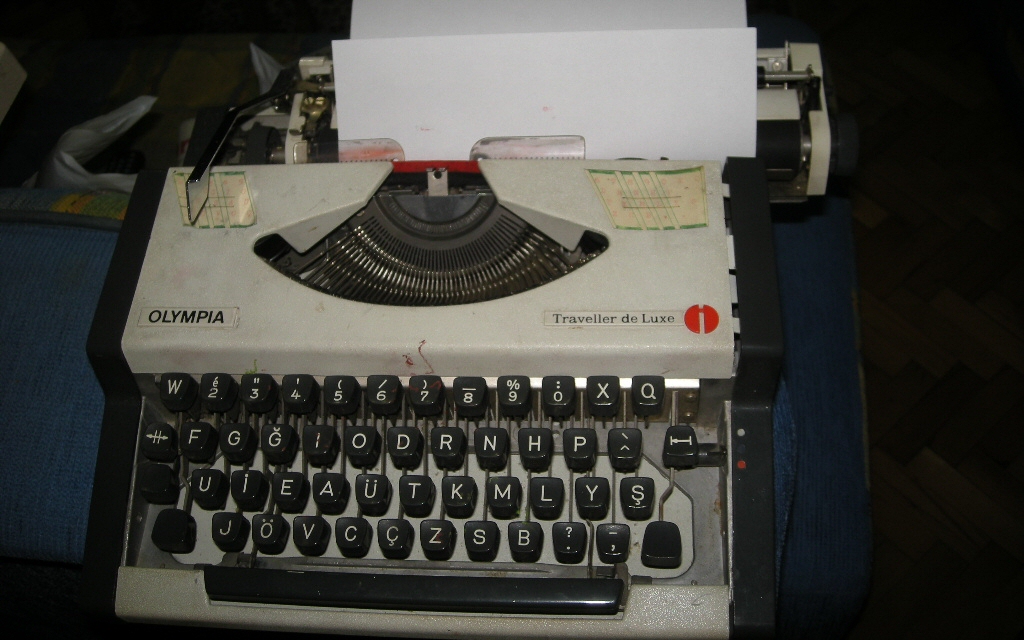
IDENTITY OF THE TYPEWRITER
In the past, it was clear on which typewriter a text was written. As typewriters got old, the letters would shift up and down, and some letters would wear out a bit. In short, the typewriter would give itself away. It could be understood on which typewriter the mimeographed and distributed leaflets were written from the font of the typewriter, the melted, distorted, shifted letters. The criminals (!) would be caught.
IDENTITY OF THE COMPUTER
When typing on a computer, the ASCII code of the letter “A” is 65, and the letter “B” is 66… The ASCII codes of lowercase letters are different: the letter “a” is 97, the letter “b” is 98… No matter which computer you write your text on, it will be ASCII 65 when you type “A”. Even if you keep your diary on your home computer or someone else keeps a diary on your behalf, it is impossible for you to understand who wrote it. This is similar to neither handwritten nor typewritten text.
If you move that diary to another computer after writing it, it is not clear on which computer you wrote it, however:
The computer on which you wrote the document and the program you used leave some traces on the written document. For example, if you are using the MS Word program while writing. Some information about the identity of the computer where MS Office is installed is saved along with the Word file. Even information such as how long the computer remained open while writing that document is stored, however:
If you do not want to transfer that information when giving that document to someone else, you copy your text and paste it into a program that does not leave a trace, such as Notepad, and you have a pristine text. All formats and all traces are cleaned.
PRETENDING
Let’s say there is a small document that came from a person and was written with MS Word, which you received as an e-mail attachment or in some other way. It doesn’t matter what its content is. You can delete that document, write whatever you want inside that file, and make it look as if it came out of that computer. You can even write two words and then leave it open all night and ensure it is recorded as if that document had been written on for hours.
There is no need to deal with these too much. There is no need to be a good computer expert either. In an editor where you can change every byte of the document, you can change the identity of that document as if it were written on the computer of any person you wish.
IN OTHER WORDS
In other words, when they say this document came out of this computer, there may be those who believe it, but I do not.
BLOGNOTE 1:
TDK has given two equivalents and examples for the word “Daktilo” (Typewriter). The first meaning I used here is the writing machine: 1 . Writing machine: “The same paragraph indentations, the same line spacings, I am sure even the typewriter they were written on is the same.” – A. Ümit. 2 . Typist: “It is not a condition for a typist to be in your house.” – H. Taner.
BLOGNOTE 2:
My typewriter still stands. I took it out of its place after many years to take its photo. It didn’t write because its ribbon had dried up. However, the sound of the keys has not changed at all.
Ankara, July 8, 2008
| aydintiryaki.org | YouTube | Aydın Tiryaki’nin Yazıları ve Videoları │Articles and Videos by Aydın Tiryaki | Bilgi Merkezi│Knowledge Hub | ░ Virgülüne Dokunmadan │ Verbatim ░ |
A Note on Methods and Tools: The original Turkish version of this work was authored entirely by the author, without any assistance from artificial intelligence. (Note: AI was utilized solely as a translation and writing assistant to prepare this English version of the original text.) This text has been prepared within the scope of the “Verbatim” project for the purpose of transferring previously published articles to the present day.
 Aydın Tiryaki