
Author: Aydın Tiryaki
Thought Partner: Gemini
Date: December 20, 2025
1. Introduction: From Numerical Chaos to Geometrical Order
Historically, football pitches have been shaped by the irrational conversion of British Imperial units (yards) into the metric system. The current FIFA standards, featuring measurements like 9.15 meters (10 yards) or 16.5 meters, create significant complexity for modern sports engineering and technological officiating systems like VAR. The Hybrid Rational Stadium Standards (HRSS) eliminate this chaos by synthesizing Decimal and Binary systems into a perfectly rational geometrical matrix.
2. Macro Structure and Modular Framework
HRSS v4.5 builds the pitch on two foundational numerical cores:
- The Core Structure: The primary length is established on a 100-meter decimal axis, while the width is based on a 64-meter (2^6) binary core, ensuring maximum stability for digital tracking.
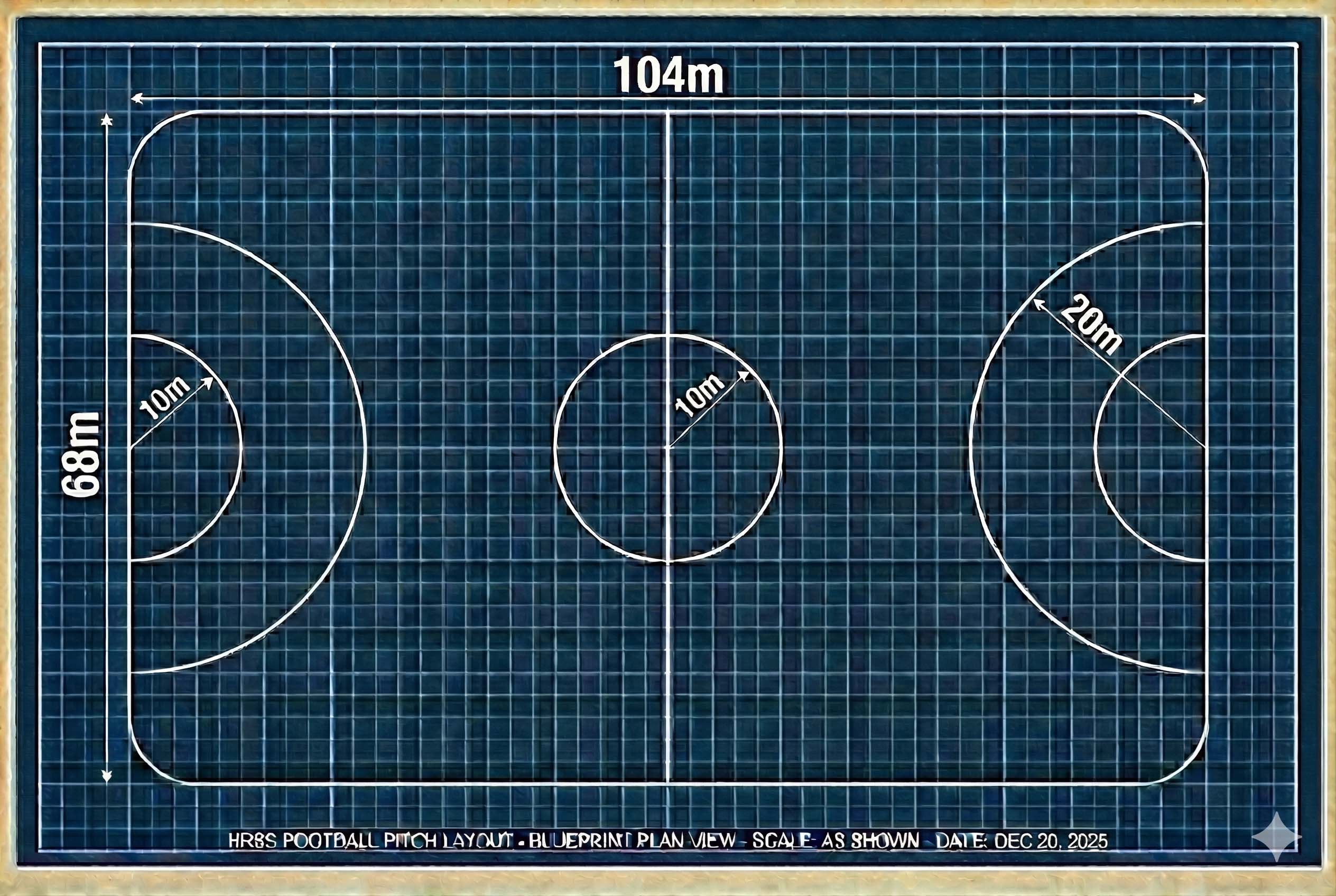
- Modular Expansion: This core is expanded by a 2-meter modular frame on all sides. Consequently, the final dimensions are certified at 104 meters in length and 68 meters in width.
- Line Standardization: All lines on the pitch are fixed at a constant metric width of 10 centimeters to serve as a precise reference for computer vision.
3. Corner Navigation and the “3-Meter Rule”
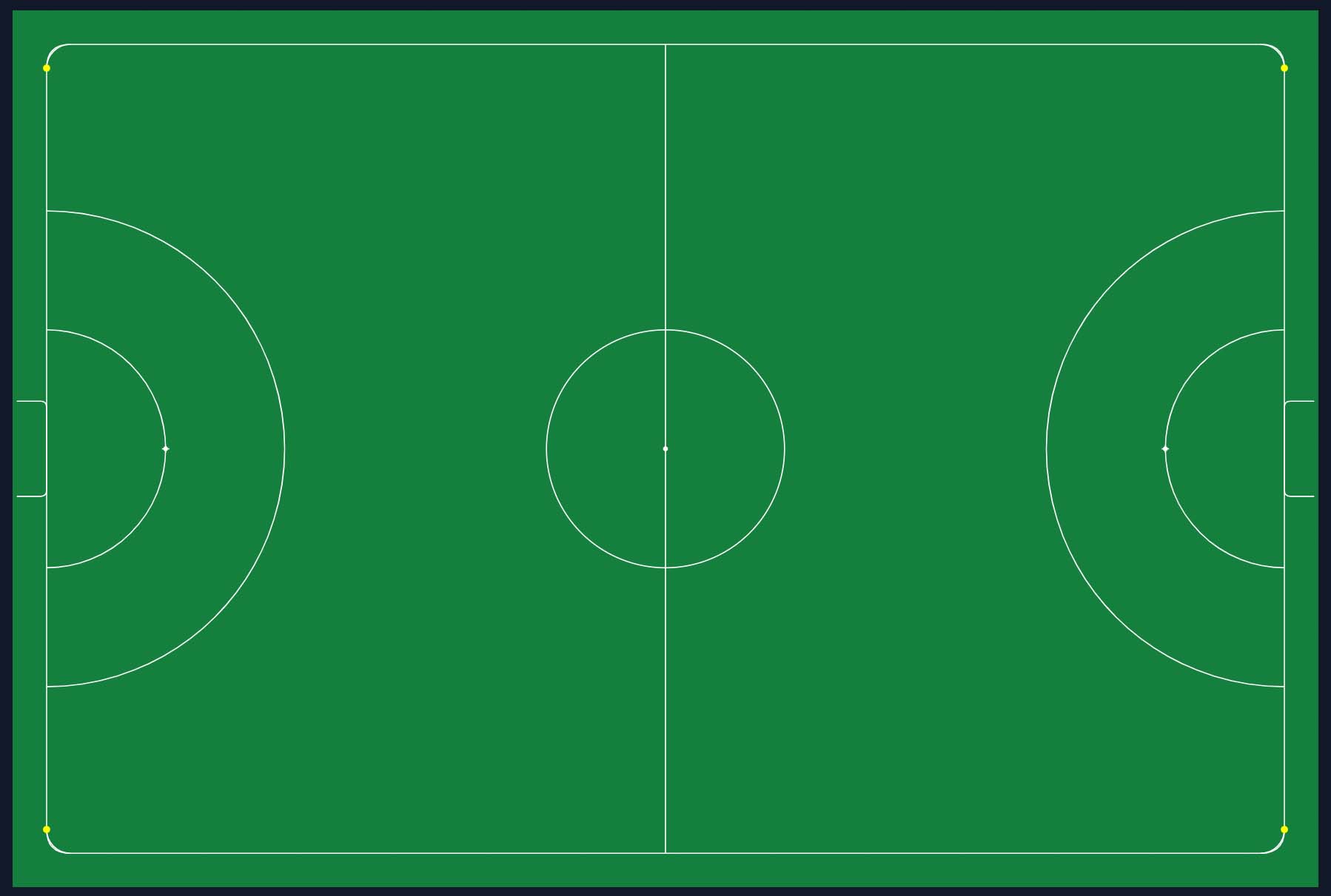
HRSS replaces the traditional 90-degree sharp corners with 2-meter radius (r=2) quarter-circle arcs.
- Navigation: The “Lock Line” for corner kicks is positioned exactly one meter along the arc from its starting point.
- Ergonomic Outcome: This places the ball exactly three meters away from the virtual (traditional) corner point. This distance eliminates any physical interference from the corner flag, providing the kicker with a spacious “comfort zone” and a wider angle for superior technical delivery.
4. Flag Placement and Boundary Jurisdictions
In the HRSS system, the corner flag serves as a “boundary sentinel.” It is placed at the end of the 2-meter arc on the goal line.
- Touchline Jurisdiction: The entire 2-meter corner arc is part of the touchline’s jurisdiction. Any ball exiting via the arc results in a Throw-in. This allows teams trapped in the corner to utilize the arc’s geometry for more creative and expansive restarts.
- Goal Line Jurisdiction: The goal line is strictly defined as the flat segment between the two flags. Only balls exiting this segment result in a Corner Kick or a Goal Kick.
5. Rational Goal Design: Curved Ergonomics
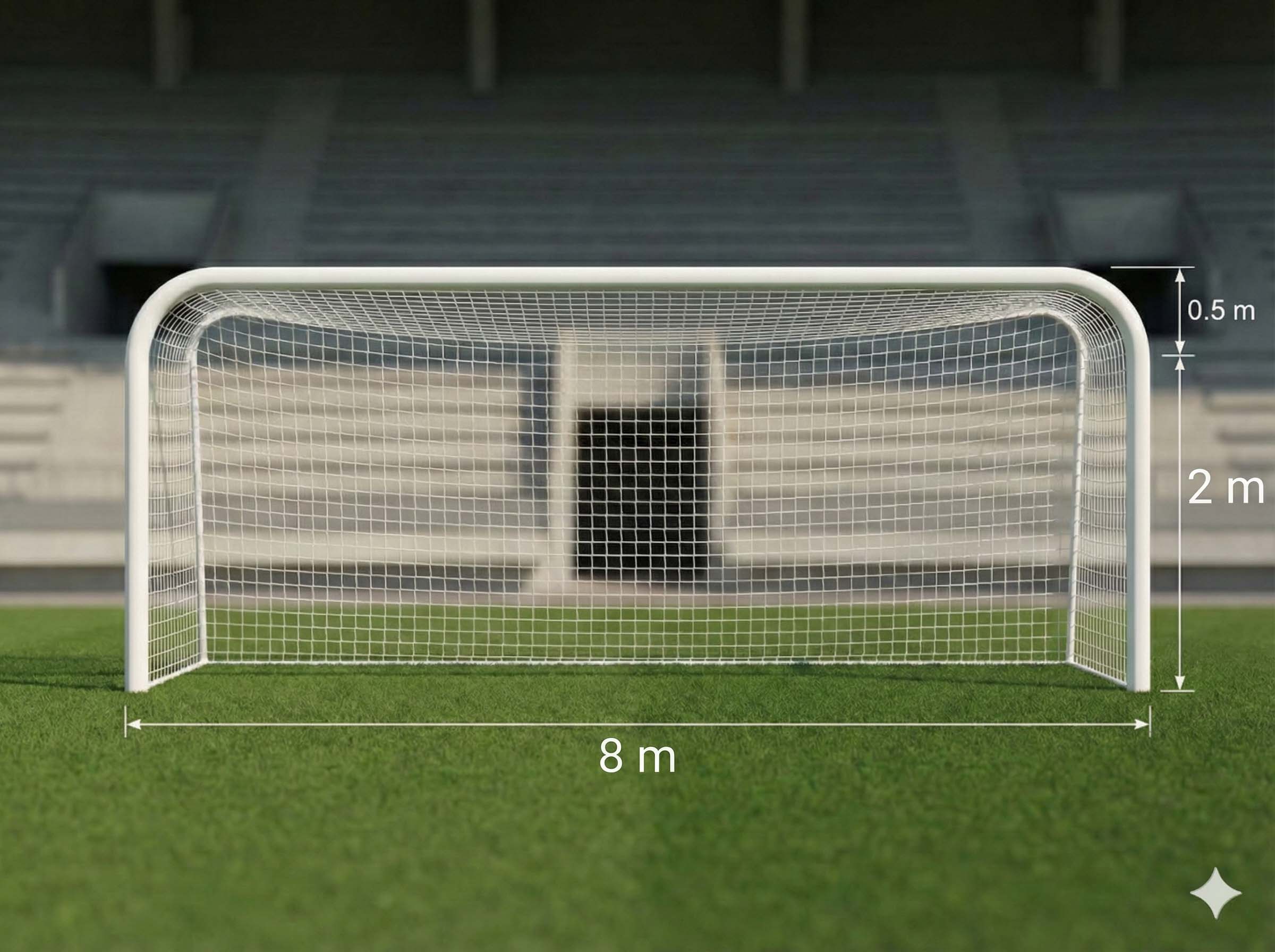
The HRSS goal is designed for both peak athletic safety and geometrical purity:
- Dimensions: A width of 8 meters (2^3) and a height of 2.5 meters.
- Curved Corners: The joints between the crossbar and the posts are softened with quarter-circle arcs of a 0.5-meter radius. This design rationalizes ball-rebound physics and minimizes the risk of player injury during collisions.
6. The Goal Area: Nested Arcs and the Natural Barrier
HRSS replaces rectangular boxes with two concentric semi-circles centered at the midpoint of the goal line:
- Inner Arc (Goal Area): A 10-meter radius semi-circle. It expands the goalkeeper’s absolute zone of protection by 55%.
- Penalty Lock Line: The penalty spot is defined by a perpendicular “Lock Line” (+) at the 10-meter peak of this inner arc.
- Outer Arc (Penalty Area): A 20-meter radius semi-circle.
- Natural Barrier: The 10-meter difference between the penalty mark (10m) and the penalty area boundary (20m) naturally provides the required distance for opposing players during a penalty kick, eliminating the need for an additional “D” arc.
7. Central Symmetry
The center circle is designed with a 10-meter radius (20-meter diameter). This measurement is in perfect geometrical sync with the 20-meter outer arc and the 10-meter inner arc at the goals. The entire pitch operates on a singular scale of 10 and 20 units.
APPENDIX: MASTER COMPARISON AND AREA ANALYSIS TABLE
| FEATURE | TRADITIONAL (FIFA) | HRSS v4.5 (NEW) | FIFA AREA (m2) | HRSS AREA (m2) | FUNCTIONAL IMPACT |
| Total Length | 105 m | 104 m | 7,140 m^2 | 7,072 m^2 | Modular & Compact |
| Total Width | 68 m | 68 m | – | – | 64m Binary Core |
| Goal Area | 18.32 x 5.5 m | r=10 m (Arc) | ~101 m^2 | ~157 m^2 | +55% Keeper Zone |
| Penalty Area | 40.32 x 16.5 m | r=20 m (Arc) | ~665 m^2 | ~628 m^2 | Rational Depth |
| Center Circle | r=9.15 m | r=10 m | ~263 m^2 | ~314 m^2 | Metric Symmetry |
| Corner Area | 1 m (Narrow) | r=2 m (Arc) | ~0.78 m^2 | ~3.14 m^2 | +300% Kicking Space |
| Flag Position | 0 m | 2 m along Goal Line | – | – | Defined Boundaries |
| Kick Point | 0 m (Corner) | 3 m (2+1 Offset) | – | – | Ergonomic Comfort |
| Goal Size | 7.32 x 2.44 m | 8 x 2.5 m | 17.86 m^2 | ~20 m^2 (19,89 m^2) | Binary/Metric Synthesis |
| Penalty Spot | 11 m | 10 m | – | – | Integrated with Arc |
| Barrier Dist. | 9.15 m | 10 m | – | – | Natural 10m Gap |
| Line Width | Variable | 10 cm | – | – | Technological Reference |
Visual Credits: The technical prompts for the pitch layout and goal designs featured in this article were prepared by Gemini, and the visual illustrations were generated using the Nano Banana AI platform.
 Aydın Tiryaki